
【Codefoces487E/UOJ#30】Tourists Tarjan 点双连通分量 + 树链剖分
E. Tourists
2 seconds
256 megabytes
standard input
:standard output
There are n cities in Cyberland, numbered from 1 to n, connected by m bidirectional roads. The j-th road connects city aj and bj.
For tourists, souvenirs are sold in every city of Cyberland. In particular, city i sell it at a price of wi.
Now there are q queries for you to handle. There are two types of queries:
- "C a w": The price in city a is changed to w.
- "A a b": Now a tourist will travel from city a to b. He will choose a route, he also doesn't want to visit a city twice. He will buy souvenirs at the city where the souvenirs are the cheapest (possibly exactly at city a or b). You should output the minimum possible price that he can buy the souvenirs during his travel.
More formally, we can define routes as follow:
- A route is a sequence of cities [x1, x2, ..., xk], where k is a certain positive integer.
- For any 1 ≤ i < j ≤ k, xi ≠ xj.
- For any 1 ≤ i < k, there is a road connecting xi and xi + 1.
- The minimum price of the route is min(wx1, wx2, ..., wxk).
- The required answer is the minimum value of the minimum prices of all valid routes from a to b.
Input
The first line of input contains three integers n, m, q (1 ≤ n, m, q ≤ 105), separated by a single space.
Next n lines contain integers wi (1 ≤ wi ≤ 109).
Next m lines contain pairs of space-separated integers aj and bj (1 ≤ aj, bj ≤ n, aj ≠ bj).
It is guaranteed that there is at most one road connecting the same pair of cities. There is always at least one valid route between any two cities.
Next q lines each describe a query. The format is "C a w" or "A a b" (1 ≤ a, b ≤ n, 1 ≤ w ≤ 109).
Output
For each query of type "A", output the corresponding answer.
Examples
3 3 3
1
2
3
1 2
2 3
1 3
A 2 3
C 1 5
A 2 3
1
2
7 9 4
1
2
3
4
5
6
7
1 2
2 5
1 5
2 3
3 4
2 4
5 6
6 7
5 7
A 2 3
A 6 4
A 6 7
A 3 3
output
2
1
5
3
Note
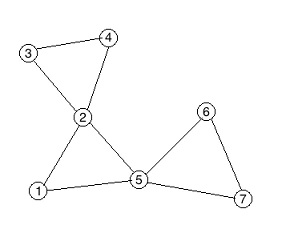
For the second sample, an optimal routes are:
From 2 to 3 it is [2, 3].
From 6 to 4 it is [6, 5, 1, 2, 4].
From 6 to 7 it is [6, 5, 7].
From 3 to 3 it is [3].
Solution
中文题面见UOJ#30 : UOJ#30
思路比较显然,把图缩点重建,再利用数据结构去维护。
要求简单路径,显然可以考虑点双连通分量,我们先对图Tarjan求点双连通分量,然后将这些BCC维护一个最小值,然后缩成一个点,这样就形成一棵树,就可以树剖。
但是这里有一个问题,割点可能会存在于多个点双连通分量中,而这会比较蛋疼,因为割点的答案显然应该是距离它最小的那个。
所以我们对割点单独处理,每个割点新建一个点单独向它所在的所有点双连通分量连一条边; 这样我们就可以在询问的时候,搞定割点的问题了。
那么修改一个点,这个点所在点双的值就有可能发生改变,如果修改割点,那么就会对很多点双造成影响,所以要特殊处理这种情况。
但是我们发现,我们这样建出来的新图(树)一定是满足 块->割点->块->割点 的。
所以我们不妨定义一个点双维护的是,这个点双中除了它fa的割点的所有点的权值+连向它的割点的权值最小,这样如果修改一个割点,就只会影响到它的fa点双。
查询的时候,我们查询$<u,v>$,如果$LCA(u,v)$是一个割点,我们可以直接统计答案。 如果$LCA(u,v)$是一个点双,那么我们还得查它的fa割点的值。
点双内的最小值,可以用multiset来维护。
这样的查询复杂度是$O(log^{2}N)$,修改的复杂度是$O(logN)$,总的复杂度就是$O(Nlog^{2}N)$
对于Tarjan点双连通分量,网上有些人说要边入栈,但很多人却写的点入栈,其实都是可以的。 但是这道题,如果用边入栈的方法,在连边的时候会连出问题的,需要额外判,所以就用来点入栈的方法。
Code
#include<iostream>

#include<cstdio>

#include<algorithm>

#include<cmath>

#include<vector>

#include<set>

#include<cstring>

using namespace std;

inline int read()

{

    int x=; char ch=getchar();

    while (ch<'' || ch>'') {ch=getchar();}

    while (ch>='' && ch<='') {x=x*+ch-''; ch=getchar();}

    return x;

}

#define INF 0x7fffffff

#define MAXN 100100

int N,M,Q,val[MAXN],Val[MAXN<<];

struct RoadNode{int next,to;}road[MAXN<<];

int tot=,first[MAXN];

struct EdgeNode{int next,to;}edge[MAXN<<];

int cnt=,head[MAXN<<];

inline void AddEdge(int u,int v) {cnt++; edge[cnt].next=head[u]; head[u]=cnt; edge[cnt].to=v;}

inline void InsertEdge(int u,int v) {AddEdge(u,v); AddEdge(v,u);}

multiset<int>::iterator ist;

struct BlockNode

{

    multiset<int>st; int val;

    inline void insert(int x) {st.insert(x); val=*st.begin();}

    inline void change(int x,int y) {st.erase(*st.find(x)); st.insert(y); val=*st.begin();}

}B[MAXN<<];

namespace Graph

{

    inline void AddRoad(int u,int v) {tot++; road[tot].next=first[u]; first[u]=tot; road[tot].to=v;}

    inline void InsertRoad(int u,int v) {AddRoad(u,v); AddRoad(v,u);}

    int dfn[MAXN],low[MAXN],dfsn,bcc,now,belong[MAXN],size[MAXN],cut[MAXN],st[MAXN],top;

    inline void Tarjan(int now)

    {

        dfn[now]=low[now]=++dfsn; st[++top]=now;

        for (int i=first[now]; i; i=road[i].next)

            if (!dfn[road[i].to])

                {

                    Tarjan(road[i].to); low[now]=min(low[now],low[road[i].to]);

                    if (dfn[now]<=low[road[i].to])

                        {

                            bcc++; cut[now]=; int tp=;

                            while ()

                                {

                                    tp=st[top--]; belong[tp]=bcc;

                                    if (cut[tp]) InsertEdge(tp+N,bcc); if (tp==road[i].to) break;

                                }

                            InsertEdge(now+N,bcc);

                        }

                }

            else low[now]=min(low[now],dfn[road[i].to]);

    }

    inline void reBuild()

    {

        for (int i=; i<=N; i++) if (!dfn[i]) Tarjan(i);

        for (int i=; i<=N; i++)

            {

                if (i!=) B[belong[i]].insert(val[i]);

                if (cut[i]) B[i+N].insert(INF);

            }

    }

}

namespace SegmentTree

{

    struct SegmentTreeNode{int l,r,minx;}tree[MAXN<<];

    #define ls now<<1

    #define rs now<<1|1

    inline void Update(int now) {tree[now].minx=min(tree[ls].minx,tree[rs].minx);}

    inline void BuildTree(int now,int l,int r)

    {

        tree[now].l=l; tree[now].r=r;

        if (l==r) {tree[now].minx=Val[l]; return;}

        int mid=(l+r)>>;

        BuildTree(ls,l,mid); BuildTree(rs,mid+,r);

        Update(now);

    }

    inline void Change(int now,int pos,int D)

    {

        int l=tree[now].l,r=tree[now].r;

        if (l==r) {tree[now].minx=D; return;}

        int mid=(l+r)>>;

        if (pos<=mid) Change(ls,pos,D);

        if (pos>mid) Change(rs,pos,D);

        Update(now);

    }

    inline int Query(int now,int L,int R)

    {

        int l=tree[now].l,r=tree[now].r;

        if (L<=l && R>=r) return tree[now].minx;

        int mid=(l+r)>>,re=INF;

        if (L<=mid) re=min(re,Query(ls,L,R));

        if (R>mid) re=min(re,Query(rs,L,R));

        return re;

    }

}

namespace TreePartition

{

    int fa[MAXN<<],size[MAXN<<],son[MAXN<<],deep[MAXN<<],pl[MAXN<<],dfn,pre[MAXN<<],top[MAXN<<];

    inline void DFS_1(int now)

    {

        size[now]=;

        for (int i=head[now]; i; i=edge[i].next)

            if (edge[i].to!=fa[now])

                {

                    fa[edge[i].to]=now;

                    deep[edge[i].to]=deep[now]+;

                    DFS_1(edge[i].to);

                    size[now]+=size[edge[i].to];

                    if (size[son[now]]<size[edge[i].to]) son[now]=edge[i].to;

                }

    }

    inline void DFS_2(int now,int chain)

    {

        pl[now]=++dfn; pre[dfn]=now;  top[now]=chain; Val[dfn]=B[now].val;

        if (son[now]) DFS_2(son[now],chain);

        for (int i=head[now]; i; i=edge[i].next)

            if (edge[i].to!=fa[now] && edge[i].to!=son[now])

                DFS_2(edge[i].to,edge[i].to);

    }

    inline int LCA(int u,int v)

    {

        while (top[u]!=top[v])

                {

                if (deep[top[u]]<deep[top[v]]) swap(u,v);

                u=fa[top[u]];

            }

        if (deep[u]>deep[v]) swap(u,v);

        return u;

    }

    inline int Query(int x,int y)

    {

        x=Graph::cut[x]? x+N:Graph::belong[x]; y=Graph::cut[y]? y+N:Graph::belong[y];

        int re=INF; int lca=LCA(x,y);

        if (lca<=Graph::bcc) lca=fa[lca]; re=val[lca-N];

        while (top[x]!=top[y])

            {

                if (deep[top[x]]<deep[top[y]]) swap(x,y);

                re=min(re,SegmentTree::Query(,pl[top[x]],pl[x]));

                x=fa[top[x]];

            }

        if (deep[x]>deep[y]) swap(x,y);

        re=min(re,SegmentTree::Query(,pl[x],pl[y]));

        return re;

    }

    inline void Change(int pos,int D) {SegmentTree::Change(,pl[pos],D);}

}

int main()

{

    N=read(),M=read(),Q=read();

    for (int i=; i<=N; i++) val[i]=read();

    for (int x,y,i=; i<=M; i++) x=read(),y=read(),Graph::InsertRoad(x,y);

    Graph::reBuild();

//    for (int i=1; i<=N; i++) printf("%d %d %d %d\n",dfn[i],low[i],cut[i],belong[i]);

    TreePartition::DFS_1(N+); TreePartition::DFS_2(N+,N+);

    SegmentTree::BuildTree(,,TreePartition::dfn);

    while (Q--)

        {

            char opt[]; scanf("%s",opt); int x=read(),y=read();

            switch (opt[])

                {

                    case 'C': if (x!=) {B[Graph::belong[x]].change(val[x],y); TreePartition::Change(Graph::belong[x],B[Graph::belong[x]].val);} val[x]=y; break;

                    case 'A': if (x==y) printf("%d\n",val[x]); else printf("%d\n",TreePartition::Query(x,y)); break;

                }

        }

    return ;

}
UOJ上跑的还挺快QAQ...就是死活压不到6000ms+....
【Codefoces487E/UOJ#30】Tourists Tarjan 点双连通分量 + 树链剖分的更多相关文章
- CF487 E. Tourists [点双连通分量 树链剖分 割点]
E. Tourists 题意: 无向连通图 C a w: 表示 a 城市的纪念品售价变成 w. A a b: 表示有一个游客要从 a 城市到 b 城市,你要回答在所有他的旅行路径中最低售价的最低可能值 ...
- HDU 2460 Network(双连通+树链剖分+线段树)
HDU 2460 Network 题目链接 题意:给定一个无向图,问每次增加一条边,问个图中还剩多少桥 思路:先双连通缩点,然后形成一棵树,每次增加一条边,相当于询问这两点路径上有多少条边,这个用树链 ...
- BZOJ 4732 UOJ #268 [清华集训2016]数据交互 (树链剖分、线段树)
题目链接 (BZOJ) https://www.lydsy.com/JudgeOnline/problem.php?id=4732 (UOJ) http://uoj.ac/problem/268 题解 ...
- 2018.10.30 NOIP训练 【模板】树链剖分(换根树剖)
传送门 纯粹是为了熟悉板子. 然后发现自己手生了足足写了差不多25min而且输出的时候因为没开long longWA了三次还不知所云 代码
- uoj 30 tourists
题目大意: 一个无向图 每个点有权值 支持两个操作 1 修改某个点的权值 2 查询a-b所有简单路径的点上的最小值 思路: 可以把图变成圆方树 然后树链剖分 维护 对于每个方点使用可删堆维护 #inc ...
- BZOJ_4326_[NOIP2015]_运输计划_(二分+LCA_树链剖分/Tarjan+差分)
描述 http://www.lydsy.com/JudgeOnline/problem.php?id=4326 给出一棵带有边权的树,以及一系列任务,任务是从树上的u点走到v点,代价为u到v路径上的权 ...
- JZYZOJ1454 NOIP2015 D2T3_运输计划 二分 差分数组 lca tarjan 树链剖分
http://172.20.6.3/Problem_Show.asp?id=1454 从这道题我充分认识到我的脑子里好多水orz. 如果知道了这个要用二分和差分写,就没什么思考上的难点了(屁咧你写了一 ...
- CF487E Tourists(圆方树+树链剖分+multiset/可删堆)
CF487E Tourists(圆方树+树链剖分+multiset/可删堆) Luogu 给出一个带点权的无向图,两种操作: 1.修改某点点权. 2.询问x到y之间简单路径能走过的点的最小点权. 题解 ...
- UOJ#30/Codeforces 487E Tourists 点双连通分量,Tarjan,圆方树,树链剖分,线段树
原文链接https://www.cnblogs.com/zhouzhendong/p/UOJ30.html 题目传送门 - UOJ#30 题意 uoj写的很简洁.清晰,这里就不抄一遍了. 题解 首先建 ...
随机推荐
- footer置底
html代码: <div class="container"> <div cass="header"></div> < ...
- 对象映射工具AutoMapper介绍
AutoMapper是用来解决对象之间映射转换的类库.对于我们开发人员来说,写对象之间互相转换的代码是一件极其浪费生命的事情,AutoMapper能够帮助我们节省不少时间. 一. AutoMapper ...
- javascript-观察者模式
观察者模式方法 1.称之为消息机制或发布-订阅者模式 2.定义了一种依赖关系解决了主体对象与观察者之间功能的耦合 观察者方法 //将观察者放在闭包中,当页面加载就立即执行 var Observ ...
- .NET应用架构设计—面向对象分析与设计四色原型模式(彩色建模、领域无关模型)(概念版)
阅读目录: 1.背景介绍 2.问自己,UML对你来说有意义吗?它帮助过你对系统进行分析.建模吗? 3.一直以来其实我们被一个缝隙隔开了,使我们对OOAD遥不可及 4.四色原型模式填补这个历史缝隙,让我 ...
- Writing to a MySQL database from SSIS
Writing to a MySQL database from SSIS 出处 : http://blogs.msdn.com/b/mattm/archive/2009/01/07/writin ...
- Mysql小技巧总汇
1.datetime类型字段格式化 SELECT DATE_FORMAT(date,'%Y-%m-%d %h:%m:%s') date FROM message; 结果: +------------- ...
- 解决MyEclipse中的js报错的小方法
今天,下了个模版,但是导进去的时候发现js会报错.看了下其他都没有错误.而有一个js报错误,请原谅我有点红色强迫症,不能留一点红色 . 错误如下:Syntax error on token " ...
- Spring事务管理的三种方式
一 .第一种:全注解声明式事务 Xml代码 复制代码 收藏代码 .<?xml version="1.0" encoding="UTF-8"?> .& ...
- C# DESC加密
DESC加密方法 直接上代码: 1.加密 /// <summary> /// 加密 /// </summary> /// <param name="obj&qu ...
- Navicat安装详解
本文章介绍MySql图形化操作软件Navicat的安装 属于PHP环境搭建的一部分. PHP完整配置信息请参考 http://www.cnblogs.com/azhe-style/p/php_new_ ...