
Design Pattern ->Abstract Factory
Layering & Contract Philosophy With additional indirection
Abstract Factory
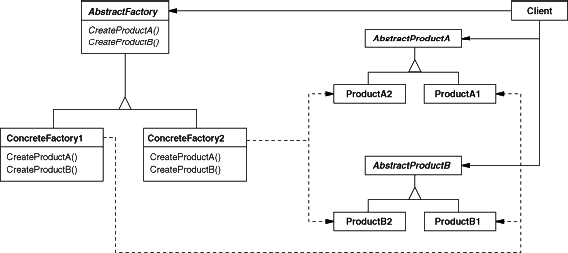
 //The example code is as following:

 class CAbstractProductA;

 class CAbstractProductB;

 // multiple families of products.

 class CProductA1:public CAbstractProductA;

 class CProductB1:public CAbstractProductB;

 class CProductA2:public CAbstractProductA;

 class CProductB2:public CAbstractProductB;

 class CAbstractFactory

 {

 public:

     virtual CAbstractProductA* CreateProductA() = ;

     virtual CAbstractProductA* CreateProductB() = ;

 };

 class CConreateFactory1:public CAbstractFactory;  //indirection layer

 {

 public:

     virtual CAbstractProductA* CreateProductA() { return new CProductA1; }

     virtual CAbstractProductB* CreateProductB() { return new CProductB1; }

 }

 class CConreateFactory2:public CAbstractFactory;//indirection layer

 {

 public:

     virtual CAbstractProductA* CreateProductA() { return new CProductA2; }

     virtual CAbstractProductB* CreateProductB() { return new CProductB2; }

 }

 class CClient

 {

 public:

     CAbstractFactory  *pFactory = NULL;

     void main()

     {

            if ( the system is windows )
              {

                    pFactory  = new CConreateFactory1();
              }

            else
              {

                   pFactory  = new CConreateFactory2();

             }

        CAbstractProductA *pProductA = pFactory->CreateProductA();

        CAbstractProductB *pProductB = pFactory->CreateProductB();

      }

 };
Applicability
Use the Abstract Factory pattern when:
- A system should be independent of how its products are created, compose /decompose, and represented.
- A system should be configured with one of multiple families of products.
- A family of related product objects is designed to be used together, and you need to enforce this constraint.
- You want to provide a class library of products, and you want to reveal just their interfaces, not their implementations. Interface-Oriented programming, Open For Extension, Close For Change,These All is said to Users or Client. Users don’t care or never know what is changed, so called “Close For Change”.
- You want to create a set of product without changing client code. Just create a new pointer to the object instantiated with class derived from base class AbstractClass.
Participants
- AbstractFactory (WidgetFactory): declares an interface for operations that create abstract product objects.
- ConcreteFactory (MotifWidgetFactory, PMWidgetFactory):implements the operations to create concrete product objects.
- AbstractProduct (Window, ScrollBar):declares an interface for a type of product object.
- ConcreteProduct (MotifWindow, MotifScrollBar): concrete / specific defines a product object to be created by the corresponding concrete factory,implements the AbstractProduct interface.
- Client: uses only interfaces declared by AbstractFactory and AbstractProduct classes.
Collaborations
- Normally a single instance of a ConcreteFactory class is created at run-time.This concrete factory creates product objects having a particular implementation. To create different product objects, clients should use a different concrete factory.The Client get the a pointer or reference from the Singleton object created with ConcreteFactory at run-time.
- AbstractFactory defers creation of product objects to its ConcreteFactory subclass.
From:Design Patterns:Elements of Reusable Object-Oriented Software, by GoF
Design Pattern ->Abstract Factory的更多相关文章
- LN : Eden Polymorphic And OOP Design Pattern Abstract Factory
Appreciation to our TA, +7, who designed this task. Client.cpp #include <iostream> #include &l ...
- [design pattern](5) Factory Method
前言 在前面一章博主介绍了简单工厂模式(Simple Factory),接着上面的章节,今天博主就来介绍下工厂方法模式(Factory Method). 思考题 首先,让我们来思考下面的问题: 在上一 ...
- 简单工厂设计模式(Simple Factory Design Pattern)
[引言]最近在Youtub上面看到一个讲解.net设计模式的视频,其中作者的一个理解让我印象很深刻:所谓的设计模式其实就是运用面向对象编程的思想来解决平时代码中的紧耦合,低扩展的问题.另外一点比较有见 ...
- [转]Design Pattern Interview Questions - Part 1
Factory, Abstract factory, prototype pattern (B) What are design patterns? (A) Can you explain facto ...
- Design Pattern ——Factory Method&Abstract Factory
今天开始复习设计模式.设计模式相关的资料有很多,概念性的东西就画个图就可以了.把关注点放在例子上,设计模式还是要使用中才有感受. 从Factory Method&Abstract Factor ...
- 大白话抽象工厂模式(Abstract Factory Pattern)
实例分析 大白话工厂方法模式(Factory Method)一文中,我们讲解了日产4S店工厂规模的扩大,创建了针对不同车型的工厂,减少了工厂的工作内容,提高了效率.下面我们继续以4S店的故事讨论抽象工 ...
- Net设计模式实例之抽象工厂模式(Abstract Factory Pattern)
一.抽象工厂模式简介(Bref Introduction) 抽象工厂模式(Abstract Factory Pattern),提供一个创建一系列相关或者相互依赖对象的接口,而无需制定他们的具体类.优点 ...
- [Design Pattern] Factory Pattern 简单案例
Factory Pattern , 即工厂模式,用于创建对象的场景,属于创建类的设计模式 . 下面是一个工厂模式案例. Shape 作为接口, Circle, Square, Rectangle 作为 ...
- design pattern factory method #Reprinted#
引入人.工厂.和斧子的问题: (1),原始社会时,劳动社会基本没有分工,需要斧子的人(调用者)只好自己去磨一把斧子,每个人拥有自己的斧子,如果把大家的石斧改为铁斧,需要每个人都要学会磨铁斧的本领,工作 ...
随机推荐
- Redis及虚拟机windows两种环境安装配置
---恢复内容开始--- Redis /rae dis/是一个开源的Key-Value数据库.和Memcached类似,它支持存储的value类型相对更多,包括string(字符串).list(链 ...
- window 使用频率最高的快捷键
window 使用频率最高的快捷键 一个电脑使用者不完全一切操作都靠鼠标 适当的快捷键 不但可以提高效率 而且还可以适当的装一下自己是大神啦啦啦 个人最常用的快捷键: Ctrl + c : 复制 C ...
- JS模式和原型精解
首先需要知道的是 模式只是思想.不要用 结构 看模式. ES中函数是对象,因此函数也有属性和方法. 每个函数含有两个属性: length 和 prototype 每个函数含有两个非继承的方法: app ...
- fsockopen函数被禁用的解决方法
判断fsockopen 是否可用:function_exists('fsockopen');如果没有开启 一.开启fsockopen函数 修改php.ini,将 disable_functions = ...
- jquery each循环,实现break和continue的功能
break----用return false; continue --用return ture;
- 解决windows server 2008 r2 登录进入桌面只显示一片蓝色背景
非常高的可能性问题是:explorer.exe进程无法加载.请按ctrl+shift+esc调出任务管理器--文件-新任务-输入‘explorer’--确定即可.如无法解决,请进入安全模式关闭非必要的 ...
- Java String 字符串操作小结
// 转载加编辑 -- 21 Apr 2014 1. Java字符串中子串的查找 Java中字符串中子串的查找共有四种方法,如下: 1.int indexOf(String str) :返回第一次出现 ...
- day_09 函数及参数
1.定义:把功能封装起来,方便下次直接调用 2.语法:def 关键词开头,空格之后接函数名称和圆括号(). def 函数名(形参) 函数体 3.参数:圆括号用来接收参数.若传入多个参数,参数之间用逗号 ...
- day22 正则表达式 re
1. 正则表达式 正则表达式是对字符串操作的一种逻辑公式. 我们一般使用正则表达式对字符串进行匹配和过滤. 工具: 各大文本编辑器⼀般都有正则匹配功能. 我们也可以去http://tool.china ...
- sysbench 安装、使用和测试
摘要: sysbench是一个开源的.模块化的.跨平台的多线程性能测试工具,可以用来进行CPU.内存.磁盘I/O.线程.数据库的性能测试.目前支持的数据库有MySQL.Oracle和Post ...