
An interesting combinational problem
A question of details in the solution at the end of this post of the question is asked by me at MSE.
Nowadays, I learnt from Liu Ben a question asked in the interview of ENS.
Assume $m,n$ are two coprime odd numbers, consider the interval $[0,mn]$. We cut the interval by $m,2m,\ldots,(n-1)m$ and $n, 2n,\ldots, (m-1)n$ into $m+n-1$ pieces of small intervals. And we color them from left to right by black-and-white periodically and black first. The question is to show $$(\textrm{the length of black})-(\textrm{the length of white})=1$$
For example, if $m=3,n=5$, $$\begin{array}{c*{31}}0 &&&&&& 3 &&&&&& 6 &&&&&& 9 &&&&&& 12 &&&&&& 15 \\ \mid & \blacksquare && \blacksquare && \blacksquare &\mid & \square && \square & \mid & \blacksquare & \mid & \square&& \square&& \square &\mid & \blacksquare &\mid & \square&& \square&\mid & \blacksquare&& \blacksquare&& \blacksquare & \mid \\ 0 &&&&&&&&&& 5 &&&&&&&&&& 10 &&&&&&&&&& 15\end{array} $$The length of black is $8$ and the length of white is $7$.

The problem seems to be elementary at the first sight. But after a period of thinking, one find it is hard to deal with. Here is Liu Ben's Original answer, I fulfill details to read more easily,
The number of cuts before $x$ is $\lfloor \frac{x-1}{n}\rfloor+\lfloor \frac{x-1}{m}\rfloor$, so $$(-1)^{\lfloor \frac{x-1}{n}\rfloor+\lfloor \frac{x-1}{m}\rfloor}=\begin{cases} 1 & \textrm{$[x-1,x]$ is colored by black }\\ -1 & \textrm{$[x-1,x]$ is colored by white } \end{cases}$$Thus it is equivlent to show that $\sum_{x=0}^{mn-1} (-1)^{\lfloor \frac{x}{n}\rfloor+\lfloor \frac{x}{m}\rfloor}=1$, and we have know that $(-1)^{m+n}=1, (-1)^0=1$, so it is equivlent to show that $$\sum_{x=1}^{mn} (-1)^{\lfloor \frac{x}{n}\rfloor+\lfloor \frac{x}{m}\rfloor}=1$$Now we need some identity to expand the expression $(-1)^{\lfloor \frac{x}{n}\rfloor}$,
$$\begin{array}{rll} (-1)^{\lfloor x \rfloor}& = (-1)^{\lfloor x\rfloor}-1+1 \\ & =1+ 2\left(\sum_{n=0}^{\lfloor x\rfloor}(-1)^{n}\right)= 1+ 2\left(\sum_{n\leq x}(-1)^{n}\right)\end{array}$$
So
$$\begin{array}{rll}&\quad \sum_{x=1}^{mn} (-1)^{\lfloor \frac{x}{n}\rfloor+\lfloor \frac{x}{m}\rfloor} \\ & =\sum_{x=1}^{mn} \left(1+2\left(\sum_{k\leq x/n} (-1)^k \right)\right)\left(1+2\left(\sum_{k\leq x/m} (-1)^k\right)\right) \\ & = mn+2\underbrace{\sum_{x=1}^{mn}\sum_{k\leq x/n} (-1)^k}_{:=A}+2\underbrace{\sum_{x=1}^{mn}\sum_{k\leq x/m} (-1)^k}_{:=B}+4\sum_{x=1}^{mn}\left(\sum_{k\leq x/n} (-1)^k\right)\left(\sum_{h\leq x/m} (-1)^h\right)\end{array}$$
Firstly, we calculate $A$,
$$\begin{array}{rll}A & =\sum_{x=1}^{mn}\sum_{k\leq x/n} (-1)^k \\ & = \sum_{k=1}^m \#\{x\geq nk: x=1,\ldots,mn\}(-1)^k \\ & =\sum_{k=0}^m n(m-k)(-1)^k \\ & = n\sum_{k=0}^m k(-1)^k\\& =-n\frac{m+1}{2}\end{array}$$
Similarly, $B=-m\frac{n+1}{2}$, therefore it remains to show
$$\sum_{x=1}^{mn}\left(\sum_{k\leq x/n} (-1)^k\right)\left(\sum_{h\leq x/m} (-1)^h\right)=\frac{(m+1)(n+1)}{4}$$
Let's compute !
$$\begin{array}{rll}\sum_{x=1}^{mn}\left(\sum_{k\leq x/n} (-1)^k\right)\left(\sum_{h\leq x/m} (-1)^h\right) & =\sum_{k=0}^{m}\sum_{h=0}^n\#\{x\geq \max (nk,mh), x=1,\ldots,mn\}(-1)^{k+h}\\ & =\sum_{k=0}^{m}\sum_{h=0}^n(mn- \max(nk,mh))(-1)^{k+h} \\ & =\sum_{k=0}^{m}\sum_{h=0}^n \max(nk,mh)(-1)^{k+h} \\ & =\sum_{k=0}^{m}\sum_{h=0}^n \frac{1}{2}(nk+mh+\left|nk-mh\right|)(-1)^{k+h} \\ &= \frac{1}{2}\sum_{k=0}^{m}\sum_{h=0}^n \left|nk-mh\right|(-1)^{k+h} \\ & = \frac{mn}{2}\sum_{k=0}^m\sum_{h=0}^n\left|\frac{k}{m}-\frac{h}{n}\right|(-1)^{k+h}\end{array}$$
So it reduces to show $\sum_{k=0}^m\sum_{h=0}^n\left|\frac{k}{m}-\frac{h}{n}\right|(-1)^{k+h}=0$. We need some tools to calculate, consider the function $f$ with peroid $2$ and $f(x)=|x|$ for $x\in [-1,1]$, then the Fourier series of $f$ is $$f=\sum_{\ell \in \mathbb{Z}} a_{\ell} \mathrm{e}^{\frac{2\pi i \ell x}{2}}\qquad a_{\ell} =\frac{1}{2}\int_{-1}^1 |x| \mathrm{e}^{\frac{2\pi i \ell x}{2}}\textrm{d}x=\begin{cases}\frac{1}{2} & n=0 \\ -\frac{2}{\pi^2 n^2} & n\textrm{is odd} \\ 0 & n\neq 0\textrm{is even}\end{cases}$$
In other word, we have
$$x\in [-1,1]\Rightarrow \frac{1}{4}-\frac{|x|}{2}=\sum_{\ell \textrm{odd}} \frac{1}{\pi^2 \ell ^2}\mathrm{e}^{2\pi i \ell x}$$
Now, continuous
$$\begin{array}{rll} \frac{mn}{2}\sum_{k=0}^m\sum_{h=0}^n\left|\frac{k}{m}-\frac{h}{n}\right|(-1)^{k+h} & = mn \sum_{k=0}^m\sum_{h=0}^n\frac{\left|\frac{k}{m}-\frac{h}{n}\right|}{2}(-1)^{k+h} \\ & =mn \sum_{k=0}^m\sum_{h=0}^n\bigg(\frac{1}{4}-\frac{\left|\frac{k}{m}-\frac{h}{n}\right|(-1)^{k+h}}{2} \bigg) \\ & = \sum_{k=0}^m \sum_{h=0}^n \sum_{\ell\textrm{odd}} \frac{1}{\pi^2 \ell ^2} \mathrm{e}^{\frac{2\pi i}{2}\cdot \ell \left(\frac{k}{m}-\frac{h}{n}\right)} \\ & =mn\sum_{\ell \textrm{odd}} \frac{1}{\pi^2 \ell^2 }\left(\sum_{k=0}^m (-1)^k\mathrm{e}^{\frac{2 \pi i \ell k}{2 m }}\right)\left(\sum_{h=0}^n (-1)^h\mathrm{e}^{-\frac{2 \pi i \ell h}{2 n }}\right)\end{array}$$
It reduces to the case of the summation of geometry series, we have
$$\sum_{k=0}^m (-1)^k\mathrm{e}^{\frac{2 \pi i \ell k}{2 m }}=\begin{cases}-1& m\nmid \ell \\ -1+m & m\mid \ell \end{cases}\qquad \sum_{h=0}^n (-1)^h\mathrm{e}^{-\frac{2 \pi i \ell h}{2 n }} = \begin{cases}-1& n\nmid \ell \\ -1+n & n\mid \ell \end{cases}$$
Now we can deduct the result,
$$\begin{array}{rll} & \quad mn\sum_{\ell \textrm{odd}} \frac{1}{\pi^2 \ell^2 }\left(\sum_{k=0}^m (-1)^k\mathrm{e}^{\frac{2 \pi i \ell k}{2 m }}\right)\left(\sum_{h=0}^n (-1)^h\mathrm{e}^{-\frac{2 \pi i \ell h}{2 n }}\right) \\ & =mn\sum_{\ell \textrm{odd}} \frac{1}{\pi^2 \ell^2 } - mn\sum_{\begin{subarray}{l}\ell \textrm{odd}\\ m|\ell \end{subarray}} \frac{m}{\pi^2 \ell^2} - mn\sum_{\begin{subarray}{l}\ell \textrm{odd}\\ n|\ell \end{subarray}} \frac{n}{\pi^2 \ell^2} + mn\sum_{\begin{subarray}{l}\ell \textrm{odd}\\ n|\ell \\ m|\ell \end{subarray}} \frac{nm}{\pi^2 \ell^2} \\ & = mn\sum_{\ell \textrm{odd}} \frac{1}{\pi^2 \ell^2 } - n\sum_{\begin{subarray}{l}\ell \textrm{odd}\\ m|\ell \end{subarray}} \frac{1}{\pi^2 (\ell/m)^2} - m\sum_{\begin{subarray}{l}\ell \textrm{odd}\\ n|\ell \end{subarray}} \frac{1}{\pi^2 (\ell/n)^2} + \sum_{\begin{subarray}{l}\ell \textrm{odd}\\ nm\mid \ell \end{subarray}} \frac{1}{\pi^2 (\ell/mn)^2} \\ & =(m-1)(n-1) \sum_{\ell \textrm{odd}} \frac{1}{\pi^2 \ell^2 } =\frac{(m-1)(n-1)}{4}\end{array}$$
The proof is complete. $\square$
If we reflect the process above carefully, we will find that the trick of exponential sums is useful in the domain of combinatorics involving number theory. It is powerful but not too beutiful. The amazing point is that in the process of counting number, $\pi$ can occur, even it will be cancelled finally.
Some days after, Liu Ben gives a new answer which uses Fourier analysis, it is more elegant than the above, and I fulfill details to read more easily,
Actually, as above it reduces to show $$\int_0^{mn}(-1)^{\lfloor \frac{x}{n}\rfloor+\lfloor \frac{x}{m}\rfloor}\textrm{d}x=\int_0^{mn}(-1)^{\lfloor \frac{x}{n}\rfloor}\overline{(-1)^{\lfloor \frac{x}{m}\rfloor}}\textrm{d}x=1$$Conside $f(x)=(-1)^{\lfloor x\rfloor}$ as a function of period $2$, one can calculate its Fourier expansion$$f(x)=\frac{2}{\pi i}\sum_{\ell\textrm{odd}}\frac{1}{\ell} \mathrm{e}^{\frac{2\pi i \ell x}{2}}$$So $$\begin{array}{rll}\int_0^{mn}(-1)^{\lfloor \frac{x}{n}\rfloor}\overline{(-1)^{\lfloor \frac{x}{m}\rfloor}}\textrm{d}x& =\int_{0}^{mn}f(x/n)\overline{f(x/m)}\textrm{d}x \\ & =mn\int_0^1 f(ny)\overline{f(my)}\textrm{d}y \\ & = \frac{4 mn}{\pi^2}\sum_{\begin{subarray}{l}r,s \textrm{odd} \\ mr=ns\end{subarray}}\frac{1}{rs} \\ & = \frac{4 mn}{\pi^2}\sum_{\begin{subarray}{l}r,s \textrm{odd} \\ r=tn,s=tm\end{subarray}}\frac{1}{rs} \\ & =\frac{4}{\pi^2}\sum_{t\textrm{odd}}\frac{1}{t^2}=1\end{array} $$The proof is complete. $\square$
To complete this post, I want to give my answer of this problem. I think this answer is the most ingenious one. This is a proof without words as following.
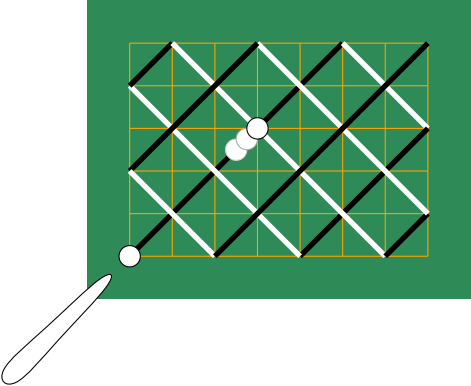
When I heared the problem, I had no papers and pen to use. After thinking over brokenly, I came up the answer above one day after. And one can easily find that in the case of one of $m,n$ is even, then the difference between black and white vanish, and when $m,n$ are odd generally, the difference is $(m,n)$.
Ackowlegement
I want to thank Liu Ben for his nice presentation of question and answer. And congratulation to his addmision by ENS.

An interesting combinational problem的更多相关文章
- hdu 2426 Interesting Housing Problem 最大权匹配KM算法
题目链接:http://acm.hdu.edu.cn/showproblem.php?pid=2426 For any school, it is hard to find a feasible ac ...
- HDU 2426 Interesting Housing Problem (最大权完美匹配)【KM】
<题目链接> 题目大意: 学校里有n个学生和m个公寓房间,每个学生对一些房间有一些打分,如果分数为正,说明学生喜欢这个房间,若为0,对这个房间保持中立,若为负,则不喜欢这个房间.学生不会住 ...
- HDU 2426 Interesting Housing Problem(二分图最佳匹配)
http://acm.hdu.edu.cn/showproblem.php?pid=2426 题意:每n个学生和m个房间,现在要为每个学生安排一个房间居住,每个学生对于一些房间有一些满意度,如果满意度 ...
- HDU2426:Interesting Housing Problem(还没过,貌似入门题)
#include <iostream> #include <queue> #include <stdio.h> #include <string.h> ...
- codeforces 361 E - Mike and Geometry Problem
原题: Description Mike wants to prepare for IMO but he doesn't know geometry, so his teacher gave him ...
- CodeForces 689E Mike and Geometry Problem (离散化+组合数)
Mike and Geometry Problem 题目链接: http://acm.hust.edu.cn/vjudge/contest/121333#problem/I Description M ...
- Codeforces Round #361 (Div. 2) E. Mike and Geometry Problem 离散化 排列组合
E. Mike and Geometry Problem 题目连接: http://www.codeforces.com/contest/689/problem/E Description Mike ...
- Codeforces Round #361 (Div. 2) E. Mike and Geometry Problem 离散化+逆元
E. Mike and Geometry Problem time limit per test 3 seconds memory limit per test 256 megabytes input ...
- Codeforces Round #361 (Div. 2) E. Mike and Geometry Problem 【逆元求组合数 && 离散化】
任意门:http://codeforces.com/contest/689/problem/E E. Mike and Geometry Problem time limit per test 3 s ...
随机推荐
- Hadoop2.0伪分布式平台环境搭建
一.搭建环境的前提条件 环境:ubuntu-16.04 hadoop-2.6.0 jdk1.8.0_161.这里的环境不一定需要和我一样,基本版本差不多都ok的,所需安装包和压缩包自行下载即可. 因 ...
- Hadoop系列009-NameNode工作机制
本人微信公众号,欢迎扫码关注! NameNode工作机制 1 NameNode & SecondaryNameNode工作机制 1.1 第一阶段:namenode启动 1)第一次启动namen ...
- 从壹开始前后端分离【 .NET Core2.0 +Vue2.0 】框架之十 || AOP面向切面编程浅解析:简单日志记录 + 服务切面缓存
代码已上传Github+Gitee,文末有地址 上回<从壹开始前后端分离[ .NET Core2.0 Api + Vue 2.0 + AOP + 分布式]框架之九 || 依赖注入IoC学习 + ...
- 【Android Studio安装部署系列】三十一、从Android studio3.0.0升级到Android studio3.0.1
版权声明:本文为HaiyuKing原创文章,转载请注明出处! 概述 突然想要升级到较高版本.要跟随潮流嘛,不然就落后了. 下载IDE http://www.wanandroid.com/tools/i ...
- node.js学习资料(2015-12)
使用vscode开发,设置代码智能提示的方法,cd 项目目录,然后使用以下命令npm install tsd -gtsd install node express angular -ros 下载 Gi ...
- stylus 详解与引入
Stylus介绍及特点Stylus 是一个基于Node.js的CSS的预处理框架,诞生于2010年,比较年轻,可以说是一种新型语言,其本质上做的事情与 Sass/LESS 等类似, 可以以近似脚本的方 ...
- 一套代码小程序&Web&Native运行的探索06——组件系统
接上文:一套代码小程序&Web&Native运行的探索05——snabbdom 对应Git代码地址请见:https://github.com/yexiaochai/wxdemo/tre ...
- jquery获取元素(父级的兄弟元素的子元素)
一.获取父级元素 使用jquery获取父级元素: parent() 例如:$(this).parent('ul'); 二.获取同级元素 使用jquery获取同级元素:siblings() 例如:$(t ...
- 2.5配置的框架浅析「深入浅出ASP.NET Core系列」
希望给你3-5分钟的碎片化学习,可能是坐地铁.等公交,积少成多,水滴石穿,谢谢关注. 配置的使用流程 //第一步.初始化Builder var builder = new ConfigurationB ...
- centos7+rsyslog+loganalyzer+mysql 搭建rsyslog日志服务器
一.简介 在centos7系统中,默认的日志系统是rsyslog,它是一类unix系统上使用的开源工具,用于在ip网络中转发日志信息,rsyslog采用模块化设计,是syslog的替代品. 1.rsy ...