
DeepLearning - Forard & Backward Propogation
In the previous post I go through basic 1-layer Neural Network with sigmoid activation function, including
How to get sigmoid function from a binary classification problem?
NN is still an optimization problem, so what's the target to optimize? - cost function
How does model learn?- gradient descent
Work flow of NN? - Backward/Forward propagation
Now let's get deeper to 2-layers Neural Network, from where you can have as many hidden layers as you want. Also let's try to vectorize everything.
1. The architecture of 2-layers shallow NN
Below is the architecture of 2-layers NN, including input layer, one hidden layer and one output layer. The input layer is not counted.
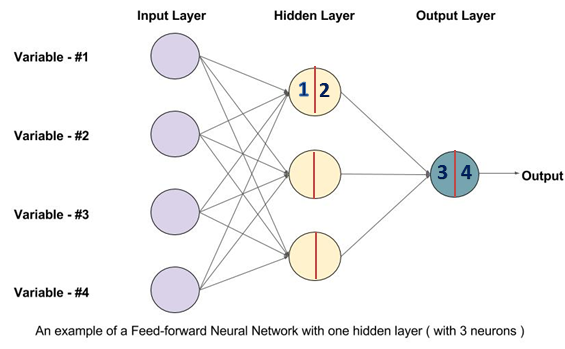
(1) Forward propagation
In each neuron, there are 2 activities going on after take in the input from previous hidden layer:
- a linear transformation of the input
- a non-linear activation function applied after
Then the ouput will pass to the next hidden layer as input.
From input layer to output layer, do above computation layer by layer is forward propagation. It tries to map each input \(x \in R^n\) to $ y$.
For each training sample, the forward propagation is defined as following:
\(x \in R^{n*1}\) denotes the input data. In the picture n = 4.
\((w^{[1]} \in R^{k*n},b^{[1]}\in R^{k*1})\) is the parameter in the first hidden layer. Here k = 3.
\((w^{[2]} \in R^{1*k},b^{[2]}\in R^{1*1})\) is the parameter in the output layer. The output is a binary variable with 1 dimension.
\((z^{[1]} \in R^{k*1},z^{[2]}\in R^{1*1})\) is the intermediate output after linear transformation in the hidden and output layer.
\((a^{[1]} \in R^{k*1},a^{[2]}\in R^{1*1})\) is the output from each layer. To make it more generalize we can use \(a^{[0]} \in R^n\) to denote \(x\)
*Here we use \(g(x)\) as activation function for hidden layer, and sigmoid \(\sigma(x)\) for output layer. we will discuss what are the available activation functions \(g(x)\) out there in the following post. What happens in forward propagation is following:
\([1]\) \(z^{[1]} = {w^{[1]}} a^{[0]} + b^{[1]}\)
\([2]\) \(a^{[1]} = g((z^{[1]} ) )\)
\([3]\) \(z^{[2]} = {w^{[2]}} a^{[1]} + b^{[2]}\)
\([4]\) \(a^{[2]} = \sigma(z^{[2]} )\)
(2) Backward propagation
After forward propagation, for each training sample \(x\) is done ,we will have a prediction \(\hat{y}\). Comparing \(\hat{y}\) with \(y\), we then use the error between prediction and real value to update the parameter via gradient descent.
Backward propagation is passing the gradient descent from output layer back to input layer using chain rule like below. The deduction is in the previous post.
\[ \frac{\partial L(a,y)}{\partial w} =
\frac{\partial L(a,y)}{\partial a} \cdot
\frac{\partial a}{\partial z} \cdot
\frac{\partial z}{\partial w}\]
\([4]\) \(dz^{[2]} = a^{[2]} - y\)
\([3]\) \(dw^{[2]} = dz^{[2]} a^{[1]T}\)
\([3]\) \(db^{[2]} = dz^{[2]}\)
\([2]\) \(dz^{[1]} = da^{[1]} * g^{[1]'}(z[1]) = w^{[2]T} dz^{[2]}* g^{[1]'}(z[1])\)
\([1]\) \(dw^{[1]} = dz^{[1]} a^{[0]T}\)
\([1]\) \(db^{[1]} = dz^{[1]}\)
2. Vectorize and Generalize your NN
Let's derive the vectorize representation of the above forward and backward propagation. The usage of vector is to speed up the computation. We will talk about this again in batch gradient descent.
\(w^{[1]},b^{[1]}, w^{[2]}, b^{[2]}\) stays the same. Generally \(w^{[i]}\) has dimension \((h_{i},h_{i-1})\) and \(b^{[i]}\) has dimension \((h_{i},1)\)
\(Z^{[1]} \in R^{k*m}, Z^{[2]} \in R^{1*m}, A^{[0]} \in R^{n*m}, A^{[1]} \in R^{k*m}, A^{[2]}\in R^{1*m}\) where \(A^{[0]}\)is the input vector, each column is one training sample.
(1) Forward propogation
Follow above logic, vectorize representation is below:
\([1]\) \(Z^{[1]} = {w^{[1]}} A^{[0]} + b^{[1]}\)
\([2]\) \(A^{[1]} = g((Z^{[1]} ) )\)
\([3]\) \(Z^{[2]} = {w^{[2]}} A^{[1]} + b^{[2]}\)
\([4]\) \(A^{[2]} = \sigma(Z^{[2]} )\)
Have you noticed that the dimension above is not a exact matched?
\({w^{[1]}} A^{[0]}\) has dimension \((k,m)\), \(b^{[1]}\) has dimension \((k,1)\).
However Python will take care of this for you with Broadcasting. Basically it will replicate the lower dimension to the higher dimension. Here \(b^{[1]}\) will be replicated m times to become \((k,m)\)
(1) Backward propogation
Same as above, backward propogation will be:
\([4]\) \(dZ^{[2]} = A^{[2]} - Y\)
\([3]\) \(dw^{[2]} =\frac{1}{m} dZ^{[2]} A^{[1]T}\)
\([3]\) \(db^{[2]} = \frac{1}{m} \sum{dZ^{[2]}}\)
\([2]\) \(dZ^{[1]} = dA^{[1]} * g^{[1]'}(z[1]) = w^{[2]T} dZ^{[2]}* g^{[1]'}(z[1])\)
\([1]\) \(dw^{[1]} = \frac{1}{m} dZ^{[1]} A^{[0]T}\)
\([1]\) \(db^{[1]} = \frac{1}{m} \sum{dZ^{[1]} }\)
In the next post, I will talk about some other details in NN, like hyper parameter, activation function.
To be continued.
Reference
- Ian Goodfellow, Yoshua Bengio, Aaron Conrville, "Deep Learning"
- Deeplearning.ai https://www.deeplearning.ai/
DeepLearning - Forard & Backward Propogation的更多相关文章
- Deeplearning - Overview of Convolution Neural Network
Finally pass all the Deeplearning.ai courses in March! I highly recommend it! If you already know th ...
- DeepLearning - Regularization
I have finished the first course in the DeepLearnin.ai series. The assignment is relatively easy, bu ...
- Coursera机器学习+deeplearning.ai+斯坦福CS231n
日志 20170410 Coursera机器学习 2017.11.28 update deeplearning 台大的机器学习课程:台湾大学林轩田和李宏毅机器学习课程 Coursera机器学习 Wee ...
- DeepLearning - Overview of Sequence model
I have had a hard time trying to understand recurrent model. Compared to Ng's deep learning course, ...
- back propogation 的线代描述
参考资料: 算法部分: standfor, ufldl : http://ufldl.stanford.edu/wiki/index.php/UFLDL_Tutorial 一文弄懂BP:https: ...
- DeepLearning Intro - sigmoid and shallow NN
This is a series of Machine Learning summary note. I will combine the deep learning book with the de ...
- 用纯Python实现循环神经网络RNN向前传播过程(吴恩达DeepLearning.ai作业)
Google TensorFlow程序员点赞的文章! 前言 目录: - 向量表示以及它的维度 - rnn cell - rnn 向前传播 重点关注: - 如何把数据向量化的,它们的维度是怎么来的 ...
- 吴恩达DeepLearning.ai的Sequence model作业Dinosaurus Island
目录 1 问题设置 1.1 数据集和预处理 1.2 概览整个模型 2. 创建模型模块 2.1 在优化循环中梯度裁剪 2.2 采样 3. 构建语言模型 3.1 梯度下降 3.2 训练模型 4. 结论 ...
- Sql Server 聚集索引扫描 Scan Direction的两种方式------FORWARD 和 BACKWARD
最近发现一个分页查询存储过程中的的一个SQL语句,当聚集索引列的排序方式不同的时候,效率差别达到数十倍,让我感到非常吃惊 由此引发出来分页查询的情况下对大表做Clustered Scan的时候, 不同 ...
随机推荐
- .net core运行环境搭建 linux + windows
---------------------------------------linux------------------------------------------------- 一.添加do ...
- GitHub Desktop 拉取 GitHub上 Tag 版本代码
一直在使用 GitHub Desktop 图形化 git 管理工具,统一项目框架版本时需要切换到ThinkPHP Tag 分支版本,步骤如下, 1,先在 GitHub 中找到需要的版本,点进去 2,点 ...
- Linux下安装 Redis
一.部署前准备 1.首先上官网下载Redis 最新稳定的压缩包 2.通过远程管理工具,将压缩包拷贝到Linux服务器中,执行解压操作 [root@CentOS6 ~]# tar zxvf redis- ...
- QQ空间认证之数据篇
最近,我们发现可以利用开通企鹅媒体平台的方式开通QQ公众号从而绑定我们的QQ号,这样我们所绑定的QQ号就成了认证空间了. 虽说这样很快捷的就认证了我们的QQ空间,但是,起有利也有弊.任何事情都不是十全 ...
- ckeditor + ckfinder + oss存储
ckeditor 与 ckfinder 的整合方法 网上有很多,这里我也就不说了. (主要是以前整合的现在忘记咋弄的了0.0) 我这里整合后直接使用js代码 <script type=&quo ...
- exynos4412—UART裸板复习
我们通过RS232来做实验. 通过电平转换芯片, 连接至核心板: 即:GPA0_0 GPA0_1 配置引脚为串口专用模式: 然后看 ULCONn [31:0] 0x3 设置串口 ...
- python 解积分方程
引用:https://www.aliyun.com/jiaocheng/527786.html sympy求解极限.积分.微分.二元一次方程:http://www.gzhshoulu.wang/art ...
- Python中的封装,继承和多态
面向对象的三大特性:封装,继承和多态 封装:在类的内部定义属性和方法,通过对象或类名来访问属性和方法,隐藏功能的实现细节,也可以设置访问权限. 广义的封装:实例化一个对象,给对象空间封装一些属性:狭义 ...
- centos升级数据库
Centos下升级MySQL数据库 备份数据 $ mysqldump -u xxx -h xxx -P 3306 -p --all-databases > databases.sql 查看版本 ...
- fiddler请求报文的headers属性详解
fiddler请求报文的headers属性详解 headers的属性包含以下几部分. (1)Cache头域 在Cache头域中,通常会出现以下属性. 1. Cache-Control 用来指定Resp ...