
DeepLearning Intro - sigmoid and shallow NN
This is a series of Machine Learning summary note. I will combine the deep learning book with the deeplearning open course . Any feedback is welcomed!
First let's go through some basic NN concept using Bernoulli classification problem as an example.
Activation Function
1.Bernoulli Output
1. Definition
When dealing with Binary classification problem, what activavtion function should we use in the output layer?
Basically given \(x \in R^n\), How to get \(P(y=1|x)\) ?
2. Loss function
Let $\hat{y} = P(y=1|x) $, We would expect following output
\[P(y|x) = \begin{cases}
\hat{y} & \quad when & y= 1\\
1-\hat{y} & \quad when & y= 0\\
\end{cases}
\]
Above can be simplified as
\[P(y|x)= \hat{y}^{y}(1-\hat{y})^{1-y}\]
Therefore, the maximum likelihood of m training samples will be
\[\theta_{ML} = argmax\prod^{m}_{i=1}P(y^i|x^i)\]
As ususal we take the log of above function and get following. Actually for gradient descent log has other advantages, which we will discuss later.
\[log(\theta_{ML}) = argmax\sum^{m}_{i=1} ylog(\hat{y})+(1-y)log(1-\hat{y}) \]
And the cost function for optimization is following
\[J(w,b) = \sum ^{m}_{i=1}L(y^i,\hat{y}^i)= -\sum^{m}_{i=1}ylog(\hat{y})+(1-y)log(1-\hat{y})\]
The cost function is the sum of loss from m training samples, which measures the performance of classification algo.
And yes here it is exactly the negative of log likelihood. While Cost function can be different from negative log likelihood, when we apply regularization. But here let's start with simple version.
So here comes our next problem, how can we get 1-dimension $ log(\hat{y})$, given input \(x\), which is n-dimension vector ?
3. Activtion function - Sigmoid
Let \(h\) denotes the output from the previous hidden layer that goes into the final output layer. And a linear transformation is applied to \(h\) before activation function.
Let \(z = w^Th +b\)
The assumption here is
\[log(\hat{y}) = \begin{cases}
z & \quad when & y= 1\\
0 & \quad when & y= 0\\
\end{cases}
\]
Above can be simplified as
\[log(\hat{y}) = yz\quad \to \quad \hat{y} = exp(yz)\]
This is an unnormalized distribution of \(\hat{y}\). Because \(y\) denotes probability, we need to further normalize it to $ [0,1]$.
\[\hat{y} = \frac{exp(yz)} {\sum^1_{y=0}exp(yz)} \\
=\frac{exp(z)}{1+exp(z)}\\
\quad \quad \quad \quad = \frac{1}{1+exp(-z)} = \sigma(z)
\]
Bingo! Here we go - Sigmoid Function: \(\sigma(z) = \frac{1}{1+exp(-z)}\)
\[p(y|x) = \begin{cases}
\sigma(z) & \quad when & y= 1\\
1-\sigma(z) & \quad when & y= 0\\
\end{cases}
\]
Sigmoid function has many pretty cool features like following:
\[ 1- \sigma(x) = \sigma(-x) \\
\frac{d}{dx} \sigma(x) = \sigma(x)(1-\sigma(x)) \\
\quad \quad = \sigma(x)\sigma(-x)
\]
Using the first feature above, we can further simply the bernoulli output into following:
\[p(y|x) = \sigma((2y-1)z)\]
4. gradient descent and back propagation
Now we have target cost fucntion to optimize. How does the NN learn from training data? The answer is -- Back Propagation.
Actually back propagation is not some fancy method that is designed for Neural Network. When training sample is big, we can use back propagation to train linear regerssion too.
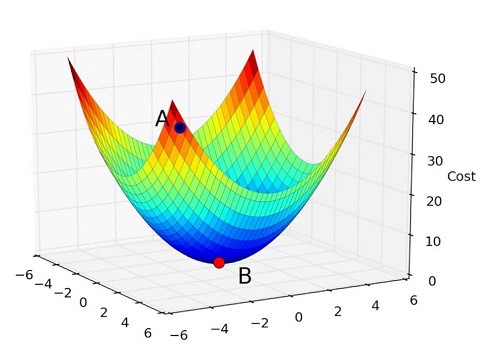
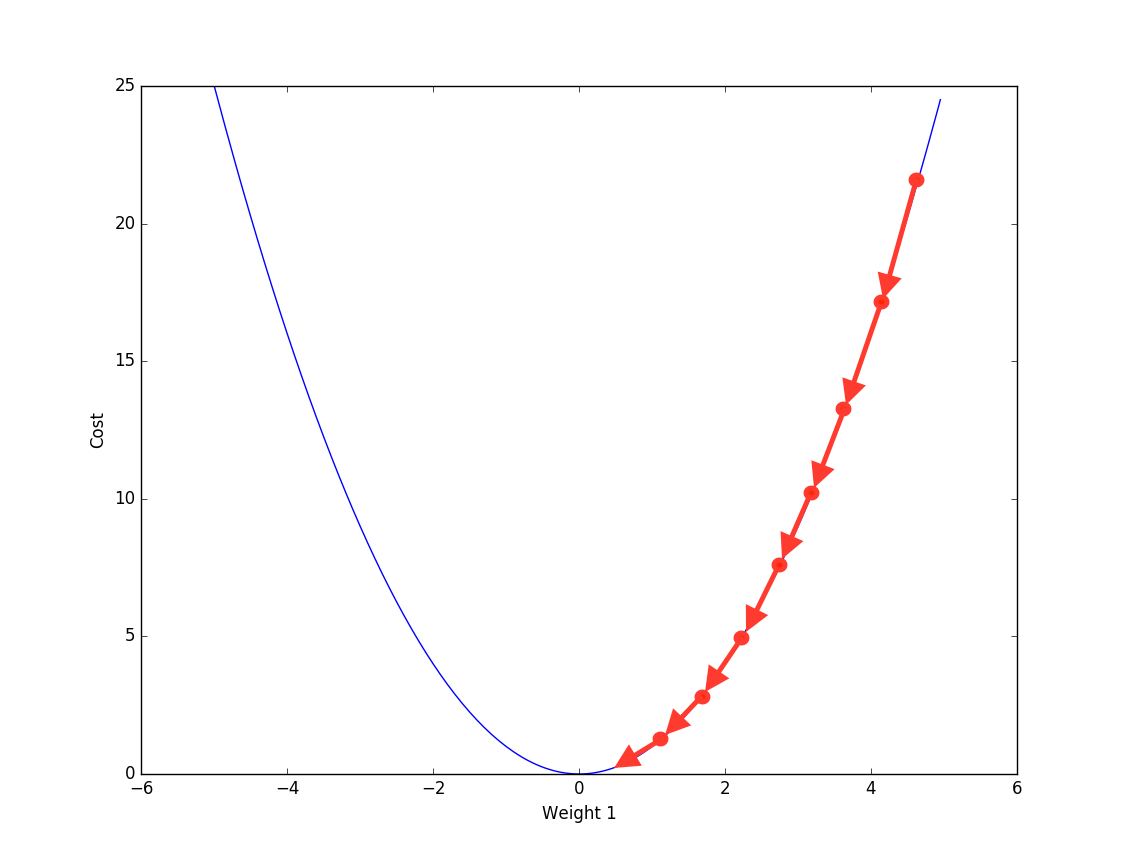
Back Propogation is iteratively using the partial derivative of cost function to update the parameter, in order to reach local optimum.
$ \
Looping \quad m \quad samples :\
w= w - \frac{\partial J(w,b)}{\partial w} \
b= b - \frac{\partial J(w,b)}{\partial b}
$
Bascically, for each training sample \((x,y)\), we compare the \(y\) with \(\hat{y}\) from output layer. Get the difference, and compute which part of difference is from which parameter( by partial derivative). And then update the parameter accordingly.
And the derivative of sigmoid function can be calcualted using chaining method:
For each training sample, let \(\hat{y}=a = \sigma(z)\)
\[ \frac{\partial L(a,y)}{\partial w} =
\frac{\partial L(a,y)}{\partial a} \cdot
\frac{\partial a}{\partial z} \cdot
\frac{\partial z}{\partial w}\]
Where
1.$\frac{\partial L(a,y)}{\partial a}
=-\frac{y}{a} + \frac{1-y}{1-a} $
Given loss function is
\(L(a,y) = -(ylog(a) + (1-y)log(1-a))\)
2.\(\frac{\partial a}{\partial z} = \sigma(z)(1-\sigma(z)) = a(1-a)\).
See above for sigmoid features.
3.\(\frac{\partial z}{\partial w} = x\)
Put them together we get :
\[ \frac{\partial L(a,y)}{\partial w} = (a-y)x\]
This is exactly the update we will have from each training sample \((x,y)\) to the parameter \(w\).
5. Entire work flow.
Summarizing everything. A 1-layer binary classification neural network is trained as following:
- Forward propagation: From \(x\), we calculate \(\hat{y}= \sigma(z)\)
- Calculate the cost function \(J(w,b)\)
- Back propagation: update parameter \((w,b)\) using gradient descent.
- keep doing above until the cost function stop improving (improment < certain threshold)
6. what's next?
When NN has more than 1 layer, there will be hidden layers in between. And to get non-linear transformation of x, we also need different types of activation function for hidden layer.
However sigmoid is rarely used as hidden layer activation function for following reasons
- vanishing gradient descent
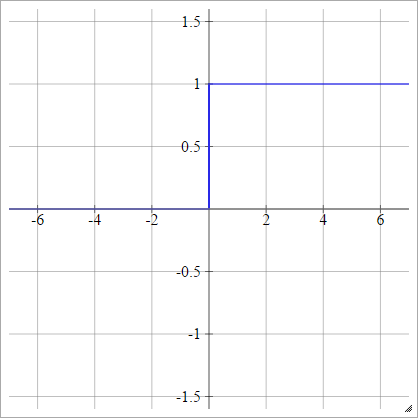
the reason we can't use [left] as activation function is because the gradient is 0 when \(z>1 ,z <0\).
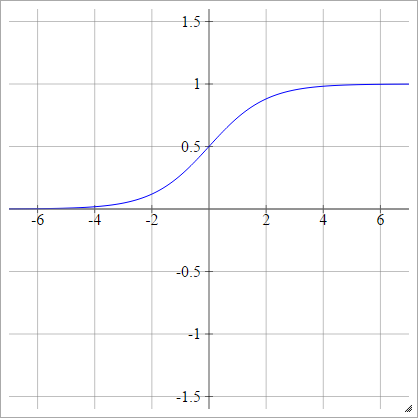
Sigmoid only solves this problem partially. Becuase \(gradient \to 0\), when \(z>1 ,z <0\).
| \(p(y=1\|x)= max\{0,min\{1,z\}\}\) | \(p(y=1\|x)= \sigma(z)\) |
|---|---|
 |
 |
- non-zero centered
To be continued
Reference
- Ian Goodfellow, Yoshua Bengio, Aaron Conrville, "Deep Learning"
- Deeplearning.ai https://www.deeplearning.ai/
DeepLearning Intro - sigmoid and shallow NN的更多相关文章
- Sigmoid function in NN
X = [ones(m, ) X]; temp = X * Theta1'; t = size(temp, ); temp = [ones(t, ) temp]; h = temp * Theta2' ...
- Deeplearning - Overview of Convolution Neural Network
Finally pass all the Deeplearning.ai courses in March! I highly recommend it! If you already know th ...
- DeepLearning - Regularization
I have finished the first course in the DeepLearnin.ai series. The assignment is relatively easy, bu ...
- DeepLearning - Forard & Backward Propogation
In the previous post I go through basic 1-layer Neural Network with sigmoid activation function, inc ...
- Pytorch_第六篇_深度学习 (DeepLearning) 基础 [2]---神经网络常用的损失函数
深度学习 (DeepLearning) 基础 [2]---神经网络常用的损失函数 Introduce 在上一篇"深度学习 (DeepLearning) 基础 [1]---监督学习和无监督学习 ...
- 0802_转载-nn模块中的网络层介绍
0802_转载-nn 模块中的网络层介绍 目录 一.写在前面 二.卷积运算与卷积层 2.1 1d 2d 3d 卷积示意 2.2 nn.Conv2d 2.3 转置卷积 三.池化层 四.线性层 五.激活函 ...
- Neural Networks and Deep Learning
Neural Networks and Deep Learning This is the first course of the deep learning specialization at Co ...
- 关于BP算法在DNN中本质问题的几点随笔 [原创 by 白明] 微信号matthew-bai
随着deep learning的火爆,神经网络(NN)被大家广泛研究使用.但是大部分RD对BP在NN中本质不甚清楚,对于为什这么使用以及国外大牛们是什么原因会想到用dropout/sigmoid ...
- Pytorch实现UNet例子学习
参考:https://github.com/milesial/Pytorch-UNet 实现的是二值汽车图像语义分割,包括 dense CRF 后处理. 使用python3,我的环境是python3. ...
随机推荐
- springmvc mybatis 整合
官网 http://www.fhadmin.org/D 集成安全权限框架shiro Shiro 是一个用 Java 语言实现的框架,通过一个简单易用的 API 提供身份验证和授权,更安全,更可靠E ...
- 破损的键盘(悲剧文本)(Broken Keyboard(a.k.a. Beiju Text),Uva 11988)
破损的键盘(悲剧文本)(Broken Keyboard(a.k.a. Beiju Text),Uva 11988) 题意描述 你在输入文章的时候,键盘上的Home键和End键出了问题,会不定时的按下. ...
- mysql使用数据库
哈哈 只能怪自己太菜哈 刚接触这个MySQL没多久 今天用终端登陆MySQL的时候mysql -u root -p 然后就想看看自己的数据库 我用的MySQL的客户端是navicat for mysq ...
- 正则验证input输入,要求只能输入正数,小数点后保留两位。
<input type="number" step="1" min="0" onkeyup="this.value= thi ...
- Yii中实现分页
$criteria = new CDbCriteria(); // 查询字段 $criteria->select = 'id, name, create_time'; // 排序 $criter ...
- PHP 中根据 IP 获取地址
这里使用的是淘宝 IP 地址库提供的 API 接口. 淘宝 IP 地址库:http://ip.taobao.com/instructions.html API 文档说明: 使用事例: /** * 调 ...
- 【JVM】上帝视角看JVM内存模型,分而治之论各模块详情
1. 上帝视角 [树看JVM] [图看JVM] 2. 分而治之 2.1 堆区 构成:堆区由新生代和老年代组成,新生代中包含伊甸区(Eden).幸存者区(survivor from .survivor ...
- Tensorflow取消占用全部GPU
参考:https://www.cnblogs.com/jiu0821/p/9501665.html Tensorflow默认是会占用全部的GPU,而有时候你根本不需要那么占用那么多GPU资源,这时候就 ...
- LeetCode初级算法的Python实现--字符串
LeetCode初级算法的Python实现--字符串 # 反转字符串 def reverseString(s): return s[::-1] # 颠倒数字 def reverse(x): if x ...
- 20145234黄斐《Java程序设计》第七周学习总结
教材学习内容总结 Lambda语法 Lambda去可以重复,符合DRY原则,而且Lambda表达式可读性更好,操作更简单 匿名类型最大的问题就在于其冗余的语法,lambda表达式是匿名方法,它提供了轻 ...