
POJ——T2553 The Bottom of a Graph
http://poj.org/problem?id=2553
| Time Limit: 3000MS | Memory Limit: 65536K | |
| Total Submissions: 10987 | Accepted: 4516 |
Description
Let n be a positive integer, and let p=(e1,...,en) be a sequence of length n of edges ei∈E such that ei=(vi,vi+1) for a sequence of vertices (v1,...,vn+1). Then p is called a path from vertex v1 to vertex vn+1 in G and we say that vn+1is reachable from v1, writing (v1→vn+1).
Here are some new definitions. A node v in a graph G=(V,E) is called a sink, if for every node w in G that is reachable from v, v is also reachable from w. The bottom of a graph is the subset of all nodes that are sinks, i.e.,bottom(G)={v∈V|∀w∈V:(v→w)⇒(w→v)}. You have to calculate the bottom of certain graphs.
Input
Output
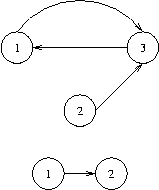
Sample Input
3 3

1 3 2 3 3 1

2 1

1 2

0
Sample Output
1 3

2
Source

 #include <algorithm>

 #include <cstring>

 #include <cstdio>

 using namespace std;

 const int MAXN();

 const int N();

 int n,m,u,v;

 int sumedge,head[N];

 struct Edge

 {

     int to,next;

     Edge(int to=,int next=) :

         to(to),next(next) {}

 }edge[MAXN];

 void ins(int from,int to)

 {

     edge[++sumedge]=Edge(to,head[from]);

     head[from]=sumedge;

 }

 int low[N],dfn[N],tim;

 int Stack[N],instack[N],top;

 int sumcol,col[N],point[N];

 void DFS(int now)

 {

     low[now]=dfn[now]=++tim;

     Stack[++top]=now; instack[now]=true;

     for(int i=head[now];i;i=edge[i].next)

     {

         int go=edge[i].to;

         if(!dfn[go])

                 DFS(go),low[now]=min(low[now],low[go]);

         else if(instack[go]) low[now]=min(low[now],dfn[go]);

     }

     if(low[now]==dfn[now])

     {

         col[now]=++sumcol;

         for(;Stack[top]!=now;top--)

         {

             col[Stack[top]]=sumcol;

             instack[Stack[top]]=false;

         }

         instack[now]=false; top--;

     }

 }

 int cnt,ans[N],chudu[N];

 void init()

 {

     tim=top=cnt=;

     sumcol=sumedge=;

     memset(ans,,sizeof(ans));

     memset(low,,sizeof(low));

     memset(dfn,,sizeof(dfn));

     memset(col,,sizeof(col));

     memset(head,,sizeof(head));

     memset(chudu,,sizeof(chudu));

     memset(Stack,,sizeof(Stack));

     memset(instack,,sizeof(instack));

 }

 int main()

 {

     /*freopen("made.txt","r",stdin);

     freopen("myout.txt","w",stdout);*/

     while(~scanf("%d",&n)&&n)

     {

         scanf("%d",&m); init();

         for(;m;m--)

             scanf("%d%d",&u,&v),ins(u,v);

         for(int i=;i<=n;i++)

             if(!dfn[i]) DFS(i);

         for(u=;u<=n;u++)

             for(v=head[u];v;v=edge[v].next)

                 if(col[u]!=col[edge[v].to]) chudu[col[u]]++;

         /*for(int sc=1;sc<=sumcol;sc++)

           if(!chudu[sc])

             for(int i=1;i<=n;i++)

             if(sc==col[i]) ans[++cnt]=i;*/

         for(int i=;i<=n;i++)

             if(!chudu[col[i]]) ans[++cnt]=i;

         sort(ans+,ans+cnt+);

         if(cnt)

         {

             for(int i=;i<cnt;i++) printf("%d ",ans[i]);

             printf("%d\n",ans[cnt]);

         }

         else printf("\n");

     }

     return ;

 }
POJ——T2553 The Bottom of a Graph的更多相关文章
- POJ 2553 The Bottom of a Graph(强连通分量)
POJ 2553 The Bottom of a Graph 题目链接 题意:给定一个有向图,求出度为0的强连通分量 思路:缩点搞就可以 代码: #include <cstdio> #in ...
- poj 2553 The Bottom of a Graph(强连通分量+缩点)
题目地址:http://poj.org/problem?id=2553 The Bottom of a Graph Time Limit: 3000MS Memory Limit: 65536K ...
- POJ 2553 The Bottom of a Graph (Tarjan)
The Bottom of a Graph Time Limit: 3000MS Memory Limit: 65536K Total Submissions: 11981 Accepted: ...
- poj 2553 The Bottom of a Graph【强连通分量求汇点个数】
The Bottom of a Graph Time Limit: 3000MS Memory Limit: 65536K Total Submissions: 9641 Accepted: ...
- POJ 2553 The Bottom of a Graph Tarjan找环缩点(题解解释输入)
Description We will use the following (standard) definitions from graph theory. Let V be a nonempty ...
- poj 2553 The Bottom of a Graph : tarjan O(n) 存环中的点
/** problem: http://poj.org/problem?id=2553 将所有出度为0环中的点排序输出即可. **/ #include<stdio.h> #include& ...
- POJ 2553 The Bottom of a Graph (强连通分量)
题目地址:POJ 2553 题目意思不好理解.题意是:G图中从v可达的全部点w,也都能够达到v,这种v称为sink.然后升序输出全部的sink. 对于一个强连通分量来说,全部的点都符合这一条件,可是假 ...
- poj - 2186 Popular Cows && poj - 2553 The Bottom of a Graph (强连通)
http://poj.org/problem?id=2186 给定n头牛,m个关系,每个关系a,b表示a认为b是受欢迎的,但是不代表b认为a是受欢迎的,关系之间还有传递性,假如a->b,b-&g ...
- poj 2553 The Bottom of a Graph
求解的是有向图中满足“自己可达的顶点都能到达自己”的顶点个数如果强连通分量中某个顶点,还能到达分量外的顶点,则该连通分量不满足要求// 因此,本题要求的是将强连通分量缩点后所构造的新图中出度为0的顶点 ...
随机推荐
- UVALive-8077 Brick Walls 找规律
题目链接:https://cn.vjudge.net/problem/UVALive-8077 题意 有一个用砖头磊起来的墙,现在又有一只蚂蚁,想沿着砖缝从起点跑到终点. 问最短路长度. 思路 找规律 ...
- BZOJ 4372/3370 烁烁的游戏/震波 (动态点分治+线段树)
烁烁的游戏 题目大意: 给你一棵$n$个节点的树,有$m$次操作,询问某个节点的权值,或者将与某个点$x$距离不超过$d$的所有节点的权值都增加$w$ 动态点分裸题 每个节点开一棵权值线段树 对于修改 ...
- 好文应该收藏-----redis 配置自启动
话不多说,请看原作者笔记,亲测,可用 https://blog.csdn.net/qq_42810276/article/details/81296012
- Git 合并流程
首先把自己的代码提交到自己的分支 再把master[主分支]的代码拉下来更新 解决冲突 推送至自己的分支 请求合并到master[主分支]
- 如何使用JAVA请求HTTPS
JDK对应的TLS版本(仅供参考) 1.写一个SSLClient类,继承至HttpClient import java.security.cert.CertificateException; impo ...
- tp框架引入第三方sdk的经验总结
tp框架开发常用到第三方的接口,这时候需要引入第三方的sdk.例如:微信扫码支付sdk,阿里大于的淘宝sdk等等 首先到官网上下载对应php的sdk文件,通常会有至少一个实例代码. 1 新建一个控制器 ...
- sql删除注意的问题
老大骂你都是有原因的,基础要打好!!!! SQL关于删除的三个语句:DROP.TRUNCATE. DELETE 的区别. DROP test; 删除表test,并释放空间,将test表删除的一干二净 ...
- java判断string数组中是否包含某个元素
- ArcEngine 一些实现代码
转自原文 ArcEngine 一些实现代码 ●·● 目录: A1 …………实现:鼠标滑过显示要素 tip A2 …………实现:通过鼠标选择要素并高亮显示(ISelectionEnvironme ...
- Android源代码解析之(七)-->LruCache缓存类
转载请标明出处:一片枫叶的专栏 android开发过程中常常会用到缓存.如今主流的app中图片等资源的缓存策略通常是分两级.一个是内存级别的缓存,一个是磁盘级别的缓存. 作为android系统的维护者 ...