
C. Edgy Trees Codeforces Round #548 (Div. 2) 并查集求连通块
2 seconds
256 megabytes
standard input
standard output
You are given a tree (a connected undirected graph without cycles) of nn vertices. Each of the n−1n−1 edges of the tree is colored in either black or red.
You are also given an integer kk. Consider sequences of kk vertices. Let's call a sequence [a1,a2,…,ak][a1,a2,…,ak] good if it satisfies the following criterion:
- We will walk a path (possibly visiting same edge/vertex multiple times) on the tree, starting from a1a1 and ending at akak.
- Start at a1a1, then go to a2a2 using the shortest path between a1a1 and a2a2, then go to a3a3 in a similar way, and so on, until you travel the shortest path between ak−1ak−1 and akak.
- If you walked over at least one black edge during this process, then the sequence is good.
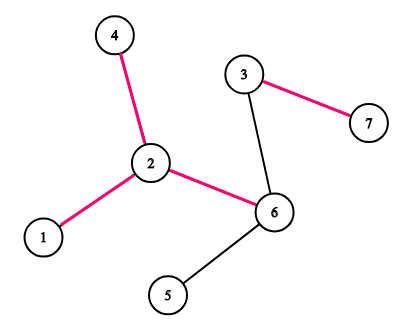
Consider the tree on the picture. If k=3k=3 then the following sequences are good: [1,4,7][1,4,7], [5,5,3][5,5,3] and [2,3,7][2,3,7]. The following sequences are not good: [1,4,6][1,4,6], [5,5,5][5,5,5], [3,7,3][3,7,3].
There are nknk sequences of vertices, count how many of them are good. Since this number can be quite large, print it modulo 109+7109+7.
The first line contains two integers nn and kk (2≤n≤1052≤n≤105, 2≤k≤1002≤k≤100), the size of the tree and the length of the vertex sequence.
Each of the next n−1n−1 lines contains three integers uiui, vivi and xixi (1≤ui,vi≤n1≤ui,vi≤n, xi∈{0,1}xi∈{0,1}), where uiui and vivi denote the endpoints of the corresponding edge and xixi is the color of this edge (00 denotes red edge and 11 denotes black edge).
Print the number of good sequences modulo 109+7109+7.
4 4

1 2 1

2 3 1

3 4 1
252
4 6

1 2 0

1 3 0

1 4 0
0
3 5

1 2 1

2 3 0
210
In the first example, all sequences (4444) of length 44 except the following are good:
- [1,1,1,1][1,1,1,1]
- [2,2,2,2][2,2,2,2]
- [3,3,3,3][3,3,3,3]
- [4,4,4,4][4,4,4,4]
In the second example, all edges are red, hence there aren't any good sequences.
这个题目读题读到我绝望,我不太理解这样子的题目。
这个题目我深刻的理解到了两个东西,一个是取模运算,还有一个是并查集求连通块,
这个就是求出有多少个0的连通块,然后用公式求出道路就可以了。
#include<iostream>

#include<cstdio>

#include<cstring>

#include <vector>

#include <algorithm>

using namespace std;

typedef long long ll;

const int maxn = 1e5 + 100;

const int mod = 1e9 + 7;

bool vis[maxn];

int f[maxn];

int findx(int x)

{

	return f[x] == x ? x : f[x] = findx(f[x]);

}

void unite(int x, int y)

{

	x = findx(x);

	y = findx(y);

	if (x == y) return;

	f[x] = y;

}

int exa[maxn];

int main()

{

	int n, k, num = 0;

	cin >> n >> k;

	ll ans = 1;

	for (int i = 1; i <= k; i++)

	{

		ans *= n;

		ans %= mod;

	}

	//printf("%lld\n", ans);

	memset(vis, 0, sizeof(vis));

	for (int i = 1; i <= n; i++) f[i] = i;

	for (int i = 1; i < n; i++)

	{

		int  a, b, x;

		scanf("%d%d%d", &a, &b, &x);

		if (x) continue;

		unite(a, b);

		if (vis[a] == 0)

		{

			vis[a] = 1;

			num++;

		}

		if (vis[b] == 0)

		{

			vis[b] = 1;

			num++;

		}

	}

	for (int i = 1; i <= n; i++) exa[i] = 0;

	for (int i = 1; i <= n; i++)

	{

		if (vis[i] == 0) continue;

		int x = findx(i);

		exa[x]++;

		//printf("exa[%d]=%d %d\n", x, exa[x],i);

	}

	for (int i = 1; i <= n; i++)

	{

		ll sum = 1;

		if (exa[i] == 0) continue;//printf("%d\n", exa[i]);

		for (int j = 1; j <= k; j++)

		{

			sum *= exa[i];

			sum %= mod;

		}

		//printf("%lld\n", sum);

		ans = (ans - sum + mod) % mod;

	}

	ans = (ans - (n - num) + mod) % mod;

	printf("%lld\n", ans);

	return 0;

}
C. Edgy Trees Codeforces Round #548 (Div. 2) 并查集求连通块的更多相关文章
- C. Edgy Trees Codeforces Round #548 (Div. 2) 【连通块】
一.题面 here 二.分析 这题刚开始没读懂题意,后来明白了,原来就是一个数连通块里点数的问题.首先在建图的时候,只考虑红色路径上的点.为什么呢,因为为了不走红色的快,那么我们可以反着想只走红色的路 ...
- Codeforces Round 548 (Div. 2)
layout: post title: Codeforces Round 548 (Div. 2) author: "luowentaoaa" catalog: true tags ...
- Codeforces Round #548 (Div. 2) C dp or 排列组合
https://codeforces.com/contest/1139/problem/C 题意 一颗有n个点的树,需要挑选出k个点组成序列(可重复),按照序列的顺序遍历树,假如经过黑色的边,那么这个 ...
- Codeforces Round #548 (Div. 2) C. Edgy Trees
You are given a tree (a connected undirected graph without cycles) of
- Codeforces Round #548 (Div. 2) F splay(新坑) + 思维
https://codeforces.com/contest/1139/problem/F 题意 有m个人,n道菜,每道菜有\(p_i\),\(s_i\),\(b_i\),每个人有\(inc_j\), ...
- Codeforces Round #548 (Div. 2) E 二分图匹配(新坑) or 网络流 + 反向处理
https://codeforces.com/contest/1139/problem/E 题意 有n个学生,m个社团,每个学生有一个\(p_i\)值,然后每个学生属于\(c_i\)社团, 有d天,每 ...
- Codeforces Round #548 (Div. 2) D 期望dp + 莫比乌斯反演
https://codeforces.com/contest/1139/problem/D 题意 每次从1,m中选一个数加入队列,假如队列的gcd==1停止,问队列长度的期望 题解 概率正着推,期望反 ...
- Codeforces Round #548 (Div. 2) B. Chocolates
You went to the store, selling
- Codeforces Round #548 (Div. 2) A. Even Substrings
You are given a string
随机推荐
- Winform下KeyDown,KeyPress,KeyUp事件的总结(转)
原文: http://www.cnblogs.com/xiashengwang/archive/2011/09/15/2578798.html 在winform程序中,经常会用到这几个事件用于控制数字 ...
- vs 中引用自己创建程序集出现小叹号
出现的问题: 原因是.net frame work版本不一致 解决方法: 项目单击右键-->属性: 改为与你要引用的项目的程序集的版本一致即可
- log4.net 自定义日志文件名称
插件化项目中,遇到这样一个需求,每个插件 或者每个方法 一个日志文件,方便后期错误排查 源码地址: https://github.com/xlb378917466/SharpHttpServerCas ...
- BurpSuite 各模块使用
Proxy 代理 对浏览器进行代理 对浏览器增加代理服务器 可以对http 请求进行监视 intercept is on 进行监控 off 不监控 可以任意修改 对任意的网络请求 进行爬虫 在 s ...
- [PHP] 理解依赖注入
两个类有依赖关系的时候 使用者通过构造函数参数,方法或属性等方式将具体组件,传给自己 $storage=new Storge(); //构造函数注入 class User{ public functi ...
- What does operator “dot” (.) mean?
Question: Given the code : A = [1 2 3; 3 2 1] B = A.^2 The output : B = 1 4 9 9 4 1 But if I do this ...
- Go实现基于WebSocket的弹幕服务
拉模式和推模式 拉模式 1.数据更新频率低,则大多数请求是无效的 2.在线用户量多,则服务端的查询负载高 3.定时轮询拉取,实时性低 推模式 1.仅在数据更新时才需要推送 2.需要维护大量的在线长连接 ...
- Ext中defaults与fieldDefaults
不同点:defaults :直接子组件中的默认配置fieldDefaults: 后代组件中的默认配置 相同点:组件自己的配置中指定的值优先
- 二进制安装 kubernetes 1.12(一) - 安装 ETCD
软件环境 软件 版本 操作系统 CentOS 7.4 Docker 18-ce Kubernetes 1.12 服务器角色 角色 IP 组件 k8s-master 192.168.0.205 kube ...
- MySQL 查看执行计划
MySQL 使用 explain + sql 语句查看 执行计划,该执行计划不一定完全正确但是可以参考. EXPLAIN SELECT * FROM user WHERE nid = 3; selec ...