
HDU 3779 Railroad(记忆化搜索)
Railroad
Time Limit : 4000/2000ms (Java/Other) Memory Limit : 32768/32768K (Java/Other)
Total Submission(s) : 10 Accepted Submission(s) : 3
Font: Times New Roman | Verdana | Georgia
Font Size: ← →
Problem Description
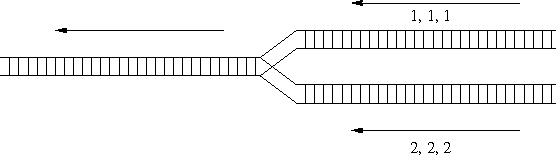
Figure 1: Merging railroad tracks.
The two trains each contain some railroad cars. Each railroad car contains a single type of products identified by a positive integer up to 1,000,000. The two trains come in from the right on separate tracks, as in the diagram above. To combine the two trains, we may choose to take the railroad car at the front of either train and attach it to the back of the train being formed on the left. Of course, if we have already moved all the railroad cars from one train, then all remaining cars from the other train will be moved to the left one at a time. All railroad cars must be moved to the left eventually. Depending on which train on the right is selected at each step, we will obtain different arrangements for the departing train on the left. For example, we may obtain the order 1,1,1,2,2,2 by always choosing the top train until all of its cars have been moved. We may also obtain the order 2,1,2,1,2,1 by alternately choosing railroad cars from the two trains.
To facilitate further processing at the other train yards later on in the trip (and also at the destination), the supervisor at the train yard has been given an ordering of the products desired for the departing train. In this problem, you must decide whether it is possible to obtain the desired ordering, given the orders of the products for the two trains arriving at the train yard.
Input
The end of input is indicated by N1 = N2 = 0.
Output
Sample Input
3 3

1 2 1

2 1 1

1 2 1 1 2 1

3 3

1 2 1

2 1 2

1 1 1 2 2 2

0 0
Sample Output
possible

not possible
Source
#include<iostream>

#include<cstdio>

#include<cstring>

#include<algorithm>

using namespace std;

int n,m;

int a[],b[],c[];

bool vis[][];

bool dfs(int x,int y,int k)

{

    if (k==n+m+) return ;

    if(vis[x][y]) return ;

    vis[x][y]=;

    if (x<=n && a[x]==c[k] && dfs(x+,y,k+))

        return ;

    if (y<=m && b[y]==c[k] && dfs(x,y+,k+))

        return ;

    return ;

}

int main()

{

    while(~scanf("%d%d",&n,&m))

    {

        if (n== && m==) break;

        for(int i=;i<=n;i++) scanf("%d",&a[i]);

        for(int i=;i<=m;i++) scanf("%d",&b[i]);

        for(int i=;i<=n+m;i++)scanf("%d",&c[i]);

        memset(vis,,sizeof(vis));

        if (dfs(,,)) printf("possible\n");

           else printf("not possible\n");

    }

    return ;

}
HDU 3779 Railroad(记忆化搜索)的更多相关文章
- 不要62 hdu 2089 dfs记忆化搜索
题目:http://acm.hdu.edu.cn/showproblem.php?pid=2089 题意: 给你两个数作为一个闭区间的端点,求出该区间中不包含数字4和62的数的个数 思路: 数位dp中 ...
- hdu 1078(dfs记忆化搜索)
题意:容易理解... 思路:我开始是用dfs剪枝做的,968ms险过的,后来在网上学习了记忆化搜索=深搜形式+dp思想,时间复杂度大大降低,我个人理解,就是从某一个点出发,前面的点是由后面的点求出的, ...
- hdu 4826(dp + 记忆化搜索)
题目链接:http://acm.hdu.edu.cn/showproblem.php?pid=4826 思路:dp[x][y][d]表示从方向到达点(x,y)所能得到的最大值,然后就是记忆化了. #i ...
- hdu---(3779)Railroad(记忆化搜索/dfs)
Railroad Time Limit: 4000/2000 MS (Java/Others) Memory Limit: 32768/32768 K (Java/Others)Total Su ...
- POJ 1198 / HDU 1401 Solitaire (记忆化搜索+meet in middle)
题目大意:给你一个8*8的棋盘,上面有四个棋子,给你一个初始排布,一个目标排布,每次移动,可以把一个棋子移动到一个相邻的空位,或者跨过1个相邻的棋子,在保证棋子移动不超过8次的情况下,问能否把棋盘上的 ...
- hdu 4345 Permutation 记忆化搜索
思路:实际上求的是和小于等于n的质数的种类数!!! 代码如下: #include<iostream> #include<stdio.h> #include<algorit ...
- POJ1088 滑雪题解+HDU 1078(记忆化搜索DP)
Description Michael喜欢滑雪百这并不奇怪, 因为滑雪的确很刺激.可是为了获得速度,滑的区域必须向下倾斜,而且当你滑到坡底,你不得不再次走上坡或者等待升降机来载你.Michael想知道 ...
- hdu1078 记忆化搜索
/* hdu 1078 QAQ记忆化搜索 其实还是搜索..因为里面开了一个数组这样可以省时间 (dp[x][y]大于0就不用算了直接返回值) */ #include<stdio.h> #i ...
- HDU 1429 (BFS+记忆化状压搜索)
题目链接: http://acm.hdu.edu.cn/showproblem.php?pid=1429 题目大意:最短时间内出迷宫,可以走回头路,迷宫内有不同的门,对应不同的钥匙. 解题思路: 要是 ...
随机推荐
- spring boot 使用属性加载顺序
1.命令行中传入的参数 2.SPRING_APPLICATION_JSON中的属性.SPRING_APPLICATION_JSON是以JSON格式配置再系统环境变量中的内容 3.java:comp/e ...
- PreparedStatement和Statement区别详解
技术原理 该 PreparedStatement接口继承Statement,并与之在两方面有所不同: PreparedStatement 实例包含已编译的 SQL 语句.这就是使语句“准备好”.包含于 ...
- java中数组以及集合
java中数组: 数组在Java里是一种特殊类型,有别于普通的“类的实例”的对象.但实际数组也是一种对象类型,int[]a = new int[5] a是在java栈中分配的引用变量,类型是int[ ...
- NOIP2019前的训练记录
\(April\):肛多项式,学\(FWT\)一个小时无果后背了六个公式,看来证明又得咕很久了
- js正则匹配两位小数
今天写一个用js正则校验最多保留两位小数的格式. a = /^\d+|\d+\.\d{1,2}$/; 测试 a.test(1.222); 结果:true 一下蒙了,怎么可能,最后找了好久,原来需要把^ ...
- Windows打开软件老是弹出无法验证发布者
使用组策略管理器 gpedit.msc 用户配置-管理模板-Windows组件-附件管理器-中等风险文件类型的包含列表 .exe;.cmd;.bat;.js即可
- Windos 系统网络连接 调优
1.运行进入注册表:regedit 2.进入注册表指定路径 [HKEY_LOCAL_MACHINE\SYSTEM\CurrentControlSet\Services\Tcpip\Parameters ...
- 20145329 《Java程序设计》第九周学习总结
教材学习内容总结 十六章 1.Metadata即"诠读数据的数据",数据库是用来存储数据的地方,然而数据库本身产品名称为何?数据库中有几个数据表格?表格名称为何?表格中有几个字段等 ...
- 20145329 《Java程序设计》实验二总结
实验指导教师:娄嘉鹏老师 实验日期:2016.4.12 实验时间:15:30~17:30 实验序号:实验二 实验名称:Java面向对象程序设计 实验目的与要求: 1.初步掌握单元测试和TDD 2.理解 ...
- 算法学习 - ST表 - 稀疏表 - 解决RMQ问题
2017-08-26 21:44:45 writer:pprp RMQ问题就是区间最大最小值查询问题: 这个SparseTable算法构造一个表,F[i][j] 表示 区间[i, i + 2 ^ j ...