
hdu 1685 Booksort (IDA*)
Booksort
There is one department in the library, full of bookcases, where still the old way of borrowing is in use. Students can simply walk around there, pick out the books they like and, after registration, take them home for at most three weeks.
Quite often, however, it happens that a student takes a book from the shelf, takes a closer look at it, decides that he does not want to read it, and puts it back. Unfortunately, not all students are very careful with this last step. Although each book has a unique identification code, by which the books are sorted in the bookcase, some students put back the books they have considered at the wrong place. They do put it back onto the right shelf. However, not at the right position on the shelf.
Other students use the unique identification code (which they can find in an online catalogue) to find the books they want to borrow. For them, it is important that the books are really sorted on this code. Also for the librarian, it is important that the books are sorted. It makes it much easier to check if perhaps some books are stolen: not borrowed, but yet missing.
Therefore, every week, the librarian makes a round through the department and sorts the books on every shelf. Sorting one shelf is doable, but still quite some work. The librarian has considered several algorithms for it, and decided that the easiest way for him to sort the books on a shelf, is by sorting by transpositions: as long as the books are not sorted,
take out a block of books (a number of books standing next to each other),
shift another block of books from the left or the right of the resulting ‘hole’, into this hole,
and put back the first block of books into the hole left open by the second block.
One such sequence of steps is called a transposition.
The following picture may clarify the steps of the algorithm, where X denotes the first block of books, and Y denotes the second block.
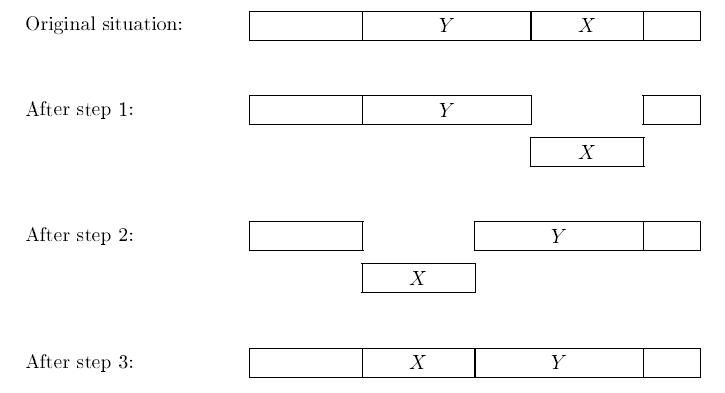
Of course, the librarian wants to minimize the work he has to do. That is, for every bookshelf, he wants to minimize the number of transpositions he must carry out to sort the books. In particular, he wants to know if the books on the shelf can be sorted by at most 4 transpositions. Can you tell him?
One line with one integer n with 1 ≤ n ≤ 15: the number of books on a certain shelf.
One line with the n integers 1, 2, …, n in some order, separated by single spaces: the unique identification codes of the n books in their current order on the shelf.
if the minimal number of transpositions to sort the books on their unique identification codes (in increasing order) is T ≤ 4, then this minimal number T;
if at least 5 transpositions are needed to sort the books, then the message "5 or more".
6
1 3 4 6 2 5
5
5 4 3 2 1
10
6 8 5 3 4 7 2 9 1 10
3
5 or more
#include <iostream>

#include <cstdio>

#include <cstring>

#include <queue>

#define maxn 16

using namespace std;

int n,m,ans,depth,flag;

int a[maxn];

bool isok()

{

    int i,j;

    for(i=1;i<=n;i++)

    {

        if(a[i]!=i) return false ;

    }

    return true ;

}

int h()

{

    int i,j,t=0;

    for(i=0;i<=n;i++)

    {

        if(a[i]+1!=a[i+1]) t++;

    }

    return t;

}

void dfs(int d)

{

    if(isok())

    {

        flag=1;

        return ;

    }

    if(flag||(d-1)*3+h()>depth*3) return ;  // 实现IDA*

    int i,j,k,p;

    int tmp[maxn];

    for(i=1; i<=n; i++)    // 模拟操作

    {

        for(j=i; j<=n; j++)

        {

            for(k=1; k<=i-1; k++)

            {

                memcpy(tmp,a,sizeof(tmp));

                for(p=k; p<=i-1; p++)

                {

                    a[p+j-i+1]=tmp[p];

                }

                for(p=i; p<=j; p++)

                {

                    a[p-i+k]=tmp[p];

                }

                dfs(d+1);

                memcpy(a,tmp,sizeof(tmp));

            }

            for(k=j+1; k<=n; k++)

            {

                memcpy(tmp,a,sizeof(tmp));

                for(p=j+1; p<=k; p++)

                {

                    a[p-j-1+i]=tmp[p];

                }

                for(p=i; p<=j; p++)

                {

                    a[p+k-j]=tmp[p];

                }

                dfs(d+1);

                memcpy(a,tmp,sizeof(tmp));

            }

        }

    }

}

int main()

{

    int i,j,t,flg;

    scanf("%d",&t);

    while(t--)

    {

        scanf("%d",&n);

        flg=1;

        for(i=1; i<=n; i++)

        {

            scanf("%d",&a[i]);

            if(a[i]!=i) flg=0;

        }

        a[0]=0,a[n+1]=n+1;

        if(flg)

        {

            printf("0\n");

            continue ;

        }

        flag=depth=0;

        while(!flag)

        {

            depth++;

            dfs(1);

            if(depth>=4) break ;

        }

        if(flag) printf("%d\n",depth);

        else printf("5 or more\n");

    }

    return 0;

}
hdu 1685 Booksort (IDA*)的更多相关文章
- POJ 1077 HDU 1043 Eight (IDA*)
题意就不用再说明了吧......如此经典 之前想用双向广搜.a*来写,但总觉得无力,现在用IDA*感觉其他的解法都弱爆了..............想法活跃,时间,空间消耗很小,给它跪了 启发式搜索关 ...
- DNA sequence HDU - 1560(IDA*,迭代加深搜索)
题目大意:有n个DNA序列,构造一个新的序列,使得这n个DNA序列都是它的子序列,然后输出最小长度. 题解:第一次接触IDA*算法,感觉~~好暴力!!思路:维护一个数组pos[i],表示第i个串该匹配 ...
- HDU 2485 Destroying the bus stations (IDA*+ BFS)
传送门:http://acm.hdu.edu.cn/showproblem.php?pid=2485 题意:给你n个点,m条相连的边,问你最少去掉几个点使从1到n最小路径>=k,其中不能去掉1, ...
- HDU 1813 Escape from Tetris (IDA*)
传送门:http://acm.hdu.edu.cn/showproblem.php?pid=1813 题意:给你一个n*n的迷宫,其中0代表有一个人在这个位置,1代表墙,现在要求一个路线,使所有的人通 ...
- POJ3460 Booksort(IDA*)
POJ3460 Booksort 题意:给定一个长度为n的序列,每次可以取出其中的一段数,插入任意一个位置,问最少需要几次操作才能使整个序列变为1~n 思路:IDA*+迭代加深搜索 小技巧:将一段数插 ...
- hdu 2234(IDA*)
题目链接:http://acm.hdu.edu.cn/showproblem.php?pid=2234 思路:IDA*可以搞,借鉴的是大牛的启发式函数h(): 可以考虑把每一行上的数转化成相同的,或者 ...
- hdu 1667(IDA*)
题目链接:http://acm.hdu.edu.cn/showproblem.php?pid=1667 思路:大牛说是IDA*的入门题=.=构造h()=8-max(1,2,3); max(1,2,3 ...
- HDU 1043 & POJ 1077 Eight(康托展开+BFS | IDA*)
Eight Time Limit: 1000MS Memory Limit: 65536K Total Submissions: 30176 Accepted: 13119 Special ...
- HDU 1560 DNA sequence (IDA* 迭代加深 搜索)
题目地址:http://acm.hdu.edu.cn/showproblem.php?pid=1560 BFS题解:http://www.cnblogs.com/crazyapple/p/321810 ...
随机推荐
- Android 自定义日历
好久没来写博客了,这半年多发生了好多的事情,废话不多说,今天在公司里比较闲在,写一篇最近写的公司用到的控件——日历控件. 控件的功能比较少,根据需求只有选择开始时间和结束时间并返回时间段. 效果图如下 ...
- Android ScrollView 不能滚动但是有滚动条
如果一切都检查完毕,没有任何设置为不能滚动,而且outouch事件也没有被拦截的话,那么在布局文件中检查下是否在ScrollView中的子View中设置了margin_top属性.如果设置了,那么Sc ...
- CXF自动生成客户端
官网下载apache-cxf-3.1.6,bin目录下.配置环境变量,生成客户端 http://blog.csdn.net/jaune161/article/details/25499939 http ...
- Linq 实现普通sql中 where in 的功能
user.ProjectIds 的值是使用逗号分隔的 例如:1,2,3 projectList = (from a in projectList where (user.ProjectIds.Spli ...
- PhotoShop 移动工具详解
自动选择工具 勾选后 可以随意移动任意图层 不勾选 只适用于移动当前所选图层 Ctrl+Z 还原移动Ctrl+Alt+Z 后退一步 复制图像 Alt键+拖动 Shift+Alt+拖动 ...
- Centos 6安装python3.5
安装python3.5 安装步骤如下 :1 准备编译环境(环境如果不对的话,可能遇到各种问题,比如wget无法下载https链接的文件) yum groupinstall 'Development T ...
- python使用PIL压缩图片
import Image import os import os.path import sys path = sys.argv[1] small_path = (path[:-1] if path[ ...
- 牛人总结python中string模块各属性以及函数的用法,果断转了,好东西
http://blog.chinaunix.net/uid-25992400-id-3283846.html http://blog.csdn.net/xiaoxiaoniaoer1/article/ ...
- 基于Redis的CAS服务端集群
为了保证生产环境CAS(Central Authentication Service)认证服务的高可用,防止出现单点故障,我们需要对CAS Server进行集群部署. CAS的Ticket默认是以Ma ...
- Instruments 使用指南
Instruments 用户指南 http://cdn.cocimg.com/bbs/attachment/Fid_6/6_24457_90eabb4ed5b3863.pdf 原著:Apple Inc ...