
用Keras搭建神经网络 简单模版(二)——Classifier分类(手写数字识别)
# -*- coding: utf-8 -*-

import numpy as np

np.random.seed(1337) #for reproducibility再现性

from keras.datasets import mnist

from keras.utils import np_utils

from keras.models import Sequential#按层

from keras.layers import Dense, Activation#全连接层

import matplotlib.pyplot as plt

from keras.optimizers import RMSprop
从mnist下载手写数字图片数据集,图片为28*28,将每个像素的颜色(0到255)改为(0倒1),将标签y变为10个长度,若为1,则在1处为1,剩下的都标为0。
#dowmload the mnisst the path '~/.keras/datasets/' if it is the first time to be called

#x shape (60000 28*28),y shape(10000,)

(x_train,y_train),(x_test,y_test) = mnist.load_data()#0-9的图片数据集

#data pre-processing

x_train = x_train.reshape(x_train.shape[0],-1)/255 #normalize 到【0,1】

x_test = x_test.reshape(x_test.shape[0],-1)/255

y_train = np_utils.to_categorical(y_train, num_classes=10) #把标签变为10个长度,若为1,则在1处为1,剩下的都标为0

y_test = np_utils.to_categorical(y_test,num_classes=10)
搭建神经网络,Activation为激活函数。由于第一个Dense传出32.所以第二个的Dense默认传进32,不用特意设置。
#Another way to build neural net

model = Sequential([

        Dense(32,input_dim=784),#传出32

        Activation('relu'),

        Dense(10),

        Activation('softmax')

        ])

#Another way to define optimizer

rmsprop = RMSprop(lr=0.001,rho=0.9,epsilon=1e-08,decay=0.0)

# We add metrics to get more results you want to see

model.compile( #编译

        optimizer = rmsprop,

        loss = 'categorical_crossentropy',

        metrics=['accuracy'], #在更新时同时计算一下accuracy

        )
训练和测试
print("Training~~~~~~~~")

#Another way to train the model

model.fit(x_train,y_train, epochs=2, batch_size=32) #训练2大批,每批32个

print("\nTesting~~~~~~~~~~")

#Evalute the model with the  metrics we define earlier

loss,accuracy = model.evaluate(x_test,y_test)

print('test loss:',loss)

print('test accuracy:', accuracy)
全代码:
# -*- coding: utf-8 -*-

import numpy as np

np.random.seed(1337) #for reproducibility再现性

from keras.datasets import mnist

from keras.utils import np_utils

from keras.models import Sequential#按层

from keras.layers import Dense, Activation#全连接层

import matplotlib.pyplot as plt

from keras.optimizers import RMSprop

#dowmload the mnisst the path '~/.keras/datasets/' if it is the first time to be called

#x shape (60000 28*28),y shape(10000,)

(x_train,y_train),(x_test,y_test) = mnist.load_data()#0-9的图片数据集

#data pre-processing

x_train = x_train.reshape(x_train.shape[0],-1)/255 #normalize 到【0,1】

x_test = x_test.reshape(x_test.shape[0],-1)/255

y_train = np_utils.to_categorical(y_train, num_classes=10) #把标签变为10个长度,若为1,则在1处为1,剩下的都标为0

y_test = np_utils.to_categorical(y_test,num_classes=10)

#Another way to build neural net

model = Sequential([

        Dense(32,input_dim=784),#传出32

        Activation('relu'),

        Dense(10),

        Activation('softmax')

        ])

#Another way to define optimizer

rmsprop = RMSprop(lr=0.001,rho=0.9,epsilon=1e-08,decay=0.0)

# We add metrics to get more results you want to see

model.compile( #编译

        optimizer = rmsprop,

        loss = 'categorical_crossentropy',

        metrics=['accuracy'], #在更新时同时计算一下accuracy

        )

print("Training~~~~~~~~")

#Another way to train the model

model.fit(x_train,y_train, epochs=2, batch_size=32) #训练2大批,每批32个

print("\nTesting~~~~~~~~~~")

#Evalute the model with the  metrics we define earlier

loss,accuracy = model.evaluate(x_test,y_test)

print('test loss:',loss)

print('test accuracy:', accuracy)
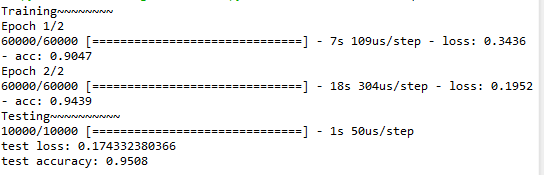
结果为:

用Keras搭建神经网络 简单模版(二)——Classifier分类(手写数字识别)的更多相关文章
- 机器学习(二)-kNN手写数字识别
一.kNN算法是机器学习的入门算法,其中不涉及训练,主要思想是计算待测点和参照点的距离,选取距离较近的参照点的类别作为待测点的的类别. 1,距离可以是欧式距离,夹角余弦距离等等. 2,k值不能选择太大 ...
- 用Keras搭建神经网络 简单模版(三)—— CNN 卷积神经网络(手写数字图片识别)
# -*- coding: utf-8 -*- import numpy as np np.random.seed(1337) #for reproducibility再现性 from keras.d ...
- 用Keras搭建神经网络 简单模版(六)——Autoencoder 自编码
import numpy as np np.random.seed(1337) from keras.datasets import mnist from keras.models import Mo ...
- 用Keras搭建神经网络 简单模版(四)—— RNN Classifier 循环神经网络(手写数字图片识别)
# -*- coding: utf-8 -*- import numpy as np np.random.seed(1337) from keras.datasets import mnist fro ...
- 用Keras搭建神经网络 简单模版(一)——Regressor 回归
首先需要下载Keras,可以看到我用的是TensorFlow 的backend 自己构建虚拟数据,x是-1到1之间的数,y为0.5*x+2,可视化出来 # -*- coding: utf-8 -*- ...
- 用Keras搭建神经网络 简单模版(五)——RNN LSTM Regressor 循环神经网络
# -*- coding: utf-8 -*- import numpy as np np.random.seed(1337) import matplotlib.pyplot as plt from ...
- 吴裕雄 python 神经网络TensorFlow实现LeNet模型处理手写数字识别MNIST数据集
import tensorflow as tf tf.reset_default_graph() # 配置神经网络的参数 INPUT_NODE = 784 OUTPUT_NODE = 10 IMAGE ...
- 吴裕雄 python 神经网络——TensorFlow实现AlexNet模型处理手写数字识别MNIST数据集
import tensorflow as tf # 输入数据 from tensorflow.examples.tutorials.mnist import input_data mnist = in ...
- 【问题解决方案】Keras手写数字识别-ConnectionResetError: [WinError 10054] 远程主机强迫关闭了一个现有的连接
参考:台大李宏毅老师视频课程-Keras-Demo 在载入数据阶段报错: ConnectionResetError: [WinError 10054] 远程主机强迫关闭了一个现有的连接 Google之 ...
随机推荐
- Spring学习笔记之Testing
测试嘛,一般也就两种,一种就是单元测试,另外一个就是集成测试.都是废话 一.单元测试 以前也就是搞个模拟,main函数一写搞定. 现在呢,有了个spring,也有了个推荐规范?这个是个什么东西?什么叫 ...
- L1-019 谁先倒
划拳是古老中国酒文化的一个有趣的组成部分.酒桌上两人划拳的方法为:每人口中喊出一个数字,同时用手比划出一个数字.如果谁比划出的数字正好等于两人喊出的数字之和,谁就输了,输家罚一杯酒.两人同赢或两人同输 ...
- ListBox 控件单击事件
XAML: <ListBox x:Name="ItemBox" Grid.Column="0" Tap="ItemBox_Tap"&g ...
- I.MX6 计算iomux Pin配置
/********************************************************************************* * I.MX6 计算iomux P ...
- int类型转string类型c++
前言 使用VS的过程中,经常会用到需要将int类型数据转换为字符串类型,便于显示信息等. 实现方法 c++11标准中的to_string函数,在VS安装文件的include文件中生成的只读文件,使用起 ...
- 轻松制作儿童趣味算术软件 - imsoft.cnblogs
轻松制作儿童趣味算术软件 马震安 电脑爱好者 2014-07-23 08:38技巧 0 条评论 标签:软件 兴趣是学习的动力,以动感的软件和自动判断得分的形式测试孩子的算术能力,总要比在白纸上出几 ...
- 在U盘上安装Windows 7的详细步骤
买到苹果新款MacBook Air后大家最想干的事是什么?体验一下Mac OS X?事实告诉我们有几乎一半的人第一件想要做的事是装一个微软的Windows系统,但问题是新版的MBA已经没有光驱了,这可 ...
- ubuntu git生成ssh key (公钥私钥)配置github或者码云
Git是分布式的代码管理工具,远程的代码管理是基于SSH的,所以要使用远程的Git则需要SSH的配置. github的SSH配置如下: 设置Git的user name和email: git confi ...
- python open和file的区别
opne和file都是用来对文件的操作 open:内置函数,使用方式是open('file_name', mode, buffering),返回值是一个file对象,以写模式打开文件如果不存在会被创建 ...
- 偶尔用得上的Git操作
Git 工作流 一个不错的工作流图示 创建一个空分支 git checkout --orphan 分支名 删除远程分支和tag git push origin :<branchName> ...