
SpringBoot+MyBatis项目Dao层最简单写法
前言
DAO(Data Access Object) 是数据访问层,说白了就是跟数据库打交道的,而数据库都有哪几种操作呢?没错,就是增删改查。这就意味着Dao层要提供增删改查操作。
不知道大家是怎么写Dao层的接口的。如果你没有一个好的思路,那就看看我的思路吧。如果你有更好的思路,欢迎指正。
正文
1.每一个实体类对应一个Dao接口文件和一个mybatis文件
结构如下:
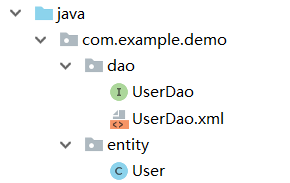
2.UserDao采用统一写法
Dao层只写六个接口就能解决百分之九十的问题
User.java
package com.example.demo.entity;

public class User {

    private Long id;

    private String username;

    private String password;

    private String realname;

    public Long getId() {

        return id;

    }

    public void setId(Long id) {

        this.id = id;

    }

    public String getUsername() {

        return username;

    }

    public void setUsername(String username) {

        this.username = username;

    }

    public String getPassword() {

        return password;

    }

    public void setPassword(String password) {

        this.password = password;

    }

    public String getRealname() {

        return realname;

    }

    public void setRealname(String realname) {

        this.realname = realname;

    }

    @Override

    public String toString() {

        return "User{" +

                "id=" + id +

                ", username='" + username + '\'' +

                ", password='" + password + '\'' +

                ", realname='" + realname + '\'' +

                '}';

    }

}
UserDao.java
package com.example.demo.dao;

import com.example.demo.entity.User;

import org.apache.ibatis.annotations.Param;

import java.util.List;

public interface UserDao {

    // 用于添加用户

    int insertUser(User user);

    // 用于删除用户

    int deleteUser(Long userId);

    // 用于更新用户

    int updateUser(User user);

    // 用于查询用户

    User getUser(Long userId);

    // 用于查询用户列表

    List<User> getUserList(@Param("userCondition") User userCondition,

                                @Param("rowIndex") int rowIndex,

                                @Param("pageSize") int pageSize);

    // 用于查询用户列表数量

    int getUserCount(@Param("userCondition") User userCondition);

}
UserDao.xml
<?xml version="1.0" encoding="UTF-8" ?>

<!DOCTYPE mapper PUBLIC "-//mybatis.org//DTD Mapper 3.0//EN" "http://mybatis.org/dtd/mybatis-3-mapper.dtd" >

<mapper namespace="com.example.demo.dao.UserDao">

    <insert id="insertUser" parameterType="com.example.demo.entity.User"

            useGeneratedKeys="true" keyProperty="id" keyColumn="id">

        insert into

        tb_user(username,password,realname)

        values (#{username},#{password},#{realname})

    </insert>

    <delete id="deleteUser">

        delete from

        tb_user

        where id=#{id}

    </delete>

    <update id="updateUser" parameterType="com.example.demo.entity.User"

            keyProperty="id" useGeneratedKeys="true">

        update tb_user

        <set>

            <if test="username != null">username = #{username},</if>

            <if test="password != null">password = #{password},</if>

            <if test="realname != null">realname = #{realname}</if>

        </set>

        where id=#{id}

    </update>

    <select id="getUser" resultType="com.example.demo.entity.User" parameterType="Long">

         select

         u.id,

         u.username,

         u.password,

         u.realname

         from tb_user u

         where ur.id = #{id}

    </select>

    <select id="getUserList" resultType="com.example.demo.entity.User">

        select

        u.id,

        u.username,

        u.password,

        u.realname

        from tb_user u

        <where>

            <if test="userCondition != null and userCondition.username != null">

                and u.username LIKE concat('%',#{userCondition.username},'%')

            </if>

            <if test="userCondition != null and userCondition.realname != null">

                and u.realname LIKE concat('%',#{userCondition.realname},'%')

            </if>

        </where>

        limit #{rowIndex},#{pageSize};

    </select>

    <select id="getUserCount" resultType="int">

        select count(1) from tb_user u

        <where>

            <if test="userCondition != null and userCondition.username != null">

                and u.username LIKE concat('%',#{userCondition.username},'%')

            </if>

            <if test="userCondition != null and userCondition.realname != null">

                and u.realname LIKE concat('%',#{userCondition.realname},'%')

            </if>

        </where>

    </select>

</mapper>
3.使用方法
添加用户
User user = new User();

user.setUsername("lauyon");

user.setRealname("lauyon");

user.setPassword("e10adc3949ba59abbe56e057f20f883e");

int insertCount = userDao.insertUser(user);   //返回添加数据的条数
删除用户
int deleteCount = userDao.deleteUser(1L); //返回删除用户的个数
更新用户
User user = new User();

user.setId(1L);         // 注意:与添加用户不同

user.setUsername("lauyon2");

user.setRealname("lauyon2");

user.setPassword("pf2wzmefd3sfgh5dfs6sdf");

int count = userDao.updateUser(user);   //返回更新数据的条数
查询用户
User user = userDao.getUser(1L); //返回用户,参数为用户Id
查询用户列表
int listCount = userDao.getUserCount(userCondition);	//返回给service层,用于封装分页对象

List<User> userList = userDao.getUserList(userCondition, (page - 1) * size, size);	//page:页码		size:每页的数据数量
至此,已经列举了基本的增删改查接口。当然,还可以组合出其他接口,可以解决大部分实际问题。
如果这篇博客对你有用,点个赞再走呗~
SpringBoot+MyBatis项目Dao层最简单写法的更多相关文章
- SpringBoot Mybatis项目中的多数据源支持
1.概述 有时项目里里需要抽取不同系统中的数据源,需要访问不同的数据库,本文介绍在Springboot+Mybatis项目中如何支持多数据源操作. 有需要的同学可以下载 示例代码 项目结构如下: 2. ...
- Mybatis的dao层实现 接口代理方式实现规范+plugins-PageHelper
Mybatis的dao层实现 接口代理方式实现规范 Mapper接口实现时的相关规范: Mapper接口开发只需要程序员编写Mapper接口而不用具体实现其代码(相当于我们写的Imp实现类) Mapp ...
- Mybatis的Dao层实现原理
1.Mybatis的Dao层实现 1.1 传统开发方式 1.1.1编写UserDao接口 public interface UserDao { List<User> findAll() t ...
- 基于Mybatis的Dao层的开发
基于Mybatis的Dao层开发 SqlSessionFactoryBuilder用于创建SqlSessionFacoty,SqlSessionFacoty一旦创建完成就不需要SqlSessionFa ...
- MyBatis开发Dao层的两种方式(原始Dao层开发)
本文将介绍使用框架mybatis开发原始Dao层来对一个对数据库进行增删改查的案例. Mapper动态代理开发Dao层请阅读我的下一篇博客:MyBatis开发Dao层的两种方式(Mapper动态代理方 ...
- MyBatis开发Dao层的两种方式(Mapper动态代理方式)
MyBatis开发原始Dao层请阅读我的上一篇博客:MyBatis开发Dao层的两种方式(原始Dao层开发) 接上一篇博客继续介绍MyBatis开发Dao层的第二种方式:Mapper动态代理方式 Ma ...
- 基于Mybatis的Dao层开发
转自:https://www.cnblogs.com/rodge-run/p/6528398.html 基于Mybatis的Dao层开发 SqlSessionFactoryBuilder用于创建 Sq ...
- IDEA项目搭建四——使用Mybatis实现Dao层
一.引入mybatis及mysql的jar包 可以从阿里云上面查找版本,db操作放在dao层所以打开该层的pom.xml文件,找到<dependencies>节点增加两个引入 <de ...
- 零基础IDEA整合SpringBoot + Mybatis项目,及常见问题详细解答
开发环境介绍:IDEA + maven + springboot2.1.4 1.用IDEA搭建SpringBoot项目:File - New - Project - Spring Initializr ...
随机推荐
- 从头学pytorch(七):dropout防止过拟合
上一篇讲了防止过拟合的一种方式,权重衰减,也即在loss上加上一部分\(\frac{\lambda}{2n} \|\boldsymbol{w}\|^2\),从而使得w不至于过大,即不过分偏向某个特征. ...
- requests + bs4 爬取豌豆荚所有应用的信息
1.分析豌豆荚的接口的规律 - 获取所有app的接口url 2.往每一个接口发送请求,获取json数据 解析并提取想要的数据 app_data: 1.图标 app_img_url 2.名字 app_n ...
- 不仅仅是双11大屏—Flink应用场景介绍
双11大屏 每年天猫双十一购物节,都会有一块巨大的实时作战大屏,展现当前的销售情况. 这种炫酷的页面背后,其实有着非常强大的技术支撑,而这种场景其实就是实时报表分析. 实时报表分析是近年来很多公司采用 ...
- $bzoj2560$ 串珠子 容斥+$dp$
正解:容斥+$dp$ 解题报告: 传送门$QwQ$ $umm$虽然题目蛮简练的了但还是有点难理解,,,我再抽象一点儿,就说有$n$个点,点$i$和点$j$之间有$a_{i,j}$条无向边可以连,问有多 ...
- MyBatis原理-架构流程
一 .MyBatis原理架构图 Mybatis的功能架构分为三层: API接口层:提供给外部使用的接口API,开发人员通过这些本地API来操纵数据库.接口层一接收到调用请求就会调用数据处理层来完成具体 ...
- openlayers中实现点的拖拽(modify),在layer中增加修改删除point。
最近忙着整地图,都忘记了总结来沉淀自己,自我检讨一下. 总结一下最近使用openlayer时学习的内容,先说下我的业务逻辑吧,在室内地图中 1,点击新增在地图上新增一个可以拖拽的点,拖拽完成后确定位置 ...
- spring系列框架篇-承接各类型中小型项目-期待与您的长期合作!
框架选型: 1.基本框架:springboot2.2+springcloud(Hoxton.M2)+nacos (所有公共模块全部使用 starter 方式依赖) 2.授权及权限:oauth2+jwt ...
- ReentrantLock 源码分析从入门到入土
回答一个问题 在开始本篇文章的内容讲述前,先来回答我一个问题,为什么 JDK 提供一个 synchronized 关键字之后还要提供一个 Lock 锁,这不是多此一举吗?难道 JDK 设计人员都是沙雕 ...
- k8s-手动安装
预先准备信息 以下列节点数与规格来进行部署 Kubernetes 集群,操作系统CentOS 7.x IP Address Role CPU Memory 192.168.2.10 node10 4 ...
- java序列化(一)
今天我们来探讨一下java的序列化与反序列化.之前对此一直有概念,但是并没有真正的去测试.大家都知道,所谓的序列化就是把java代码读取到一个文件中,反序列化就是从文件中读取出对象.在网络传输过程中, ...