
VAE论文学习
intractable棘手的,难处理的 posterior distributions后验分布 directed probabilistic有向概率
approximate inference近似推理 multivariate Gaussian多元高斯 diagonal对角 maximum likelihood极大似然
参考:https://blog.csdn.net/yao52119471/article/details/84893634
VAE论文所在讲的问题是:
我们现在就是想要训练一个模型P(x),并求出其参数Θ:
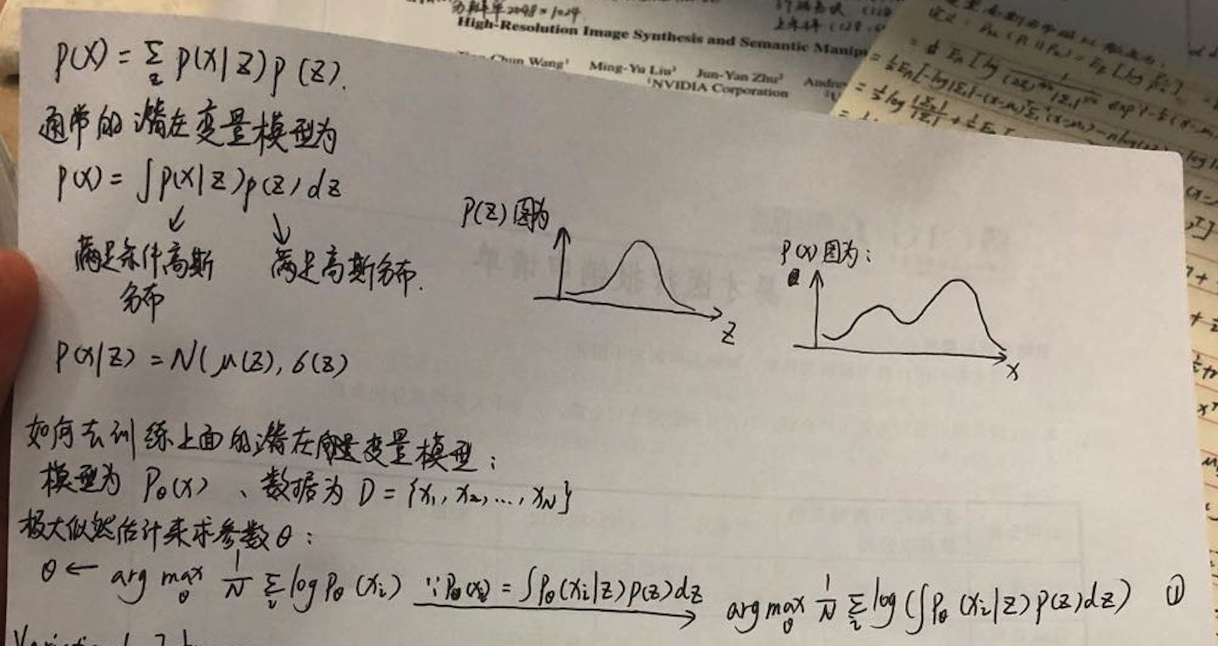
通过极大似然估计求其参数
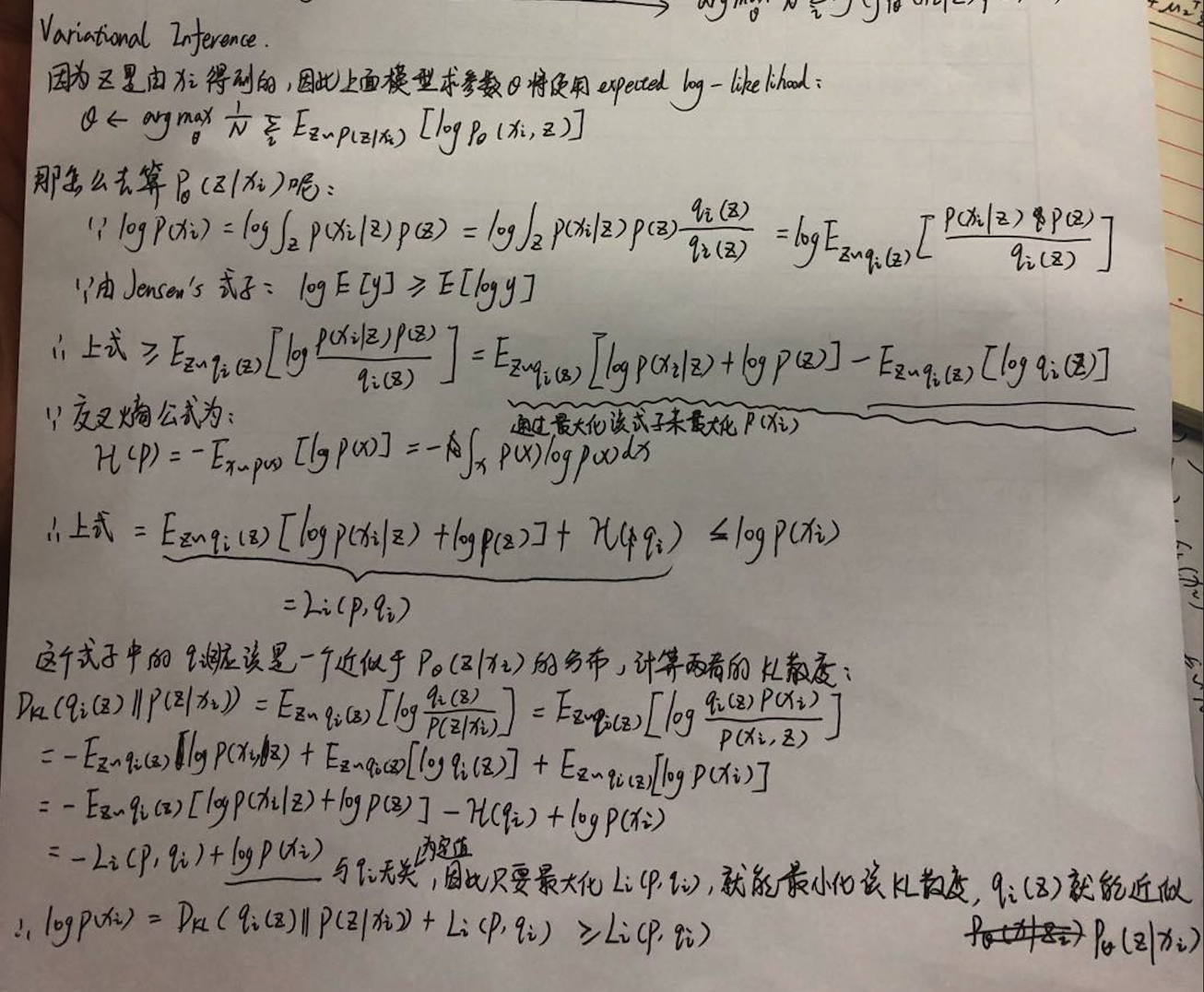
Variational Inference
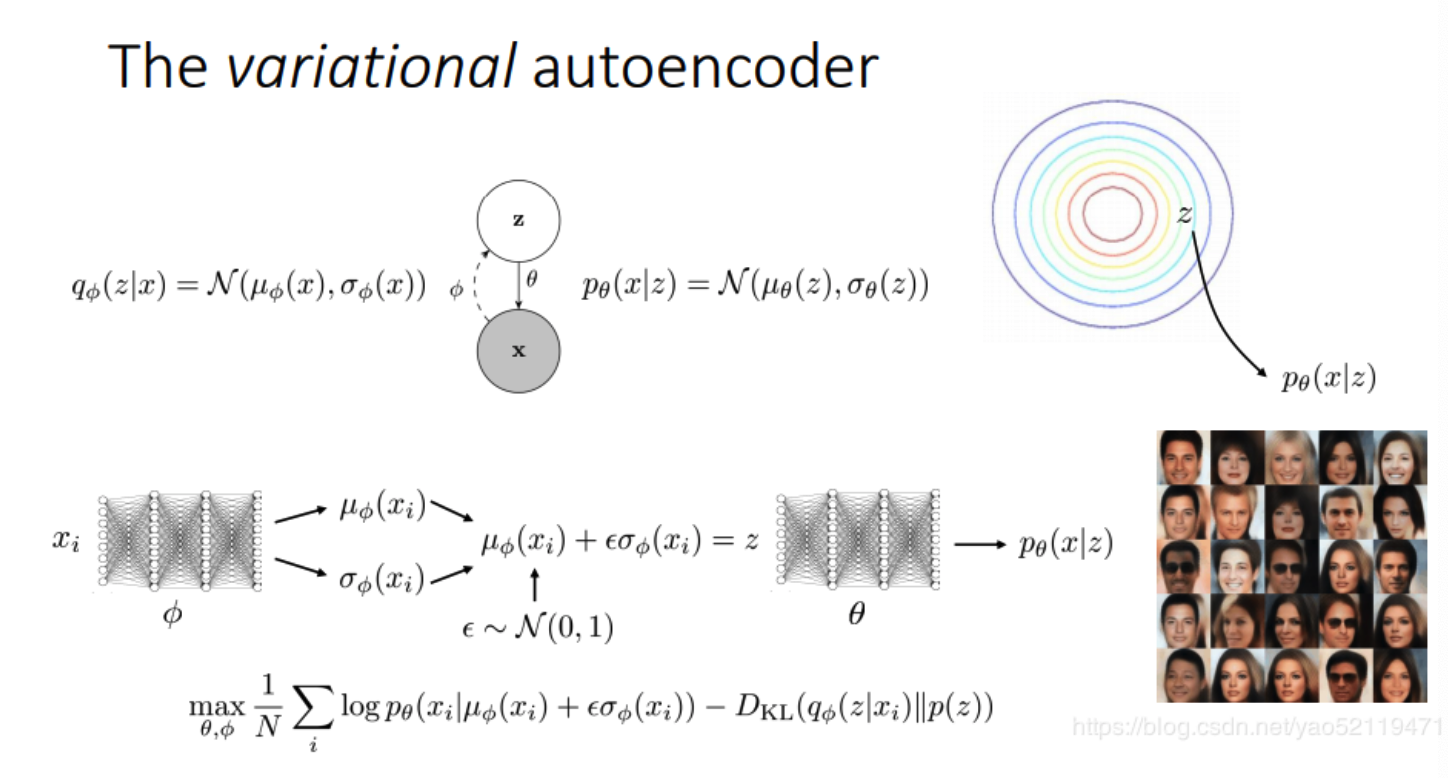
在论文中P(x)模型会被拆分成两部分,一部分由数据x生成潜在向量z,即pθ(z|X);一部分从z重新在重构数据x,即pθ(X|z)
实现过程则是希望能够使用一个qΦ(z|X)模型去近似pθ(z|X),然后作为模型的Encoder;后半部分pθ(X|z)则作为Decoder,Φ/θ表示参数,实现一种同时学习识别模型参数φ和参数θ的生成模型的方法,推导过程为:
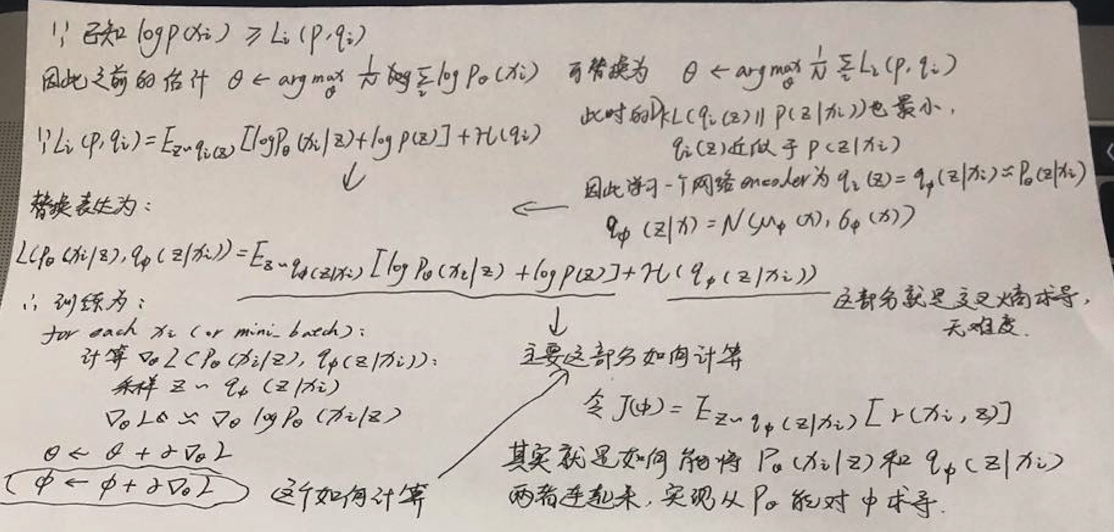
现在问题就在于怎么进行求导,因为现在模型已经不是一个完整的P(x) = pθ(z|X) + pθ(X|z),现在变成了P(x) = qΦ(z|X) + pθ(X|z),那么如果对Φ求导就会变成一个问题,因此论文中就提出了一个reparameterization trick方法:

取样于一个标准正态分布来采样z,以此将qΦ(z|X) 和pθ(X|z)两个子模型通过z连接在了一起
最终的目标函数为:
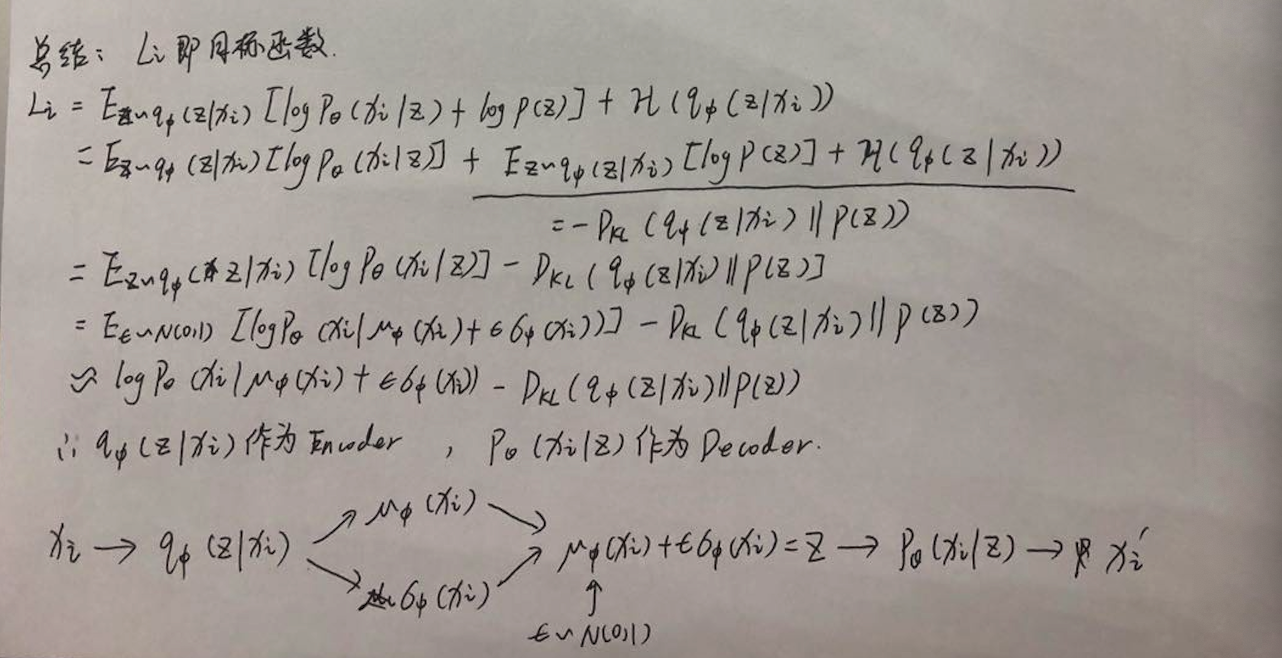
因此目标函数 = 输入和输出x求MSELoss - KL(qΦ(z|X) || pθ(z))
在论文上对式子最后的KL散度 -KL(qΦ(z|X) || pθ(z))的计算有简化为:

多维KL散度的推导可见:KL散度
假设pθ(z)服从标准正态分布,采样ε服从标准正态分布满足该假设
简单代码实现:
import torch

from torch.autograd import Variable

import numpy as np

import torch.nn.functional as F

import torchvision

from torchvision import transforms

import torch.optim as optim

from torch import nn

import matplotlib.pyplot as plt

class Encoder(torch.nn.Module):

    def __init__(self, D_in, H, D_out):

        super(Encoder, self).__init__()

        self.linear1 = torch.nn.Linear(D_in, H)

        self.linear2 = torch.nn.Linear(H, D_out)

    def forward(self, x):

        x = F.relu(self.linear1(x))

        return F.relu(self.linear2(x))

class Decoder(torch.nn.Module):

    def __init__(self, D_in, H, D_out):

        super(Decoder, self).__init__()

        self.linear1 = torch.nn.Linear(D_in, H)

        self.linear2 = torch.nn.Linear(H, D_out)

    def forward(self, x):

        x = F.relu(self.linear1(x))

        return F.relu(self.linear2(x))

class VAE(torch.nn.Module):

    latent_dim =

    def __init__(self, encoder, decoder):

        super(VAE, self).__init__()

        self.encoder = encoder

        self.decoder = decoder

        self._enc_mu = torch.nn.Linear(, )

        self._enc_log_sigma = torch.nn.Linear(, )

    def _sample_latent(self, h_enc):

        """

        Return the latent normal sample z ~ N(mu, sigma^)

        """

        mu = self._enc_mu(h_enc)

        log_sigma = self._enc_log_sigma(h_enc) #得到的值是loge(sigma)

        sigma = torch.exp(log_sigma) # = e^loge(sigma) = sigma

        #从均匀分布中取样

        std_z = torch.from_numpy(np.random.normal(, , size=sigma.size())).float()

        self.z_mean = mu

        self.z_sigma = sigma

        return mu + sigma * Variable(std_z, requires_grad=False)  # Reparameterization trick

    def forward(self, state):

        h_enc = self.encoder(state)

        z = self._sample_latent(h_enc)

        return self.decoder(z)

# 计算KL散度的公式

def latent_loss(z_mean, z_stddev):

    mean_sq = z_mean * z_mean

    stddev_sq = z_stddev * z_stddev

    return 0.5 * torch.mean(mean_sq + stddev_sq - torch.log(stddev_sq) - )

if __name__ == '__main__':

    input_dim =  *

    batch_size =

    transform = transforms.Compose(

        [transforms.ToTensor()])

    mnist = torchvision.datasets.MNIST('./', download=True, transform=transform)

    dataloader = torch.utils.data.DataLoader(mnist, batch_size=batch_size,

                                             shuffle=True, num_workers=)

    print('Number of samples: ', len(mnist))

    encoder = Encoder(input_dim, , )

    decoder = Decoder(, , input_dim)

    vae = VAE(encoder, decoder)

    criterion = nn.MSELoss()

    optimizer = optim.Adam(vae.parameters(), lr=0.0001)

    l = None

    for epoch in range():

        for i, data in enumerate(dataloader, ):

            inputs, classes = data

            inputs, classes = Variable(inputs.resize_(batch_size, input_dim)), Variable(classes)

            optimizer.zero_grad()

            dec = vae(inputs)

            ll = latent_loss(vae.z_mean, vae.z_sigma)

            loss = criterion(dec, inputs) + ll

            loss.backward()

            optimizer.step()

            l = loss.data[]

        print(epoch, l)

    plt.imshow(vae(inputs).data[].numpy().reshape(, ), cmap='gray')

    plt.show(block=True)
VAE论文学习的更多相关文章
- Faster RCNN论文学习
Faster R-CNN在Fast R-CNN的基础上的改进就是不再使用选择性搜索方法来提取框,效率慢,而是使用RPN网络来取代选择性搜索方法,不仅提高了速度,精确度也更高了 Faster R-CNN ...
- 《Explaining and harnessing adversarial examples》 论文学习报告
<Explaining and harnessing adversarial examples> 论文学习报告 组员:裴建新 赖妍菱 周子玉 2020-03-27 1 背景 Sz ...
- 论文学习笔记 - 高光谱 和 LiDAR 融合分类合集
A³CLNN: Spatial, Spectral and Multiscale Attention ConvLSTM Neural Network for Multisource Remote Se ...
- Apache Calcite 论文学习笔记
特别声明:本文来源于掘金,"预留"发表的[Apache Calcite 论文学习笔记](https://juejin.im/post/5d2ed6a96fb9a07eea32a6f ...
- FactorVAE论文学习-1
Disentangling by Factorising 我们定义和解决了从变量的独立因素生成的数据的解耦表征的无监督学习问题.我们提出了FactorVAE方法,通过鼓励表征的分布因素化且在维度上独立 ...
- GoogleNet:inceptionV3论文学习
Rethinking the Inception Architecture for Computer Vision 论文地址:https://arxiv.org/abs/1512.00567 Abst ...
- IEEE Trans 2008 Gradient Pursuits论文学习
之前所学习的论文中求解稀疏解的时候一般采用的都是最小二乘方法进行计算,为了降低计算复杂度和减少内存,这篇论文梯度追踪,属于贪婪算法中一种.主要为三种:梯度(gradient).共轭梯度(conjuga ...
- Raft论文学习笔记
先附上论文链接 https://pdos.csail.mit.edu/6.824/papers/raft-extended.pdf 最近在自学MIT的6.824分布式课程,找到两个比较好的githu ...
- 论文学习-系统评估卷积神经网络各项超参数设计的影响-Systematic evaluation of CNN advances on the ImageNet
博客:blog.shinelee.me | 博客园 | CSDN 写在前面 论文状态:Published in CVIU Volume 161 Issue C, August 2017 论文地址:ht ...
随机推荐
- 微信小程序使用本地图片在真机不显示的问题
最近做的小程序,在真机测试发现有些本地图片在开发工具上可以显示,但是在真机上预览的时候不能显示 代码是这样写的 <view class='seat-size' wx:for="{{it ...
- 51nod 1396 还是01串
给定一个0-1串s,长度为n,下标从0开始,求一个位置k,满足0<=k<=n, 并且子串s[0..k - 1]中的0的个数与子串s[k..n - 1]中1的个数相等. 注意: (1) 如果 ...
- nodejs保存图片至本地
const request = require("request"); const fs = require("fs"); for(let i = 1; i & ...
- 使用笔记:TF辅助工具--tensorflow slim(TF-Slim)
如果抛开Keras,TensorLayer,tfLearn,tensroflow 能否写出简介的代码? 可以!slim这个模块是在16年新推出的,其主要目的是来做所谓的“代码瘦身” 一.简介 slim ...
- contextMenuEvent
#include "mainwindow.h" #include "ui_mainwindow.h" #include <QDesktopWidget&g ...
- 繁繁的游戏 Floyd
繁繁的游戏 Floyd 繁繁想和小伙伴们打游戏,游戏在一个山庄进行,这个山庄有N座山,编号为\(1\)到\(N\),为了方便大 家在不同的山之间移动,繁繁建了一些桥,由于技术的原因,桥连接的两座山的高 ...
- Cogs 2546. 取石块儿(博弈)
取石块儿 ★ 输入文件:tstones.in 输出文件:tstones.out 简单对比 时间限制:1 s 内存限制:256 MB 问题描述 小L和小T进行取石块儿游戏,给定一个整数n表示石块儿总数, ...
- 洛谷 P1102 A-B数对 题解
P1102 A-B 数对 题目描述 出题是一件痛苦的事情! 题目看多了也有审美疲劳,于是我舍弃了大家所熟悉的 A+B Problem,改用 A-B 了哈哈! 好吧,题目是这样的:给出一串数以及一个数字 ...
- lixuxmint系统定制与配置(4)-应用安装
小书匠Linux 先简单列一下,其实每个软件都有自己的个性化配置,以后有时间了,逐个记录下来.编程主力环境是Python,编辑器使用Jupyter,这个编辑器是在远程服务器启动,映射端口到本地来编辑. ...
- 【一起来烧脑】入门ES6体系
为什么要学习ES6 掌握ES3.ES5.ES6的联系和区别 快速入门ES6 学会快速构建ES6的编译环境 学习ES6: 常量 作用域 箭头函数 默认参数 对象代理 git git clone http ...