
Netty源码学习(三)NioEventLoop
0. NioEventLoop简介
NioEventLoop如同它的名字,它是一个无限循环(Loop),在循环中不断处理接收到的事件(Event)
在Reactor模型中,NioEventLoop就是Worker的角色,关联于多个Channel,监听这些Channel上的read/write事件,一旦有事件发生,就做出相应的处理
1. NioEventLoop类图
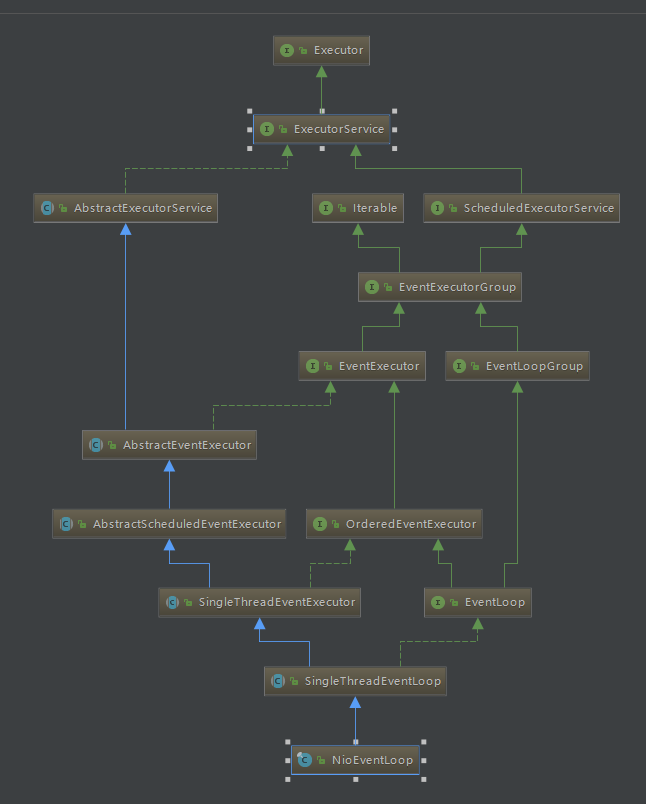
继承关系可以说是相当复杂了,我们慢慢分析
2. NioEventLoop的构造方法
    NioEventLoop(NioEventLoopGroup parent, Executor executor, SelectorProvider selectorProvider,

                 SelectStrategy strategy, RejectedExecutionHandler rejectedExecutionHandler) {

        super(parent, executor, false, DEFAULT_MAX_PENDING_TASKS, rejectedExecutionHandler);

        if (selectorProvider == null) {

            throw new NullPointerException("selectorProvider");

        }

        if (strategy == null) {

            throw new NullPointerException("selectStrategy");

        }

        provider = selectorProvider;

        final SelectorTuple selectorTuple = openSelector();

        selector = selectorTuple.selector;

        unwrappedSelector = selectorTuple.unwrappedSelector;

        selectStrategy = strategy;

    }

    private SelectorTuple openSelector() {

        final Selector unwrappedSelector;

        try {

            unwrappedSelector = provider.openSelector();//利用JDK提供的SelectorProvider直接创建一个Selector

        } catch (IOException e) {

            throw new ChannelException("failed to open a new selector", e);

        }

        if (DISABLE_KEYSET_OPTIMIZATION) {//如果没有开启KEYSET优化,将上面的那个Selector直接返回

            return new SelectorTuple(unwrappedSelector);

        }

        final SelectedSelectionKeySet selectedKeySet = new SelectedSelectionKeySet();//创建一个专门存放SelectionKey的Set对象

        Object maybeSelectorImplClass = AccessController.doPrivileged(new PrivilegedAction<Object>() {

            @Override

            public Object run() {

                try {//用反射的方式创建一个SelectorImpl对象

                    return Class.forName(

                            "sun.nio.ch.SelectorImpl",

                            false,

                            PlatformDependent.getSystemClassLoader());

                } catch (Throwable cause) {

                    return cause;

                }

            }

        });

        if (!(maybeSelectorImplClass instanceof Class) ||

                // ensure the current selector implementation is what we can instrument.

                !((Class<?>) maybeSelectorImplClass).isAssignableFrom(unwrappedSelector.getClass())) {

            if (maybeSelectorImplClass instanceof Throwable) {

                Throwable t = (Throwable) maybeSelectorImplClass;

                logger.trace("failed to instrument a special java.util.Set into: {}", unwrappedSelector, t);

            }

            return new SelectorTuple(unwrappedSelector);

        }

        final Class<?> selectorImplClass = (Class<?>) maybeSelectorImplClass;

        Object maybeException = AccessController.doPrivileged(new PrivilegedAction<Object>() {

            @Override

            public Object run() {

                try {

                    Field selectedKeysField = selectorImplClass.getDeclaredField("selectedKeys");

                    Field publicSelectedKeysField = selectorImplClass.getDeclaredField("publicSelectedKeys");

                    Throwable cause = ReflectionUtil.trySetAccessible(selectedKeysField);

                    if (cause != null) {

                        return cause;

                    }

                    cause = ReflectionUtil.trySetAccessible(publicSelectedKeysField);

                    if (cause != null) {

                        return cause;

                    }

                    selectedKeysField.set(unwrappedSelector, selectedKeySet);//强制将SelectorImpl中的selectedKeys域替换为优化版的SelectedSelectionKeySet对象

                    publicSelectedKeysField.set(unwrappedSelector, selectedKeySet);//强制将SelectorImpl中的publicSelectedKeys域替换为优化版的SelectedSelectionKeySet对象

                    return null;

                } catch (NoSuchFieldException e) {

                    return e;

                } catch (IllegalAccessException e) {

                    return e;

                }

            }

        });

        if (maybeException instanceof Exception) {

            selectedKeys = null;

            Exception e = (Exception) maybeException;

            logger.trace("failed to instrument a special java.util.Set into: {}", unwrappedSelector, e);

            return new SelectorTuple(unwrappedSelector);

        }

        selectedKeys = selectedKeySet;

        logger.trace("instrumented a special java.util.Set into: {}", unwrappedSelector);

        return new SelectorTuple(unwrappedSelector,

                                 new SelectedSelectionKeySetSelector(unwrappedSelector, selectedKeySet));

    }
构造方法的主要作用是创建了一个SelectorImpl对象,如果没有设置DISABLE_KEYSET_OPTIMIZATION属性,SelectorImpl中类型为Set<SelectionKey>的selectedKeys与publicSelectedKeys域会被替换为一个SelectedSelectionKeySet对象。
为什么搞得这么麻烦呢?因为默认的域是Set类型,插入元素的开销是o(log n),而优化版的SelectedSelectionKeySet继承了AbstractSet,具有Set的功能,但是内部是用数组实现,只具有add功能,而且其开销为o(1)。
3. NioEventLoop.run()
run方法是NioEventLoop的核心,此方法会在无限循环中监听关联的Channel上是否有新事件产生
    @Override

    protected void run() {

        for (;;) {//无限循环

            try {

                switch (selectStrategy.calculateStrategy(selectNowSupplier, hasTasks())) {//如果任务队列中有任务,调用selectNow()方法,如果没有,则直接返回SelectStrategy.SELECT

                    case SelectStrategy.CONTINUE://没搞懂这个分支的目的是什么,全局搜了一下SelectStrategy.CONTINUE,没发现有赋这个值的地方

                        continue;

                    case SelectStrategy.SELECT:

                        select(wakenUp.getAndSet(false));//调用select()方法,尝试从关联的channel里读取IO事件。需要注意的是这个select方法相当复杂,因为它悄悄的解决了老版本的JDK的select方法存在的bug,有兴趣的可以仔细分析一下相关源码

                        if (wakenUp.get()) {

                            selector.wakeup();

                        }

                    default:

                }

                cancelledKeys = 0;

                needsToSelectAgain = false;

                final int ioRatio = this.ioRatio;//ioRatio代表EventLoop会花多少时间在IO事件上

                if (ioRatio == 100) {

                    try {

                        processSelectedKeys();//处理IO事件

                    } finally {

                        // Ensure we always run tasks.

                        runAllTasks();//处理CPU事件

                    }

                } else {

                    final long ioStartTime = System.nanoTime();

                    try {

                        processSelectedKeys();//处理IO事件

                    } finally {

                        // Ensure we always run tasks.

                        final long ioTime = System.nanoTime() - ioStartTime;//本次循环处理IO事件的耗时

                        runAllTasks(ioTime * (100 - ioRatio) / ioRatio);//分给CPU事件的耗时

                    }

                }

            } catch (Throwable t) {

                handleLoopException(t);

            }

            // Always handle shutdown even if the loop processing threw an exception.

            try {

                if (isShuttingDown()) {

                    closeAll();

                    if (confirmShutdown()) {

                        return;

                    }

                }

            } catch (Throwable t) {

                handleLoopException(t);

            }

        }

    }

    private void processSelectedKeys() {

        if (selectedKeys != null) {

            processSelectedKeysOptimized();//处理IO事件。由于这里采用的是优化版的SelectorImpl,IO事件已经被写在selectedKeys属性里了,所以无需额外传参

        } else {

            processSelectedKeysPlain(selector.selectedKeys());//未优化版的SelectorImpl,需要调用selectedKeys()方法才能获取准备好的IO事件

        }

    }

    private void processSelectedKeysOptimized() {

        for (int i = 0; i < selectedKeys.size; ++i) {//遍历已经准备好的IO事件

            final SelectionKey k = selectedKeys.keys[i];

            // null out entry in the array to allow to have it GC'ed once the Channel close

            // See https://github.com/netty/netty/issues/2363

            selectedKeys.keys[i] = null;//手动将数组元素赋为null,以帮助gc(因为在系统压力大的时候,SelectionKey数组靠后的部分会被占用,如果不手动将用过的元素设置为null,那么在系统压力小的时候,这些元素是不会被释放的,也就是内存泄漏了)

            final Object a = k.attachment();//附件是这个事件所关联的Channel,后续的代码会直接从这个Channel上读取数据

            if (a instanceof AbstractNioChannel) {

                processSelectedKey(k, (AbstractNioChannel) a);//处理某个IO事件

            } else {

                @SuppressWarnings("unchecked")

                NioTask<SelectableChannel> task = (NioTask<SelectableChannel>) a;

                processSelectedKey(k, task);

            }

            if (needsToSelectAgain) {

                // null out entries in the array to allow to have it GC'ed once the Channel close

                // See https://github.com/netty/netty/issues/2363

                selectedKeys.reset(i + 1);

                selectAgain();

                i = -1;

            }

        }

    }

    private void processSelectedKey(SelectionKey k, AbstractNioChannel ch) {

        final AbstractNioChannel.NioUnsafe unsafe = ch.unsafe();

        if (!k.isValid()) {

            final EventLoop eventLoop;

            try {

                eventLoop = ch.eventLoop();

            } catch (Throwable ignored) {

                // If the channel implementation throws an exception because there is no event loop, we ignore this

                // because we are only trying to determine if ch is registered to this event loop and thus has authority

                // to close ch.

                return;

            }

            // Only close ch if ch is still registered to this EventLoop. ch could have deregistered from the event loop

            // and thus the SelectionKey could be cancelled as part of the deregistration process, but the channel is

            // still healthy and should not be closed.

            // See https://github.com/netty/netty/issues/5125

            if (eventLoop != this || eventLoop == null) {

                return;

            }

            // close the channel if the key is not valid anymore

            unsafe.close(unsafe.voidPromise());

            return;

        }

        try {

            int readyOps = k.readyOps();//获取事件的类型

            // We first need to call finishConnect() before try to trigger a read(...) or write(...) as otherwise

            // the NIO JDK channel implementation may throw a NotYetConnectedException.

            if ((readyOps & SelectionKey.OP_CONNECT) != 0) {//不太理解这段代码的原因

                // remove OP_CONNECT as otherwise Selector.select(..) will always return without blocking

                // See https://github.com/netty/netty/issues/924

                int ops = k.interestOps();

                ops &= ~SelectionKey.OP_CONNECT;

                k.interestOps(ops);

                unsafe.finishConnect();

            }

            // Process OP_WRITE first as we may be able to write some queued buffers and so free memory.

            if ((readyOps & SelectionKey.OP_WRITE) != 0) {//如果是可写事件,则flush缓存

                // Call forceFlush which will also take care of clear the OP_WRITE once there is nothing left to write

                ch.unsafe().forceFlush();

            }

            // Also check for readOps of 0 to workaround possible JDK bug which may otherwise lead

            // to a spin loop

            if ((readyOps & (SelectionKey.OP_READ | SelectionKey.OP_ACCEPT)) != 0 || readyOps == 0) {//如果是可写事件,则调用unsafe.read()方法

                unsafe.read();//此处的unsafe为NioSocketChannel.NioSocketChannelUnsafe

            }

        } catch (CancelledKeyException ignored) {

            unsafe.close(unsafe.voidPromise());

        }

    }
代码很长,大概逻辑如下:
a. 在无限循环中调用Selector.select方法
b. 使用ioRatio控制IO事件与CPU事件的耗时比例(ioRatio的默认值为50)
c. 如果有IO事件发生,遍历所有IO事件并调用processSelectedKey方法
d. 在processSelectedKey中,如果发现事件是READ/ACCEPT类型,则调用NioSocketChannel.NioSocketChannelUnsafe.read()方法对事件进行处理。其实际实现位于AbstractNioByteChannel中:
        @Override

        public final void read() {

            final ChannelConfig config = config();

            final ChannelPipeline pipeline = pipeline();//获取用户注册的pipeline

            final ByteBufAllocator allocator = config.getAllocator();//默认值为PooledByteBufAllocator,也就是申请direct memory

            final RecvByteBufAllocator.Handle allocHandle = recvBufAllocHandle();

            allocHandle.reset(config);

            ByteBuf byteBuf = null;

            boolean close = false;

            try {

                do {

                    byteBuf = allocHandle.allocate(allocator);//开辟一块内存作为buffer

                    allocHandle.lastBytesRead(doReadBytes(byteBuf));//doReadBytes方法会从绑定的Channel里读取数据到buffer里。顺便记录一下本次读了多少字节的数据出来

                    if (allocHandle.lastBytesRead() <= 0) {

                        // nothing was read. release the buffer.

                        byteBuf.release();

                        byteBuf = null;

                        close = allocHandle.lastBytesRead() < 0;

                        break;

                    }

                    allocHandle.incMessagesRead(1);//计数

                    readPending = false;

                    pipeline.fireChannelRead(byteBuf);//触发pipeline的channelRead事件

                    byteBuf = null;

                } while (allocHandle.continueReading());

                allocHandle.readComplete();

                pipeline.fireChannelReadComplete();//触发pipeline的channelReadComplete事件

                if (close) {

                    closeOnRead(pipeline);

                }

            } catch (Throwable t) {

                handleReadException(pipeline, byteBuf, t, close, allocHandle);

            } finally {

                // Check if there is a readPending which was not processed yet.

                // This could be for two reasons:

                // * The user called Channel.read() or ChannelHandlerContext.read() in channelRead(...) method

                // * The user called Channel.read() or ChannelHandlerContext.read() in channelReadComplete(...) method

                //

                // See https://github.com/netty/netty/issues/2254

                if (!readPending && !config.isAutoRead()) {

                    removeReadOp();

                }

            }

        }

    }
这段代码主要做了两件事情:
a. 在循环中将Channel可读的数据读到一个临时的ByteBuf中
b. 调用pipeline.fireChannelRead方法,处理读取到数据。(具体的处理逻辑在后续文章中阐述)
现在我们已经基本搞清楚NioEventLoop的工作逻辑了:
在无限循环中监听绑定的Channel上的事件,如果有ACCEPT/READ事件发生,则从Channel里读取数据,并调用关联的pipeline的fireChannelRead方法进行处理。
目前仍不清楚的地方是:NioEventLoop是如何与Channel/Pipeline绑定的?
且听后文分解。
Netty源码学习(三)NioEventLoop的更多相关文章
- Netty源码分析之NioEventLoop(三)—NioEventLoop的执行
前面两篇文章Netty源码分析之NioEventLoop(一)—NioEventLoop的创建与Netty源码分析之NioEventLoop(二)—NioEventLoop的启动中我们对NioEven ...
- 【Netty源码学习】DefaultChannelPipeline(三)
上一篇博客中[Netty源码学习]ChannelPipeline(二)我们介绍了接口ChannelPipeline的提供的方法,接下来我们分析一下其实现类DefaultChannelPipeline具 ...
- Netty 源码学习——EventLoop
Netty 源码学习--EventLoop 在前面 Netty 源码学习--客户端流程分析中我们已经知道了一个 EventLoop 大概的流程,这一章我们来详细的看一看. NioEventLoopGr ...
- Netty源码学习系列之4-ServerBootstrap的bind方法
前言 今天研究ServerBootstrap的bind方法,该方法可以说是netty的重中之重.核心中的核心.前两节的NioEventLoopGroup和ServerBootstrap的初始化就是为b ...
- 【Netty源码解析】NioEventLoop
上一篇博客[Netty源码学习]EventLoopGroup中我们介绍了EventLoopGroup,实际说来EventLoopGroup是EventLoop的一个集合,EventLoop是一个单线程 ...
- Netty 源码学习——客户端流程分析
Netty 源码学习--客户端流程分析 友情提醒: 需要观看者具备一些 NIO 的知识,否则看起来有的地方可能会不明白. 使用版本依赖 <dependency> <groupId&g ...
- 【Netty源码学习】ChannelPipeline(一)
ChannelPipeline类似于一个管道,管道中存放的是一系列对读取数据进行业务操作的ChannelHandler. 1.ChannelPipeline的结构图: 在之前的博客[Netty源码学习 ...
- 【Netty源码学习】ServerBootStrap
上一篇博客[Netty源码学习]BootStrap中我们介绍了客户端使用的启动服务,接下来我们介绍一下服务端使用的启动服务. 总体来说ServerBootStrap有两个主要功能: (1)调用父类Ab ...
- 【Netty源码学习】EventLoopGroup
在上一篇博客[Netty源码解析]入门示例中我们介绍了一个Netty入门的示例代码,接下来的博客我们会分析一下整个demo工程运行过程的运行机制. 无论在Netty应用的客户端还是服务端都首先会初始化 ...
- mybatis源码学习(三)-一级缓存二级缓存
本文主要是个人学习mybatis缓存的学习笔记,主要有以下几个知识点 1.一级缓存配置信息 2.一级缓存源码学习笔记 3.二级缓存配置信息 4.二级缓存源码 5.一级缓存.二级缓存总结 1.一级缓存配 ...
随机推荐
- Java重写与重载
重写的规则: 参数列表必须完全与被重写方法的相同: 返回类型必须完全与被重写方法的返回类型相同: 访问权限不能比父类中被重写的方法的访问权限更低.例如:如果父类的一个方法被声明为public,那么在子 ...
- 后端接口迁移(从 webapi 到 openapi)前端经验总结
此文已由作者张磊授权网易云社区发布. 欢迎访问网易云社区,了解更多网易技术产品运营经验. 前情提要 以前用的是 webapi 现在统一切成 openapi,字段结构统统都变了 接入接口 20+,涉及模 ...
- Android学习记录(9)—Android之Matrix的用法
Matrix ,中文里叫矩阵,高等数学里有介绍,在图像处理方面,主要是用于平面的缩放.平移.旋转等操作. 首先介绍一下矩阵运算.加法和减法就不用说了,对应位相加就好.图像处理,主要用到的是乘法 .下面 ...
- python学习笔记十六:读取JSON文件
读取JSON文件可以用JSON库,示例代码: #coding:utf-8 import json with open("msg.json") as jsonfile: json_d ...
- Python程序执行时的不同电脑路径不同问题
原因:因代码转移时项目路径发生了变化,导致解释器无法找到对应路径,是的程序无法正常执行 需求: 1.我希望代码能在不同的电脑下,不必修改源代码就能正常执行(所需模块已安装的前提下) 2.我希望代码在命 ...
- css3实现圆角边框渐变
<button class="border">112233</button> 创建button .border{ position: relative; b ...
- json序列化datetime类型数据
错误描述: import jsonimport datetime a = datetime.datetime.now()print(a) b = json.dumps(a)print(b) 如上代码, ...
- Python全栈 MySQL 数据库 (简述 、安装、基本命令)
ParisGabriel 每天坚持手写 一天一篇 决定坚持几年 为了梦想为了信仰 开局一张图 一个月的python已经结束了 下面就是数据库了 先说M ...
- java案例1,打印hello java
package anli1; public class hellojava { public static void main(String []args){ System.out.println(& ...
- A Neural Algorithm of Artistic Style
本系列文章由 @yhl_leo 出品,转载请注明出处. 文章链接: http://blog.csdn.net/yhl_leo/article/details/53931536 1. 资源 Paper: ...