
深度学习面试题20:GoogLeNet(Inception V1)
目录
简介
网络结构
对应代码
网络说明
参考资料
|
简介 |
2014年,GoogLeNet和VGG是当年ImageNet挑战赛(ILSVRC14)的双雄,GoogLeNet获得了第一名、VGG获得了第二名,这两类模型结构的共同特点是层次更深了。VGG继承了LeNet以及AlexNet的一些框架结构,而GoogLeNet则做了更加大胆的网络结构尝试,虽然深度只有22层,但大小却比AlexNet和VGG小很多,GoogleNet参数为500万个,AlexNet参数个数是GoogleNet的12倍,VGGNet参数又是AlexNet的3倍,因此在内存或计算资源有限时,GoogleNet是比较好的选择;从模型结果来看,GoogLeNet的性能却更加优越。
GoogLeNet是谷歌(Google)研究出来的深度网络结构,为什么不叫“GoogleNet”,而叫“GoogLeNet”,是为了向“LeNet”致敬,因此取名为“GoogLeNet”
GoogLeNet团队要打造一个Inception模块(名字源于盗梦空间),让深度网络的表现更好。

|
网络结构 |
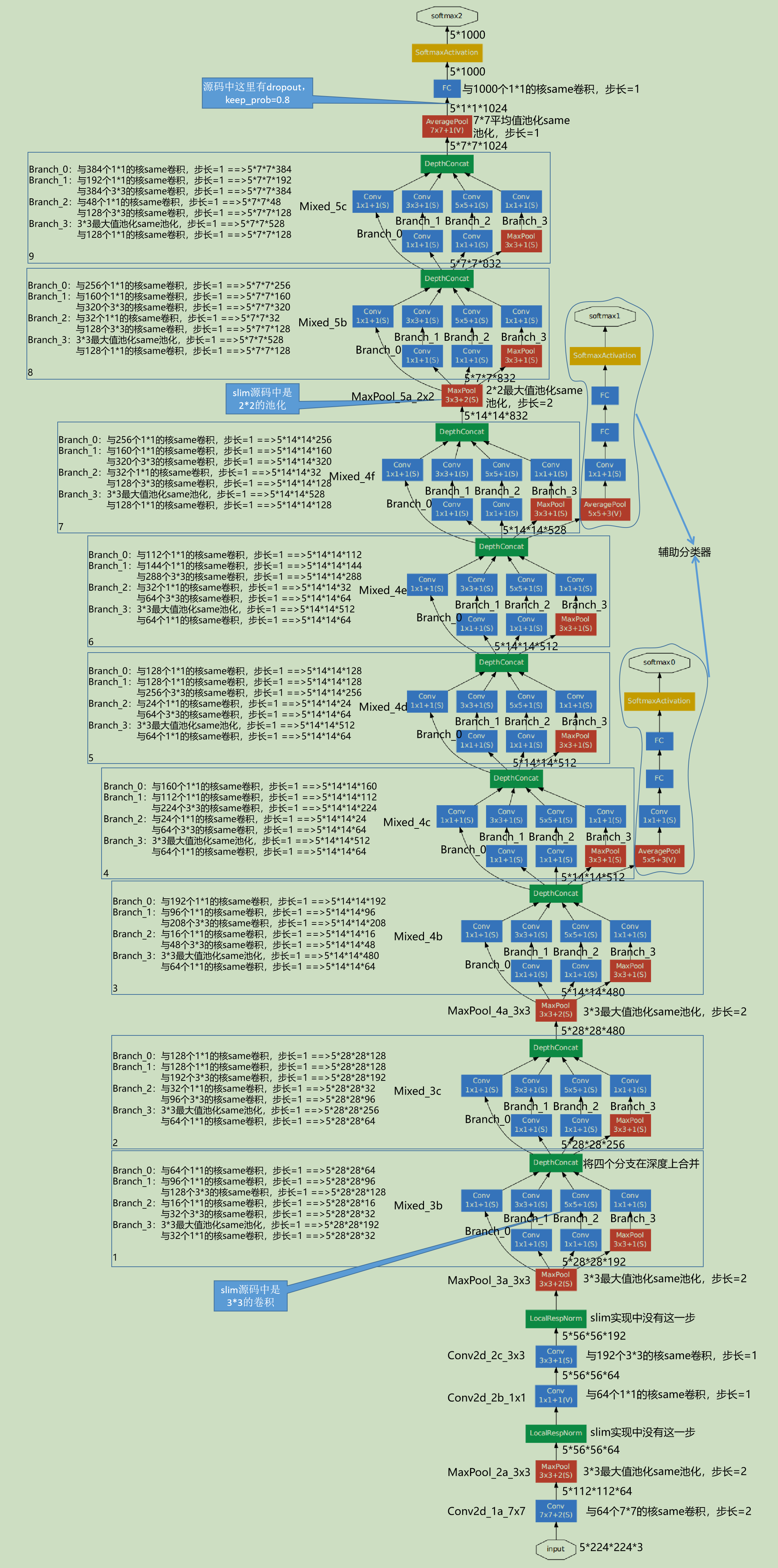
PS:Slim是2016年开发出来的,即使在InceptionV1中,他也没有使用论文里说的5*5的卷积核,而是用的3*3的卷积核。
|
对应代码 |
这里采用的官网的代码tensorflow/models/research/slim/nets/inception_v1.py
下载方式
git clone https://github.com/tensorflow/models.git
这个项目比较大,如果下载很慢的话,可以在qq群:537594183文件中只下载slim的代码即可。
# Copyright 2016 The TensorFlow Authors. All Rights Reserved.

#

# Licensed under the Apache License, Version 2.0 (the "License");

# you may not use this file except in compliance with the License.

# You may obtain a copy of the License at

#

# http://www.apache.org/licenses/LICENSE-2.0

#

# Unless required by applicable law or agreed to in writing, software

# distributed under the License is distributed on an "AS IS" BASIS,

# WITHOUT WARRANTIES OR CONDITIONS OF ANY KIND, either express or implied.

# See the License for the specific language governing permissions and

# limitations under the License.

# ==============================================================================

"""Contains the definition for inception v1 classification network."""

from __future__ import absolute_import

from __future__ import division

from __future__ import print_function

import tensorflow as tf

from nets import inception_utils

slim = tf.contrib.slim

trunc_normal = lambda stddev: tf.truncated_normal_initializer(0.0, stddev)

def inception_v1_base(inputs,

                      final_endpoint='Mixed_5c',

                      include_root_block=True,

                      scope='InceptionV1'):

  """Defines the Inception V1 base architecture.

  This architecture is defined in:

    Going deeper with convolutions

    Christian Szegedy, Wei Liu, Yangqing Jia, Pierre Sermanet, Scott Reed,

    Dragomir Anguelov, Dumitru Erhan, Vincent Vanhoucke, Andrew Rabinovich.

    http://arxiv.org/pdf/1409.4842v1.pdf.

  Args:

    inputs: a tensor of size [batch_size, height, width, channels].

    final_endpoint: specifies the endpoint to construct the network up to. It

      can be one of ['Conv2d_1a_7x7', 'MaxPool_2a_3x3', 'Conv2d_2b_1x1',

      'Conv2d_2c_3x3', 'MaxPool_3a_3x3', 'Mixed_3b', 'Mixed_3c',

      'MaxPool_4a_3x3', 'Mixed_4b', 'Mixed_4c', 'Mixed_4d', 'Mixed_4e',

      'Mixed_4f', 'MaxPool_5a_2x2', 'Mixed_5b', 'Mixed_5c']. If

      include_root_block is False, ['Conv2d_1a_7x7', 'MaxPool_2a_3x3',

      'Conv2d_2b_1x1', 'Conv2d_2c_3x3', 'MaxPool_3a_3x3'] will not be available.

    include_root_block: If True, include the convolution and max-pooling layers

      before the inception modules. If False, excludes those layers.

    scope: Optional variable_scope.

  Returns:

    A dictionary from components of the network to the corresponding activation.

  Raises:

    ValueError: if final_endpoint is not set to one of the predefined values.

  """

  end_points = {}

  with tf.variable_scope(scope, 'InceptionV1', [inputs]):

    with slim.arg_scope(

        [slim.conv2d, slim.fully_connected],

        weights_initializer=trunc_normal(0.01)):

      with slim.arg_scope([slim.conv2d, slim.max_pool2d],

                          stride=1, padding='SAME'):

        net = inputs

        if include_root_block:

          end_point = 'Conv2d_1a_7x7'

          net = slim.conv2d(inputs, 64, [7, 7], stride=2, scope=end_point)

          end_points[end_point] = net

          if final_endpoint == end_point:

            return net, end_points

          end_point = 'MaxPool_2a_3x3'

          net = slim.max_pool2d(net, [3, 3], stride=2, scope=end_point)

          end_points[end_point] = net

          if final_endpoint == end_point:

            return net, end_points

          end_point = 'Conv2d_2b_1x1'

          net = slim.conv2d(net, 64, [1, 1], scope=end_point)

          end_points[end_point] = net

          if final_endpoint == end_point:

            return net, end_points

          end_point = 'Conv2d_2c_3x3'

          net = slim.conv2d(net, 192, [3, 3], scope=end_point)

          end_points[end_point] = net

          if final_endpoint == end_point:

            return net, end_points

          end_point = 'MaxPool_3a_3x3'

          net = slim.max_pool2d(net, [3, 3], stride=2, scope=end_point)

          end_points[end_point] = net

          if final_endpoint == end_point:

            return net, end_points

        end_point = 'Mixed_3b'

        with tf.variable_scope(end_point):

          with tf.variable_scope('Branch_0'):

            branch_0 = slim.conv2d(net, 64, [1, 1], scope='Conv2d_0a_1x1')

          with tf.variable_scope('Branch_1'):

            branch_1 = slim.conv2d(net, 96, [1, 1], scope='Conv2d_0a_1x1')

            branch_1 = slim.conv2d(branch_1, 128, [3, 3], scope='Conv2d_0b_3x3')

          with tf.variable_scope('Branch_2'):

            branch_2 = slim.conv2d(net, 16, [1, 1], scope='Conv2d_0a_1x1')

            branch_2 = slim.conv2d(branch_2, 32, [3, 3], scope='Conv2d_0b_3x3')

          with tf.variable_scope('Branch_3'):

            branch_3 = slim.max_pool2d(net, [3, 3], scope='MaxPool_0a_3x3')

            branch_3 = slim.conv2d(branch_3, 32, [1, 1], scope='Conv2d_0b_1x1')

          net = tf.concat(

              axis=3, values=[branch_0, branch_1, branch_2, branch_3])

        end_points[end_point] = net

        if final_endpoint == end_point: return net, end_points

        end_point = 'Mixed_3c'

        with tf.variable_scope(end_point):

          with tf.variable_scope('Branch_0'):

            branch_0 = slim.conv2d(net, 128, [1, 1], scope='Conv2d_0a_1x1')

          with tf.variable_scope('Branch_1'):

            branch_1 = slim.conv2d(net, 128, [1, 1], scope='Conv2d_0a_1x1')

            branch_1 = slim.conv2d(branch_1, 192, [3, 3], scope='Conv2d_0b_3x3')

          with tf.variable_scope('Branch_2'):

            branch_2 = slim.conv2d(net, 32, [1, 1], scope='Conv2d_0a_1x1')

            branch_2 = slim.conv2d(branch_2, 96, [3, 3], scope='Conv2d_0b_3x3')

          with tf.variable_scope('Branch_3'):

            branch_3 = slim.max_pool2d(net, [3, 3], scope='MaxPool_0a_3x3')

            branch_3 = slim.conv2d(branch_3, 64, [1, 1], scope='Conv2d_0b_1x1')

          net = tf.concat(

              axis=3, values=[branch_0, branch_1, branch_2, branch_3])

        end_points[end_point] = net

        if final_endpoint == end_point: return net, end_points

        end_point = 'MaxPool_4a_3x3'

        net = slim.max_pool2d(net, [3, 3], stride=2, scope=end_point)

        end_points[end_point] = net

        if final_endpoint == end_point: return net, end_points

        end_point = 'Mixed_4b'

        with tf.variable_scope(end_point):

          with tf.variable_scope('Branch_0'):

            branch_0 = slim.conv2d(net, 192, [1, 1], scope='Conv2d_0a_1x1')

          with tf.variable_scope('Branch_1'):

            branch_1 = slim.conv2d(net, 96, [1, 1], scope='Conv2d_0a_1x1')

            branch_1 = slim.conv2d(branch_1, 208, [3, 3], scope='Conv2d_0b_3x3')

          with tf.variable_scope('Branch_2'):

            branch_2 = slim.conv2d(net, 16, [1, 1], scope='Conv2d_0a_1x1')

            branch_2 = slim.conv2d(branch_2, 48, [3, 3], scope='Conv2d_0b_3x3')

          with tf.variable_scope('Branch_3'):

            branch_3 = slim.max_pool2d(net, [3, 3], scope='MaxPool_0a_3x3')

            branch_3 = slim.conv2d(branch_3, 64, [1, 1], scope='Conv2d_0b_1x1')

          net = tf.concat(

              axis=3, values=[branch_0, branch_1, branch_2, branch_3])

        end_points[end_point] = net

        if final_endpoint == end_point: return net, end_points

        end_point = 'Mixed_4c'

        with tf.variable_scope(end_point):

          with tf.variable_scope('Branch_0'):

            branch_0 = slim.conv2d(net, 160, [1, 1], scope='Conv2d_0a_1x1')

          with tf.variable_scope('Branch_1'):

            branch_1 = slim.conv2d(net, 112, [1, 1], scope='Conv2d_0a_1x1')

            branch_1 = slim.conv2d(branch_1, 224, [3, 3], scope='Conv2d_0b_3x3')

          with tf.variable_scope('Branch_2'):

            branch_2 = slim.conv2d(net, 24, [1, 1], scope='Conv2d_0a_1x1')

            branch_2 = slim.conv2d(branch_2, 64, [3, 3], scope='Conv2d_0b_3x3')

          with tf.variable_scope('Branch_3'):

            branch_3 = slim.max_pool2d(net, [3, 3], scope='MaxPool_0a_3x3')

            branch_3 = slim.conv2d(branch_3, 64, [1, 1], scope='Conv2d_0b_1x1')

          net = tf.concat(

              axis=3, values=[branch_0, branch_1, branch_2, branch_3])

        end_points[end_point] = net

        if final_endpoint == end_point: return net, end_points

        end_point = 'Mixed_4d'

        with tf.variable_scope(end_point):

          with tf.variable_scope('Branch_0'):

            branch_0 = slim.conv2d(net, 128, [1, 1], scope='Conv2d_0a_1x1')

          with tf.variable_scope('Branch_1'):

            branch_1 = slim.conv2d(net, 128, [1, 1], scope='Conv2d_0a_1x1')

            branch_1 = slim.conv2d(branch_1, 256, [3, 3], scope='Conv2d_0b_3x3')

          with tf.variable_scope('Branch_2'):

            branch_2 = slim.conv2d(net, 24, [1, 1], scope='Conv2d_0a_1x1')

            branch_2 = slim.conv2d(branch_2, 64, [3, 3], scope='Conv2d_0b_3x3')

          with tf.variable_scope('Branch_3'):

            branch_3 = slim.max_pool2d(net, [3, 3], scope='MaxPool_0a_3x3')

            branch_3 = slim.conv2d(branch_3, 64, [1, 1], scope='Conv2d_0b_1x1')

          net = tf.concat(

              axis=3, values=[branch_0, branch_1, branch_2, branch_3])

        end_points[end_point] = net

        if final_endpoint == end_point: return net, end_points

        end_point = 'Mixed_4e'

        with tf.variable_scope(end_point):

          with tf.variable_scope('Branch_0'):

            branch_0 = slim.conv2d(net, 112, [1, 1], scope='Conv2d_0a_1x1')

          with tf.variable_scope('Branch_1'):

            branch_1 = slim.conv2d(net, 144, [1, 1], scope='Conv2d_0a_1x1')

            branch_1 = slim.conv2d(branch_1, 288, [3, 3], scope='Conv2d_0b_3x3')

          with tf.variable_scope('Branch_2'):

            branch_2 = slim.conv2d(net, 32, [1, 1], scope='Conv2d_0a_1x1')

            branch_2 = slim.conv2d(branch_2, 64, [3, 3], scope='Conv2d_0b_3x3')

          with tf.variable_scope('Branch_3'):

            branch_3 = slim.max_pool2d(net, [3, 3], scope='MaxPool_0a_3x3')

            branch_3 = slim.conv2d(branch_3, 64, [1, 1], scope='Conv2d_0b_1x1')

          net = tf.concat(

              axis=3, values=[branch_0, branch_1, branch_2, branch_3])

        end_points[end_point] = net

        if final_endpoint == end_point: return net, end_points

        end_point = 'Mixed_4f'

        with tf.variable_scope(end_point):

          with tf.variable_scope('Branch_0'):

            branch_0 = slim.conv2d(net, 256, [1, 1], scope='Conv2d_0a_1x1')

          with tf.variable_scope('Branch_1'):

            branch_1 = slim.conv2d(net, 160, [1, 1], scope='Conv2d_0a_1x1')

            branch_1 = slim.conv2d(branch_1, 320, [3, 3], scope='Conv2d_0b_3x3')

          with tf.variable_scope('Branch_2'):

            branch_2 = slim.conv2d(net, 32, [1, 1], scope='Conv2d_0a_1x1')

            branch_2 = slim.conv2d(branch_2, 128, [3, 3], scope='Conv2d_0b_3x3')

          with tf.variable_scope('Branch_3'):

            branch_3 = slim.max_pool2d(net, [3, 3], scope='MaxPool_0a_3x3')

            branch_3 = slim.conv2d(branch_3, 128, [1, 1], scope='Conv2d_0b_1x1')

          net = tf.concat(

              axis=3, values=[branch_0, branch_1, branch_2, branch_3])

        end_points[end_point] = net

        if final_endpoint == end_point: return net, end_points

        end_point = 'MaxPool_5a_2x2'

        net = slim.max_pool2d(net, [2, 2], stride=2, scope=end_point)

        end_points[end_point] = net

        if final_endpoint == end_point: return net, end_points

        end_point = 'Mixed_5b'

        with tf.variable_scope(end_point):

          with tf.variable_scope('Branch_0'):

            branch_0 = slim.conv2d(net, 256, [1, 1], scope='Conv2d_0a_1x1')

          with tf.variable_scope('Branch_1'):

            branch_1 = slim.conv2d(net, 160, [1, 1], scope='Conv2d_0a_1x1')

            branch_1 = slim.conv2d(branch_1, 320, [3, 3], scope='Conv2d_0b_3x3')

          with tf.variable_scope('Branch_2'):

            branch_2 = slim.conv2d(net, 32, [1, 1], scope='Conv2d_0a_1x1')

            branch_2 = slim.conv2d(branch_2, 128, [3, 3], scope='Conv2d_0a_3x3')

          with tf.variable_scope('Branch_3'):

            branch_3 = slim.max_pool2d(net, [3, 3], scope='MaxPool_0a_3x3')

            branch_3 = slim.conv2d(branch_3, 128, [1, 1], scope='Conv2d_0b_1x1')

          net = tf.concat(

              axis=3, values=[branch_0, branch_1, branch_2, branch_3])

        end_points[end_point] = net

        if final_endpoint == end_point: return net, end_points

        end_point = 'Mixed_5c'

        with tf.variable_scope(end_point):

          with tf.variable_scope('Branch_0'):

            branch_0 = slim.conv2d(net, 384, [1, 1], scope='Conv2d_0a_1x1')

          with tf.variable_scope('Branch_1'):

            branch_1 = slim.conv2d(net, 192, [1, 1], scope='Conv2d_0a_1x1')

            branch_1 = slim.conv2d(branch_1, 384, [3, 3], scope='Conv2d_0b_3x3')

          with tf.variable_scope('Branch_2'):

            branch_2 = slim.conv2d(net, 48, [1, 1], scope='Conv2d_0a_1x1')

            branch_2 = slim.conv2d(branch_2, 128, [3, 3], scope='Conv2d_0b_3x3')

          with tf.variable_scope('Branch_3'):

            branch_3 = slim.max_pool2d(net, [3, 3], scope='MaxPool_0a_3x3')

            branch_3 = slim.conv2d(branch_3, 128, [1, 1], scope='Conv2d_0b_1x1')

          net = tf.concat(

              axis=3, values=[branch_0, branch_1, branch_2, branch_3])

        end_points[end_point] = net

        if final_endpoint == end_point: return net, end_points

    raise ValueError('Unknown final endpoint %s' % final_endpoint)

def inception_v1(inputs,

                 num_classes=1000,

                 is_training=True,

                 dropout_keep_prob=0.8,

                 prediction_fn=slim.softmax,

                 spatial_squeeze=True,

                 reuse=None,

                 scope='InceptionV1',

                 global_pool=False):

  """Defines the Inception V1 architecture.

  This architecture is defined in:

    Going deeper with convolutions

    Christian Szegedy, Wei Liu, Yangqing Jia, Pierre Sermanet, Scott Reed,

    Dragomir Anguelov, Dumitru Erhan, Vincent Vanhoucke, Andrew Rabinovich.

    http://arxiv.org/pdf/1409.4842v1.pdf.

  The default image size used to train this network is 224x224.

  Args:

    inputs: a tensor of size [batch_size, height, width, channels].

    num_classes: number of predicted classes. If 0 or None, the logits layer

      is omitted and the input features to the logits layer (before dropout)

      are returned instead.

    is_training: whether is training or not.

    dropout_keep_prob: the percentage of activation values that are retained.

    prediction_fn: a function to get predictions out of logits.

    spatial_squeeze: if True, logits is of shape [B, C], if false logits is of

        shape [B, 1, 1, C], where B is batch_size and C is number of classes.

    reuse: whether or not the network and its variables should be reused. To be

      able to reuse 'scope' must be given.

    scope: Optional variable_scope.

    global_pool: Optional boolean flag to control the avgpooling before the

      logits layer. If false or unset, pooling is done with a fixed window

      that reduces default-sized inputs to 1x1, while larger inputs lead to

      larger outputs. If true, any input size is pooled down to 1x1.

  Returns:

    net: a Tensor with the logits (pre-softmax activations) if num_classes

      is a non-zero integer, or the non-dropped-out input to the logits layer

      if num_classes is 0 or None.

    end_points: a dictionary from components of the network to the corresponding

      activation.

  """

  # Final pooling and prediction

  with tf.variable_scope(scope, 'InceptionV1', [inputs], reuse=reuse) as scope:

    with slim.arg_scope([slim.batch_norm, slim.dropout],

                        is_training=is_training):

      net, end_points = inception_v1_base(inputs, scope=scope)

      with tf.variable_scope('Logits'):

        if global_pool:

          # Global average pooling.

          net = tf.reduce_mean(net, [1, 2], keep_dims=True, name='global_pool')

          end_points['global_pool'] = net

        else:

          # Pooling with a fixed kernel size.

          net = slim.avg_pool2d(net, [7, 7], stride=1, scope='AvgPool_0a_7x7')

          end_points['AvgPool_0a_7x7'] = net

        if not num_classes:

          return net, end_points

        net = slim.dropout(net, dropout_keep_prob, scope='Dropout_0b')

        logits = slim.conv2d(net, num_classes, [1, 1], activation_fn=None,

                             normalizer_fn=None, scope='Conv2d_0c_1x1')

        if spatial_squeeze:

          logits = tf.squeeze(logits, [1, 2], name='SpatialSqueeze')

        end_points['Logits'] = logits

        end_points['Predictions'] = prediction_fn(logits, scope='Predictions')

  return logits, end_points

inception_v1.default_image_size = 224

inception_v1_arg_scope = inception_utils.inception_arg_scope
|
网络说明 |
(1)GoogLeNet采用了模块化的结构(Inception结构),方便增添和修改;
(2)网络最后采用了average pooling(平均池化)来代替全连接层,,事实证明这样可以将准确率提高0.6%。但是,实际在最后还是加了一个全连接层,主要是为了方便对输出进行灵活调整;
(3)虽然移除了全连接,但是网络中依然使用了Dropout ;
(4)辅助分类器的两个分支有什么用呢?
作用一:可以把他看做inception网络中的一个小细节,它确保了即便是隐藏单元和中间层也参与了特征计算,他们也能预测图片的类别,他在inception网络中起到一种调整的效果,并且能防止网络发生过拟合。
作用二:给定深度相对较大的网络,有效传播梯度反向通过所有层的能力是一个问题。通过将辅助分类器添加到这些中间层,可以期望较低阶段分类器的判别力。在训练期间,它们的损失以折扣权重(辅助分类器损失的权重是0.3)加到网络的整个损失上。
Inception V1的参数量=5607184,约为560w
|
参考资料 |
《图解深度学习与神经网络:从张量到TensorFlow实现》_张平
inceptionV1-Going Deeper with Convolutions
http://noahsnail.com/2017/07/21/2017-07-21-GoogleNet%E8%AE%BA%E6%96%87%E7%BF%BB%E8%AF%91%E2%80%94%E2%80%94%E4%B8%AD%E8%8B%B1%E6%96%87%E5%AF%B9%E7%85%A7/
《深-度-学-习-核-心-技-术-与-实-践》
大话CNN经典模型:GoogLeNet(从Inception v1到v4的演进)
https://my.oschina.net/u/876354/blog/1637819
深度学习面试题20:GoogLeNet(Inception V1)的更多相关文章
- 深度学习面试题29:GoogLeNet(Inception V3)
目录 使用非对称卷积分解大filters 重新设计pooling层 辅助构造器 使用标签平滑 参考资料 在<深度学习面试题20:GoogLeNet(Inception V1)>和<深 ...
- 深度学习面试题27:非对称卷积(Asymmetric Convolutions)
目录 产生背景 举例 参考资料 产生背景 之前在深度学习面试题16:小卷积核级联卷积VS大卷积核卷积中介绍过小卷积核的三个优势: ①整合了三个非线性激活层,代替单一非线性激活层,增加了判别能力. ②减 ...
- 深度学习面试题13:AlexNet(1000类图像分类)
目录 网络结构 两大创新点 参考资料 第一个典型的CNN是LeNet5网络结构,但是第一个引起大家注意的网络却是AlexNet,Alex Krizhevsky其实是Hinton的学生,这个团队领导者是 ...
- 深度学习面试题26:GoogLeNet(Inception V2)
目录 第一层卷积换为分离卷积 一些层的卷积核的个数发生了变化 多个小卷积核代替大卷积核 一些最大值池化换为了平均值池化 完整代码 参考资料 第一层卷积换为分离卷积 net = slim.separab ...
- 深度学习(十) GoogleNet
GoogLeNet Incepetion V1 这是GoogLeNet的最早版本,出现在2014年的<Going deeper with convolutions>.之所以名为“GoogL ...
- 深度学习面试题21:批量归一化(Batch Normalization,BN)
目录 BN的由来 BN的作用 BN的操作阶段 BN的操作流程 BN可以防止梯度消失吗 为什么归一化后还要放缩和平移 BN在GoogLeNet中的应用 参考资料 BN的由来 BN是由Google于201 ...
- 深度学习面试题18:网中网结构(Network in Network)
目录 举例 参考资料 网中网结构通过多个分支的运算(卷积或池化),将分支上的运算结果在深度上连接 举例 一个3*3*2的张量, 与3个1*1*2的卷积核分别same卷积,步长=1, 与2个2*2*2的 ...
- 深度学习面试题25:分离卷积(separable卷积)
目录 举例 单个张量与多个卷积核的分离卷积 参考资料 举例 分离卷积就是先在深度上分别卷积,然后再进行卷积,对应代码为: import tensorflow as tf # [batch, in_he ...
- 深度学习面试题17:VGGNet(1000类图像分类)
目录 VGGNet网络结构 论文中还讨论了其他结构 参考资料 2014年,牛津大学计算机视觉组(Visual Geometry Group)和Google DeepMind公司的研究员一起研发出了新的 ...
随机推荐
- live555的使用(转载)
Live555 是一个为流媒体提供解决方案的跨平台的C++开源项目,它实现了对标准流媒体传输协议如RTP/RTCP.RTSP.SIP等的支持.Live555实现 了对多种音视频编码格式的音视频数据的流 ...
- MySQL Binlog--事务日志和BINLOG落盘参数对磁盘IO的影响
参数说明 innodb_flush_log_at_trx_commit和sync_binlog 两个参数是控制MySQL 磁盘写入策略以及数据安全性的关键参数,不同参数设置对磁盘IO影响不同. 参数i ...
- MySQL Hardware--RAID卡常用信息查看
MegaRAID信息查看 #查raid卡信息(生产商.电池信息及所支持的raid级别) /usr/local/sbin/MegaCli -AdpAllInfo -aALL |grep -E " ...
- Linux的环境配置文件----.bashrc文件(转)
Linux的环境配置文件----.bashrc文件 .bashrc文件主要保存个人的一些个性化设置,如命令别名.路径等.也即在同一个服务器上,只对某个用户的个性化设置相关.它是一个隐藏文件,需要使 ...
- C++ 谓词(predicate) 与 仿函数 ( functor (function object))
谓词与函数对象 谓词 predicate C++ 标准定义谓词如下: The Predicate parameter is used whenever an algorithm expects a f ...
- Linux中快速对字符串进行加密
1)进行base64的加密和解密 [root@VM_0_10_centos opt]# echo hello |base64aGVsbG8K[root@VM_0_10_centos opt]# ech ...
- 《奋斗吧!菜鸟》 第九次作业:Beta冲刺 Scrum meeting 3
项目 内容 这个作业属于哪个课程 任课教师链接 作业要求 https://www.cnblogs.com/nwnu-daizh/p/11012922.html 团队名称 奋斗吧!菜鸟 作业学习目标 掌 ...
- keras模块学习之-参数初始化与对象调用-笔记
本笔记由博客园-圆柱模板 博主整理笔记发布,转载需注明,谢谢合作! 参数初始化(Initializations) 这个模块的作用是在添加layer时调用init进行这一层的权重初始化,有两种初始化方法 ...
- LG4213 【模板】杜教筛(Sum)和 BZOJ4916 神犇和蒟蒻
P4213 [模板]杜教筛(Sum) 题目描述 给定一个正整数$N(N\le2^{31}-1)$ 求 $$ans_1=\sum_{i=1}^n\varphi(i)$$ $$ans_2=\sum_{i= ...
- cookie,session,token介绍
本文目录 发展史 Cookie Session Token 回到目录 发展史 1.很久很久以前,Web 基本上就是文档的浏览而已, 既然是浏览,作为服务器, 不需要记录谁在某一段时间里都浏览了什么文档 ...