
分析轮子(六)- LinkedList.java
注:玩的是JDK1.7版本
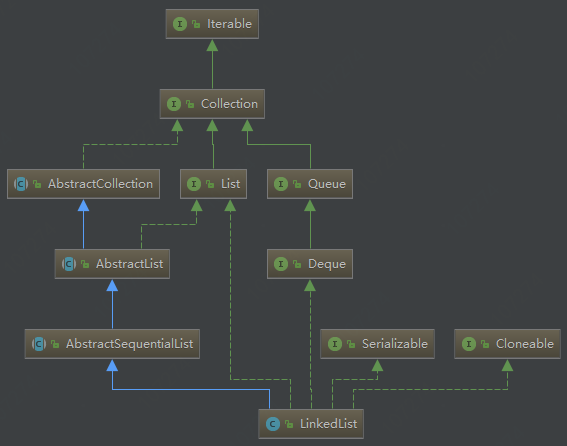
一:先上类的继承结构图
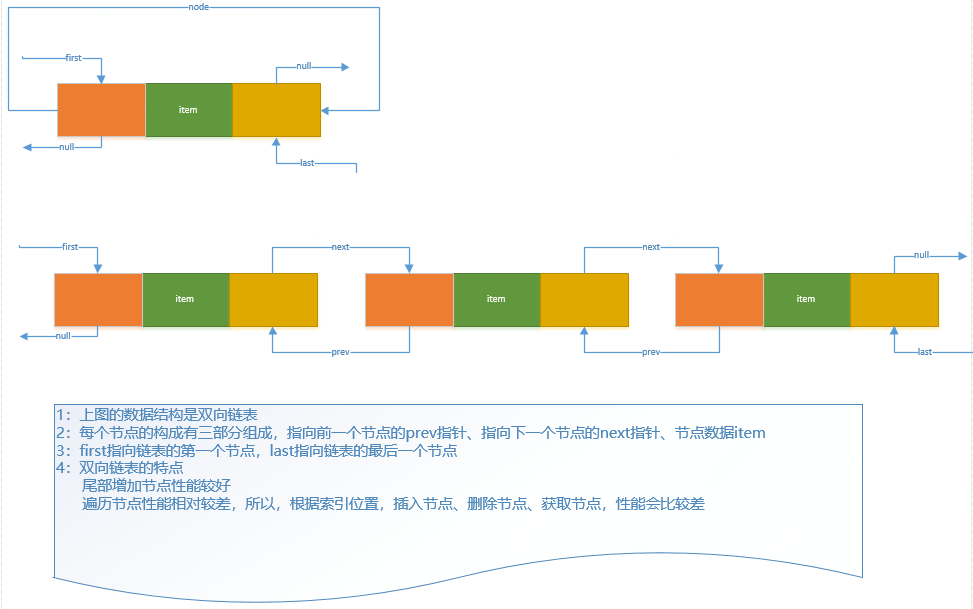
二:再看一下他的底层实现数据结构
三:然后从源码中找点好玩的东西
1)双向链表的结构构成元素,头指针、尾指针、节点信息(前向指针、后向指针、节点信息)
    /**

     * Pointer to first node.

     * Invariant: (first == null && last == null) ||

     *            (first.prev == null && first.item != null)

     */

    transient Node<E> first;

    /**

     * Pointer to last node.

     * Invariant: (first == null && last == null) ||

     *            (last.next == null && last.item != null)

     */

    transient Node<E> last;
    private static class Node<E> {

        E item;

        Node<E> next;

        Node<E> prev;

        Node(Node<E> prev, E element, Node<E> next) {

            this.item = element;

            this.next = next;

            this.prev = prev;

        }

    }
2)在链表尾部添加新节点,只需要改变链表尾指针的指针指向就可了,所以,性能相对 ArrayList.java 的数组拷贝会好很多
    /**

     * Appends the specified element to the end of this list.

     *

     * <p>This method is equivalent to {@link #addLast}.

     *

     * @param e element to be appended to this list

     * @return {@code true} (as specified by {@link Collection#add})

     */

    public boolean add(E e) {

        linkLast(e);

        return true;

    }
    /**

     * Links e as last element.

     */

    void linkLast(E e) {

        final Node<E> l = last;

        final Node<E> newNode = new Node<>(l, e, null);

        last = newNode;

        if (l == null)

            first = newNode;

        else

            l.next = newNode;

        size++;

        modCount++;

    }
3)根据索引位置,获取节点,会遍历链表性能相对会差一些,并且我们也能看到遍历的时候也有一个优化,通过索引位置和链表长度的一半比较,决定从头遍历还是从尾遍历,这样能通过减少遍历长度加快遍历速度的作用,不过当索引位置在中间的时候,就不好玩了,无论从头或从尾遍历性能不会比较差
    /**

     * Returns the element at the specified position in this list.

     *

     * @param index index of the element to return

     * @return the element at the specified position in this list

     * @throws IndexOutOfBoundsException {@inheritDoc}

     */

    public E get(int index) {

        checkElementIndex(index);

        return node(index).item;

    }
    /**

     * Returns the (non-null) Node at the specified element index.

     */

    Node<E> node(int index) {

        // assert isElementIndex(index);

        if (index < (size >> 1)) {

            Node<E> x = first;

            for (int i = 0; i < index; i++)

                x = x.next;

            return x;

        } else {

            Node<E> x = last;

            for (int i = size - 1; i > index; i--)

                x = x.prev;

            return x;

        }

    }
4)根据节点信息获取索引位置的方法,可以看到节点信息是允许为null的
/**
* Returns the index of the first occurrence of the specified element
* in this list, or -1 if this list does not contain the element.
* More formally, returns the lowest index {@code i} such that
* <tt>(o==null ? get(i)==null : o.equals(get(i)))</tt>,
* or -1 if there is no such index.
*
* @param o element to search for
* @return the index of the first occurrence of the specified element in
* this list, or -1 if this list does not contain the element
*/
public int indexOf(Object o) {
int index = 0;
if (o == null) {
for (Node<E> x = first; x != null; x = x.next) {
if (x.item == null)
return index;
index++;
}
} else {
for (Node<E> x = first; x != null; x = x.next) {
if (o.equals(x.item))
return index;
index++;
}
}
return -1;
}
5)下面的三个方法,是根据索引位置,修改、删除索引位置的节点,都会遍历链表,所以,性能相对会差一些,ArrayListljava 是通过数组的索引位置直接操作的
    /**

     * Replaces the element at the specified position in this list with the

     * specified element.

     *

     * @param index index of the element to replace

     * @param element element to be stored at the specified position

     * @return the element previously at the specified position

     * @throws IndexOutOfBoundsException {@inheritDoc}

     */

    public E set(int index, E element) {

        checkElementIndex(index);

        Node<E> x = node(index);

        E oldVal = x.item;

        x.item = element;

        return oldVal;

    }
    /**

     * Inserts the specified element at the specified position in this list.

     * Shifts the element currently at that position (if any) and any

     * subsequent elements to the right (adds one to their indices).

     *

     * @param index index at which the specified element is to be inserted

     * @param element element to be inserted

     * @throws IndexOutOfBoundsException {@inheritDoc}

     */

    public void add(int index, E element) {

        checkPositionIndex(index);

        if (index == size)

            linkLast(element);

        else

            linkBefore(element, node(index));

    }
    /**

     * Removes the element at the specified position in this list.  Shifts any

     * subsequent elements to the left (subtracts one from their indices).

     * Returns the element that was removed from the list.

     *

     * @param index the index of the element to be removed

     * @return the element previously at the specified position

     * @throws IndexOutOfBoundsException {@inheritDoc}

     */

    public E remove(int index) {

        checkElementIndex(index);

        return unlink(node(index));

    }
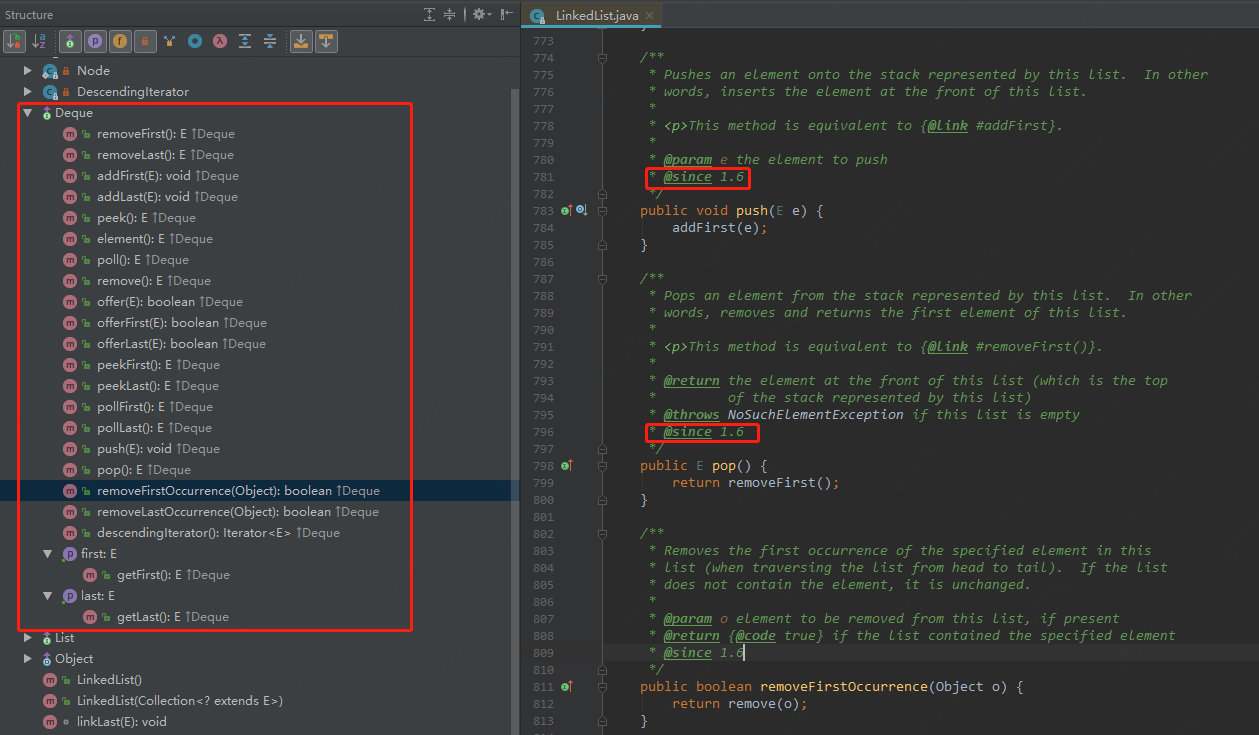
6)双向链表也可以当做双向队列使用
分析轮子(六)- LinkedList.java的更多相关文章
- java集合源码分析(六):HashMap
概述 HashMap 是 Map 接口下一个线程不安全的,基于哈希表的实现类.由于他解决哈希冲突的方式是分离链表法,也就是拉链法,因此他的数据结构是数组+链表,在 JDK8 以后,当哈希冲突严重时,H ...
- 分析轮子(五)- Vector.java
注:玩的是JDK1.7版本 一: 先上类图,从类图上看和 ArrayList.java 非常相像,可查看 分析轮子(一)-ArrayList.java 二:然后看源码,发现和 ArrayList.ja ...
- 分析轮子(四)- 我也玩一把 Serializable.java
前言:在写 分析轮子(一)-ArrayList.java 的时候曾经下过一个结论 “实现Serializable接口,表示ArrayList是可序列化的”,这个结论是以往学习的经验所得,并且平时在编程 ...
- 一点一点看JDK源码(六)java.util.LinkedList前篇之链表概要
一点一点看JDK源码(六)java.util.LinkedList前篇之链表概要 liuyuhang原创,未经允许禁止转载 本文举例使用的是JDK8的API 目录:一点一点看JDK源码(〇) 1.什么 ...
- 分析轮子(二)- << ,>>,>> (左移、右移、无符号右移)
前言:写 分析轮子(一)-ArrayList.java 的时候看到源码中有 int newCapacity = oldCapacity + (oldCapacity >> 1); 这样的代 ...
- JVM 内部原理(六)— Java 字节码基础之一
JVM 内部原理(六)- Java 字节码基础之一 介绍 版本:Java SE 7 为什么需要了解 Java 字节码? 无论你是一名 Java 开发者.架构师.CxO 还是智能手机的普通用户,Java ...
- SpringBoot启动流程分析(六):IoC容器依赖注入
SpringBoot系列文章简介 SpringBoot源码阅读辅助篇: Spring IoC容器与应用上下文的设计与实现 SpringBoot启动流程源码分析: SpringBoot启动流程分析(一) ...
- LinkedList - java.util.ConcurrentModificationException
package com.test.io; import java.io.BufferedReader; import java.io.FileNotFoundException; import jav ...
- Linux内核分析(六)----字符设备控制方法实现|揭秘系统调用本质
原文:Linux内核分析(六)----字符设备控制方法实现|揭秘系统调用本质 Linux内核分析(六) 昨天我们对字符设备进行了初步的了解,并且实现了简单的字符设备驱动,今天我们继续对字符设备的某些方 ...
- LINUX内核分析第六周学习总结——进程的描述与创建
LINUX内核分析第六周学习总结--进程的描述与创建 标签(空格分隔): 20135321余佳源 余佳源 原创作品转载请注明出处 <Linux内核分析>MOOC课程 http://mooc ...
随机推荐
- Rendering React components to the document body
React一个比较好用的功能是其简单的API,一个组件可以简单到一个return了组件结构的render函数.除了一个简单的函数之外,我们还有了一段有用且可复用的代码片段. 问题 不过有时候可能会受到 ...
- 简单窗口与hbase数据库相连
package shangke; import java.awt.Dimension; import java.awt.FlowLayout; import java.awt.event.Action ...
- Xamarin Essentials教程磁力计Magnetometer
Xamarin Essentials教程磁力计Magnetometer 磁力计也叫地磁.磁感器,可用于测试磁场强度和方向.在手持设备中,通过磁力计可以计算设备的左右.前后倾斜角度,广泛应用于手机各 ...
- Touch事件详解及区别,触屏滑动距离计算
移动端有四个关于触摸的事件,分别是touchstart.touchmove.touchend.touchcancel(比较少用), 它们的触发顺序是touchstart-->touchmove- ...
- web前端知识大纲:系列一 js篇
web前端庞大而复杂的知识体系的组成:html.css和 javascript 一.js 1.基础语法 Javascript 基础语法包括:变量声明.数据类型. ...
- Some Conclusions.
目录 DP 四边形不等式 数论 & 数学 数据结构 树链剖分 左偏树的性质及\(O(n)\)的构造 图论 树 二分图 竞赛图 平面图 双连通分量 字符串 后缀自动机 复杂度分析 没什么好写的. ...
- 2186 ACM 水题 int 向下取整
题目:http://acm.hdu.edu.cn/showproblem.php?pid=2186 扩展: #include <cstdio> 使用floor函数.floor(x)返回的是 ...
- 校园网使用IPV6 tunnel免流量上网
前段时间购买了一个vps,做梯子感觉不错,但是在校园网内,vps流量远超10块钱校园流量,眼看着上个月vps的流量被清零.但是校园网有免费的IPV6,而我的VPS也有个IPV6的地址,于是乎就想着如何 ...
- [BZOJ1814]Formula 1
Description: 一个 m * n 的棋盘,有的格子存在障碍,求经过所有非障碍格子的哈密顿回路个数 Hint: \(n,m<=12\) Solution: 插头dp模板题,注意要讨论多种 ...
- python反转列表的三种方式
1.内建函数reversed() li =[1, 2, 3, 4, 5, 6] a = list(reversed(li)) print (a) 注意:reversed()函数返回的是一个迭代器,而不 ...