
hdu 1885
Key Task
Time Limit: 3000/1000 MS (Java/Others) Memory Limit: 32768/32768 K (Java/Others)
Total Submission(s): 990 Accepted Submission(s):
378
already know that it celebrates 300 years of its existence in 2007. Some of the
university buildings are old as well. And the navigation in old buildings can
sometimes be a little bit tricky, because of strange long corridors that fork
and join at absolutely unexpected places.
The result is that some
first-graders have often di?culties finding the right way to their classes.
Therefore, the Student Union has developed a computer game to help the students
to practice their orientation skills. The goal of the game is to find the way
out of a labyrinth. Your task is to write a verification software that solves
this game.
The labyrinth is a 2-dimensional grid of squares, each square
is either free or filled with a wall. Some of the free squares may contain doors
or keys. There are four di?erent types of keys and doors: blue, yellow, red, and
green. Each key can open only doors of the same color.
You can move
between adjacent free squares vertically or horizontally, diagonal movement is
not allowed. You may not go across walls and you cannot leave the labyrinth
area. If a square contains a door, you may go there only if you have stepped on
a square with an appropriate key before.
with a line containing two integer numbers R and C (1 ≤ R, C ≤ 100) specifying
the map size. Then there are R lines each containing C characters. Each
character is one of the following:
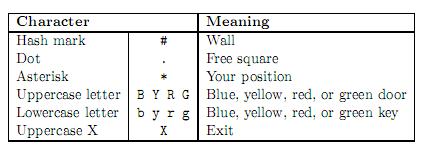
Note
that it is allowed to have
- more than one exit,
- no exit at all,
- more doors and/or keys of the same color, and
- keys without corresponding doors and vice versa.
You may assume that
the marker of your position (“*”) will appear exactly once in every map.There is one blank line after each map. The input is terminated by two
zeros in place of the map size.
“Escape possible in S steps.”, where S is the smallest possible number of step
to reach any of the exits. If no exit can be reached, output the string “The
poor student is trapped!” instead.
One step is defined as a movement
between two adjacent cells. Grabbing a key or unlocking a door does not count as
a step.
 #include<iostream>

 #include<stdio.h>

 #include<cstring>

 #include<cstdlib>

 #include<queue>

 using namespace std;

 int n,m;

 char a[][];

 bool dp[][][(<<)+];

 int map1[][]={{,},{,},{,-},{-,}};

 struct node

 {

     int x,y;

     int state;

     int time;

 };

 queue<node>Q;

 int get(char cc)

 {

     if(cc=='B' || cc=='b')return ;

     else if(cc=='Y' || cc=='y')return ;

     else if(cc=='R' || cc=='r')return ;

     else return ;

 }

 int bfs(int x,int y)

 {

     int i,x1,y1,state;

     struct node t,cur;

     t.x=x;

     t.y=y;

     t.time=;

     t.state=;

     dp[x][y][]=true;

     Q.push(t);

     while(!Q.empty())

     {

         t=Q.front();

         Q.pop();

         for(i=;i<;i++)

         {

             x1=t.x+map1[i][];

             y1=t.y+map1[i][];

             if(x1>=&&x1<n && y1>=&&y1<m && a[x1][y1]!='#')

             {

                 if(a[x1][y1]=='X')

                 {

                     printf("Escape possible in %d steps.\n",t.time+);

                     return ;

                 }

                 if(a[x1][y1]>='A'&&a[x1][y1]<='Z')

                 {

                     state=(<<get(a[x1][y1]));

                     if( (t.state&state)==state && dp[x1][y1][t.state]==false)

                     {

                         dp[x1][y1][t.state]=true;

                         cur=t;

                         cur.time++;

                         cur.x=x1;

                         cur.y=y1;

                         Q.push(cur);

                     }

                 }

                 else if(a[x1][y1]>='a'&&a[x1][y1]<='z')

                 {

                     state=(<<get(a[x1][y1]));

                     cur=t;

                     cur.state=(cur.state|state);

                     if(dp[x1][y1][cur.state]==false)

                     {

                         dp[x1][y1][cur.state]=true;

                         cur.x=x1;

                         cur.y=y1;

                         cur.time++;

                         Q.push(cur);

                     }

                 }

                 else if(dp[x1][y1][t.state]==false)

                 {

                     dp[x1][y1][t.state]=true;

                     cur.x=x1;

                     cur.y=y1;

                     cur.state=t.state;

                     cur.time=t.time+;

                     Q.push(cur);

                 }

             }

         }

     }

     return -;

 }

 int main()

 {

     int i,j,x,y,k;

     bool cur;

     while(scanf("%d%d",&n,&m)>)

     {

         if(n==&&m==)break;

         memset(dp,false,sizeof(dp));

         while(!Q.empty())

         {

             Q.pop();

         }

         for(i=;i<n;i++)

             scanf("%s",a[i]);

         cur=false;

         for(i=;i<n;i++)

         {

             for(j=;j<m;j++)

             {

                 if(a[i][j]=='*')

                 {

                     x=i;

                     y=j;

                 }

                 if(a[i][j]=='X')

                     cur=true;

             }

         }

         if(cur==false) printf("The poor student is trapped!\n");

         else

         {

             k=bfs(x,y);

             if(k==-)printf("The poor student is trapped!\n");

         }

     }

     return ;

 }
hdu 1885的更多相关文章
- HDU 1885 Key Task(三维BFS)
题目链接 题意 : 出口不止一个,一共有四种颜色不同的门由大写字母表示,而钥匙则是对应的小写字母,当你走到门前边的位置时,如果你已经走过相应的钥匙的位置这个门就可以走,只要获得一把钥匙就可以开所有同颜 ...
- hdu 1885 Key Task
题目连接 http://acm.hdu.edu.cn/showproblem.php?pid=1885 Key Task Description The Czech Technical Univers ...
- hdu 1885 Key Task(bfs)
http://acm.hdu.edu.cn/showproblem.php?pid=1885 再贴一个链接http://blog.csdn.net/u013081425/article/details ...
- HDU 1885 Key Task (带门和钥匙的迷宫搜索 bfs+二进制压缩)
传送门: http://acm.hdu.edu.cn/showproblem.php?pid=1885 Key Task Time Limit: 3000/1000 MS (Java/Others) ...
- hdu 1885 Key Task(bfs+位运算)
题意:矩阵中'#'表示墙,'.'表示通路,要求从起点'*'到达终点'X',途中可能遇到一些门(大写字母),要想经过,必须有对应的钥匙(小写字母).问能否完成,若能,花费的时间是多少. 分析:同hdu ...
- hdu 1885 Key Task (三维bfs)
题目 之前比赛的一个题, 当时是崔老师做的,今天我自己做了一下.... 还要注意用bfs的时候 有时候并不是最先到达的就是答案,比如HDU 3442 这道题是要求最小的消耗血量伤害,但是并不是最先到 ...
- HDU 1885 Key Task (BFS + 状态压缩)
题意:给定一个n*m的矩阵,里面有门,有钥匙,有出口,问你逃出去的最短路径是多少. 析:这很明显是一个BFS,但是,里面又有其他的东西,所以我们考虑状态压缩,定义三维BFS,最后一维表示拿到钥匙的状态 ...
- hdu 1885 Key Task(bfs+状态压缩)
Problem Description The Czech Technical University years of its existence . Some of the university b ...
- HDU 1885 Key Task 国家压缩+搜索
点击打开链接 Key Task Time Limit: 3000/1000 MS (Java/Others) Memory Limit: 32768/32768 K (Java/Others) ...
随机推荐
- HDU4622 Reincarnation
题目链接:戳我 因为对应的很多询问,所以我们一定要将每一种询问先处理出来,然后O(1)查询. 至于怎么处理出来子串的子串呢? 我们固定左端点,然后依次加入子串即可.然后统计的时候直接统计last那一个 ...
- maven項目創建紅叉
出现问题的原因: 解决方案: 在pom.xml中配置jdk的版本
- “全栈2019”Java多线程第二十二章:饥饿线程(Starvation)详解
难度 初级 学习时间 10分钟 适合人群 零基础 开发语言 Java 开发环境 JDK v11 IntelliJ IDEA v2018.3 文章原文链接 "全栈2019"Java多 ...
- mysql层的内存分配
参考 http://www.cnblogs.com/justfortaste/p/3198406.html http://m.blog.csdn.net/blog/IT_PCode/17007833 ...
- Ubuntu安装PhpStorm并设置快速启动phpstorm
使用sudo apt-get install phpstorm 安装php后,没有在桌面生成phpstorm的快捷方式,如果将phpstorm.sh的链接放到/usr/local/bin ,虽然可以从 ...
- java.lang.IllegalStateException: The content of the adapter has changed but ListView did not receive a notification
ListView UI重绘时触发layoutChildren, 此时会校验listView的mItemCount与其Adapter.getCount是否相同,不同报错. ListView.layout ...
- 【链表】Swap Nodes in Pairs(三指针)
题目: Given a linked list, swap every two adjacent nodes and return its head. For example,Given 1-> ...
- Google Guava--Guava新增集合
Multiset Multiset 虽然带了个set但是却允许重复元素,与set相同的是不保证元素顺序. 使用场景:获取文章中单词的出现次数 String[] wordArr = new String ...
- iptables关键学习总结
iptables技术推荐参考这位仁兄的博客:http://www.zsythink.net/archives/category/%E8%BF%90%E7%BB%B4%E7%9B%B8%E5%85%B3 ...
- mongodb二进制安装与yum安装
一.什么是mongodb MongoDB是一个高性能,开源,无模式的文档型数据库,是当前NoSql数据库中比较热门的一种.MongoDB 是一个介于关系数据库和非关系数据库之间的产品,是非关系数据库当 ...