
spark pipeline 例子
"""

Pipeline Example.

"""

# $example on$

from pyspark.ml import Pipeline

from pyspark.ml.classification import LogisticRegression

from pyspark.ml.feature import HashingTF, Tokenizer

# $example off$

from pyspark.sql import SparkSession

if __name__ == "__main__":

    spark = SparkSession\

        .builder\

        .appName("PipelineExample")\

        .getOrCreate()

    # $example on$

    # Prepare training documents from a list of (id, text, label) tuples.

    training = spark.createDataFrame([

        (0, "a b c d e spark", 1.0),

        (1, "b d", 0.0),

        (2, "spark f g h", 1.0),

        (3, "hadoop mapreduce", 0.0)

    ], ["id", "text", "label"])

    # Configure an ML pipeline, which consists of three stages: tokenizer, hashingTF, and lr.

    tokenizer = Tokenizer(inputCol="text", outputCol="words")

    hashingTF = HashingTF(inputCol=tokenizer.getOutputCol(), outputCol="features")

    lr = LogisticRegression(maxIter=10, regParam=0.001)

    pipeline = Pipeline(stages=[tokenizer, hashingTF, lr])

    # Fit the pipeline to training documents.

    model = pipeline.fit(training)

    # Prepare test documents, which are unlabeled (id, text) tuples.

    test = spark.createDataFrame([

        (4, "spark i j k"),

        (5, "l m n"),

        (6, "spark hadoop spark"),

        (7, "apache hadoop")

    ], ["id", "text"])

    # Make predictions on test documents and print columns of interest.

    prediction = model.transform(test)

    selected = prediction.select("id", "text", "probability", "prediction")

    for row in selected.collect():

        rid, text, prob, prediction = row

        print("(%d, %s) --> prob=%s, prediction=%f" % (rid, text, str(prob), prediction))

    # $example off$

    spark.stop()
"""

Decision Tree Classification Example.

"""

from __future__ import print_function

# $example on$

from pyspark.ml import Pipeline

from pyspark.ml.classification import DecisionTreeClassifier

from pyspark.ml.feature import StringIndexer, VectorIndexer

from pyspark.ml.evaluation import MulticlassClassificationEvaluator

# $example off$

from pyspark.sql import SparkSession

if __name__ == "__main__":

    spark = SparkSession\

        .builder\

        .appName("DecisionTreeClassificationExample")\

        .getOrCreate()

    # $example on$

    # Load the data stored in LIBSVM format as a DataFrame.

    data = spark.read.format("libsvm").load("data/mllib/sample_libsvm_data.txt")

    # Index labels, adding metadata to the label column.

    # Fit on whole dataset to include all labels in index.

    labelIndexer = StringIndexer(inputCol="label", outputCol="indexedLabel").fit(data)

    # Automatically identify categorical features, and index them.

    # We specify maxCategories so features with > 4 distinct values are treated as continuous.

    featureIndexer =\

        VectorIndexer(inputCol="features", outputCol="indexedFeatures", maxCategories=4).fit(data)

    # Split the data into training and test sets (30% held out for testing)

    (trainingData, testData) = data.randomSplit([0.7, 0.3])

    # Train a DecisionTree model.

    dt = DecisionTreeClassifier(labelCol="indexedLabel", featuresCol="indexedFeatures")

    # Chain indexers and tree in a Pipeline

    pipeline = Pipeline(stages=[labelIndexer, featureIndexer, dt])

    # Train model.  This also runs the indexers.

    model = pipeline.fit(trainingData)

    # Make predictions.

    predictions = model.transform(testData)

    # Select example rows to display.

    predictions.select("prediction", "indexedLabel", "features").show(5)

    # Select (prediction, true label) and compute test error

    evaluator = MulticlassClassificationEvaluator(

        labelCol="indexedLabel", predictionCol="prediction", metricName="accuracy")

    accuracy = evaluator.evaluate(predictions)

    print("Test Error = %g " % (1.0 - accuracy))

    treeModel = model.stages[2]

    # summary only

    print(treeModel)

    # $example off$

    spark.stop()
管道里的主要概念
MLlib提供标准的接口来使联合多个算法到单个的管道或者工作流,管道的概念源于scikit-learn项目。
1.数据框:机器学习接口使用来自Spark SQL的数据框形式数据作为数据集,它可以处理多种数据类型。比如,一个数据框可以有不同的列存储文本、特征向量、标签值和预测值。
2.转换器:转换器是将一个数据框变为另一个数据框的算法。比如,一个机器学习模型就是一个转换器,它将带有特征数据框转为预测值数据框。
3.估计器:估计器是拟合一个数据框来产生转换器的算法。比如,一个机器学习算法就是一个估计器,它训练一个数据框产生一个模型。
4.管道:一个管道串起多个转换器和估计器,明确一个机器学习工作流。
5.参数:管道中的所有转换器和估计器使用共同的接口来指定参数。
工作原理
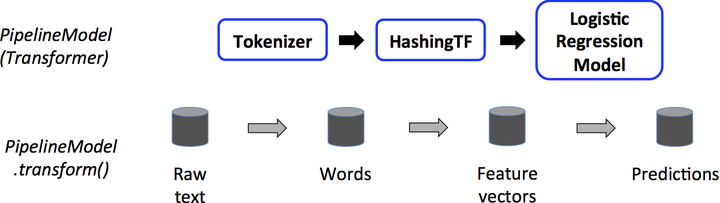
管道由一系列有顺序的阶段指定,每个状态时转换器或估计器。每个状态的运行是有顺序的,输入的数据框通过每个阶段进行改变。在转换器阶段,transform()方法被调用于数据框上。对于估计器阶段,fit()方法被调用来产生一个转换器,然后该转换器的transform()方法被调用在数据框上。
下面的图说明简单的文档处理工作流的运行。
spark pipeline 例子的更多相关文章
- spark JavaDirectKafkaWordCount 例子分析
spark JavaDirectKafkaWordCount 例子分析: 1. KafkaUtils.createDirectStream( jssc, String.class, String.c ...
- Spark Pipeline官方文档
ML Pipelines(译文) 官方文档链接:https://spark.apache.org/docs/latest/ml-pipeline.html 概述 在这一部分,我们将要介绍ML Pipe ...
- Spark SQL例子
综合案例分析 现有数据集 department.json与employee.json,以部门名称和员工性别为粒度,试计算每个部门分性别平均年龄与平均薪资. department.json如下: {&q ...
- Spark Pipeline
一个简单的Pipeline,用作estimator.Pipeline由有序列的stages组成,每个stage是一个Estimator或者一个Transformer. 当Pipeline调用fit,s ...
- Spark Streaming 例子
NetworkWordCount.scala /* * Licensed to the Apache Software Foundation (ASF) under one or more * con ...
- 看到了一个pipeline例子,
pipeline { agent any options { timestamps() } parameters { string(name: 'GIT_BRANCH', defaultValue: ...
- spark执行例子eclipse maven打包jar
首先在eclipse Java EE中新建一个Maven project具体选项如下 点击Finish创建成功,接下来把默认的jdk1.5改成jdk1.8 然后编辑pom.xml加入spark-cor ...
- spark scala 例子
object ScalaApp { def main(args: Array[String]): Unit = { var conf = new SparkConf() conf.setMaster( ...
- Spark.ML之PipeLine学习笔记
地址: http://spark.apache.org/docs/2.0.0/ml-pipeline.html Spark PipeLine 是基于DataFrames的高层的API,可以方便用户 ...
随机推荐
- ASP.NET--Attribute定义及用法
1.Attribute定义 公共语言运行时允许添加类似关键字的描述声明,叫做attributes, 它对程序中的元素进行标注,如类型.字段.方法和属性等.Attributes和Microsoft .N ...
- 讲一讲java异常及自定义异常
1.异常,说白了.两种,一种就是就是不能让代码通过编译的异常.另一种就是程序运行期间出现的异常.异常就是错误,只要出现异常,程序就不会向下运行了.就不会执行后面的代码了.这时候就可以通过显示statc ...
- NOIP2017提高组模拟赛 7(总结)
NOIP2017提高组模拟赛 7(总结) 第一题 斯诺克 考虑这样一个斯诺克球台,它只有四个袋口,分别在四个角上(如下图所示).我们把所有桌子边界上的整数点作为击球点(除了4个袋口),在每个击球点我们 ...
- ES线程池设置
每个Elasticsearch节点内部都维护着多个线程池,如index.search.get.bulk等,用户可以修改线程池的类型和大小,线程池默认大小跟CPU逻辑一致 一.查看当前线程组状态 cur ...
- ICMP 隧道——将流量封装进 IMCP 的 ping 数据包中,旨在利用 ping 穿透防火墙的检测
利用 ICMP 隧道穿透防火墙 转自:http://xiaix.me/li-yong-icmp-sui-dao-chuan-tou-fang-huo-qiang/ 以前穿透防火墙总是使用 SSH 隧道 ...
- Sobel算子及C++实现
Sobel 算子是一个离散的一阶微分算子,用来计算图像灰度函数的近似梯度. 在空间域上Sobel算子很容易实现,执行速度快,对部分噪声具有平滑作用,还能够提供较为精确的边缘方向信息,缺点是边缘定位精度 ...
- Java 7之传统I/O - 字符类 StringReader和StringWriter
转自:https://www.xuebuyuan.com/2015312.html 这两个类将String类适配到了Reader和Writer接口,在StringWriter类实现的过程中,真正使用的 ...
- 17.广度优先遍历bfs
#include <iostream> #include <boost/config.hpp> //图(矩阵实现) #include <boost/graph/adjac ...
- ServiceStack.Redis之IRedisClient<第三篇>【转】
事实上,IRedisClient里面的很多方法,其实就是Redis的命令名.只要对Redis的命令熟悉一点就能够非常快速地理解和掌握这些方法,趁着现在对Redis不是特别了解,我也对着命令来了解一下这 ...
- vue中router-link的click事件失效的解决办法
title: vue中router-link的click事件失效的解决办法 toc: false date: 2018-12-04 16:28:49 categories: Web tags: vue ...