
吴裕雄--天生自然 R语言数据分析:火箭发射的地点、日期/时间和结果分析
dfS = read.csv("F:\\kaggleDataSet\\spacex-missions\\database.csv")

library(dplyr)

library(tidyr)

library(data.table)

library(sqldf)

library(highcharter)

library(ggrepel)

library(leaflet)

library(viridisLite)

library(countrycode)

library(ggplot2)
names(dfS) <- gsub("\\.", "", names(dfS))

dfS$CustomerCountry = sub(x = dfS$CustomerCountry, pattern = "France (Mexico)", replacement = "France", fixed=T)

dfS = data.table(sqldf(c("UPDATE dfS SET PayloadType = PayloadName WHERE PayloadType == ''",

                            "SELECT * FROM main.dfS"), method = "raw"))

dfS = data.table(sqldf(c("UPDATE dfS SET PayloadOrbit = 'Unknown' WHERE PayloadOrbit == ''",

                            "SELECT * FROM main.dfS"), method = "raw"))

dfS = data.table(sqldf(c("UPDATE dfS SET CustomerName = 'N/A' WHERE CustomerName == ''", "SELECT * FROM main.dfS"),

                       method = "raw"))

dfS = data.table(sqldf(c("UPDATE dfS SET CustomerType = 'N/A' WHERE CustomerType == ''", "SELECT * FROM main.dfS"),

                       method = "raw"))

dfS = data.table(sqldf(c("UPDATE dfS SET CustomerCountry = 'N/A'WHERE CustomerCountry == ''",

                            "SELECT * FROM main.dfS"), method = "raw"))

dfS$PayloadMasskg[is.na(dfS$PayloadMasskg)] <- 'Unknown'

dfS = as.data.frame(dfS)

date.chr <- as.character(dfS$LaunchDate)

date <- strptime(date.chr,format="%d %b %Y")

dfS$LaunchDate = date

dfS$LaunchDate = as.Date(dfS$LaunchDate)
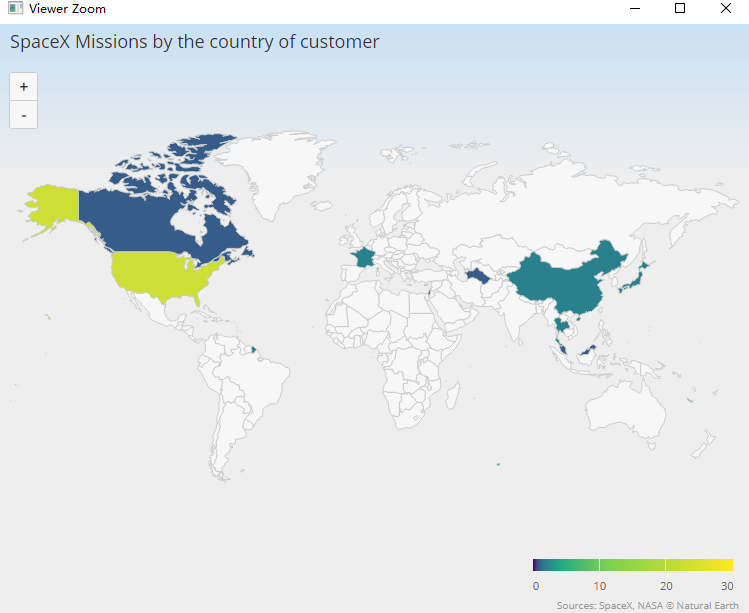
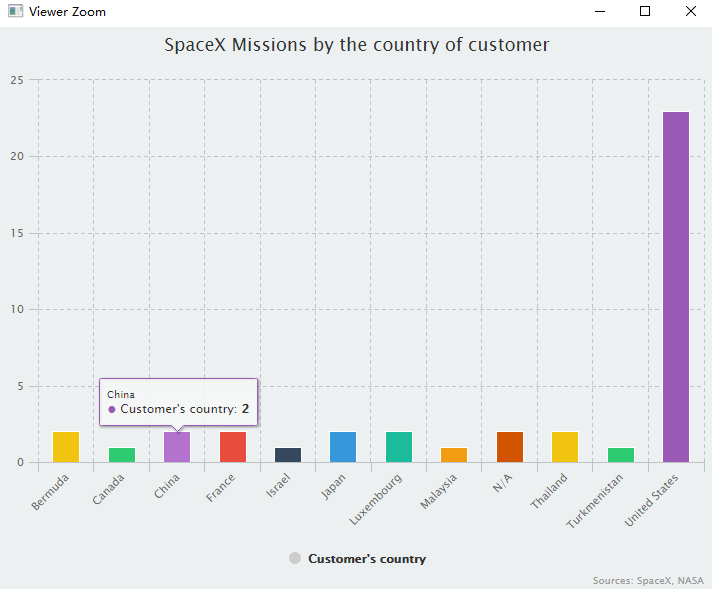
hchart(dfS$CustomerCountry, colorByPoint = TRUE, name = "Customer's country") %>%

  hc_title(text = "SpaceX Missions by the country of customer") %>% hc_add_theme(hc_theme_flat()) %>%

  hc_credits(enabled = TRUE, text = "Sources: SpaceX, NASA", style = list(fontSize = "10px"))
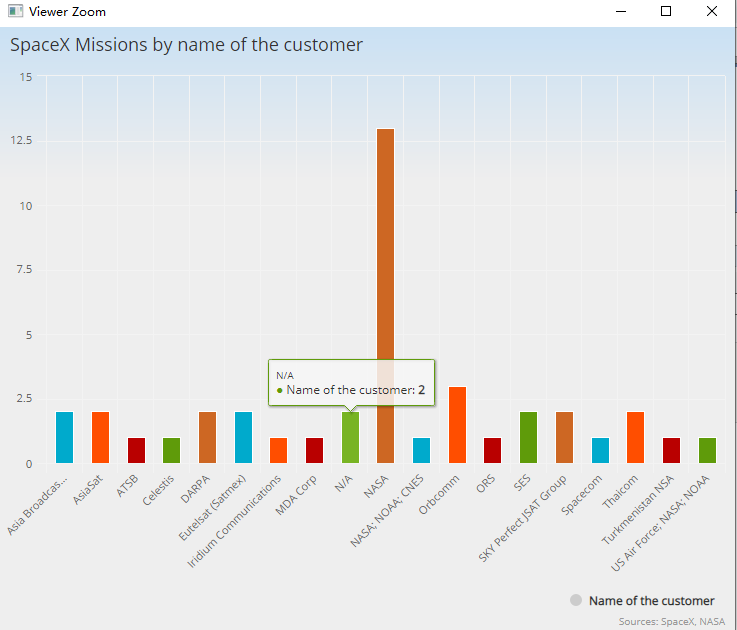
hchart(dfS$CustomerName, colorByPoint = TRUE, name = "Name of the customer") %>%

  hc_title(text = "SpaceX Missions by name of the customer") %>% hc_add_theme(hc_theme_ffx()) %>%

  hc_credits(enabled = TRUE, text = "Sources: SpaceX, NASA", style = list(fontSize = "10px"))
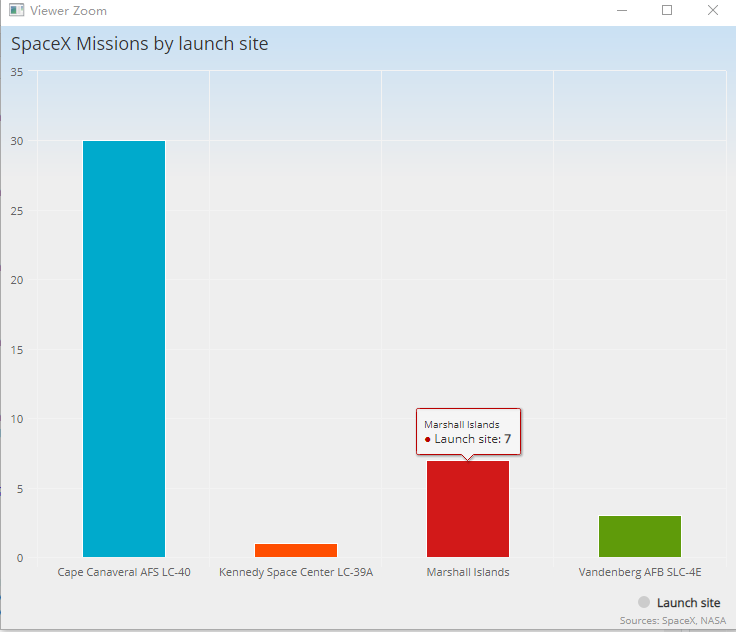
hchart(dfS$LaunchSite, colorByPoint = TRUE, name = "Launch site") %>%

  hc_title(text = "SpaceX Missions by launch site") %>% hc_add_theme(hc_theme_ffx()) %>%

  hc_credits(enabled = TRUE, text = "Sources: SpaceX, NASA", style = list(fontSize = "10px"))
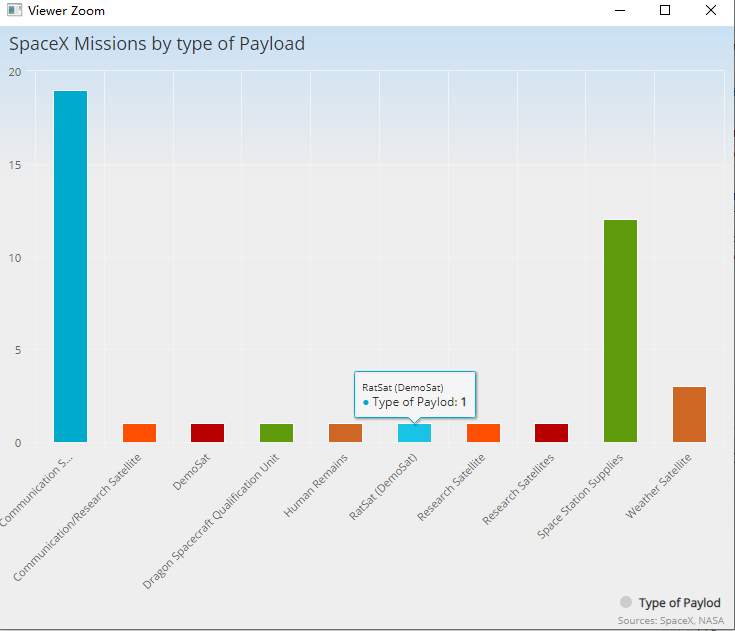
hchart(dfS$PayloadType, colorByPoint = TRUE, name = "Type of Paylod") %>%

  hc_title(text = "SpaceX Missions by type of Payload") %>% hc_add_theme(hc_theme_ffx()) %>%

  hc_credits(enabled = TRUE, text = "Sources: SpaceX, NASA", style = list(fontSize = "10px"))
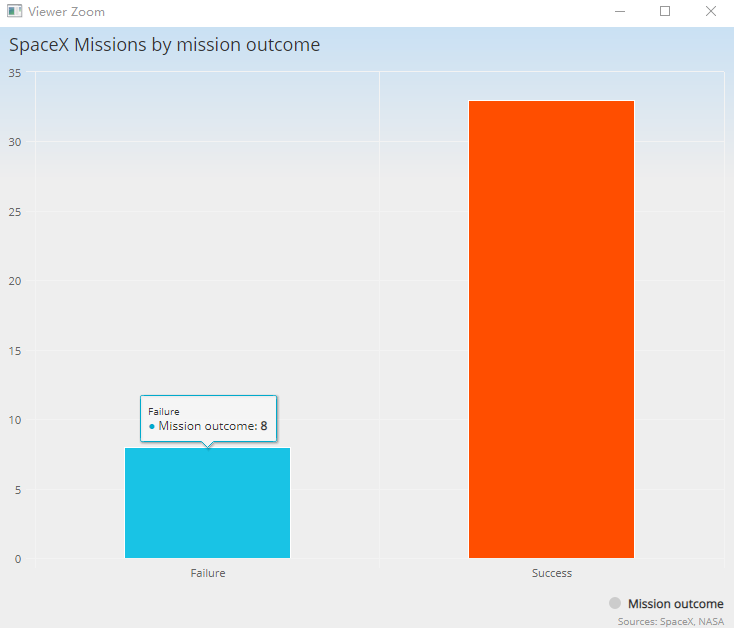
hchart(dfS$MissionOutcome, colorByPoint = TRUE, name = "Mission outcome") %>%

  hc_title(text = "SpaceX Missions by mission outcome") %>% hc_add_theme(hc_theme_ffx()) %>%

  hc_credits(enabled = TRUE, text = "Sources: SpaceX, NASA", style = list(fontSize = "10px"))
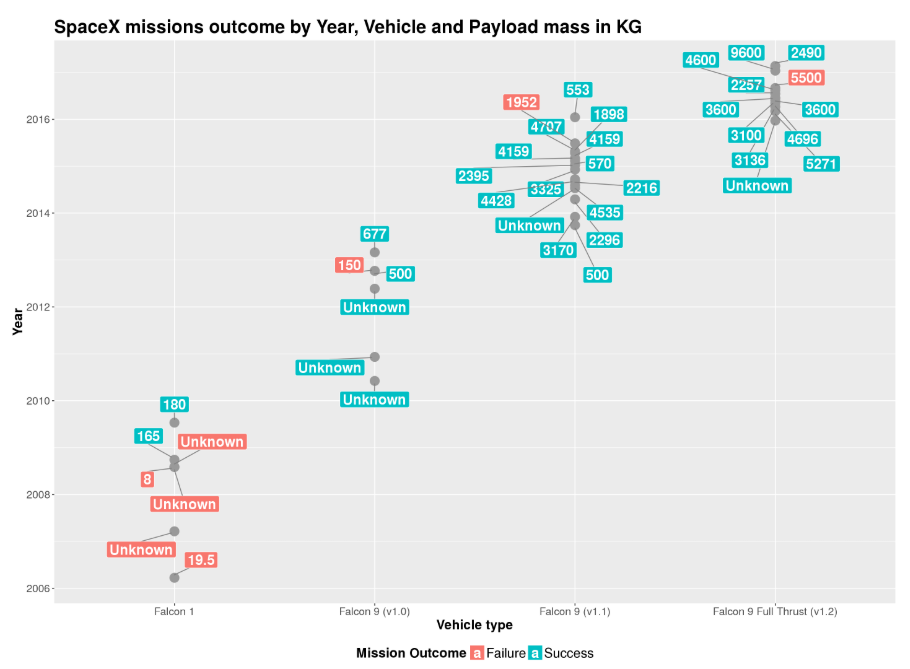
ggplot(dfS)+ geom_point(aes(VehicleType, LaunchDate), size = 5, color = 'grey60') +

  geom_label_repel(aes(VehicleType, LaunchDate, fill = ifelse(dfS$MissionOutcome == 'Failure', 'Failure', 'Success'),

        label = PayloadMasskg),fontface = 'bold', color = 'white', size = 6, box.padding = unit(0.35, "lines"),

        point.padding = unit(0.5, "lines"),segment.color = 'grey50') +

  ggtitle("SpaceX missions outcome by Year, Vehicle and Payload mass in KG")+ labs(x="Vehicle type",y="Year") +

  theme(legend.title = element_text(face = "bold", size = 16)) + theme(legend.text = element_text(size = 16)) +

  theme(legend.position = "bottom")+ labs(fill = "Mission Outcome") +

  theme(plot.title = element_text(size = 22, face = "bold")) +

  theme(axis.text=element_text(size=13), axis.title=element_text(size=16,face="bold"))
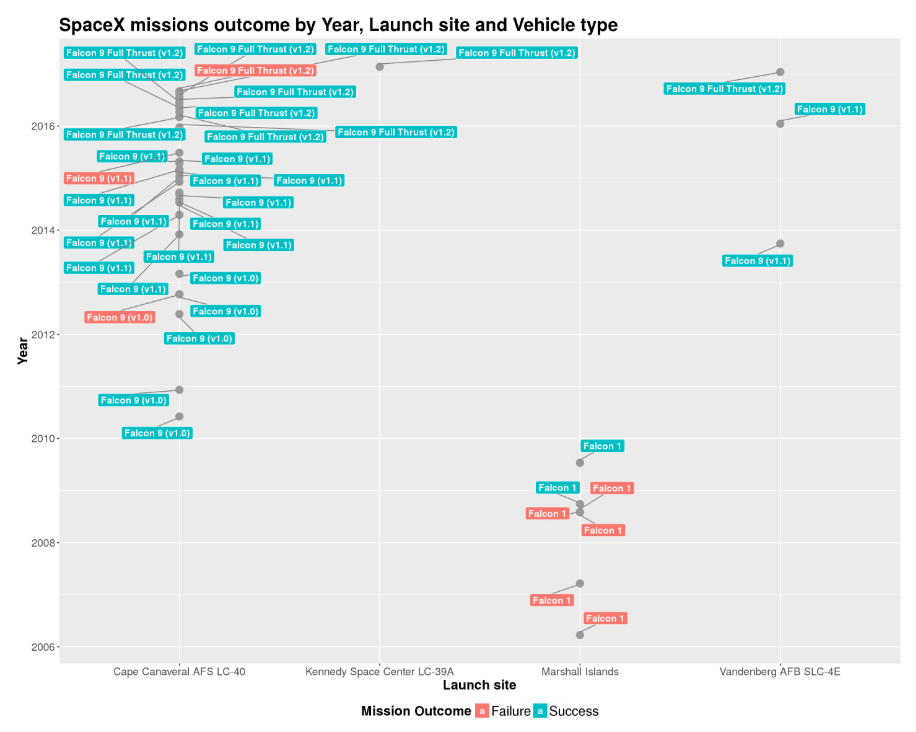
ggplot(dfS)+ geom_point(aes(LaunchSite, LaunchDate), size = 4, color = 'grey60') +

  geom_label_repel(aes(LaunchSite, LaunchDate, fill = ifelse(dfS$MissionOutcome == 'Failure', 'Failure', 'Success'),

       label = VehicleType), fontface = 'bold', color = 'white', size = 4, box.padding = unit(0.35, "lines"),

       point.padding = unit(0.5, "lines"),segment.color = 'grey50') +

  ggtitle("SpaceX missions outcome by Year, Launch site and Vehicle type")+ labs(x="Launch site",y="Year") +

  theme(legend.title = element_text(face = "bold", size = 16)) + theme(legend.text = element_text(size = 16)) +

  theme(legend.position = "bottom")+ labs(fill = "Mission Outcome") +

  theme(plot.title = element_text(size = 22, face = "bold")) +

  theme(axis.text=element_text(size=13), axis.title=element_text(size=16,face="bold"))
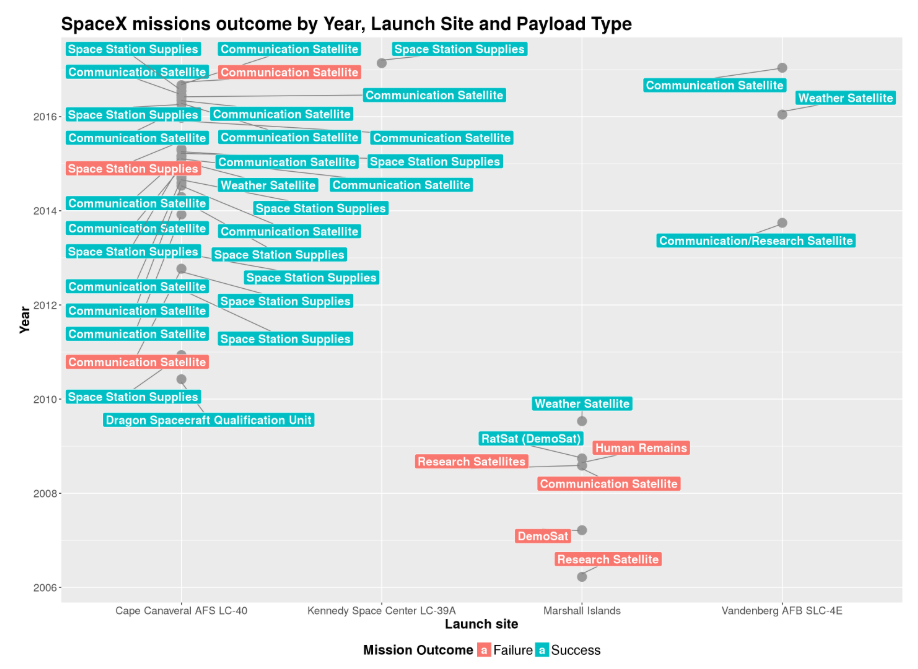
ggplot(dfS)+ geom_point(aes(LaunchSite, LaunchDate), size = 5, color = 'grey60') +

  geom_label_repel(aes(LaunchSite, LaunchDate, fill = ifelse(dfS$MissionOutcome == 'Failure', 'Failure', 'Success'),

      label = PayloadType), fontface = 'bold', color = 'white', size = 5, box.padding = unit(0.35, "lines"),

      point.padding = unit(0.5, "lines"),segment.color = 'grey50') +

  ggtitle("SpaceX missions outcome by Year, Launch Site and Payload Type")+ labs(x="Launch site",y="Year") +

  theme(legend.title = element_text(face = "bold", size = 16)) + theme(legend.text = element_text(size = 16)) +

  theme(legend.position = "bottom")+ labs(fill = "Mission Outcome") +

  theme(plot.title = element_text(size = 22, face = "bold")) +

  theme(axis.text=element_text(size=13), axis.title=element_text(size=16,face="bold"))
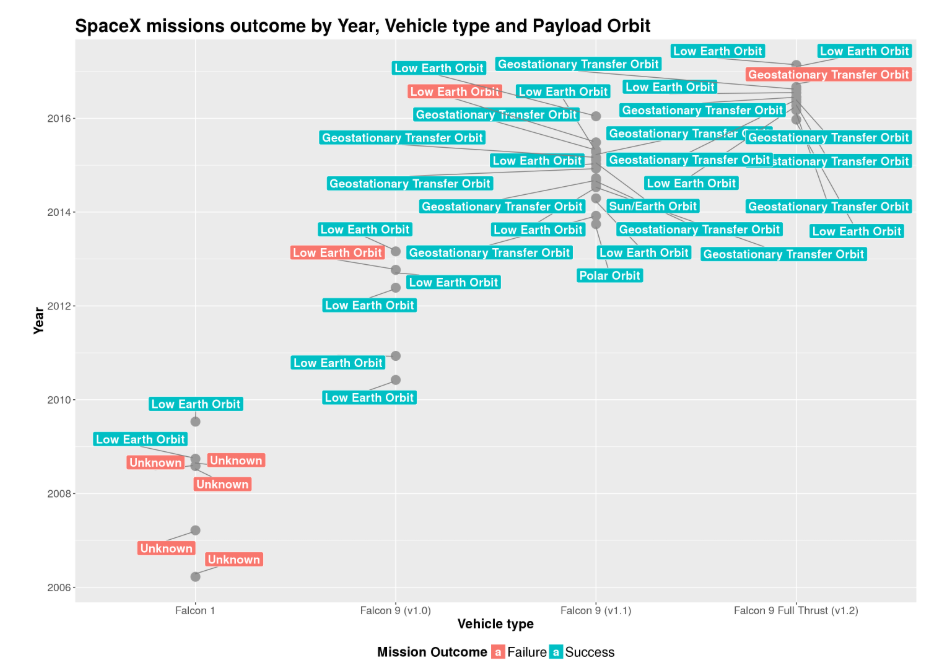
ggplot(dfS)+ geom_point(aes(VehicleType, LaunchDate), size = 5, color = 'grey60') +

  geom_label_repel(aes(VehicleType, LaunchDate, fill = ifelse(dfS$MissionOutcome == 'Failure', 'Failure', 'Success'),

      label = PayloadOrbit), fontface = 'bold', color = 'white', size = 5, box.padding = unit(0.35, "lines"),

      point.padding = unit(0.5, "lines"),segment.color = 'grey50') +

  ggtitle("SpaceX missions outcome by Year, Vehicle type and Payload Orbit")+  labs(x="Vehicle type",y="Year") +

  theme(legend.title = element_text(face = "bold", size = 16)) + theme(legend.text = element_text(size = 16)) +

  theme(legend.position = "bottom")+ labs(fill = "Mission Outcome") +

  theme(plot.title = element_text(size = 22, face = "bold")) +

  theme(axis.text=element_text(size=13), axis.title=element_text(size=16,face="bold"))
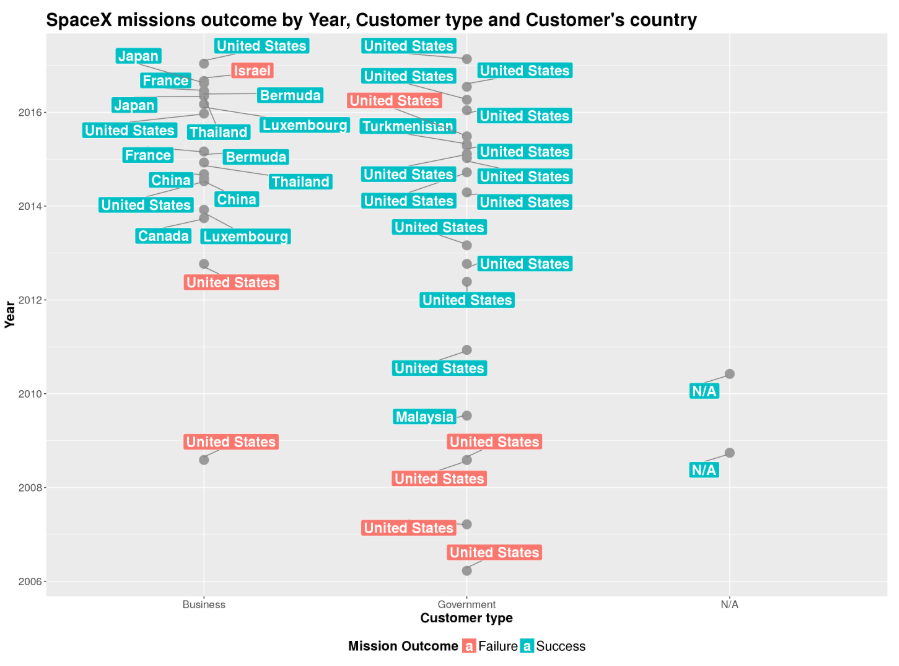
ggplot(dfS)+ geom_point(aes(CustomerType, LaunchDate), size = 5, color = 'grey60') +

  geom_label_repel(aes(CustomerType, LaunchDate, fill = ifelse(dfS$MissionOutcome == 'Failure', 'Failure', 'Success'),

      label = CustomerCountry), fontface = 'bold', color = 'white', size = 6, box.padding = unit(0.35, "lines"),

      point.padding = unit(0.5, "lines"),segment.color = 'grey50') +

  ggtitle("SpaceX missions outcome by Year, Customer type and Customer's country")+ labs(x="Customer type",y="Year") +

  theme(legend.title = element_text(face = "bold", size = 16)) + theme(legend.text = element_text(size = 16)) +

  theme(legend.position = "bottom")+ labs(fill = "Mission Outcome") +

  theme(plot.title = element_text(size = 22, face = "bold")) +

  theme(axis.text=element_text(size=13), axis.title=element_text(size=16,face="bold"))
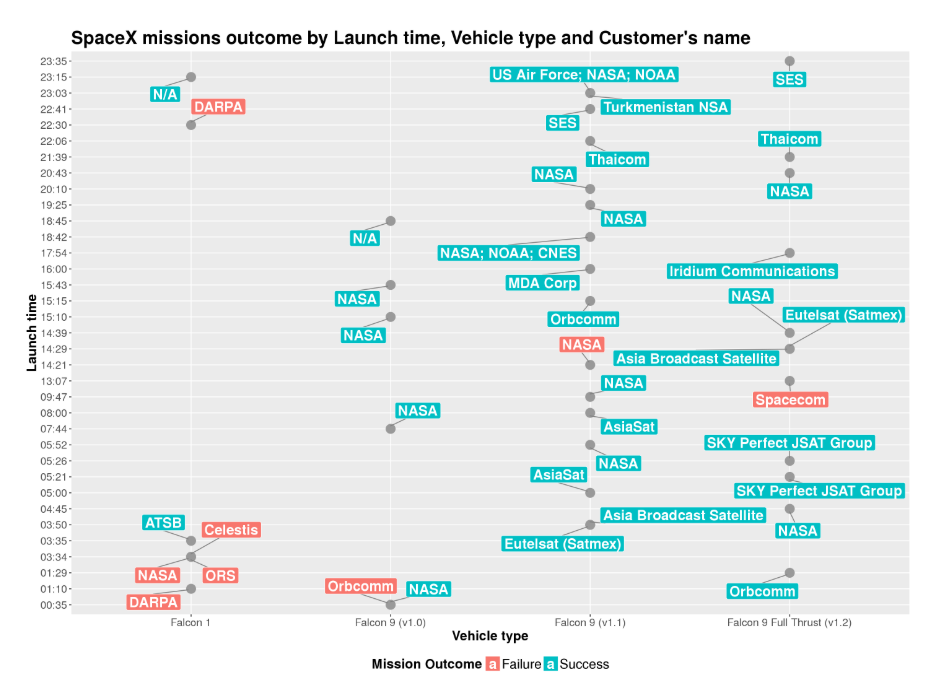
ggplot(dfS)+ geom_point(aes(VehicleType, LaunchTime), size = 5, color = 'grey60') +

  geom_label_repel(aes(VehicleType, LaunchTime, fill = ifelse(dfS$MissionOutcome == 'Failure', 'Failure', 'Success'),

      label = CustomerName), fontface = 'bold', color = 'white', size = 6, box.padding = unit(0.35, "lines"),

      point.padding = unit(0.5, "lines"),segment.color = 'grey50') +

  ggtitle("SpaceX missions outcome by Launch time, Vehicle type and Customer's name")+ labs(x="Vehicle type",y="Launch time") +

  theme(legend.title = element_text(face = "bold", size = 16)) + theme(legend.text = element_text(size = 16)) +

  theme(legend.position = "bottom")+ labs(fill = "Mission Outcome") +

  theme(plot.title = element_text(size = 22, face = "bold")) +

  theme(axis.text=element_text(size=13), axis.title=element_text(size=16,face="bold"))
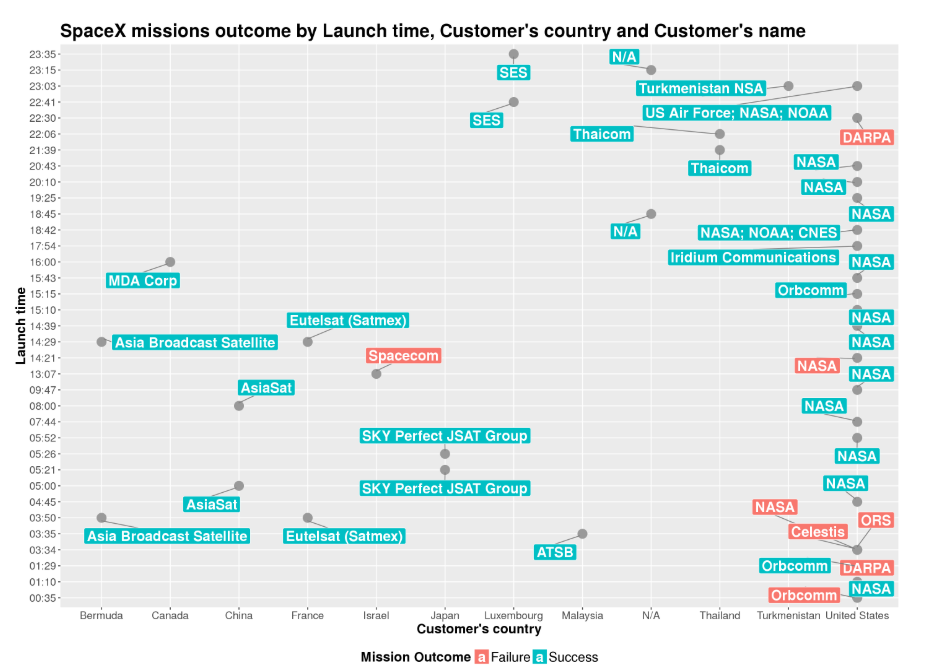
ggplot(dfS)+ geom_point(aes(CustomerCountry, LaunchTime), size = 5, color = 'grey60') +

  geom_label_repel(aes(CustomerCountry, LaunchTime, fill = ifelse(dfS$MissionOutcome == 'Failure', 'Failure', 'Success'),

      label = CustomerName), fontface = 'bold', color = 'white', size = 6, box.padding = unit(0.35, "lines"),

      point.padding = unit(0.5, "lines"),segment.color = 'grey50') +

  ggtitle("SpaceX missions outcome by Launch time, Customer's country and Customer's name")+

  labs(x="Customer's country",y="Launch time") +

  theme(legend.title = element_text(face = "bold", size = 16)) + theme(legend.text = element_text(size = 16)) +

  theme(legend.position = "bottom")+ labs(fill = "Mission Outcome") +

  theme(plot.title = element_text(size = 22, face = "bold")) +

  theme(axis.text=element_text(size=13), axis.title=element_text(size=16,face="bold"))
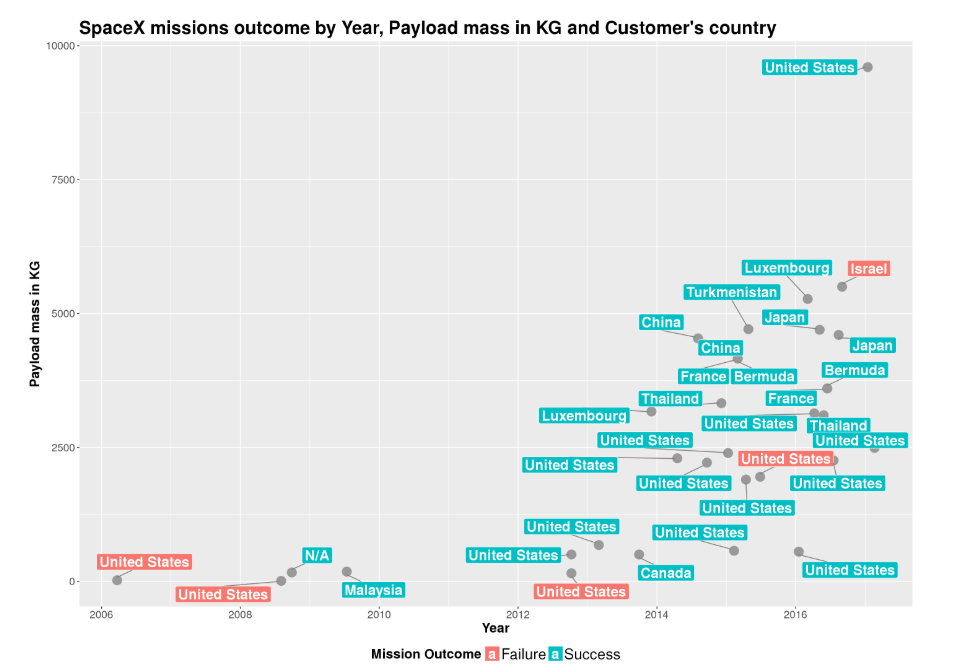
dfS$PayloadMasskg = as.integer(dfS$PayloadMasskg)

ggplot(dfS)+ geom_point(aes(LaunchDate, PayloadMasskg), size = 5, color = 'grey60') +

  geom_label_repel(aes(LaunchDate, PayloadMasskg, fill = ifelse(dfS$MissionOutcome == 'Failure', 'Failure', 'Success'),

      label = CustomerCountry), fontface = 'bold', color = 'white', size = 6, box.padding = unit(0.35, "lines"),

      point.padding = unit(0.5, "lines"),segment.color = 'grey50') +

  ggtitle("SpaceX missions outcome by Year, Payload mass in KG and Customer's country")+ labs(x="Year",y="Payload mass in KG") +

  theme(legend.title = element_text(face = "bold", size = 16)) + theme(legend.text = element_text(size = 18)) +

  theme(legend.position = "bottom")+ labs(fill = "Mission Outcome") +

  theme(plot.title = element_text(size = 22, face = "bold")) +

  theme(axis.text=element_text(size=13), axis.title=element_text(size=16,face="bold"))
吴裕雄--天生自然 R语言数据分析:火箭发射的地点、日期/时间和结果分析的更多相关文章
- 吴裕雄--天生自然 python语言数据分析:开普勒系外行星搜索结果分析
import pandas as pd pd.DataFrame({'Yes': [50, 21], 'No': [131, 2]}) pd.DataFrame({'Bob': ['I liked i ...
- 吴裕雄--天生自然 R语言开发学习:R语言的安装与配置
下载R语言和开发工具RStudio安装包 先安装R
- 吴裕雄--天生自然 R语言开发学习:数据集和数据结构
数据集的概念 数据集通常是由数据构成的一个矩形数组,行表示观测,列表示变量.表2-1提供了一个假想的病例数据集. 不同的行业对于数据集的行和列叫法不同.统计学家称它们为观测(observation)和 ...
- 吴裕雄--天生自然 R语言数据可视化绘图(3)
par(ask=TRUE) opar <- par(no.readonly=TRUE) # record current settings # Listing 11.1 - A scatter ...
- 吴裕雄--天生自然 R语言开发学习:使用键盘、带分隔符的文本文件输入数据
R可从键盘.文本文件.Microsoft Excel和Access.流行的统计软件.特殊格 式的文件.多种关系型数据库管理系统.专业数据库.网站和在线服务中导入数据. 使用键盘了.有两种常见的方式:用 ...
- 吴裕雄--天生自然 R语言开发学习:R语言的简单介绍和使用
假设我们正在研究生理发育问 题,并收集了10名婴儿在出生后一年内的月龄和体重数据(见表1-).我们感兴趣的是体重的分 布及体重和月龄的关系. 可以使用函数c()以向量的形式输入月龄和体重数据,此函 数 ...
- 吴裕雄--天生自然 R语言开发学习:基础知识
1.基础数据结构 1.1 向量 # 创建向量a a <- c(1,2,3) print(a) 1.2 矩阵 #创建矩阵 mymat <- matrix(c(1:10), nrow=2, n ...
- 吴裕雄--天生自然 R语言开发学习:图形初阶(续二)
# ----------------------------------------------------# # R in Action (2nd ed): Chapter 3 # # Gettin ...
- 吴裕雄--天生自然 R语言开发学习:图形初阶(续一)
# ----------------------------------------------------# # R in Action (2nd ed): Chapter 3 # # Gettin ...
随机推荐
- SMO算法--SVM(3)
SMO算法--SVM(3) 利用SMO算法解决这个问题: SMO算法的基本思路: SMO算法是一种启发式的算法(别管启发式这个术语, 感兴趣可了解), 如果所有变量的解都满足最优化的KKT条件, 那么 ...
- 绿洲作业第二周 - 周二music work 音乐
Please kindly find the music work from Ms. Sophie. 1.请跟随附件中老师录制的视频进行学习和练习.(附件有带拼音的乐谱供KS1和外国学生使用) htt ...
- Java复习(二)类与对象的基本概念
2.1面向对象的程序设计方法概述 对象 程序中: 一切皆是对象 都具有标识,属性和行为 通过一个或多个变量来保存其状态 通过方法实现他的行为 类 将属性及行为相同或相似的对象归为一类 类可以看成是对象 ...
- 序列化模块ModelSerializer
课程准备 配置:settings.py INSTALLED_APPS = [ # ... 'rest_framework', ] DATABASES = { 'default': { 'ENGINE' ...
- JDBC常用驱动和语法汇总
A. Firebird url=jdbc:firebirdsql:[HOST_NAME]/[PORT:][FULL_PATH_TO_DATABASE_FILE] driver=org.firebird ...
- KMP匹配(模板)
先粘上我入门KMP时看的大佬的博客:orz orz 从头到尾彻底理解KMP 我觉得这篇已经讲的很详细了,希望大家能坚持看下去. 步骤 ①寻找前缀后缀最长公共元素长度对于P = p0 p1 ...pj- ...
- [LC] 1007. Minimum Domino Rotations For Equal Row
In a row of dominoes, A[i] and B[i] represent the top and bottom halves of the i-th domino. (A domi ...
- 吴裕雄--天生自然python学习笔记:python 建立 Firebase 数据库连接
Python 程序通过 python-firebase 包可以存取 Firebase 数据库. 使用 python-firebase 包 首先必须安装 python-firebase 包,安装方法如下 ...
- text-overflow属性
text-overflow属性有两个值, 默认值是clip:当对象内文本溢出时不显示裁切掉. 另一个就是:ellipsis:对象内文本溢出时显示省略标记(...). 使用text-overflow:e ...
- vue实现动态绑定class--(boolean)绑定class,点击有,再点击取消
<template> <div :class="{'flag':selected}" @click=clickBtn>xxx</div>< ...