
SPRING IN ACTION 第4版笔记-第九章Securing web applications-001-SpringSecurity简介(DelegatingFilterProxy、AbstractSecurityWebApplicationInitializer、WebSecurityConfigurerAdapter、@EnableWebSecurity、@EnableWebMvcS)
一、SpringSecurity的模块

At the least, you’ll want to include the Core and Configuration modules in your application’s classpath. Spring Security is often used to secure web applications, and that’s certainly the case with the Spittr application, so you’ll also need to add the Web module. We’ll also be taking advantage of Spring Security’s JSP tag library, so you’ll need to add that module to the mix.
二、开启SpringSecurity的DelegatingFilterProxy
Spring Security employs several servlet filters to provide various aspects of security.You might be thinking that means you’ll need to configure several filters in a web.xml file, or perhaps in a WebApplicationInitializer class. But thanks to a little Spring magic, you’ll only need to configure one of those filters.
DelegatingFilterProxy is a special servlet filter that, by itself, doesn’t do much.Instead, it delegates to an implementation of javax.servlet.Filter that’s registered as a <bean> in the Spring application context, as illustrated in figure 9.1.
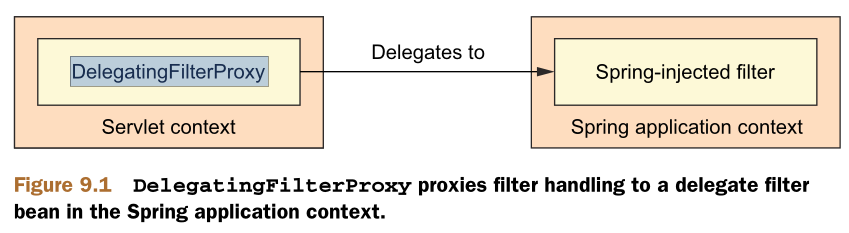
1.Java形式
If you'd rather configure DelegatingFilterProxy in Java with a WebApplicationInitializer , then all you need to do is create a new class that extends AbstractSecurityWebApplicationInitializer
 package spittr.config;

 import org.springframework.security.web.context.AbstractSecurityWebApplicationInitializer;

 public class SecurityWebInitializer extends AbstractSecurityWebApplicationInitializer {

 }
AbstractSecurityWebApplicationInitializer implements WebApplicationInitializer , so it will be discovered by Spring and be used to register DelegatingFilterProxy with the web container. Although you can override its appendFilters() or insertFilters() methods to register filters of your own choosing, you need not override anything to register DelegatingFilterProxy
2.xml形式
 <filter>

     <filter-name>springSecurityFilterChain</filter-name>

     <filter-class>

         org.springframework.web.filter.DelegatingFilterProxy

     </filter-class>

 </filter>
The most important thing here is that the <filter-name> be set to springSecurityFilterChain . That’s because you’ll soon be configuring Spring Security for web security, and there will be a filter bean named springSecurityFilterChain that
DelegatingFilterProxy will need to delegate to.
Whether you configure DelegatingFilterProxy in web.xml or by subclassing AbstractSecurityWebApplicationInitializer , it will intercept requests coming into the application and delegate them to a bean whose ID is springSecurityFilterChain .
As for the springSecurityFilterChain bean itself, it’s another special filter known as FilterChainProxy . It’s a single filter that chains together one or more additional filters. Spring Security relies on several servlet filters to provide different security features, but you should almost never need to know these details, as you likely won’t need to explicitly declare the springSecurityFilterChain bean or any of the filters it chains together. Those filters will be created when you enable web security.
三、编写简单的SpringSecurity配置
1.Java形式
(1)一般应用,@EnableWebSecurity
 package spitter.config;

 import org.springframework.context.annotation.Configuration;

 import org.springframework.security.config.annotation.web.configuration.EnableWebSecurity;

 import org.springframework.security.config.annotation.web.configuration.WebSecurityConfigurerAdapter;

 @Configuration

 @EnableWebSecurity

 public class SecurityConfig extends WebSecurityConfigurerAdapter {}
As its name suggests, the @EnableWebSecurity annotation enables web security. It is useless on its own, however. Spring Security must be configured in a bean that implements WebSecurityConfigurer or (for convenience) extends WebSecurityConfigurerAdapter . Any bean in the Spring application context that implements WebSecurityConfigurer can contribute to Spring Security configuration, but it’s often most convenient for the configuration class to extend WebSecurityConfigurerAdapter , as shown in listing 9.1. @EnableWebSecurity is generally useful for enabling security in any web application. But if you happen to be developing a Spring MVC application, you should consider using @EnableWebMvcSecurity instead
(2)SpringMVC应用@EnableWebMvcSecurity
 package spitter.config;

 import org.springframework.context.annotation.Configuration;

 import org.springframework.security.config.annotation.web.

 configuration.WebSecurityConfigurerAdapter;

 import org.springframework.security.config.annotation.web.servlet.

 configuration.EnableWebMvcSecurity;

 @Configuration

 @EnableWebMvcSecurity

 public class SecurityConfig extends WebSecurityConfigurerAdapter {

 }
Among other things, the @EnableWebMvcSecurity annotation configures a Spring MVC argument resolver so that handler methods can receive the authenticated user’s principal (or username) via @AuthenticationPrincipal -annotated parameters. It also configures a bean that automatically adds a hidden cross-site request forgery ( CSRF ) token field on forms using Spring’s form-binding tag library.
It may not look like much, but the security configuration class in listings 9.1 and 9.2 packs quite a punch. Either one will lock down an application so tightly that nobody can get in!
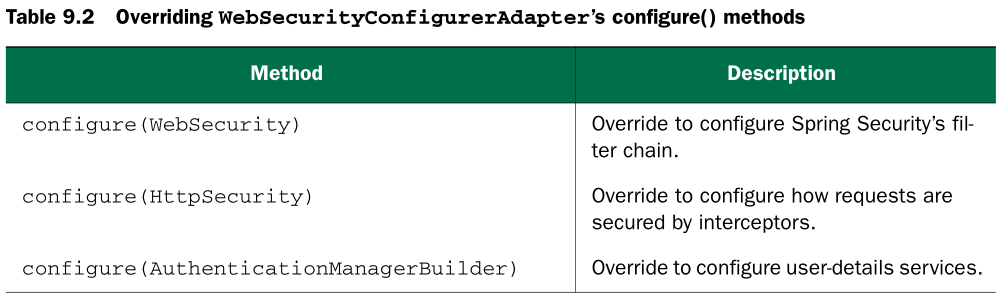
Although it’s not strictly required, you’ll probably want to specify the finer points of web security by overriding one or more of the methods from WebSecurityConfigurerAdapter . You can configure web security by overriding WebSecurity-
ConfigurerAdapter ’s three configure() methods and setting behavior on the parameter passed in. Table 9.2 describes these three methods.
四、重写WebSecurityConfigurerAdapter ’s configure()
1.
2.默认的方法如下:
 protected void configure(HttpSecurity http) throws Exception {

     http

         .authorizeRequests()

         .anyRequest().authenticated()

         .and()

         .formLogin().and()

         .httpBasic();

 }
This simple default configuration specifies how HTTP requests should be secured and what options a client has for authenticating the user. The call to authorizeRequests() and anyRequest().authenticated() demands that all HTTP requests coming into the application be authenticated. It also configures Spring Security to support authentication via a form-based login (using a predefined login page) as well as HTTP Basic.
Meanwhile, because you haven’t overridden the configure(AuthenticationManagerBuilder) method, there’s no user store backing the authentication process.With no user store, there are effectively no users. Therefore, all requests require
authentication, but there’s nobody who can log in.You’re going to need to add a bit more configuration to bend Spring Security to fit your application’s needs. Specifically, you’ll need to…
Configure a user store
Specify which requests should and should not require authentication, as well as what authorities they require
Provide a custom login screen to replace the plain default login screen In addition to these facets of Spring Security, you may also want to selectively render certain content in your web views based on security constraints.
SPRING IN ACTION 第4版笔记-第九章Securing web applications-001-SpringSecurity简介(DelegatingFilterProxy、AbstractSecurityWebApplicationInitializer、WebSecurityConfigurerAdapter、@EnableWebSecurity、@EnableWebMvcS)的更多相关文章
- SPRING IN ACTION 第4版笔记-第九章Securing web applications-011-把敏感信息请求转为https(requiresChannel())
1.把包含敏感信息的请求转为https请求,则较为安全,但如何只把有需要安全的请求转为https,而不是不加分辩就把所有请求都转为https呢?可以用requiresChannel() @Overri ...
- SPRING IN ACTION 第4版笔记-第九章Securing web applications-010-拦截请求
一. What if you wanted to restrict access to certain roles only on Tuesday? Using the access() method ...
- SPRING IN ACTION 第4版笔记-第九章Securing web applications-008-使用非关系型数据库时如何验证用户(自定义UserService)
一. 1.定义接口 Suppose that you need to authenticate against users in a non-relational database suchas Mo ...
- SPRING IN ACTION 第4版笔记-第九章Securing web applications-007-设置LDAP server比较密码(contextSource、root()、ldif()、)
一.LDAP server在哪 By default, Spring Security’s LDAP authentication assumes that the LDAP server is li ...
- SPRING IN ACTION 第4版笔记-第九章Securing web applications-004-对密码加密passwordEncoder
一. 1.Focusing on the authentication query, you can see that user passwords are expected to be stored ...
- SPRING IN ACTION 第4版笔记-第九章Securing web applications-003-把用户数据存在数据库
一. 1.It’s quite common for user data to be stored in a relational database, accessed via JDBC . To c ...
- SPRING IN ACTION 第4版笔记-第九章Securing web applications-002-把用户数据存在memory里(AuthenticationManagerBuilder、 UserDetailsManagerConfigurer.UserDetailsBuilder)
Spring Security is extremely flexible and is capable of authenticating users against virtually any d ...
- SPRING IN ACTION 第4版笔记-第九章Securing web applications-009-拦截请求()
一. 对特定的请求拦截 For example, consider the requests served by the Spittr application. Certainly, thehome ...
- SPRING IN ACTION 第4版笔记-第九章Securing web applications-006-用LDAP比较密码(passwordCompare()、passwordAttribute("passcode")、passwordEncoder(new Md5PasswordEncoder()))
一. The default strategy for authenticating against LDAP is to perform a bind operation,authenticatin ...
随机推荐
- jQuery-ui treegird 使用
在实际应用中可能会碰到不同的需求,比如会根据每行不同的参数或属性设置来设置同列不同的editor类型,这时原有的例子就显的有点太过简单,不能实现我们的需求,现在应用我在项目中的操作为例,显示下实现同列 ...
- C# 导出 Excel
/// <summary> /// 导出Excel /// </summary> public void ExportExcel() { #region 添加引用 Micros ...
- grails导入excel
grails导入excel,意思是说从excel表中读取多条数据,批量写入数据库. 有2种方案,1是使用grails的excel插件,2是调用java代码使用POI等第三方java控件. 今天比较累, ...
- 一句话解释jquery中offset、pageX, pageY、position、scrollTop, scrollLeft的区别
offset 元素相对文档的偏移 pageX, pageY 事件(鼠标)相对文档的偏移 注意:文档是指document, 而不是当前窗口,是包含了滚动位置的,即滚动条的位置对这些值是不产生影响的 ...
- 使用GruntJS构建Web程序
Gruntjs是JavaScript项目的构建工具,也是基于node的一个命令行工具.很多开源JS项目都是使用它搭建.如jQuery.Qunit.CanJS等.它有以下作用 合并JS文件 压缩JS文件 ...
- [ Windows] [ OS ] [ Remote Desktop ] 開啟同一個帳號同時2的連線RDP的方式
感謝同事 Allen 的Support :) 執行>gpedit.msc 電腦設定>Windows元件>遠端桌面服務>遠端桌面工作階段主機>連線>限制遠端桌面服務的 ...
- 設定 Bootstrap/SASS/Bower/gulp (Windows平台)
請注意:在進行以下步驟前,你會需要先安裝git,可以參考這篇 git安裝教學 前言 時至今日,幾乎每個人都在討論bootstrap.less 或 sass.我們知道它們是比較新的前端技術,而且有開始愈 ...
- dapper 自定义数据库字段和代码中Model字段不一致时候的mapping方法
namespace YourNamespace { /// <summary> /// Uses the Name value of the ColumnAttribute specifi ...
- VB.Net 字符串加密类
Public Class Cls_JM '使用 'Dim Jm As New Cls_JM(2) 'Dim strTmp As String 'Jm.jiemi(strTmp) 'Jm.Jiami(s ...
- Virtual Box中 CentOS双网卡设置
Virtual Box中 CentOS双网卡设置: 在Virtual Box中安装CentOS x86-64 6.4(final),配置了双网卡,eth0 为桥接模式 , eth1为内网模式 ...