
Event Recommendation Engine Challenge分步解析第六步
一、请知晓
本文是基于:
Event Recommendation Engine Challenge分步解析第一步
Event Recommendation Engine Challenge分步解析第二步
Event Recommendation Engine Challenge分步解析第三步
Event Recommendation Engine Challenge分步解析第四步
Event Recommendation Engine Challenge分步解析第五步
需要读者先阅读前五篇文章解析
二、特征构建
前五步我们已经将需要的数据进行了结构的存储,这一部分我们将利用前五步的数据
1)生成训练数据
dr = DataRewriter()

print('生成训练数据...\n')

dr.rewriteData(train=True, start=2, header=True)
我们先来解析这个DataRewriter类的rewriteData方法:该方法把前面user-based协同过滤和item-based协同过滤及各种热度和影响度作为特征组合在一起生成新的训练数据,用于分类器使用
    def rewriteData(self, start=1, train=True, header=True):

        """

        把前面user-based协同过滤和item-based协同过滤以及各种热度和影响度作为特征组合在一起

        生成新的train,用于分类器分类使用

        """

        fn = 'train.csv' if train else 'test.csv'

        fin = open(fn)

        fout = open('data_' + fn, 'w')

        #write output header

        if header:

            ocolnames = ['invited', 'user_reco', 'evt_p_reco', 'evt_c_eco', 'user_pop', 'frnd_infl', 'evt_pop']

            if train:

                ocolnames.append('interested')

                ocolnames.append('not_interested')

            fout.write( ','.join(ocolnames) + '\n' )
fn:即为train.csv或者test.csv
fout:即为我们要写入保存的文件,data_train.csv或者data_test.csv
ocolnames:即为我们的特征,如果是train.csv的话应该还有标签-interested或not_interested
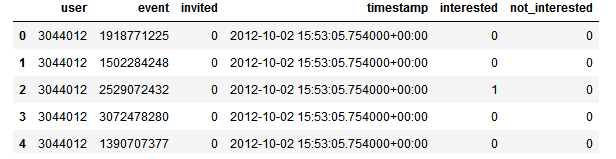
这里以train.csv为例讲解代码,其中train.csv文件如下所示:
    def rewriteData(self, start=1, train=True, header=True):

        """

        把前面user-based协同过滤和item-based协同过滤以及各种热度和影响度作为特征组合在一起

        生成新的train,用于分类器分类使用

        """

        fn = 'train.csv' if train else 'test.csv'

        fin = open(fn)

        fout = open('data_' + fn, 'w')

        #write output header

        if header:

            ocolnames = ['invited', 'user_reco', 'evt_p_reco', 'evt_c_eco', 'user_pop', 'frnd_infl', 'evt_pop']

            if train:

                ocolnames.append('interested')

                ocolnames.append('not_interested')

            fout.write( ','.join(ocolnames) + '\n' )

        ln = 0

        for line in fin:

            ln += 1

            if ln < start:

                continue

            cols = line.strip().split(',')

            #user,event,invited,timestamp,interested,not_interested

            userId = cols[0]

            eventId = cols[1]

            invited = cols[2]

            if ln % 500 == 0:

                print("%s : %d (userId, eventId) = (%s, %s)" % (fn, ln, userId, eventId))
a)逐行读取train.csv或者test.csv,逗号分隔后获取userId,eventId,和invited,即前三列信息,然后调用self.userReco( userId, eventId)方法计算user_reco:
#这是特征构建部分

#import cPickle

#From python3, cPickle has beed replaced by _pickle

import _pickle as cPickle

import scipy.io as sip

class DataRewriter:

    def __init__(self):

        #读入数据做初始化

        self.userIndex = cPickle.load( open('PE_userIndex.pkl','rb') )

        self.eventIndex = cPickle.load( open('PE_eventIndex.pkl', 'rb') )

        self.userEventScores = sio.mmread('PE_userEventScores').todense()

        self.userSimMatrix = sio.mmread('US_userSimMatrix').todense()

        self.eventPropSim = sio.mmread('EV_eventPropSim').todense()

        self.eventContSim = sio.mmread('EV_eventContSim').todense()

        self.numFriends = sio.mmread('UF_numFriends')

        self.userFriends = sio.mmread('UF_userFriends').todense()

        self.eventPopularity = sio.mmread('EA_eventPopularity').todense()

    def userReco(self, userId, eventId):

        """

        根据User-based协同过滤,得到event的推荐度

        基本的伪代码思路如下:

                for item in i

                        for every other user v that has a preference for i

                                compute similarity s between u and v

                                incorporate v's preference for i weighted by s into running average

                return top items ranked by weighted average

        """

        i = self.userIndex[userId]

        j = self.eventIndex[eventId]

        vs = self.userEventScores[:, j]

        sims = self.userSimMatrix[i, :]

        prod = sims * vs

        try:

            return prod[0, 0] - self.userEventScores[i, j]

        except IndexError:

            return 0
如在处理train.csv的第一行时,userId = 3044012, eventId = 1918771225
#import cPickle

#From python3, cPickle has beed replaced by _pickle

import _pickle as cPickle

userIndex = cPickle.load( open('PE_userIndex.pkl','rb') )

eventIndex = cPickle.load( open('PE_eventIndex.pkl', 'rb') )

userEventScores = sio.mmread('PE_userEventScores').todense()

userSimMatrix = sio.mmread('US_userSimMatrix').todense()

userId = '3044012'

eventId = '1918771225'

i = userIndex[userId]

j = eventIndex[eventId]

print('The first line in train.csv: userIndex of (userId = %s) is (i = %d) ' %(userId, i) )

print('The first line in train.csv: eventIndex of (eventId = %s) is (j = %d) ' %(eventId, j) )

vs = userEventScores[:, j]#获得所有user对event j兴趣分,即userEventScores的第j+1列

sims = userSimMatrix[i, :]#获得userSimMatrix的第i+1行,即每个user对该user的相似度

prod = sims * vs

try:

    print(prod[0, 0] - userEventScores[i, j])

except IndexError:

    print(0)
代码示例结果:

这样我们得到该user的user_reco值
b)evt_p_reco和evt_c_reco的计算
过程和上面的userReco()类似,读者可以参考eventPropSim和eventContSim的结构信息
   def eventReco(self, userId, eventId):

        """

        根据基于物品的协同过滤,得到Event的推荐度

        基本的伪代码思路:

        for item i:

            for every item j that u has a preference for

                compute similarity s between i and j

                add u's preference for j weighted by s to a running average

        return top items, ranked by weighted average

        """

        i = self.userIndex[userId]

        j = self.eventIndex[eventId]

        js = self.userEventScores[i, :]#user i对每个event的兴趣分

        psim = self.eventPropSim[:, j]

        csim = self.eventContSim[:, j]

        pprod = js * psim

        cprod = js * csim

        pscore = 0

        cscore = 0

        try:

            pscore = pprod[0, 0] - self.userEventScores[i, j]

        except IndexError:

            pass

        try:

            cscore = cprod[0, 0] - self.userEventScores[i, j]

        except IndexError:

            pass

        return pscore, cscore
c)user_pop计算:调用self.userPop()方法
这里需要用户的朋友数(已经用占比表示):
    def userPop(self, userId):

        """

        基于用户的朋友个数来推断用户的社交程度

        主要的考量是如果用户的朋友非常多,可能会更倾向于参加各种社交活动

        """

        if userId in self.userIndex:

            i = self.userIndex[userId]

            try:

                return self.numFriends[0, i]

            except IndexError:

                return 0

        else:

            return 0
d)frnd_infl计算:调用self.friendInfluence()方法,朋友对该用户的影响,即用户的所有朋友中,有多少是非常喜欢参加各种社交活动(event)的
这里需要变量self.userFriends
    def friendInfluence(self, userId):

        """

        朋友对用户的影响

        主要考虑用户的所有朋友中,有多少是非常喜欢参加各种社交活动(event)的

        用户的朋友圈如果都是积极参加各种event,可能会对当前用户有一定的影响

        """

        nusers = np.shape(self.userFriends)[1]

        i = self.userIndex[userId]

        #下面的一行代码是不是有问题呢?

        #是不是应该为某个用户的所有朋友的兴趣分之和,然后除以nusers,也就是axis应该=1

        return (self.userFriends[i, :].sum(axis=0) / nusers)[0, 0]
e)evt_pop的计算:调用self.eventPop()方法,某个event的热度,主要通过参与的人数来界定的
需要用到变量self.eventPopularity
    def eventPop(self, eventId):

        """

        活动本身的热度

        主要通过参与的参数来界定的

        """

        i = self.eventIndex[eventId]

        return self.eventPopularity[i, 0]
f)然后就是将该行的信息写入文件保存
文件信息包含:[invited, user_reco, evt_p_reco, evt_c_reco, user_pop, frnd_infl, evt_pop],如果读取的是train.csv,则还需要append 标签interested和not_interested
#读取一行,处理后,将该行写入,保存

fout.write(','.join( map(lambda x: str(x), ocols)) + '\n')
g)构建特征完整代码
#这是特征构建部分

#import cPickle

#From python3, cPickle has beed replaced by _pickle

import _pickle as cPickle

import scipy.io as sio

import numpy as np

class DataRewriter:

    def __init__(self):

        #读入数据做初始化

        self.userIndex = cPickle.load( open('PE_userIndex.pkl','rb') )

        self.eventIndex = cPickle.load( open('PE_eventIndex.pkl', 'rb') )

        self.userEventScores = sio.mmread('PE_userEventScores').todense()

        self.userSimMatrix = sio.mmread('US_userSimMatrix').todense()

        self.eventPropSim = sio.mmread('EV_eventPropSim').todense()

        self.eventContSim = sio.mmread('EV_eventContSim').todense()

        self.numFriends = sio.mmread('UF_numFriends')

        self.userFriends = sio.mmread('UF_userFriends').todense()

        self.eventPopularity = sio.mmread('EA_eventPopularity').todense()

    def userReco(self, userId, eventId):

        """

        根据User-based协同过滤,得到event的推荐度

        基本的伪代码思路如下:

                for item in i

                        for every other user v that has a preference for i

                                compute similarity s between u and v

                                incorporate v's preference for i weighted by s into running average

                return top items ranked by weighted average

        """

        i = self.userIndex[userId]

        j = self.eventIndex[eventId]

        vs = self.userEventScores[:, j]

        sims = self.userSimMatrix[i, :]

        prod = sims * vs

        try:

            return prod[0, 0] - self.userEventScores[i, j]

        except IndexError:

            return 0

    def eventReco(self, userId, eventId):

        """

        根据基于物品的协同过滤,得到Event的推荐度

        基本的伪代码思路:

        for item i:

            for every item j that u has a preference for

                compute similarity s between i and j

                add u's preference for j weighted by s to a running average

        return top items, ranked by weighted average

        """

        i = self.userIndex[userId]

        j = self.eventIndex[eventId]

        js = self.userEventScores[i, :]

        psim = self.eventPropSim[:, j]

        csim = self.eventContSim[:, j]

        pprod = js * psim

        cprod = js * csim

        pscore = 0

        cscore = 0

        try:

            pscore = pprod[0, 0] - self.userEventScores[i, j]

        except IndexError:

            pass

        try:

            cscore = cprod[0, 0] - self.userEventScores[i, j]

        except IndexError:

            pass

        return pscore, cscore

    def userPop(self, userId):

        """

        基于用户的朋友个数来推断用户的社交程度

        主要的考量是如果用户的朋友非常多,可能会更倾向于参加各种社交活动

        """

        if userId in self.userIndex:

            i = self.userIndex[userId]

            try:

                return self.numFriends[0, i]

            except IndexError:

                return 0

        else:

            return 0

    def friendInfluence(self, userId):

        """

        朋友对用户的影响

        主要考虑用户的所有朋友中,有多少是非常喜欢参加各种社交活动(event)的

        用户的朋友圈如果都是积极参加各种event,可能会对当前用户有一定的影响

        """

        nusers = np.shape(self.userFriends)[1]

        i = self.userIndex[userId]

        #下面的一行代码是不是有问题呢?

        #是不是应该为某个用户的所有朋友的兴趣分之和,然后除以nusers,也就是axis应该=1

        return (self.userFriends[i, :].sum(axis=0) / nusers)[0, 0]

    def eventPop(self, eventId):

        """

        活动本身的热度

        主要通过参与的参数来界定的

        """

        i = self.eventIndex[eventId]

        return self.eventPopularity[i, 0]

    def rewriteData(self, start=1, train=True, header=True):

        """

        把前面user-based协同过滤和item-based协同过滤以及各种热度和影响度作为特征组合在一起

        生成新的train,用于分类器分类使用

        """

        fn = 'train.csv' if train else 'test.csv'

        fin = open(fn)

        fout = open('data_' + fn, 'w')

        #write output header

        if header:

            ocolnames = ['invited', 'user_reco', 'evt_p_reco', 'evt_c_reco', 'user_pop', 'frnd_infl', 'evt_pop']

            if train:

                ocolnames.append('interested')

                ocolnames.append('not_interested')

            fout.write( ','.join(ocolnames) + '\n' )

        ln = 0

        for line in fin:

            ln += 1

            if ln < start:

                continue

            cols = line.strip().split(',')

            #user,event,invited,timestamp,interested,not_interested

            userId = cols[0]

            eventId = cols[1]

            invited = cols[2]

            if ln % 500 == 0:

                print("%s : %d (userId, eventId) = (%s, %s)" % (fn, ln, userId, eventId))

            user_reco = self.userReco( userId, eventId )

            evt_p_reco, evt_c_reco = self.eventReco( userId, eventId )

            user_pop = self.userPop( userId )

            frnd_infl = self.friendInfluence( userId )

            evt_pop = self.eventPop( eventId )

            ocols = [invited, user_reco, evt_p_reco, evt_c_reco, user_pop, frnd_infl, evt_pop]

            if train:

                ocols.append( cols[4] )#interested

                ocols.append( cols[5] )#not_interested

            fout.write(','.join( map(lambda x: str(x), ocols)) + '\n')

        fin.close()

        fout.close()

    def rewriteTrainingSet(self):

        self.rewriteData(True)

    def rewriteTestSet(self):

        self.rewriteData(False)

dr = DataRewriter()

print('生成训练数据...\n')

dr.rewriteData(train=True, start=2, header=True)

print('生成预测数据...\n')

dr.rewriteData(train=False, start=2, header=True)

print('done')
2)生成测试数据:过程和生成训练数据类似
至此,第六步完成,哪里有不明白的请留言
在特征构建好了之后,我们有很多办法去训练得到模型和完成预测
我们来看看Event Recommendation Engine Challenge分步解析第七步
Event Recommendation Engine Challenge分步解析第六步的更多相关文章
- Event Recommendation Engine Challenge分步解析第七步
一.请知晓 本文是基于: Event Recommendation Engine Challenge分步解析第一步 Event Recommendation Engine Challenge分步解析第 ...
- Event Recommendation Engine Challenge分步解析第五步
一.请知晓 本文是基于: Event Recommendation Engine Challenge分步解析第一步 Event Recommendation Engine Challenge分步解析第 ...
- Event Recommendation Engine Challenge分步解析第四步
一.请知晓 本文是基于: Event Recommendation Engine Challenge分步解析第一步 Event Recommendation Engine Challenge分步解析第 ...
- Event Recommendation Engine Challenge分步解析第三步
一.请知晓 本文是基于: Event Recommendation Engine Challenge分步解析第一步 Event Recommendation Engine Challenge分步解析第 ...
- Event Recommendation Engine Challenge分步解析第二步
一.请知晓 本文是基于Event Recommendation Engine Challenge分步解析第一步,需要读者先阅读上篇文章解析 二.用户相似度计算 第二步:计算用户相似度信息 由于用到:u ...
- Event Recommendation Engine Challenge分步解析第一步
一.简介 此项目来自kaggle:https://www.kaggle.com/c/event-recommendation-engine-challenge/ 数据集的下载需要账号,并且需要手机验证 ...
- SpringBoot 源码解析 (六)----- Spring Boot的核心能力 - 内置Servlet容器源码分析(Tomcat)
Spring Boot默认使用Tomcat作为嵌入式的Servlet容器,只要引入了spring-boot-start-web依赖,则默认是用Tomcat作为Servlet容器: <depend ...
- (转) Quick Guide to Build a Recommendation Engine in Python
本文转自:http://www.analyticsvidhya.com/blog/2016/06/quick-guide-build-recommendation-engine-python/ Int ...
- 卷积神经网络 cnnff.m程序 中的前向传播算法 数据 分步解析
最近在学习卷积神经网络,哎,真的是一头雾水!最后决定从阅读CNN程序下手! 程序来源于GitHub的DeepLearnToolbox 由于确实缺乏理论基础,所以,先从程序的数据流入手,虽然对高手来讲, ...
随机推荐
- 实验吧 WEB 貌似有点难
错误!你的IP不在允许列表之内! 提示:代码审计 这个提示可谓是非常良心了,一看源代码是一个识别ip地址的东西,如果IP为1.1.1.1那么就会得到KEY. 第一个if是判断是否有client-ip ...
- [UOJ86]mx的组合数——NTT+数位DP+原根与指标+卢卡斯定理
题目链接: [UOJ86]mx的组合数 题目大意:给出四个数$p,n,l,r$,对于$\forall 0\le a\le p-1$,求$l\le x\le r,C_{x}^{n}\%p=a$的$x$的 ...
- 一个模拟——抢票部分功能的 简单版(主要实例化一下 Lock 的使用)
""" 抢票! 多个用户在同时读写同一个数据 """ from multiprocessing import Process,Lock im ...
- QML用Qt.labs.settings实现保存用户设置
举个简单的例子: main.cpp中设置程序信息 QGuiApplication::setApplicationName("Gallery"); QGuiApplication:: ...
- python学习日记(练习,流程控制+数据结构)
简易计算器 #简易计算器,蠢新一枚,功能尚不完善,本为个人练习,仅供参考 while 1: a = input('请输入第一个运算数:').strip()#可输入前后带空格的数字 if a.lower ...
- Spring MVC工作原理 及注解说明
SpringMVC框架介绍 1) spring MVC属于SpringFrameWork的后续产品,已经融合在Spring Web Flow里面. Spring 框架提供了构建 Web 应用程序的全功 ...
- 【UOJ#236】[IOI2016]railroad(欧拉回路,最小生成树)
[UOJ#236][IOI2016]railroad(欧拉回路,最小生成树) 题面 UOJ 题解 把速度看成点,给定的路段看成边,那么现在就有了若干边,然后现在要补上若干边,以及一条\([inf,\) ...
- https搭建实例
:(用的)https://www.coderecord.cn/lets-encrypt-wildcard-certificates.html :acme.shvim .acme.sh/account. ...
- CodeForces - 589A(字符串处理)
题目链接:http://codeforces.com/problemset/problem/589/A 题目大意:给定n个邮件地址,任何电子邮件地址都将显示为“login @ domain”,其中: ...
- MongoDb 命令查询所有数据库列表
原文:http://blog.csdn.net/huxu981598436/article/details/47216493 MongoDb 命令查询所有数据库列表 CODE: > show d ...