
强化学习(六):n-step Bootstrapping
n-step Bootstrapping
n-step 方法将Monte Carlo 与 one-step TD统一起来。 n-step 方法作为 eligibility traces 的引入,eligibility traces 可以同时的在很多时间间隔进行bootstrapping.
n-step TD Prediction
one-step TD 方法只是基于下一步的奖励,通过下一步状态的价值进行bootstrapping,而MC方法则是基于某个episode的整个奖励序列。n-step 方法则是基于两者之间。使用n 步更新的方法被称作n-step TD 方法。
对于MC方法,估计\(v_{\pi}(S_t)\), 使用的是完全收益(complete return)是:
\]
而在one-step TD方法中,则是一步收益(one-step return):
\]
那么n-step return:
\]
其中 \(n\ge 1, 0\le t< T-n\)。
因为在t+n 时刻才可知道 \(R_{t+n}, V_{t+n-1}\) ,故可定义:
\]
# n-step TD for estimating V = v_pi

Input: a policy pi

Algorithm parameters: step size alpha in (0,1], a positive integer n

Initialize V(s) arbitrarily, s in S

All store and access operations (for S_t and R_t) can take their index mod n+1

Loop for each episode:

     Initialize and store S_0 != terminal

     T = infty

     Loop for t = 0,1,2,...

         if t < T, then:

             Take an action according to pi(.|S_t)

             Observe and store the next reward as R_{t+1} and the next state as S_{t+1}

             If S_{t+1} is terminal, then T = t + 1

         tau = t - n + 1 (tau is the time whose state's estimate is being updated)

         if tau >= 0:

             G = sum_{i = tau +1}^{min(tau+n,T)} gamma^{i-tau-1} R_i

             if tau + n < T, then G = G + gamma^n V(S_{tau+n})

             V(S_{tau}) = V(S_{tau} + alpha [G - V(S_tau)])

     Until tau = T - 1
n-step Sarsa
与n-step TD方法类似,只不过n-step Sarsa 使用的state-action对,而不是state:
\]
自然地:
\]
# n-step Sarsa for estimating Q = q* or q_pi

Initialize Q(s,a) arbitrarily, for all s in S, a in A

Initialize pi to be e-greedy with respect to Q, or to a fixed given policy

Algorithm parameters: step size alpha in (0,1], small e >0, a positive integer n

All store and access operations (for S_t, A_t and R_t) can take their index mod n+1

Loop for each episode:

     Initialize and store S_o != terminal

     Select and store an action A_o from pi(.|S_0)

     T = infty

     Loop for t = 0,1,2,...:

         if t < T, then:

             Take action A_t

             Observe and store the next reward as R_{t+1} and the next state as S_{t+1}

             If S_{t+1} is terminal, then:

                  T = t + 1

             else:

                 Select and store an action A_{t+1} from pi(.|S_{t+1})

         tau = t - n + 1 (tau is the time whose estimate is being  updated)

         if tau >= 0:

             G = sum_{i = tau+1}^{min(tau+n,T)} gamma^{i-tau-1}R_i

             if tau + n < T, then G = G + gamma^nQ(S_{tau +n}, A_{tau+n})

             Q(S_tau,A_tau) = Q(S_{tau},A_{tau}) + alpha [ G - Q(S_{tau},A_{tau})]
至于 Expected Sarsa:
\]
\]
n-step Off-policy Learning by Importance Sampling
一个简单off-policy 版的 n-step TD:
\]
其中 \(\rho_{t:t+n-1}\) 是 importance sampling ratio:
\]
off-policy n-step Sarsa更新形式:
\]
# Off-policy n-step Sarsa for estimating Q = q* or q_pi

Input: an arbitrary behavior policy b such that b(a|s) > 0, for all s in S, a in A

Initialize pi to be greedy with respect to Q, or as a fixed given policy

Algorithm parameters: step size alpha in (0,1], a positive integer n

All store and access operations (for S_t, A_t, and R_t) can take their index mod n + 1

Loop for each episode:

    Initialize and store S_0 != terminal

    Select and store an action A_0 from b(.|S0)

    T = infty

    Loop for t = 0,1,2,...:

        if t<T, then:

            take action At

            Observe and store the next reward as R_{t+1} and the next state as S_{t+1}

            if S_{t+1} is terminal, then:

                 T = t+1

            else:

                 select and store an action A_{t+1} from b(.|S_{t+1})

        tau = t - n + 1 (tau is the time whose estimate is being updated)

        if tau >=0:

            rho = \pi_{i = tau+1}^min(tau+n-1, T-1) pi(A_i|S_i)/b(A_i|S_i)

            G = sum_{i = tau +1}^min(tau+n, T) gamma^{i-tau-1}R_i

            if tau + n < T, then: G = G + gamma^n Q(S_{tau+n}, A_{tau+n})

            Q(S_tau,A_tau) = Q(S_tau, A_tau) + alpha rho [G-Q(s_tau, A_tau)]

            if pi is being learned, then ensure that pi(.|S_tau) is greedy wrt Q

    Until tau = T - 1
Per-decision Off-policy Methods with Control Variates
pass
Off-policy Learning without Importance Sampling: The n-step Tree Backup Algorithm
tree-backup 算法是一种可以不借助importance sampling的off-policy n-step 方法。 tree-backup 的更新基于整个估计行动价值树,或者说,更新是基于树中叶结点(未被选中的行动)的估计的行动价值。树的内部的行动结点(即实际被选择的行动)不参加更新。
\]
G_{t:t+2} &\dot =& R_{t+1} + \gamma\sum_{a \ne A_{t+1}} \pi(a|S_{t+1})Q_{t+1}(S_{t+1},a)+ \gamma \pi(A_{t+1}|S_{t+1})(R_{t+2}+\gamma \sum_{a}\pi(a|S_{t+2},a)) \\
& = & R_{t+1} + \gamma\sum_{a\ne A_{t+1}}\pi(a|S_{t+1})Q_{t+1}(S_{t+1},a) + \gamma\pi(A_{t+1}|S_{t+1})G_{t+1:t+2}
\end{array}
\]
于是
\]
算法更新规则:
\]
# n-step Tree Backup for estimating Q = q* or q_pi

Initialize Q(s,a) arbitrarily, for all s in S, a in A

Initialize pi to be greedy with respect to Q, or as a fixed given policy

Algorithm parameters: step size alpha in (0,1], a positive integer n

All store and access operations can take their index mod n+1

Loop for each episode:

    Initialize and store S_0 != terminal

    Choose an action A_0 arbitrarily as a function of S_0; Store A_0

    T = infty

    Loop for t = 0,1,2,...:

        If t < T:

            Take action A_t; observe and store the next reward and state as R_{t+1}, S_{t+1}

            if S_{t+1} is terminal:

                T = t + 1

            else:

                Choose an action A_{t+1} arbitrarily as a function of S_{t+1}; Store A_{t+1}

        tau = t+1 - n (tau is the time whose estimate is being updated)

        if tau >= 0:

            if t + 1 >= T:

                G = R_T

            else:

                G = R_{t+1} + gamma sum_{a} pi(a|S_{t+1})Q(S_{t+1},a)

            Loop for k = min(t, T - 1) down through tau + 1:

                G = R_k + gamma sum_{a != A_k}pi(a|S_k)Q(S_k,a) + gamma pi(A_k|S_k) G

            Q(S_tau,A_tau) = Q(S_tau,A_tau) + alpha [G - Q(S_tau,A_tau)]

            if pi is being learned, then ensure that pi(.|S_tau) is greedy wrt Q

     Until tau = T - 1
*A Unifying Algorithm: n-step Q(\(\sigma\))
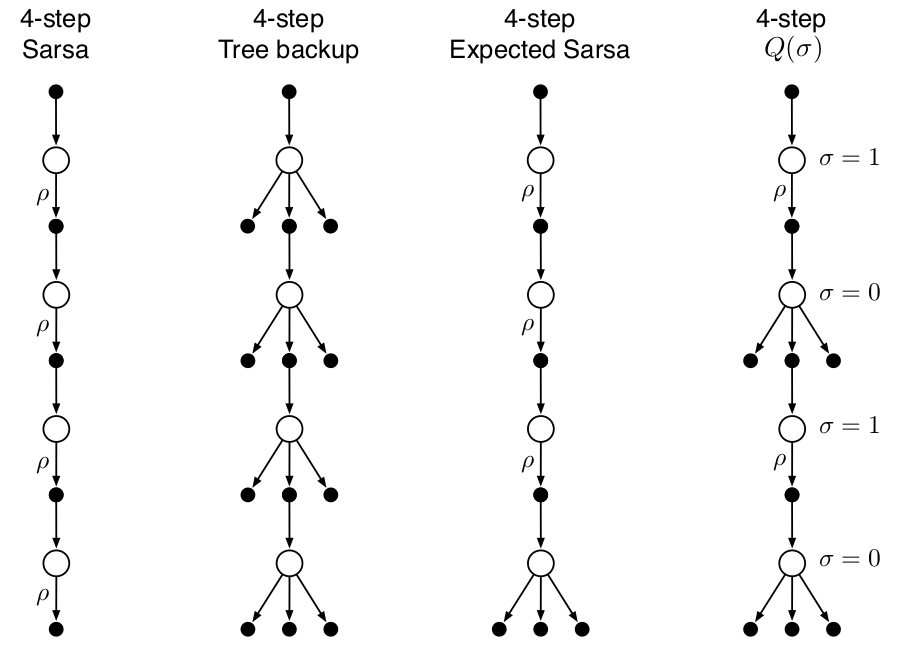
在n-step Sarsa方法中,使用所有抽样转换(transitions), 在tree-backup 方法中,使用state-to-action所有分支的转换,而非抽样,而在期望 n-step 方法中,除了最后一步不使用抽样而使用所有分支的转换外,其他所有都进行抽样转换。
为统一以上三种算法,有一种思路是引入一个随机变量抽样率:\(\sigma\in [0,1]\),当其取1时,表示完全抽样,当取0时表示使用期望而不抽样。
根据tree-backup n-step return (h = t + n)以及\(\bar V\):
G_{t:h} &\dot =& R_{t+1} + \gamma\sum_{a\ne A_{t+1}}\pi(a|S_{t+1})Q_{t+1}(S_{t+1},a) + \gamma\pi(A_{t+1}|S_{t+1})G_{t+1:h}\\
& = & R_{t+1} +\gamma \bar V_{h-1} (S_{t+1}) - \gamma\pi(A_{t+1}|S_{t+1})Q_{h-1}(S_{t+1},A_{t+1}) + \gamma\pi(A_{t+1}| S_{t+1})G_{t+1:h}\\
& =& R_{t+1} +\gamma\pi(A_{t+1}|S_{t+1})(G_{t+1:h} - Q_{h-1}(S_{t+1},A_{t+1})) + \gamma \bar V_{h-1}(S_{t+1})\\
\\
&& (\text{引入}, \sigma)\\
\\
& = & R_{t+1} + \gamma(\sigma_{t+1}\rho_{t+1} + (1 - \sigma_{t+1})\pi(A_{t+1}|S_{t+1}))(G_{t+1:h} - Q_{h-1}(S_{t+1}, A_{t+1})) + \gamma \bar V_{h-1}(S_{t+1})
\end{array}
\]
# n-step Tree Backup for estimating Q = q* or q_pi

Initialize Q(s,a) arbitrarily, for all s in S, a in A

Initialize pi to be greedy with respect to Q, or as a fixed given policy

Algorithm parameters: step size alpha in (0,1], a positive integer n

All store and access operations can take their index mod n+1

Loop for each episode:

    Initialize and store S_0 != terminal

    Choose an action A_0 arbitrarily as a function of S_0; Store A_0

    T = infty

    Loop for t = 0,1,2,...:

        If t < T:

            Take action A_t; observe and store the next reward and state as R_{t+1}, S_{t+1}

            if S_{t+1} is terminal:

                T = t + 1

            else:

                Choose an action A_{t+1} arbitrarily as a function of S_{t+1}; Store A_{t+1}

                Select and store sigma_{t+1}

                Store rho_{t+1} = pi(A_{t+1}|S_{t+1})/b(A_{t+1}|S_{t+1})

        tau = t+1 - n (tau is the time whose estimate is being updated)

        if tau >= 0:

            G = 0

            Loop for k = min(t, T - 1) down through tau + 1:

                if k = T:

                    G = R_t

                else:

                     V_bar = sum_{a} pi(a|S_k) Q(S_k,a)

                     G = R_k + gamma(simga_k rho_k + (1-simga_k)pi(A_k|S_k))(G - Q(S_k,A_k)) + gamma V_bar

            Q(S_tau,A_tau) = Q(S_tau,A_tau) + alpha [G - Q(S_tau,A_tau)]

            if pi is being learned, then ensure that pi(.|S_tau) is greedy wrt Q

     Until tau = T - 1
强化学习(六):n-step Bootstrapping的更多相关文章
- 强化学习(六)时序差分在线控制算法SARSA
在强化学习(五)用时序差分法(TD)求解中,我们讨论了用时序差分来求解强化学习预测问题的方法,但是对控制算法的求解过程没有深入,本文我们就对时序差分的在线控制算法SARSA做详细的讨论. SARSA这 ...
- 【转载】 强化学习(六)时序差分在线控制算法SARSA
原文地址: https://www.cnblogs.com/pinard/p/9614290.html ------------------------------------------------ ...
- 强化学习(十六) 深度确定性策略梯度(DDPG)
在强化学习(十五) A3C中,我们讨论了使用多线程的方法来解决Actor-Critic难收敛的问题,今天我们不使用多线程,而是使用和DDQN类似的方法:即经验回放和双网络的方法来改进Actor-Cri ...
- 强化学习(五)用时序差分法(TD)求解
在强化学习(四)用蒙特卡罗法(MC)求解中,我们讲到了使用蒙特卡罗法来求解强化学习问题的方法,虽然蒙特卡罗法很灵活,不需要环境的状态转化概率模型,但是它需要所有的采样序列都是经历完整的状态序列.如果我 ...
- 强化学习(八)价值函数的近似表示与Deep Q-Learning
在强化学习系列的前七篇里,我们主要讨论的都是规模比较小的强化学习问题求解算法.今天开始我们步入深度强化学习.这一篇关注于价值函数的近似表示和Deep Q-Learning算法. Deep Q-Lear ...
- 强化学习(七)时序差分离线控制算法Q-Learning
在强化学习(六)时序差分在线控制算法SARSA中我们讨论了时序差分的在线控制算法SARSA,而另一类时序差分的离线控制算法还没有讨论,因此本文我们关注于时序差分离线控制算法,主要是经典的Q-Learn ...
- 【转载】 强化学习(八)价值函数的近似表示与Deep Q-Learning
原文地址: https://www.cnblogs.com/pinard/p/9714655.html ------------------------------------------------ ...
- 【转载】 强化学习(七)时序差分离线控制算法Q-Learning
原文地址: https://www.cnblogs.com/pinard/p/9669263.html ------------------------------------------------ ...
- 强化学习中的无模型 基于值函数的 Q-Learning 和 Sarsa 学习
强化学习基础: 注: 在强化学习中 奖励函数和状态转移函数都是未知的,之所以有已知模型的强化学习解法是指使用采样估计的方式估计出奖励函数和状态转移函数,然后将强化学习问题转换为可以使用动态规划求解的 ...
- DRL强化学习:
IT博客网 热点推荐 推荐博客 编程语言 数据库 前端 IT博客网 > 域名隐私保护 免费 DRL前沿之:Hierarchical Deep Reinforcement Learning 来源: ...
随机推荐
- cshtml razor
禁止转换字符 @(Html.Raw(@item.conent)) 三目运算 @(ViewBag.submitType==1?"blue":"")
- 2018-2019-3 网络对抗技术 20165305 Exp3 免杀原理与实践
1.实验内容及步骤 1.1 正确使用msf编码器,msfvenom生成如jar之类的其他文件,veil-evasion,加壳工具,使用shellcode编程 将做实验二时生成的后门文件用virusto ...
- nodejs笔记之连接mysql数据库
1.安装mysql模块: npm install mysql 2.引入mysql模块 创建一个server.js文件 const http = require("http"); c ...
- setInterval中this
今天使用react做钟表,自然用到了setInterval,但是出现this指向不明的问题. <html> <head> <meta charset="UTF- ...
- kafka 控制台命令
后台启动:bin/kafka-server-start.sh config/server.properties > /dev/null 2>&1 & 启动生产者:bin/k ...
- 小试wsl
安装 管理员权限运行powershell,执行如下命令: Enable-WindowsOptionalFeature -Online -FeatureName Microsoft-Windows-Su ...
- 01: 腾讯云API-云服务器
1.1 云服务器 1.腾讯云SDK使用举例 网址:https://cloud.tencent.com/document/sdk/Python #! /usr/bin/env python # -*- ...
- 解决 httpclient 下 Address already in use: connect 的错误
最近做httpclient做转发服务,发现服务器上总是有很多close_wait状态的连接,而且这些连接都不会关闭,最后导致服务器没法建立新的网络连接,从而停止响应. 后来在网上搜索了一下,发现解决的 ...
- spring boot+自定义 AOP 实现全局校验
最近公司重构项目,重构为最热的微服务框架 spring boot, 重构的时候遇到几个可以统一处理的问题,也是项目中经常遇到,列如:统一校验参数,统一捕获异常... 仅凭代码 去控制参数的校验,有时候 ...
- CF 528D. Fuzzy Search NTT
CF 528D. Fuzzy Search NTT 题目大意 给出文本串S和模式串T和k,S,T为DNA序列(只含ATGC).对于S中的每个位置\(i\),只要中[i-k,i+k]有一个位置匹配了字符 ...