
Composite 模式的实现
实现要点:
1.组合模式采用树形结构来实现普遍存在的对象容器,从而将“一对多”的关系转化“一对一”的关系,使得客户代码可以一致地处理对象和对象容器,无需关心处理的是单个的对象,还是组合的对象容器。
2.将“客户代码与复杂的对象容器结构”解耦是组合模式的核心思想,解耦之后,客户代码将与纯粹的抽象接口——而非对象容器的复内部实现结构——发生依赖关系,从而更能“应对变化”。
3.组合模式中,是将“Add和Remove等和对象容器相关的方法”定义在“表示抽象对象的Component类”中,还是将其定义在“表示对象容器的Composite类”中,是一个关乎“透明性”和“安全性”的两难问题,需要仔细权衡。这里有可能违背面向对象的“单一职责原则”,但是对于这种特殊结构,这又是必须付出的代价。
4.组合模式在具体实现中,可以让父对象中的子对象反向追溯;如果父对象有频繁的遍历需求,可使用缓存技巧来改善效率。
5. 客户端尽量不要直接调用树叶类的方法,而是借助其父类(Component)的多态性完成调用,这样可以增加代码的复用性。
使用场景:
以下情况下适用组合模式:
1.你想表示对象的部分-整体层次结构。
2.你希望用户忽略组合对象与单个对象的不同,用户将统一地使用组合结构中的所有对象。
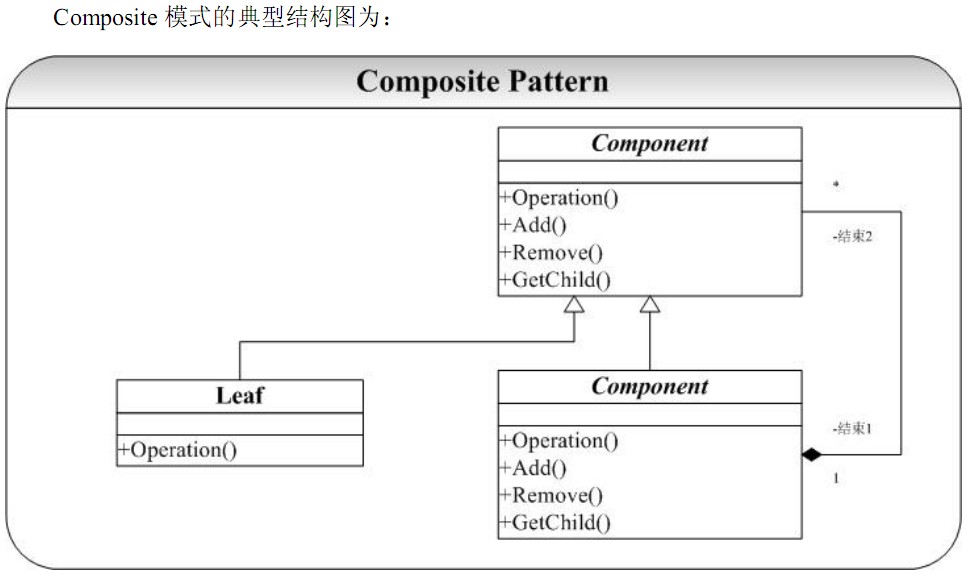
/////////////////Component.h////////////////////////
 #pragma once

 class Component

 {

 public:

     virtual ~Component();

     Component();

     virtual void Operation() =  ;

     virtual void Add( Component*);

     virtual void Remove( Component*);

     virtual Component* GetChild(int);

 protected:

 private:

 };
 /////////////////Component.cpp////////////////////////

 #include "Component.h"

 Component::Component()

 {

 }

 Component::~Component()

 {

 }

 void Component::Add( Component* com)

 {

 }

 void Component::Remove( Component* com)

 {

 }

 void Component::Operation()

 {

 }

 Component* Component::GetChild(int index)

 {

     return ;

 }
 /////////////////Composite.h////////////////////////

 #pragma once

 #include "Component.h"

 #include <vector>

 using namespace std;

 class Composite : public Component

 {

 public:

     Composite(const string&);

     ~Composite();

     void Operation() ;

     void Add( Component*);

     void Remove( Component*);

     Component* GetChild(int);

 protected:

 private:

     vector<Component*> comVec ;

     string  _name ;

 };
 /////////////////Composite.cpp////////////////////////

 #include "Composite.h"

 #include "Component.h"

 #include <iostream>

 #include <string>

 using namespace std;

 Composite::Composite(const string& name)

 {

     _name = name ;

 }

 Composite::~Composite()

 {

 }

 void Composite::Operation()

 {

     cout<<"Composite operation : "<<_name<<endl;

     vector<Component*>::iterator iter = comVec.begin();

     for (;iter != comVec.end() ; iter++)

     {

         if (_name == "Com2")

         {

             cout<<"------";

         }

         if (_name == "Com1")

         {

             cout<<"---";

         }

         (*iter)->Operation();

     }

 }

 void Composite::Add( Component* com)

 {

     comVec.push_back(com);

 }

 void Composite::Remove( Component* com)

 {

     for (vector<Component*>::iterator it = comVec.begin() ; it != comVec.end() ;)

     {

         if (com == *it)

         {

             it = comVec.erase(it);

         }

         else

         {

             it++;

         }

     }

 }

 Component* Composite::GetChild(int index)

 {

     return comVec[index] ;

 }
 ////////////////////Leaf.h///////////////////////

 #pragma once

 #include "Component.h"

 #include <iostream>

 #include <string>

 using namespace std;

 class Leaf : public Component

 {

 public:

     Leaf(const string&);

     ~Leaf();

     void Operation();

 protected:

 private:

     string _name;

 };

 Leaf::Leaf(const string& name)

 {

     _name = name ;

 }

 Leaf::~Leaf()

 {

 }

 void Leaf::Operation()

 {

     cout<<"Leaf operation : "<< _name <<endl;

 }
 /////////////////main////////////////////////////

 #include "Component.h"

 #include "Composite.h"

 #include "Leaf.h"

 #include <iostream>

 #include <string>

 using namespace std;

 int main()

 {

     Component* leaf1 = new Leaf("leaf1") ;

     Component* leaf2 = new Leaf("leaf2") ;

     Component* leaf3 = new Leaf("leaf3") ;

     Component* com1 = new Composite("Com1");

     com1->Add(leaf1);

     com1->Add(leaf2);

     com1->Add(leaf3);

     Component* leaf4 = new Leaf("leaf4") ;

     Component* leaf5 = new Leaf("leaf5") ;

     Component* com2 = new Composite("Com2");

     com2->Add(leaf4);

     com2->Add(leaf5);

     com1->Add(com2);

     com1->Operation();

     getchar();

     return ;

 }

Composite 模式的实现的更多相关文章
- 组合模式/composite模式/对象结构型模式
组合模式/composite模式/对象结构型 意图 将对象组合成树形结构以表示"整体--部分"的层次结构.Composite使得用户对单个对象和组合对象的使用具有一致性. 动机 C ...
- C++基础——模拟事务 (2)Composite模式
=================================版权声明================================= 版权声明:原创文章 禁止转载 请通过右侧公告中的“联系邮 ...
- Composite模式
1 意图:将对象组成树形结构,以表示“部分——整体”的层次结构.Composite使得用户对单个对象和组合对象的使用具有一致性. 2 动机:同意处理图元对象和包含图元的容器对象.Composite通过 ...
- Java 实现组合(Composite)模式
类图 /** * 树 总体 * * @author stone * */ public class Tree { private TreeNode root; //根节点 public Tree(St ...
- 【结构型】Composite模式
组合模式意在将对象组合成树形结构以表示部分与整体的层次结构关系,并且用户对单个对象的操作以有对组合对象的操作都是一致的.即:组合对象 is-a 单个对象,同时又可以组合着 n 个的单个对象(甚至于其他 ...
- (原创)composite模式和bridge模式是天生的好朋友
composite模式的意图是:将对象组合成树形结构以表示“部分-整体”的层次结构.composite使得用户对单个对象和组合对象的使用具有一致性.它的类图如下: composite模式的实现分为透明 ...
- Java设计模式(8)组合模式(Composite模式)
Composite定义:将对象以树形结构组织起来,以达成“部分-整体” 的层次结构,使得客户端对单个对象和组合对象的使用具有一致性. Composite比较容易理解,想到Composite就应该想到树 ...
- 设计模式之——Composite模式
composite模式又叫做组合模式/复合模式. 它是一种能够使容器与内容具有一致性,创造出递归结构的模式. 示例程序是列出文件夹以及其内部文件与文件夹一览的功能: 可以由示例图看出,有一个电影文件夹 ...
- Composite模式 组合模式
Android的ViewGroup 和 View 的关系,即是采用组合模式 1. 概述 在数据结构里面,树结构是很重要,我们可以把树的结构应用到设计模式里面. 例子1:就是多级树形菜单. 例子2:文件 ...
- Composite模式(组合设计模式)
Composite 设计模式? 在计算机的文件系统中,有"文件夹"的概念(在有些操作系统(Linux操作系统)中,也称为"目录").文件夹里面既可以放入文件,也 ...
随机推荐
- [XenServer] XenServer修改IP 以及 root密码
A.修改IP以及DNS 1. root用户登录console 2.输入命令获得UUID xe pif-list 3.利用UUID查看之前的IP,注意替换下面的1111111111 xe pif-pa ...
- HDOJ 1237题 简单计算器
简单计算器 Time Limit: 2000/1000 MS (Java/Others) Memory Limit: 65536/32768 K (Java/Others) Total Submiss ...
- JavaScript 概览 更新时间2014-0414-0837
一些概念 DOM(文档对象模型)是HTML和XML的应用程序接口(API).DOM Level1规划文档结构:DOM Level2扩展了对鼠标和用户界面事件等的支持:DOM Level3支持了XML1 ...
- 【转】VS2013编译libjpeg库
原文地址:http://blog.csdn.net/weixinhum/article/details/42718959 现在,很多图像处理工具和开源库都给出了图像解码的函数接口,然而有时这些接口并不 ...
- poj 1789 Truck History【最小生成树prime】
Truck History Time Limit: 2000MS Memory Limit: 65536K Total Submissions: 21518 Accepted: 8367 De ...
- windows Nginx基本使用方法
相信很多人都听过nginx,这个小巧的东西慢慢地在吞食apache和IIS的份额.那究竟它有什么作用呢?可能很多人未必了解. 说到反向代理,可能很多人都听说,但具体什么是反向代理,很多人估计就不清楚了 ...
- Eclipse(PHP、JAVA)的快捷键大全
Eclipse是一个开放源代码的软件开发项目,专注于为高度集成的工具开发提 供一个全功能的.具有商业品质的工业平台.它主要由Eclipse项目.Eclipse工具项目和Eclipse技术项目三个项目组 ...
- windows 下删除.svn文件
Windows Registry Editor Version 5.00 [HKEY_LOCAL_MACHINE\SOFTWARE\Classes\Folder\shell\DeleteSVN] @= ...
- 支持MySql的数据库自动分表工具DBShardTools发布
支持MySql的数据库自动分表工具DBShardTools发布 前段时间参与了公司的一个项目,这个项目的特点是数据量.访问量都比较大,考虑使用数据库水平分表策略,Google了大半天,竟然没有找到分表 ...
- [RxJS] Transformation operators: debounce and debounceTime
Debounce and debounceTime operators are similar to delayWhen and delay, with the difference that the ...