
[LeetCode] Minesweeper 扫雷游戏
Let's play the minesweeper game (Wikipedia, online game)!
You are given a 2D char matrix representing the game board. 'M' represents an unrevealed mine, 'E' represents an unrevealed empty square, 'B' represents a revealed blank square that has no adjacent (above, below, left, right, and all 4 diagonals) mines, digit ('1' to '8') represents how many mines are adjacent to this revealed square, and finally 'X' represents a revealed mine.
Now given the next click position (row and column indices) among all the unrevealed squares ('M' or 'E'), return the board after revealing this position according to the following rules:
- If a mine ('M') is revealed, then the game is over - change it to 'X'.
- If an empty square ('E') with no adjacent mines is revealed, then change it to revealed blank ('B') and all of its adjacent unrevealed squares should be revealed recursively.
- If an empty square ('E') with at least one adjacent mine is revealed, then change it to a digit ('1' to '8') representing the number of adjacent mines.
- Return the board when no more squares will be revealed.
Example 1:
Input:

[['E', 'E', 'E', 'E', 'E'],

 ['E', 'E', 'M', 'E', 'E'],

 ['E', 'E', 'E', 'E', 'E'],

 ['E', 'E', 'E', 'E', 'E']]

Click : [3,0]

Output:

[['B', '1', 'E', '1', 'B'],

 ['B', '1', 'M', '1', 'B'],

 ['B', '1', '1', '1', 'B'],

 ['B', 'B', 'B', 'B', 'B']]

Explanation:
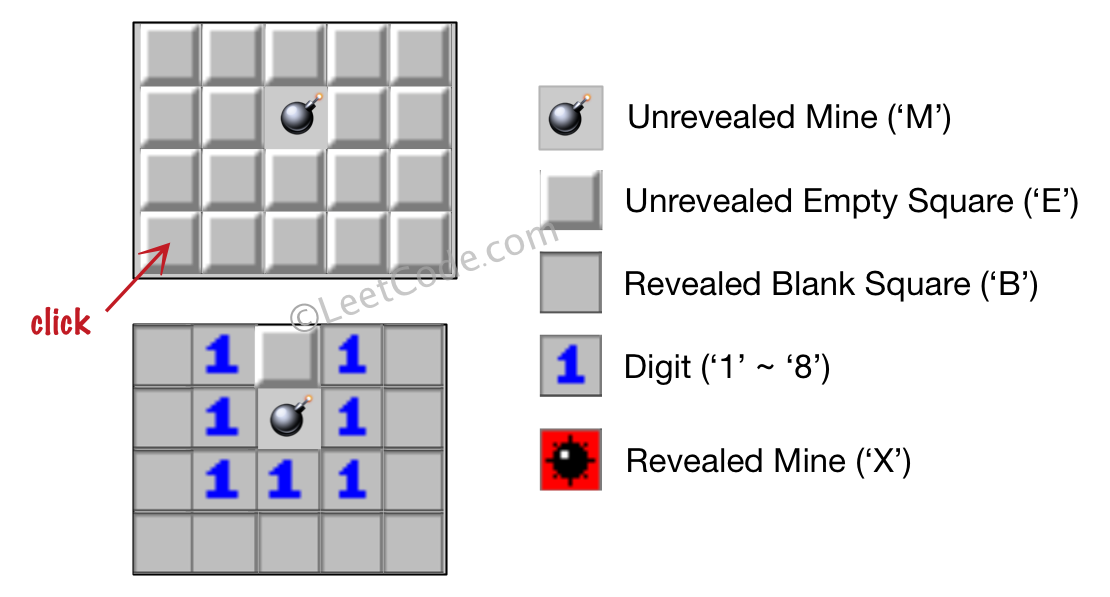
Example 2:
Input:

[['B', '1', 'E', '1', 'B'],

 ['B', '1', 'M', '1', 'B'],

 ['B', '1', '1', '1', 'B'],

 ['B', 'B', 'B', 'B', 'B']]

Click : [1,2]

Output:

[['B', '1', 'E', '1', 'B'],

 ['B', '1', 'X', '1', 'B'],

 ['B', '1', '1', '1', 'B'],

 ['B', 'B', 'B', 'B', 'B']]

Explanation:
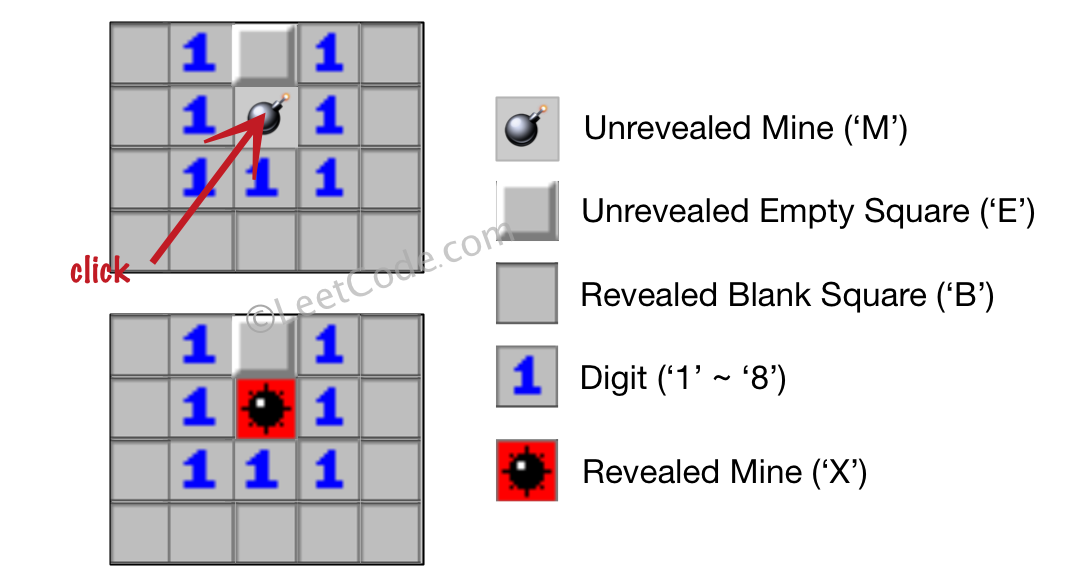
Note:
- The range of the input matrix's height and width is [1,50].
- The click position will only be an unrevealed square ('M' or 'E'), which also means the input board contains at least one clickable square.
- The input board won't be a stage when game is over (some mines have been revealed).
- For simplicity, not mentioned rules should be ignored in this problem. For example, you don't need to reveal all the unrevealed mines when the game is over, consider any cases that you will win the game or flag any squares.
这道题就是经典的扫雷游戏啦,经典到不能再经典,从Win98开始,附件中始终存在的游戏,和纸牌、红心大战、空当接龙一起称为四大天王,曾经消耗了博主太多的时间。小时侯一直不太会玩扫雷,就是瞎点,完全不根据数字分析,每次点几下就炸了,就觉得这个游戏好无聊。后来长大了一些,慢慢的理解了游戏的玩法,才发现这个游戏果然很经典,就像破解数学难题一样,充满了挑战与乐趣。花样百出的LeetCode这次把扫雷出成题,让博主借机回忆了一把小时侯,不错不错,那么来做题吧。题目中图文并茂,相信就算是没玩过扫雷的也能弄懂了,而且规则也说的比较详尽了,那么我们相对应的做法也就明了了。对于当前需要点击的点,我们先判断是不是雷,是的话直接标记X返回即可。如果不是的话,我们就数该点周围的雷个数,如果周围有雷,则当前点变为雷的个数并返回。如果没有的话,我们再对周围所有的点调用递归函数再点击即可。参见代码如下:
解法一:
class Solution {

public:

    vector<vector<char>> updateBoard(vector<vector<char>>& board, vector<int>& click) {

        if (board.empty() || board[].empty()) return {};

        int m = board.size(), n = board[].size(), row = click[], col = click[], cnt = ;

        if (board[row][col] == 'M') {

            board[row][col] = 'X';

        } else {

            for (int i = -; i < ; ++i) {

                for (int j = -; j < ; ++j) {

                    int x = row + i, y = col + j;

                    if (x <  || x >= m || y <  || y >= n) continue;

                    if (board[x][y] == 'M') ++cnt;

                }

            }

            if (cnt > ) {

                board[row][col] = cnt + '';

            } else {

                board[row][col] = 'B';

                for (int i = -; i < ; ++i) {

                    for (int j = -; j < ; ++j) {

                        int x = row + i, y = col + j;

                        if (x <  || x >= m || y <  || y >= n) continue;

                        if (board[x][y] == 'E') {

                            vector<int> nextPos{x, y};

                            updateBoard(board, nextPos);

                        }

                    }

                }

            }

        }

        return board;

    }

};
下面这种解法跟上面的解法思路基本一样,写法更简洁了一些。可以看出上面的解法中的那两个for循环出现了两次,这样显得代码比较冗余,一般来说对于重复代码是要抽离成函数的,但那样还要多加个函数,也麻烦。我们可以根据第一次找周围雷个数的时候,若此时cnt个数为0并且标识是E的位置记录下来,那么如果最后雷个数确实为0了的话,我们直接遍历我们保存下来为E的位置调用递归函数即可,就不用再写两个for循环了,参见代码如下:
解法二:
class Solution {

public:

    vector<vector<char>> updateBoard(vector<vector<char>>& board, vector<int>& click) {

        if (board.empty() || board[].empty()) return {};

        int m = board.size(), n = board[].size(), row = click[], col = click[], cnt = ;

        if (board[row][col] == 'M') {

            board[row][col] = 'X';

        } else {

            vector<vector<int>> neighbors;

            for (int i = -; i < ; ++i) {

                for (int j = -; j < ; ++j) {

                    int x = row + i, y = col + j;

                    if (x <  || x >= m || y <  || y >= n) continue;

                    if (board[x][y] == 'M') ++cnt;

                    else if (cnt ==  && board[x][y] == 'E') neighbors.push_back({x, y});

                }

            }

            if (cnt > ) {

                board[row][col] = cnt + '';

            } else {

                for (auto a : neighbors) {

                    board[a[]][a[]] = 'B';

                    updateBoard(board, a);

                }

            }

        }

        return board;

    }

};
下面这种方法是上面方法的迭代写法,用queue来存储之后要遍历的位置,这样就不用递归调用函数了,参见代码如下:
解法三:
class Solution {

public:

    vector<vector<char>> updateBoard(vector<vector<char>>& board, vector<int>& click) {

        if (board.empty() || board[].empty()) return {};

        int m = board.size(), n = board[].size();

        queue<pair<int, int>> q({{click[], click[]}});

        while (!q.empty()) {

            int row = q.front().first, col = q.front().second, cnt = ; q.pop();

            vector<pair<int, int>> neighbors;

            if (board[row][col] == 'M') board[row][col] = 'X';

            else {

                for (int i = -; i < ; ++i) {

                    for (int j = -; j < ; ++j) {

                        int x = row + i, y = col + j;

                        if (x <  || x >= m || y <  || y >= n) continue;

                        if (board[x][y] == 'M') ++cnt;

                        else if (cnt ==  && board[x][y] == 'E') neighbors.push_back({x, y});

                    }

                }

            }

            if (cnt > ) board[row][col] = cnt + '';

            else {

                for (auto a : neighbors) {

                    board[a.first][a.second] = 'B';

                    q.push(a);

                }

            }

        }

        return board;

    }

};
参考资料:
https://discuss.leetcode.com/topic/80844/c-16-lines-bfs/2
https://discuss.leetcode.com/topic/80802/java-solution-dfs-bfs
LeetCode All in One 题目讲解汇总(持续更新中...)
[LeetCode] Minesweeper 扫雷游戏的更多相关文章
- Leetcode 529.扫雷游戏
扫雷游戏 让我们一起来玩扫雷游戏! 给定一个代表游戏板的二维字符矩阵. 'M' 代表一个未挖出的地雷,'E' 代表一个未挖出的空方块,'B' 代表没有相邻(上,下,左,右,和所有4个对角线)地雷的已挖 ...
- Java实现 LeetCode 529 扫雷游戏(DFS)
529. 扫雷游戏 让我们一起来玩扫雷游戏! 给定一个代表游戏板的二维字符矩阵. 'M' 代表一个未挖出的地雷,'E' 代表一个未挖出的空方块,'B' 代表没有相邻(上,下,左,右,和所有4个对角线) ...
- 529 Minesweeper 扫雷游戏
详见:https://leetcode.com/problems/minesweeper/description/ C++: class Solution { public: vector<ve ...
- 529. Minesweeper扫雷游戏
[抄题]: Let's play the minesweeper game (Wikipedia, online game)! You are given a 2D char matrix repre ...
- Leetcode之广度优先搜索(BFS)专题-529. 扫雷游戏(Minesweeper)
Leetcode之广度优先搜索(BFS)专题-529. 扫雷游戏(Minesweeper) BFS入门详解:Leetcode之广度优先搜索(BFS)专题-429. N叉树的层序遍历(N-ary Tre ...
- [Swift]LeetCode529. 扫雷游戏 | Minesweeper
Let's play the minesweeper game (Wikipedia, online game)! You are given a 2D char matrix representin ...
- [LeetCode] 529. Minesweeper 扫雷
Let's play the minesweeper game (Wikipedia, online game)! You are given a 2D char matrix representin ...
- Java练习(模拟扫雷游戏)
要为扫雷游戏布置地雷,扫雷游戏的扫雷面板可以用二维int数组表示.如某位置为地雷,则该位置用数字-1表示, 如该位置不是地雷,则暂时用数字0表示. 编写程序完成在该二维数组中随机布雷的操作,程序读入3 ...
- 基于jQuery经典扫雷游戏源码
分享一款基于jQuery经典扫雷游戏源码.这是一款网页版扫雷小游戏特效代码下载.效果图如下: 在线预览 源码下载 实现的代码. html代码: <center> <h1>j ...
随机推荐
- SQL注入之Sqli-labs系列第三篇
废话不在多说 let's go! 继续挑战第三关(Error Based- String) 1.访问地址,加入参数后 and 1=1和and 1=2进行测试,木有任何动静 2.再使用 ' 出现报 ...
- [poj2585]Window Pains_拓扑排序
Window Pains poj-2585 题目大意:给出一个4*4的方格表,由9种数字组成.其中,每一种数字只会出现在特定的位置,后出现的数字会覆盖之前在当前方格表内出现的.询问当前给出的方格表是否 ...
- easyUi五个常用插件
1.对话框(Dialog) 对话框(dialog)是一个特殊类型的窗口,它在顶部有一个工具栏,在底部有一个按钮栏.默认情况下,对话框(dialog)只有一个显示在头部右侧的关闭工具.用户可以配置对话框 ...
- 设计模式之 外观模式详解(Service第三者插足,让action与dao分手)
作者:zuoxiaolong8810(左潇龙),转载请注明出处,特别说明:本博文来自博主原博客,为保证新博客中博文的完整性,特复制到此留存,如需转载请注明新博客地址即可. 各位好,LZ今天给各位分享一 ...
- [BZOJ 1079][SCOI 2008]着色方案
1079: [SCOI2008]着色方案 Time Limit: 10 Sec Memory Limit: 162 MBSubmit: 2237 Solved: 1361[Submit][Stat ...
- 深入理解C++ new/delete, new []/delete[]动态内存管理
在C语言中,我们写程序时,总是会有动态开辟内存的需求,每到这个时候我们就会想到用malloc/free 去从堆里面动态申请出来一段内存给我们用.但对这一块申请出来的内存,往往还需要我们对它进行稍许的“ ...
- 课堂作业 泛型类-Bag
自定义泛型类Bag 一.具体代码: 代码连接 二.伪代码: 1.思路: 老师讲完后我的想法是要做出一个类似于List的Bag,首先它的本身是又数组构成的并且是可自动增加长度的,然后实现一些基本的操作, ...
- 和为S的连续正数序列——牛客网(剑指offer)
题目描述 小明很喜欢数学,有一天他在做数学作业时,要求计算出9~16的和,他马上就写出了正确答案是100.但是他并不满足于此,他在想究竟有多少种连续的正数序列的和为100(至少包括两个数).没多久,他 ...
- beat冲刺计划安排
1. 团队成员 组长:郭晓迪 组员:钟平辉 柳政宇 徐航 曾瑞 2. 主要计划安排如下: 3. 详细日程任务安排
- 201621123057 《Java程序设计》第8周学习总结
1. 本周学习总结 思维导图归纳总结集合相关内容. 2. 书面作业 1. ArrayList代码分析 1.1 解释ArrayList的contains源代码 ArrayList是允许重复的,但当用它来 ...