
week3编程作业: Logistic Regression中一些难点的解读
%% ============ Part : Compute Cost and Gradient ============

%  In this part of the exercise, you will implement the cost and gradient

%  for logistic regression. You neeed to complete the code in

%  costFunction.m

%  Setup the data matrix appropriately, and add ones for the intercept term

[m, n] = size(X);

% Add intercept term to x and X_test

X = [ones(m, ) X];

% Initialize fitting parameters

initial_theta = zeros(n + , );

% Compute and display initial cost and gradient

[cost, grad] = costFunction(initial_theta, X, y);
难点1:X和theta的维度变化,怎么变得,为什么?
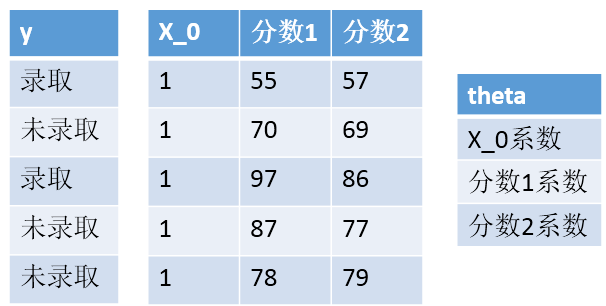
X加了一列1,θ加了一行θ0,因为最后边界是θ0+θ1X1+θ2X2,要符合矩阵运算
难点2:costFunction中grad是什么函数,有什么作用?
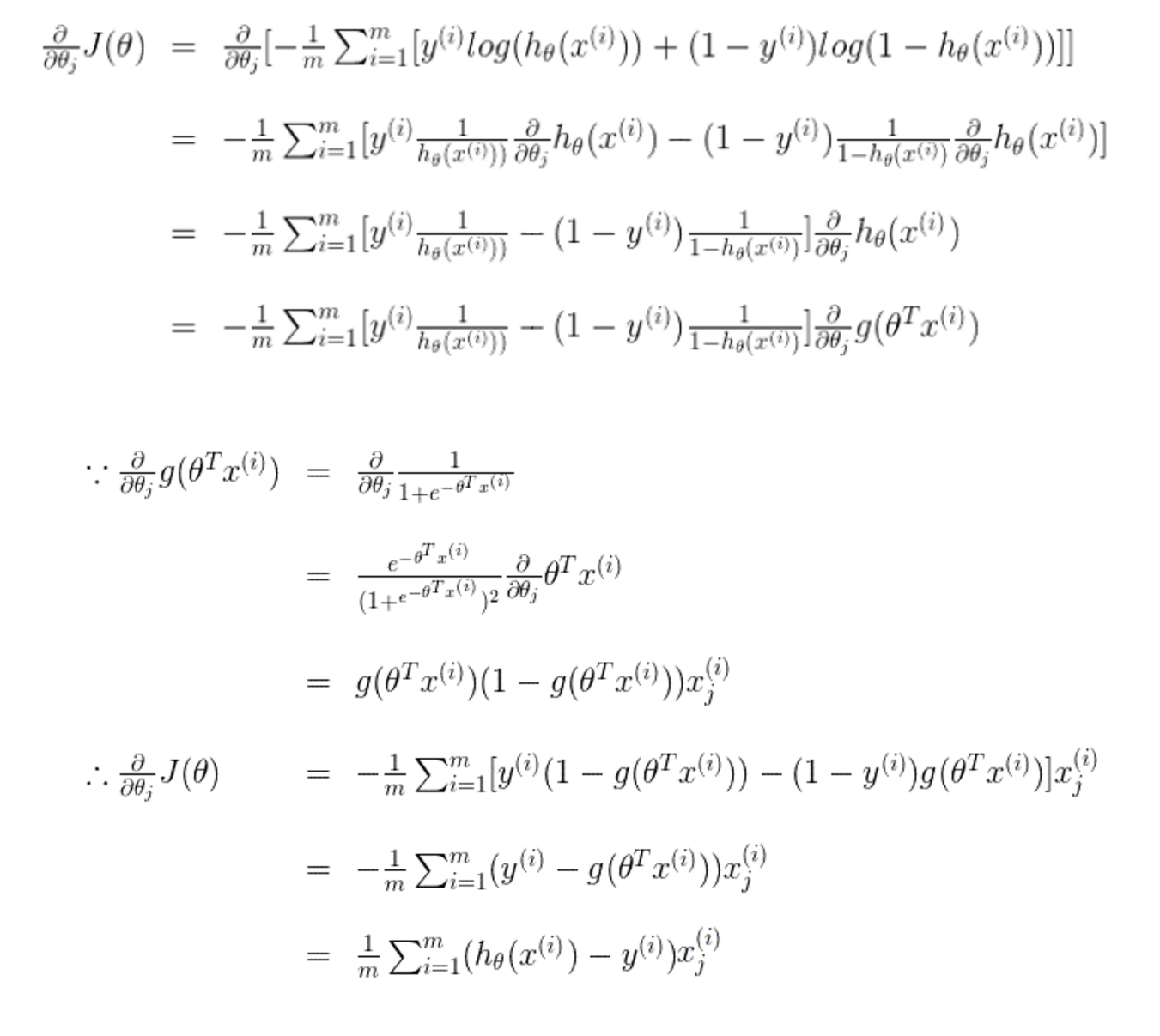
w.r.t 什么意思?
with regard to
with reference to

关于的意思
难点3:linear regression的代价函数和logistic regression的代价函数,为什么不一样?
和幂次有关,如果还用原来的代价函数,那么会有很多局部最值,没有办法梯度下降到最小值。
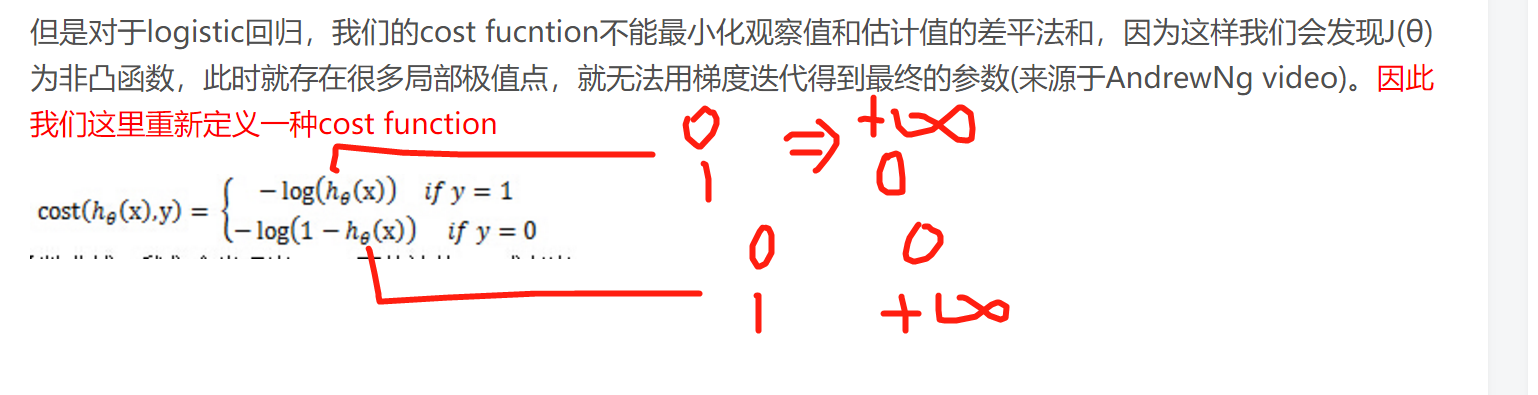
另一个解读角度:从最大似然函数出发考虑。
下面的文章写得很好,参考链接:
http://blog.csdn.net/lu597203933/article/details/38468303
http://blog.csdn.net/it_vitamin/article/details/45625143
%% ============= Part : Optimizing using fminunc  =============

%  In this exercise, you will use a built-in function (fminunc) to find the

%  optimal parameters theta.

%  Set options for fminunc

options = optimset('GradObj', 'on', 'MaxIter', );

%  Run fminunc to obtain the optimal theta

%  This function will return theta and the cost

[theta, cost] = ...

    fminunc(@(t)(costFunction(t, X, y)), initial_theta, options);
难点4:optimset是什么作用?
options = optimset('GradObj', 'on', 'MaxIter', 400); //
通过optimset函数设置或改变这些参数。其中有的参数适用于所有的优化算法,有的则只适用于大型优化问题,另外一些则只适用于中型问题。
LargeScale – 当设为'on'时使用大型算法,若设为'off'则使用中型问题的算法。
适用于大型和中型算法的参数:
Diagnostics – 打印最小化函数的诊断信息。
Display – 显示水平。选择'off',不显示输出;选择'iter',显示每一步迭代过程的输出;选择'final',显示最终结果。打印最小化函数的诊断信息。
GradObj – 用户定义的目标函数的梯度。对于大型问题此参数是必选的,对于中型问题则是可选项。
MaxFunEvals – 函数评价的最大次数。
MaxIter – 最大允许迭代次数。
TolFun – 函数值的终止容限。
TolX – x处的终止容限。
options = optimset('param1',value1,'param2',value2,...) %设置所有参数及其值,未设置的为默认值
options = optimset('GradObj', 'on', 'MaxIter', 400);
在使用options的函数中,参数是由用户自行定义的,最大递归次数为400
难点5:[theta, cost] = fminunc(@(t)(costFunction(t, X, y)), initial_theta, options)是怎么实现功能?
关于句柄@,参考偏文章:http://blog.csdn.net/gzp444280620/article/details/49252491
关于fiminuc,参考这篇文章:http://blog.csdn.net/gzp444280620/article/details/49272977
fminunc(@(t)(costFunction(t, X, y)), initial_theta, options); %是为了当代码里面有这样的函数的时候,fminunc(1,θ,option)第一个参数,
会传递给costFunction(t, X, y)的第一个参数里面进行计算。
function plotDecisionBoundary(theta, X, y)

%PLOTDECISIONBOUNDARY Plots the data points X and y into a new figure with

%the decision boundary defined by theta

%   PLOTDECISIONBOUNDARY(theta, X,y) plots the data points with + for the

%   positive examples and o for the negative examples. X is assumed to be

%   a either

%   ) Mx3 matrix, where the first column is an all-ones column for the

%      intercept.

%   ) MxN, N> matrix, where the first column is all-ones

% Plot Data

plotData(X(:,:), y);

hold on

if size(X, ) <=

    % Only need  points to define a line, so choose two endpoints

    plot_x = [min(X(:,))-,  max(X(:,))+];

    % Calculate the decision boundary line//令theta装置乘以X等于0,即可

   plot_y = (-./theta()).*(theta().*plot_x + theta());

    % Plot, and adjust axes for better viewing

    plot(plot_x, plot_y)

    % Legend, specific for the exercise

    legend('Admitted', 'Not admitted', 'Decision Boundary')

    axis([, , , ])

else

    % Here is the grid range

    u = linspace(-, 1.5, );

    v = linspace(-, 1.5, );

    z = zeros(length(u), length(v));

    % Evaluate z = theta*x over the grid

    for i = :length(u)

        for j = :length(v)

            z(i,j) = mapFeature(u(i), v(j))*theta;

        end

    end

    z = z'; % important to transpose z before calling contour

    % Plot z =

    % Notice you need to specify the range [, ]

    contour(u, v, z, [, ], 'LineWidth', )

end

hold off

end
难点6:这个plotDecisionBoundary函数是怎么画出边界的?
plotDecisionBoundary中的下面的两行看不懂:
plot_x = [min(X(:,2))-2, max(X(:,2))+2]; //直线的参数其实已经得到,选划线的范围,把直线画出来即可。为了美观,扩大了两个单位
% Calculate the decision boundary line//令theta装置乘以X等于0,即可 plot_y = (-1./theta(3)).*(theta(2).*plot_x + theta(1));
plot_y = (-1./theta(3)).*(theta(2).*plot_x + theta(1));
function plotData(X, y)    //会按照真类和假类分类 画出输入的点

%PLOTDATA Plots the data points X and y into a new figure

%   PLOTDATA(x,y) plots the data points with + for the positive examples

%   and o for the negative examples. X is assumed to be a Mx2 matrix.

% Create New Figure

figure; hold on;

% ====================== YOUR CODE HERE ======================

% Instructions: Plot the positive and negative examples on a

%               2D plot, using the option 'k+' for the positive

%               examples and 'ko' for the negative examples.

%

% Find Indices of Positive and Negative Examples              //返回 y=1和y=0的位置,也就是行数

  pos = find(y==);        neg = find(y == );                //利用find的查找功能,把正类和负类分开,并把横纵坐标保存在pos里面

% Plot Examples

plot(X(pos, ), X(pos, ), 'k+','LineWidth', , ...

'MarkerSize', );

plot(X(neg, ), X(neg, ), 'ko', 'MarkerFaceColor', 'y', ...

'MarkerSize', );

% =========================================================================

hold off;

end
%% =========== Part : Regularized Logistic Regression ============

%  In this part, you are given a dataset with data points that are not

%  linearly separable. However, you would still like to use logistic

%  regression to classify the data points.

%

%  To do so, you introduce more features to use -- in particular, you add

%  polynomial features to our data matrix (similar to polynomial

%  regression).

%

% Add Polynomial Features

% Note that mapFeature also adds a column of ones for us, so the intercept

% term is handled

X = mapFeature(X(:,), X(:,));

% Initialize fitting parameters

initial_theta = zeros(size(X, ), );

% Set regularization parameter lambda to

lambda = ;

% Compute and display initial cost and gradient for regularized logistic

% regression

[cost, grad] = costFunctionReg(initial_theta, X, y, lambda);
难点7:mapFeature是怎么工作的,原理?
难点8:[cost, grad] = costFunctionReg(initial_theta, X, y, lambda);怎么工作?
%% ============= Part : Regularization and Accuracies =============

%  Optional Exercise:

%  In this part, you will get to try different values of lambda and

%  see how regularization affects the decision coundart

%

%  Try the following values of lambda (, , , ).

%

%  How does the decision boundary change when you vary lambda? How does

%  the training set accuracy vary?

%

% Initialize fitting parameters

initial_theta = zeros(size(X, ), );

% Set regularization parameter lambda to  (you should vary this)

lambda = ;

% Set Options

options = optimset('GradObj', 'on', 'MaxIter', );

% Optimize

[theta, J, exit_flag] = ...

    fminunc(@(t)(costFunctionReg(t, X, y, lambda)), initial_theta, options);
难点9:为什么fminunc可以返回三个变量?
ps:先把问题记录一下,稍后会一个个解决。
week3编程作业: Logistic Regression中一些难点的解读的更多相关文章
- Andrew Ng机器学习编程作业:Logistic Regression
编程作业文件: machine-learning-ex2 1. Logistic Regression (逻辑回归) 有之前学生的数据,建立逻辑回归模型预测,根据两次考试结果预测一个学生是否有资格被大 ...
- logistic regression中的cost function选择
一般的线性回归使用的cost function为: 但由于logistic function: 本身非凸函数(convex function), 如果直接使用线性回归的cost function的话, ...
- Andrew Ng机器学习编程作业: Linear Regression
编程作业有两个文件 1.machine-learning-live-scripts(此为脚本文件方便作业) 2.machine-learning-ex1(此为作业文件) 将这两个文件解压拖入matla ...
- Logistic regression中regularization失败的解决方法探索(文末附解决后code)
在matlab中做Regularized logistic regression 原理: 我的代码: function [J, grad] = costFunctionReg(theta, X, y, ...
- Coursera machine learning 第二周 编程作业 Linear Regression
必做: [*] warmUpExercise.m - Simple example function in Octave/MATLAB[*] plotData.m - Function to disp ...
- Andrew Ng 的 Machine Learning 课程学习 (week3) Logistic Regression
这学期一直在跟进 Coursera上的 Machina Learning 公开课, 老师Andrew Ng是coursera的创始人之一,Machine Learning方面的大牛.这门课程对想要了解 ...
- 逻辑回归 logistic regression(1)逻辑回归的求解和概率解释
本系列内容大部分来自Standford公开课machine learning中Andrew老师的讲解,附加自己的一些理解,编程实现和学习笔记. 第一章 Logistic regression 1.逻辑 ...
- Matlab实现线性回归和逻辑回归: Linear Regression & Logistic Regression
原文:http://blog.csdn.net/abcjennifer/article/details/7732417 本文为Maching Learning 栏目补充内容,为上几章中所提到单参数线性 ...
- Probabilistic SVM 与 Kernel Logistic Regression(KLR)
本篇讲的是SVM与logistic regression的关系. (一) SVM算法概论 首先我们从头梳理一下SVM(一般情况下,SVM指的是soft-margin SVM)这个算法. 这个算法要实现 ...
随机推荐
- Android下用程序的方法为ListView设置分割线Divider样式
使用XML的时候可以使用android:divider属性为ListView设置分割线的样式(颜色或者资源文件),而在Java代码中默认提供的方法 listView.setDivider() 却只支持 ...
- ubuntu将python3设为默认后再安装支持python3.x的包
简介: ubuntu默认python2.7版本,如果想要装python3.x版本,请记住python2.7版本一定不能卸载!!!但是即使我 python3.x版本安装成功,当运行python脚本时,系 ...
- 2016最新Java学习计划
一.Java学习路线图 二.Java学习路线图--视频篇 六大阶段 学完后目标 知识点 配套免费资源(视频+笔 记+源码+模板) 密码 第一阶段 Java基础 入门 学习周期: 35天 ...
- 使用Keras进行多GPU训练 multi_gpu_model
使用Keras训练具有多个GPU的深度神经网络(照片来源:Nor-Tech.com). 摘要 在今天的博客文章中,我们学习了如何使用多个GPU来训练基于Keras的深度神经网络. 使用多个GPU使我们 ...
- 多张报表导出到一个多sheet页excel
业务需求: 通过勾选不同的报表名称,然后直接执行导出excel.并且这些报表需要统一导入到一个excel的多个sheet页中,并且对某些报表可能需要增加一些类似'已审核'之类的图片(展现时并没有 ...
- 润乾配置连接kingbase(金仓)数据库
问题背景 客户根据项目的不同,使用润乾连接的数据库类型各种各样,此文针对前几日使用润乾设计器连接kingbase金仓数据库做一个说明. kingbase金仓数据库是一款国产数据库,操作方式和配置 ...
- 润乾在jetty应用服务器下的JNDI配置一
一. 此处绑定的数据源是以 DBCP 为实现.首先必须将数据库驱动(这里用了MYSQL数据库)和DBCP所需要的 Jar 包复制到 Jetty 根目录的 lib 目录下.DBCP主要需要以下3个 ...
- redis订阅与发布(把redis作为消息中间件)
订阅频道127.0.0.1:6379> subscribe chat1Reading messages... (press Ctrl-C to quit)1) "subscribe&q ...
- Python 中单双引号
TODO, 在python中, 其实单双引号还是有分别的, 具体是什么?
- 【gp数据库】OLTP和OLAP区别详解
原来一直使用Oracle,新公司使用greenplum后发现系统的并发性差很多,后来才了解因为Oracle属于OLTP类型,而gp数据库属于OLAP类型的.具体了解如下: 数据库系统一般分为两种类型, ...