
[CVPR2017] Weakly Supervised Cascaded Convolutional Networks论文笔记
p.p1 { margin: 0.0px 0.0px 0.0px 0.0px; font: 14.0px "Helvetica Neue"; color: #042eee }
p.p2 { margin: 0.0px 0.0px 0.0px 0.0px; font: 14.0px "Helvetica Neue"; color: #323333 }
p.p3 { margin: 0.0px 0.0px 0.0px 0.0px; font: 16.0px "Helvetica Neue"; color: #323333 }
p.p4 { margin: 0.0px 0.0px 0.0px 0.0px; font: 14.0px "Helvetica Neue"; color: #323333; min-height: 16.0px }
p.p5 { margin: 0.0px 0.0px 0.0px 0.0px; font: 17.0px STIXGeneral; color: #323333 }
p.p6 { margin: 0.0px 0.0px 0.0px 0.0px; font: 12.0px STIXGeneral; color: #323333 }
p.p7 { margin: 0.0px 0.0px 0.0px 0.0px; font: 17.0px "Helvetica Neue"; color: #323333; min-height: 20.0px }
p.p8 { margin: 0.0px 0.0px 0.0px 0.0px; font: 17.0px STIXSizeOneSym; color: #323333 }
p.p9 { margin: 0.0px 0.0px 0.0px 0.0px; text-align: center; font: 17.0px STIXGeneral; color: #323333 }
p.p10 { margin: 0.0px 0.0px 0.0px 0.0px; text-align: center; font: 14.0px "Helvetica Neue"; color: #323333 }
p.p11 { margin: 0.0px 0.0px 0.0px 0.0px; font: 9.0px STIXGeneral; color: #323333 }
li.li2 { margin: 0.0px 0.0px 0.0px 0.0px; font: 14.0px "Helvetica Neue"; color: #323333 }
span.s1 { text-decoration: underline }
span.s2 { }
span.s3 { vertical-align: -0.5px }
span.s4 { vertical-align: -9.0px }
ul.ul1 { list-style-type: disc }
ul.ul2 { list-style-type: circle }
https://www.csee.umbc.edu/~hpirsiav/papers/cascade_cvpr17.pdf
Weakly Supervised Cascaded Convolutional Networks, Ali Diba, Vivek Sharma, Ali Pazandeh, Hamed Pirsiavash and Luc Van Gool
亮点
- 通过多任务叠加(分类,分割)提高了多物体弱监督检测的正确率
- 通过利用segmentation筛选纯净的proposals,得到了更鲁棒的结果
- 为弱监督分割任务设计比较鲁棒的loss
- 只考虑全局的分类结果和置信度对高的部分
- 通过loss的weights关注到最需要关注的部分
相关工作
One of the most common approaches [7] consists of the following steps:
- generates object proposals,
- extracts features from the proposals,
- applies multiple instance learning (MIL) to the features and finds the box labels from the weak bag (image) labels.
弱监督物体检测难点: 弱监督物体检测对初始化要求很高,不好的初始化可能会使网络陷入局部最优解,解决的办法主要有以下几个:
- improve the initialization [31, 9, 28, 29]
- regularizing the optimization strategies [4, 5, 7]
- [17] employ an iterative self-learning strategy to employ harder samples to a small set of initial samples
- [15] use a convex relaxation of soft-max loss
Majority of the previous works [25, 32] use a large collection of noisy object proposals to train their object detector. In contrast, our method only focuses on a very few clean collection of object proposals that are far more reliable, robust, computationally efficient, and gives better performance
方法
Two-stage: proposal and image classification (conv1 till con5, global pooling) + multiple instance learning (2fc, score layer)

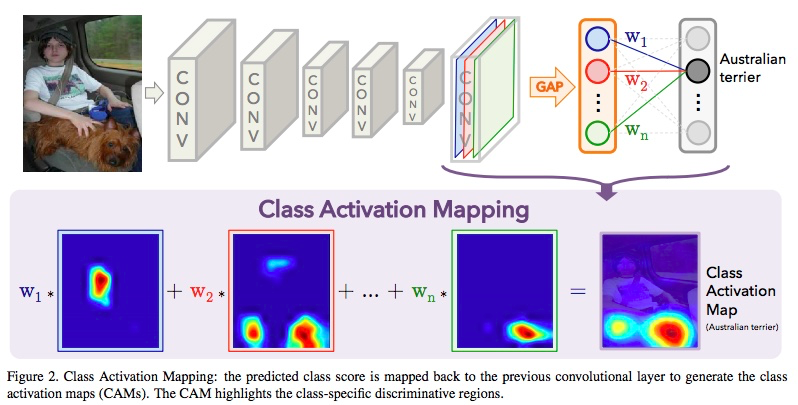
1. image classification: CNN with global average pooling (GAP) [36]中引入,将分类过程中fc层的weights作为原来convolutional layer输出的权重并将所有频道加权得到的图作为class activation map。在这一步中,还产生一个分类的loss LGAP
[36] B. Zhou, A. Khosla, A. Lapedriza, A. Oliva, and A. Torralba. Learning deep features for discriminative localization. In CVPR, 2016. 3, 4, 5, 6, 7, 8
2. multiple instance learning
Proposal: edgeboxs [37] is used to generate an initial set of object proposals. Then we threshold the class activation map [36] to come up with a mask. Finally, we choose the initial boxes with largest overlap with the mask.

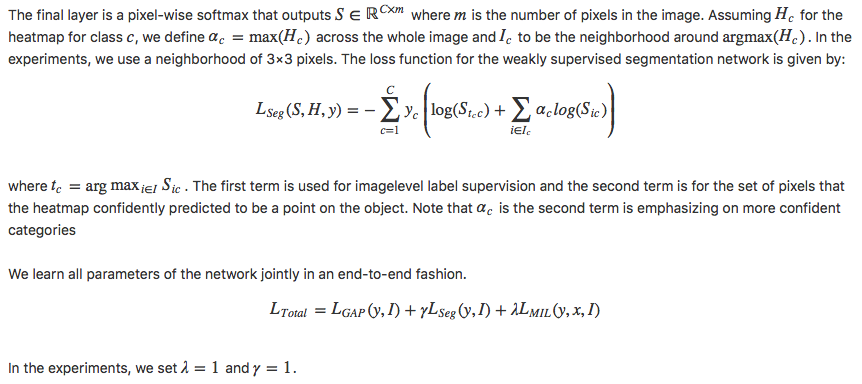
Three-stage: more information about the objects’ boundary learned in a segmentation task can lead to acquisition of a better appearance model and then better object localization.
- 主要思想:分割监督信号帮助提升定位准确率。
- 弱分割监督信号:上一级得到的mask

实验结果
PASCAL VOC 2007
- +3.3% classification compared with [18]
- +1.6% correct localization compared with [27]
- +0.6% compared with [6]
PASCAL VOC 2010
- +3.3% compared with [6]
PASCAL VOC 2012
- +8.8% compared with [18]
- ILSVRC 2013
- +5.5% compared with [18]
Object detection training
- PASCAL VOC 2007 test set: Faster RCNN trained by the pseudo ground-truth (GT) bounding boxes generated by our cascaded networks performs slightly better than our transfered model. (+0.3%)
[6] H. Bilen and A. Vedaldi. Weakly supervised deep detection networks. In CVPR, 2016. 6, 7, 8
[18] D. Li, J.-B. Huang, Y. Li, S. Wang, and M.-H. Yang. Weakly supervised object localization with progressive domain adaptation. In IEEE Conference on Computer Vision and Pattern Recognition, 2016. 2, 6, 7
[27] K. Simonyan and A. Zisserman. Very deep convolutional networks for large-scale image recognition. In ICLR, 2015. 5, 6
p.p1 { margin: 0.0px 0.0px 0.0px 0.0px; font: 16.0px "Helvetica Neue"; color: #323333 }
p.p2 { margin: 0.0px 0.0px 0.0px 0.0px; font: 14.0px "Helvetica Neue"; color: #323333 }
li.li2 { margin: 0.0px 0.0px 0.0px 0.0px; font: 14.0px "Helvetica Neue"; color: #323333 }
span.s1 { }
ul.ul1 { list-style-type: disc }
ul.ul2 { list-style-type: circle }
p.p1 { margin: 0.0px 0.0px 0.0px 0.0px; font: 14.0px "Helvetica Neue"; color: #042eee }
p.p2 { margin: 0.0px 0.0px 0.0px 0.0px; font: 14.0px "Helvetica Neue"; color: #323333 }
p.p3 { margin: 0.0px 0.0px 0.0px 0.0px; font: 16.0px "Helvetica Neue"; color: #323333 }
p.p4 { margin: 0.0px 0.0px 0.0px 0.0px; font: 14.0px "Helvetica Neue"; color: #323333; min-height: 16.0px }
p.p5 { margin: 0.0px 0.0px 0.0px 0.0px; font: 17.0px STIXGeneral; color: #323333 }
p.p6 { margin: 0.0px 0.0px 0.0px 0.0px; font: 12.0px STIXGeneral; color: #323333 }
p.p7 { margin: 0.0px 0.0px 0.0px 0.0px; font: 17.0px "Helvetica Neue"; color: #323333; min-height: 20.0px }
p.p8 { margin: 0.0px 0.0px 0.0px 0.0px; font: 17.0px STIXSizeOneSym; color: #323333 }
p.p9 { margin: 0.0px 0.0px 0.0px 0.0px; text-align: center; font: 17.0px STIXGeneral; color: #323333 }
p.p10 { margin: 0.0px 0.0px 0.0px 0.0px; text-align: center; font: 14.0px "Helvetica Neue"; color: #323333 }
p.p11 { margin: 0.0px 0.0px 0.0px 0.0px; font: 9.0px STIXGeneral; color: #323333 }
li.li2 { margin: 0.0px 0.0px 0.0px 0.0px; font: 14.0px "Helvetica Neue"; color: #323333 }
span.s1 { text-decoration: underline }
span.s2 { }
span.s3 { vertical-align: -0.5px }
span.s4 { vertical-align: -9.0px }
ul.ul1 { list-style-type: disc }
ul.ul2 { list-style-type: circle }
[CVPR2017] Weakly Supervised Cascaded Convolutional Networks论文笔记的更多相关文章
- [CVPR 2016] Weakly Supervised Deep Detection Networks论文笔记
p.p1 { margin: 0.0px 0.0px 0.0px 0.0px; font: 13.0px "Helvetica Neue"; color: #323333 } p. ...
- [论文阅读] Joint Face Detection and Alignment using Multi-task Cascaded Convolutional Networks(MTCNN)
相关论文:Joint Face Detection and Alignment using Multi-task Cascaded Convolutional Networks 概论 用于人脸检测和对 ...
- Visualizing and Understanding Convolutional Networks论文复现笔记
目录 Visualizing and Understanding Convolutional Networks 论文复现笔记 Abstract Introduction Approach Visual ...
- 《Joint Face Detection and Alignment using Multi-task Cascaded Convolutional Networks》
<Joint Face Detection and Alignment using Multi-task Cascaded Convolutional Networks> 论文主要的三个贡 ...
- Densely Connected Convolutional Networks 论文阅读
毕设终于告一段落,传统方法的视觉做得我整个人都很奔溃,终于结束,可以看些搁置很久的一些论文了,嘤嘤嘤 Densely Connected Convolutional Networks 其实很早就出来了 ...
- 【Semantic Segmentation】 Instance-sensitive Fully Convolutional Networks论文解析(转)
这篇文章比较简单,但还是不想写overview,转自: https://blog.csdn.net/zimenglan_sysu/article/details/52451098 另外,读这篇pape ...
- 【Detection】R-FCN: Object Detection via Region-based Fully Convolutional Networks论文分析
目录 0. Paper link 1. Overview 2. position-sensitive score maps 2.1 Background 2.2 position-sensitive ...
- [CVPR2015] Is object localization for free? – Weakly-supervised learning with convolutional neural networks论文笔记
p.p1 { margin: 0.0px 0.0px 0.0px 0.0px; font: 13.0px "Helvetica Neue"; color: #323333 } p. ...
- Bag of Tricks for Image Classification with Convolutional Neural Networks论文笔记
一.高效的训练 1.Large-batch training 使用大的batch size可能会减小训练过程(收敛的慢?我之前训练的时候挺喜欢用较大的batch size),即在相同的迭代次数 ...
随机推荐
- 高通 MSM8K bootloader 之三: LK
- 恭喜发财! -- 手把手教你仿造一个qq下拉抢红包 Android自定义view
猴年猴赛雷啊各位,今天没吃药我感觉自己萌萌哒! qq和微信和支付宝红包大战,不知道各位的战绩是多少嘞? 反正我qq抢到的都是气泡.因为太不爽,所以自己写一个下拉抢红包自己玩(自己跟自己玩). 先来看效 ...
- Ubuntu ROS Arduino Gazebo学习镜像iso说明(indigo版)
ROS机器人程序设计(原书第2版)学习镜像分享及使用说明 新版已经发布,请参考: http://blog.csdn.net/zhangrelay/article/details/53324759 Ub ...
- Gradle 1.12用户指南翻译——第三十三章. PMD 插件
本文由CSDN博客万一博主翻译,其他章节的翻译请参见: http://blog.csdn.net/column/details/gradle-translation.html 翻译项目请关注Githu ...
- Java泛型type体系
最近看开源代码,看到里面很多Java泛型,并且通过反射去获取泛型信息.如果说要看懂泛型代码,那还是比较容易,但是如果要自己利用泛型写成漂亮巧妙的框架,那必须对泛型有足够的了解.所以这两三天就不在不断地 ...
- Android虚拟设备访问WebSocket问题
Android虚拟设备访问WebSocket问题 最近写erlang的WebSocket网站,需要运行在RHEL6上,用Android设备访问. 可惜AVD无法访问主机 Win7上的虚拟机(RHEL6 ...
- Machine Learning 学习笔记
点击标题可转到相关博客. 博客专栏:机器学习 PDF 文档下载地址:Machine Learning 学习笔记 机器学习 scikit-learn 图谱 人脸表情识别常用的几个数据库 机器学习 F1- ...
- PS 图像调整算法— —渐变映射
这个调整简单来说就是先建立一张lookup table, 然后以图像的灰度值作为索引,映射得到相应的颜色值.图像的灰度值是由图像本身决定的,但是lookup table 却可以各种各样,所以不同的lo ...
- thrift实现HDFS文件操作
thrift 文件如下 namespace java com.pera.file.transform struct File{ 1:string path , 2:string co ...
- C语言实现某年某月某日是某年的第几天
看到这个标题,想实现这样的功能其实挺简单的,用C语言的switch语句加上闰年,平年条件的判断,再加上一定的逻辑可以轻松实现这样的函数,在linux内核中,存在判断闰年平年的接口,我将它移植出来后,写 ...