
SDOI2017 Round2 详细题解
这套题实在是太神仙了。。做了我好久。。。好多题都是去搜题解才会的 TAT。
剩的那道题先咕着,如果省选没有退役就来填吧。
「SDOI2017」龙与地下城
题意
丢 \(Y\) 次骰子,骰子有 \(X\) 面,每一面的概率均等,取值为 \([0, X)\) ,问最后取值在 \([a, b]\) 之间的概率。
一个浮点数,绝对误差不超过 \(0.013579\) 为正确。
数据范围
每组数据有 \(10\) 次询问。
\(100\%\) 的数据,\(T \leq 10\),\(2 \leq X \leq 20\),\(1 \leq Y \leq 200000\),\(0 \leq A \leq B \leq (X − 1)Y\) ,保证满足 \(Y > 800\) 的数据不超过 2 组。
题解
一开始不难想到一个暴力做法,设 \(P(x)\) 为丢一次骰子的概率生成函数,也就是 \(\displaystyle P(x) = \sum_{i = 0}^{X - 1} \frac{1}{X} x^i\) ,我们其实就是求 \(P^Y(x)\) 的 \(x^a \sim x^b\) 项的系数之和。
我们考虑一开始用 \(FFT\) 求出 \(2^k \ge (X - 1) \times Y\) 个单位根的点值。
那么多项式乘法就可以变为点值的乘法,也就是说每个点值对应变成它的 \(Y\) 次方,就可以在 \(\mathcal O(XY \log XY)\) 的时间内处理出这个多项式的 \(Y\) 次方的答案啦。
这样在考场应该只有 \(60 \sim 70pts\) 但是由于 \(LOJ\) 机子神速,可以直接过。。。代码在这里。
至于正解,与这个前面提到那个暴力解法是完全没有关系的。。
如果你足够聪明,看懂了出题人的提示,那就会做啦。
需要知道一个 中心极限定理。
以下内容来自维基百科:
中心极限定理说明,在适当的条件下,大量相互独立随机变量的均值经适当标准化后依分布收敛于 正态分布 。
设随机变量 \(X_1, X_2, \dots, X_n\) 独立同分布,并且具有有限的 数学期望 和 方差 : \(E(X_i)=μ, D(X_i)=\sigma^2 \not = 0(i=1,2,\dots, n)\)。
记 \(\displaystyle \bar{X} = \frac{1}{n} \sum_{i = 1}^{n} X_i, \zeta_n = \frac{\bar{x} - \mu}{\sigma / \sqrt n}\) ,则 \(\displaystyle \lim_{n \to \infty} P(\zeta_n \le z) = \Phi (z)\) 。
其中 \(\Phi (z)\) 是标准正态分布函数。
如果你回去上过文化课,学过统计中的正态分布应该就会啦。
说人话??好吧。。
\(n\) 个独立同分布,且具有有限的数学期望 \(\mu\) 和方差 \(\sigma ^2\) 的随机变量,他们的平均值的分布函数在 \(n \to \infty\) 时近似为位置参数为 \(\mu\) 尺度参数为 \(\sigma\) 的正态分布。
至于标准正态分布函数其实就是:
\]
也就是最后答案在 \([a, b]\) 的概率为 \(\displaystyle P(a \le X \le b) = \int_{a}^b \Phi(x) \mathrm{d}x\) 。
至于这个积分是个初等函数,并且极其光滑,那么我们利用辛普森就可以积出来了。
但是有很多点值都趋近于 \(0\) ,会被卡。
此时利用高中学的 \(3\sigma\) 原则 (2017全国一卷理科数学) ,可知, \(P(\mu - 3 \sigma < x \le \mu + 3 \sigma) \approx 0.9974\) 。
落在剩下区间的概率不足 \(0.3 \%\) 根据题目要求的精度基本可以忽略。
那么得到了最后的解法,在 \(Y\) 较小用 \(FFT\) 或者暴力卷积实现,在 \(Y\) 比较大的时候用辛普森求积分就好啦。
总结
独立同分布变量可以利用正态分布函数求积分快速计算估计值。
代码
#include <bits/stdc++.h>

#define For(i, l, r) for (register int i = (l), i##end = (int)(r); i <= i##end; ++i)

#define Fordown(i, r, l) for (register int i = (r), i##end = (int)(l); i >= i##end; --i)

#define Rep(i, r) for (register int i = (0), i##end = (int)(r); i < i##end; ++i)

#define Set(a, v) memset(a, v, sizeof(a))

#define Cpy(a, b) memcpy(a, b, sizeof(a))

#define debug(x) cout << #x << ": " << (x) << endl

using namespace std;

using vd = vector<double>;

template<typename T> inline bool chkmin(T &a, T b) { return b < a ? a = b, 1 : 0; }

template<typename T> inline bool chkmax(T &a, T b) { return b > a ? a = b, 1 : 0; }

inline int read() {

	int x(0), sgn(1); char ch(getchar());

	for (; !isdigit(ch); ch = getchar()) if (ch == '-') sgn = -1;

	for (; isdigit(ch); ch = getchar()) x = (x * 10) + (ch ^ 48);

	return x * sgn;

}

void File() {

#ifdef zjp_shadow

	freopen ("2267.in", "r", stdin);

	freopen ("2267.out", "w", stdout);

#endif

}

const int N = 1610;

struct Complex {

	double re, im;

	inline Complex friend operator + (const Complex &lhs, const Complex &rhs) {

		return (Complex) {lhs.re + rhs.re, lhs.im + rhs.im};

	}

	inline Complex friend operator - (const Complex &lhs, const Complex &rhs) {

		return (Complex) {lhs.re - rhs.re, lhs.im - rhs.im};

	}

	inline Complex friend operator * (const Complex &lhs, const Complex &rhs) {

		return (Complex) {lhs.re * rhs.re - lhs.im * rhs.im, lhs.re * rhs.im + lhs.im * rhs.re};

	}

};

const double Pi = acos(-1.0), eps = 1e-15;

namespace poly {

	const int Maxn = 1 << 24;

	int len, rev[Maxn];

	void FFT(Complex *P, int opt) {

		Rep (i, len) if (i < rev[i]) swap(P[i], P[rev[i]]);

		for (int i = 2, p = 1; i <= len; p = i, i <<= 1) {

			Complex Wi = (Complex) {cos(2 * Pi / i), opt * sin(2 * Pi / i)};

			for (int j = 0; j < len; j += i) {

				Complex x = (Complex) {1, 0};

				for (int k = 0; k < p; ++ k, x = x * Wi) {

					Complex u = P[j + k], v = x * P[j + k + p];

					P[j + k] = u + v; P[j + k + p] = u - v;

				}

			}

		}

		if (!~opt) Rep (i, len) P[i].re /= len;

	}

	Complex A[Maxn], B[Maxn], C[Maxn];

	inline vd operator * (const vd &a, const vd &b) {

		int na = a.size() - 1, nb = b.size() - 1, nc = na + nb, cnt = 0;

		for (len = 1; len <= nc; len <<= 1) ++ cnt;

		Rep (i, len) rev[i] = (rev[i >> 1] >> 1) | ((i & 1) << (cnt - 1));

		Rep (i, len) A[i] = (Complex) {i <= na ? a[i] : 0, 0};

		Rep (i, len) B[i] = (Complex) {i <= nb ? b[i] : 0, 0};

		FFT(A, 1); FFT(B, 1);

		Rep (i, len) C[i] = A[i] * B[i];

		FFT(C, -1);

		vd res(nc + 1);

		For (i, 0, nc) res[i] = C[i].re;

		return res;

	}

}

template<typename T>

inline T fpm(T x, int power) {

	T res = x; -- power;

	for (; power; power >>= 1, x = x * x)

		if (power & 1) res = res * x;

	return res;

}

double mu, sigma;

#define sqr(x) ((x) * (x))

double f(double x) {

	return exp(- sqr(x - mu) / (2 * sqr(sigma))) / (sqrt(2 * Pi) * sigma);

}

double Asr(double l, double r) {

	return (r - l) * (f(l) + 4 * f((l + r) / 2) + f(r)) / 6;

}

double Simpson(double l, double r, double area) {

	double mid = (l + r) / 2, la = Asr(l, mid), ra = Asr(mid, r);

	if (fabs(area - la - ra) < eps) return la + ra;

	return Simpson(l, mid, la) + Simpson(mid, r, ra);

}

int main () {

	File();

	int cases = read();

	while (cases --) {

		int x = read(), y = read();

		using namespace poly;

		if (y <= 2000) {

			int nc = (x - 1) * y, cnt = 0;

			for (len = 1; len <= nc; len <<= 1) ++ cnt;

			Rep (i, len) rev[i] = (rev[i >> 1] >> 1) | ((i & 1) << (cnt - 1));

			Rep (i, len) A[i] = (Complex) {i < x ? 1.0 / x : 0, 0};

			FFT(A, 1);

			Rep (i, len) A[i] = fpm(A[i], y);

			FFT(A, -1);

			vd ans(nc + 1);

			Rep (i, ans.size()) {

				ans[i] = A[i].re;

				if (i) ans[i] += ans[i - 1];

			}

			For (i, 1, 10) {

				int l = read(), r = read();

				printf ("%.6lf\n", ans[r] - (l ? ans[l - 1] : 0));

			}

		} else {

			mu = (x - 1) / 2.0 * y;

			sigma = sqrt(y * (1.0 * x * x - 1) / 12.0);

			For (i, 1, 10) {

				double l = max((double)read(), mu - 3 * sigma);

				double r = min((double)read(), mu + 3 * sigma);

				double ans = l <= r ? Simpson(l, r, Asr(l, r)) : 0;

				printf ("%.6lf\n", ans);

			}

		}

	}

	return 0;

}
「SDOI2017」苹果树
题意
有 \(n\) 个点的一颗树,每个点有 \(a_i\) 个物品,权值为 \(v_i\) ,可以取走 \(t\) 个物品,取一个物品的时候它的父亲至少也要取一个物品。
假设取了物品的节点最大深度为 \(h\) 要求 \(t - h \le k\) 。
最大化最后取物品的权值和。
数据范围
\(Q\) 为数据组数。
\(1 \leq Q \leq 5\),\(1 \leq n \leq 20\,000\),\(1 \leq k \leq 500\,000\),\(1 \leq nk \leq 25\,000\,000\),\(1 \leq a_i \leq 10^8\),\(1 \leq v_i \le 100\)
题解
首先忽略 \(t\) 的要求,就是 树上依赖多重背包 。
这个怎么做呢?树上依赖背包其实就是你考虑按树的后序遍历(先儿子后根)标号。
令 \(f_{i, j}\) 为后序遍历前 \(i\) 个节点,背包大小为 \(j\) 的时候的最大权值。
然后依次转移每个点,如果这个点要选的话,那么它可以直接从 \(f_{i - 1, j - v} + w\) 转移过来,否则它不选就只能从 \(f_{i - sz, j}\) 转移过来(也就是子树内一个都不能选)。
然后由于是多重背包,二进制分组被卡了,只能单调队列优化,物品大小为 \(1\) 的话就不需要按模数分类了。具体来说,对于 \(f_{i - 1, j - kv} + kw (v = 1)\) 可以拆成 \((f_{i - 1, j - k} - (j - k) w) + jw\) 的形式。前者只与 \(j - k\) 有关,然后是要求 \([j - c, j]\) 这个的最大值,这很显然是可以用单调队列的。
最后考虑 \(t - h \le k\) 的限制是什么意思,其实就是根到一个节点路径上每个点都可以免费拿一个,剩下的拿 \(k\) 个。显然我们是选一个叶子节点是最优的,但注意不是选最深的那个叶子!
然后我们只需要考虑,这条路上都少一个容量的答案如何快速算,考虑拆点,把 \(i\) 号点拆个容量为 \(a_i - 1\) 价值为 \(v_i\) 的节点 \(i'\) 出来,把 \(i \to i'\) 连一条边。
此时原来树上每个点的容量就恰好是 \(1\) 了,新加的我们可以在外面算。
然后不难发现除了这条链的子树就是对应着后序遍历上的两段区间,我们正反各做一遍 \(dp\) 就能求出来了。
最后复杂度是 \(\mathcal O(nk)\) 的。
总结
经典背包还是要多记一下。图论还是要多想下拆点,有可能就好做许多。
代码
#include <bits/stdc++.h>

#define For(i, l, r) for (register int i = (l), i##end = (int)(r); i <= i##end; ++i)

#define Fordown(i, r, l) for (register int i = (r), i##end = (int)(l); i >= i##end; --i)

#define Rep(i, r) for (register int i = (0), i##end = (int)(r); i < i##end; ++i)

#define Set(a, v) memset(a, v, sizeof(a))

#define Cpy(a, b) memcpy(a, b, sizeof(a))

#define debug(x) cout << #x << ": " << (x) << endl

using namespace std;

template<typename T> inline bool chkmin(T &a, T b) { return b < a ? a = b, 1 : 0; }

template<typename T> inline bool chkmax(T &a, T b) { return b > a ? a = b, 1 : 0; }

inline int read() {

	int x(0), sgn(1); char ch(getchar());

	for (; !isdigit(ch); ch = getchar()) if (ch == '-') sgn = -1;

	for (; isdigit(ch); ch = getchar()) x = (x * 10) + (ch ^ 48);

	return x * sgn;

}

void File() {

#ifdef zjp_shadow

	freopen ("2268.in", "r", stdin);

	freopen ("2268.out", "w", stdout);

#endif

}

const int N = 40100, K = 500100, M = 5.5e7 + 10;

int n, m;

int dfn[2][N], lis[2][N], sz[N], clk;

vector<int> G[N];

int w[N], c[N], sum[N];

void Dfs_Init(int u, int id) {

	sz[u] = 1; sum[u] += w[u];

	for (int v : G[u])

		sum[v] = sum[u], Dfs_Init(v, id), sz[u] += sz[v];

	lis[id][dfn[id][u] = ++ clk] = u;

}

#define dp(id, x, y) dp[id][(x) * (m + 1) + (y)]

int dp[2][M], val[K], que[K], fr, tl;

void Dp(int id) {

	For (i, 1, clk) {

		int u = lis[id][i];

		For (j, 0, m)

			dp(id, i, j) = dp(id, i - sz[u], j);

		fr = 1; tl = 0;

		For (j, 0, m) {

			while (fr <= tl && j - que[fr] > c[u]) ++ fr;

			if (fr <= tl)

				chkmax(dp(id, i, j), val[que[fr]] + j * w[u]);

			val[j] = dp(id, i - 1, j) - j * w[u];

			while (fr <= tl && val[que[tl]] <= val[j]) -- tl;

			que[++ tl] = j;

		}

	}

}

bool leaf[N]; int tot;

void Init() {

	Set(leaf, true);

	For (i, 1, n) G[i].clear();

}

int main () {

	File();

	int cases = read();

	while (cases --) {

		Init();

		tot = n = read(), m = read();

		int rt = 0;

		For (i, 1, n) {

			int fa = read();

			if (fa) {

				leaf[fa] = false;

				G[fa].push_back(i);

			} else rt = i;

			int ai = read(), vi = read(); w[i] = vi; c[i] = 1;

			if (ai > 1) {

				int id = ++ tot;

				w[id] = vi; c[id] = ai - 1; G[i].push_back(id);

			}

		}

		Rep (id, 2) {

			sum[rt] = clk = 0, Dfs_Init(rt, id), Dp(id);

			For (i, 1, n) reverse(G[i].begin(), G[i].end());

			For (i, 1, n) For (j, 1, m)

				chkmax(dp(id, i, j), dp(id, i, j - 1));

		}

		int ans = 0;

		For (i, 1, n) if (leaf[i]) {

			For (j, 0, m)

				chkmax(ans, dp(0, dfn[0][i] - 1, j) + dp(1, dfn[1][i] - sz[i], m - j) + sum[i]);

		}

		For (i, 1, tot) For (j, 0, m)

			dp(0, i, j) = dp(1, i, j) = 0;

		printf ("%d\n", ans);

	}

	return 0;

}
「SDOI2017」切树游戏
题意
一棵有 \(n\) 个点的树 \(T\) ,节点带权,两种操作:
\(\text{Change x y}\) : 将编号为 \(x\) 的结点的权值修改为 \(y\) 。
\(\text{Query k}\) : 询问有多少棵 \(T\) 的非空连通子树,满足其中所有点权值的异或和恰好为 \(k\) 。
数据范围
\(n, q \le 3 \times 10^4, m \le 128\) 修改操作不超过 \(10^4\) 。
题解
动态 \(dp\) 经典题目,参考了 dy0607 的博客 orz dy。
先考虑暴力怎么做,设 \(f [ i ] [ j ]\) 表示包含 \(i\) 的连通块( \(i\) 为连通块中深度最小的节点),异或和为 \(j\) 的方案数,从下往上DP即可。
注意到在合并子树信息时实际上是在做异或卷积,可以用 \(FWT\) 优化,注意 \(FWT\) 不存在循环卷积的性质十分优秀,加减乘除全都可以在点值上做。那么可以全程用 \(FWT\) 之后的点值计算,算答案时再 \(IFWT\) 回去,此时的复杂度为 \(\mathcal O (nqm + qm \log m)\) 。
为了动态修改,我们利用重链剖分变成序列问题,设 \(i\) 重儿子为 \(j\) ,轻儿子集合为 \(child(i)\) 。
利用集合幂级数的形式来定义 \(dp\) 转移:
\]
注意 \(z_0\) 对应着转移时候的空树,统计答案的时候应该去掉。我们用另外一个幂级数 \(G\) 统计答案:
\]
我们假设把轻儿子的幂级数设为常数,即:
Gl_i(z) &= \sum_{c \in child(i)} G_c(z)\\
Fl_i(z) &= z^{v_i} \times \prod_{c \in child(i)} F_c(z)
\end{aligned}
\]
那么对于 \((F_j, G_j, 1) \to (F_i, G_i, 1)\) 是一个线性变换可以写成:
F_j & G_j & 1
\end{pmatrix}
\times
\begin{pmatrix}
Fl_i & Fl_i& 0\\
0 & 1 & 0 \\
1 & Gl_i & 1
\end{pmatrix}
=
\begin{pmatrix}
F_i & G_i & 1
\end{pmatrix} %]]>
\]
注意此处的 \(1\) 对应的就是集合幂级数的单位元 \(z_0\) 。
我们考虑用一个线段树维护矩阵的乘积,那么我们就可以动态算出重链顶端的 \(F, G\) 了。
那么每次修改的时候我们只需要考虑那些常数要怎么改了。
对于 \(Gl_i(z)\) 比较好改,假设当前修改的是 \(c \in child(i)\) 。那么只需要减掉之前的 \(G(c)\) 加上后来的 \(G'(c)\) 。
但是对于 \(Fl_i(z)\) 就不好改了,需要变换的其实就是 \(F_c(z)\) 这个先要除掉,除的时候可能会除 \(0\) ,看到网上有神仙做法是维护 \(0\) 的个数,我不太会。。
其实可以对于每个点在线段树上维护它轻儿子的 \(F_c(z)\) 的值,那么我们可以直接在线段树上修改然后求出 \(Fl_i(z)\) 的值。
其中有一个常数优化是,矩阵上 \(0\) 的跳过去,这个优化十分显著。
其实只需要维护 \(4\) 个值 \(a, b, c, d\) ,如下图。
\]
复杂度是 \(\mathcal O(qm(\log^2 n + \log m))\) 。
总结
\(ddp\) 主要就是考虑轻儿子如何贡献的,把这个当做常数递推的系数。每次修改的时候只需要修改轻儿子的贡献上来的矩阵就行了。
代码
#include <bits/stdc++.h>

#define For(i, l, r) for (register int i = (l), i##end = (int)(r); i <= i##end; ++i)

#define Fordown(i, r, l) for (register int i = (r), i##end = (int)(l); i >= i##end; --i)

#define Rep(i, r) for (register int i = (0), i##end = (int)(r); i < i##end; ++i)

#define Set(a, v) memset(a, v, sizeof(a))

#define Cpy(a, b) memcpy(a, b, sizeof(a))

#define debug(x) cout << #x << ": " << (x) << endl

#define plus Plus

using namespace std;

template<typename T> inline bool chkmin(T &a, T b) { return b < a ? a = b, 1 : 0; }

template<typename T> inline bool chkmax(T &a, T b) { return b > a ? a = b, 1 : 0; }

inline int read() {

	int x(0), sgn(1); char ch(getchar());

	for (; !isdigit(ch); ch = getchar()) if (ch == '-') sgn = -1;

	for (; isdigit(ch); ch = getchar()) x = (x * 10) + (ch ^ 48);

	return x * sgn;

}

void File() {

#ifdef zjp_shadow

	freopen ("2269.in", "r", stdin);

	freopen ("2269.out", "w", stdout);

#endif

}

const int N = 30100, M = 128, Mod = 10007, inv2 = (Mod + 1) / 2;

namespace Computation {

	inline void add(int &a, int b) {

		if ((a += b) >= Mod) a -= Mod;

	}

	inline int plus(int a, int b) {

		return (a += b) >= Mod ? a - Mod : a;

	}

	inline int dec(int a, int b) {

		return (a -= b) < 0 ? a + Mod : a;

	}

	inline int mul(int a, int b) {

		return 1ll * a * b % Mod;

	}

}

using namespace Computation;

int n, m, q, v[N];

struct Poly {

	int x[M];

	inline void clear() { Set(x, 0); }

	Poly(int id = 0) {

		clear(); if (id == 1) Rep (i, m) x[i] = 1;

	}

	inline Poly operator = (const Poly &rhs) {

		Rep (i, m) x[i] = rhs.x[i]; return *this;

	}

	inline Poly friend operator + (const Poly &lhs, const Poly &rhs) {

		Poly res;

		Rep (i, m) res.x[i] = plus(lhs.x[i], rhs.x[i]);

		return res;

	}

	inline Poly friend operator - (const Poly &lhs, const Poly &rhs) {

		Poly res;

		Rep (i, m) res.x[i] = dec(lhs.x[i], rhs.x[i]);

		return res;

	}

	inline Poly friend operator * (const Poly &lhs, const Poly &rhs) {

		Poly res;

		Rep (i, m) res.x[i] = mul(lhs.x[i], rhs.x[i]);

		return res;

	}

	void FWT(int opt) {

		for (int i = 2, p = 1; i <= m; p = i, i <<= 1)

			for (int j = 0; j < m; j += i) Rep (k, p) {

				int u = x[j + k], v = x[j + k + p];

				x[j + k] = mul(plus(u, v), opt == 1 ? 1 : inv2);

				x[j + k + p] = mul(dec(u, v), opt == 1 ? 1 : inv2);

			}

	}

	inline void Out() {

		this -> FWT(-1);

		Rep (i, m)

			printf ("%d%c", x[i], i == m - 1 ? '\n' : ' ');

		this -> FWT(1);

	}

};

struct Info {

	Poly a, b, c, d;

	inline Info friend operator * (const Info &lhs, const Info &rhs) {

		return (Info) {

			lhs.a * rhs.a,

				lhs.a * rhs.b + lhs.b,

				rhs.a * lhs.c + rhs.c,

				rhs.b * lhs.c + lhs.d + rhs.d};

	}

	inline void Out() {

		puts("-----------");

		a.Out(); b.Out(); c.Out(); d.Out();

		puts("-----------");

	}

};

#define mid ((l + r) >> 1)

#define lson o << 1, l, mid

#define rson o << 1 | 1, mid + 1, r

template<typename T, int maxn>

struct Segment_Tree {

	T mulv[maxn];

	void build(int o, int l, int r, T *tmp) {

		if (l == r) {

			mulv[o] = tmp[mid]; return;

		}

		build(lson, tmp);

		build(rson, tmp);

		mulv[o] = mulv[o << 1 | 1] * mulv[o << 1];

	}

	void update(int o, int l, int r, int up, T uv) {

		if (l == r) {

			mulv[o] = uv; return;

		}

		up <= mid ? update(lson, up, uv) : update(rson, up, uv);

		mulv[o] = mulv[o << 1 | 1] * mulv[o << 1];

	}

	T query(int o, int l, int r, int ql, int qr) {

		if (ql <= l && r <= qr) return mulv[o];

		if (qr <= mid) return query(lson, ql, qr);

		if (ql > mid) return query(rson, ql, qr);

		return query(rson, ql, qr) * query(lson, ql, qr);

	}

};

Segment_Tree<Info, N << 2> mat;

Segment_Tree<Poly, N << 2> FL;

#define root 1, 1, n

vector<int> E[N]; int son[N], sz[N], fa[N];

void Dfs_Init(int u) {

	sz[u] = 1;

	for (int v : E[u]) if (v != fa[u]) {

		fa[v] = u, Dfs_Init(v);

		sz[u] += sz[v]; if (sz[v] > sz[son[u]]) son[u] = v;

	}

}

int top[N], dfn[N], id[N], enl[N];

void Dfs_Part(int u) {

	static int clk = 0;

	id[dfn[u] = ++ clk] = enl[u] = u;

	top[u] = son[fa[u]] == u ? top[fa[u]] : u;

	if (son[u]) Dfs_Part(son[u]), enl[u] = enl[son[u]];

	for (int v : E[u])

		if (v != son[u] && v != fa[u]) Dfs_Part(v);

}

Poly F[N], G[N], Gl[N], Fl[N], base[N];

int Beg[N], End[N], fid[N], tot = 0;

void Dp(int u) {

	F[u] = base[v[u]];

	G[u].clear();

	for (int v : E[u])

		if (v != fa[u] && v != son[u]) {

			Dp(v);

			F[u] = F[u] * F[v];

			G[u] = G[u] + G[v];

		}

	Gl[u] = G[u]; Fl[u] = F[u];

	if (son[u]) {

		Dp(son[u]);

		F[u] = F[u] * F[son[u]];

		G[u] = G[u] + G[son[u]];

	}

	G[u] = G[u] + F[u]; F[u] = F[u] + 1;

	for (int v : E[u]) if (v != son[u] && v != fa[u])

		if (!fid[v]) {

			End[u] = fid[v] = ++ tot;

			if (!Beg[u]) Beg[u] = fid[v];

		}

}

void ask(int o) {

	Info cur = mat.query(root, dfn[o], dfn[enl[o]]);

	F[o] = (Fl[enl[o]] + 1) * cur.a + cur.c;

	G[o] = (Fl[enl[o]] + 1) * cur.b + base[v[enl[o]]] + cur.d;

}

void get_mat(int o) {

	Fl[o] = Beg[o] ? FL.query(root, Beg[o], End[o]) * base[v[o]] : base[v[o]];

	mat.update(root, dfn[o], son[o] ? (Info) {Fl[o], Fl[o], 1, Gl[o]} : (Info) {1, 0, 0, 0});

}

Info I[N]; Poly P[N];

int main () {

	File();

	n = read(); m = read();

	For (i, 1, n) v[i] = read();

	For (i, 1, n - 1) {

		int u = read(), v = read();

		E[u].push_back(v); E[v].push_back(u);

	}

	Rep (i, m)

		base[i].x[i] = 1, base[i].FWT(1);

	Dfs_Init(1); Dfs_Part(1); Dp(1);

	For (u, 1, n) {

		I[dfn[u]] = son[u] ? (Info) {Fl[u], Fl[u], 1, Gl[u]} : (Info) {1, 0, 0, 0};

		if (fid[u]) P[fid[u]] = F[u];

	}

	mat.build(root, I);

	FL.build(root, P);

	q = read();

	while (q --) {

		static char str[10];

		scanf ("%s", str + 1);

		if (str[1] == 'C') {

			int x = read(), y = read();

			v[x] = y;

			for (; x; x = fa[x]) {

				if (fa[top[x]])

					Gl[fa[top[x]]] = Gl[fa[top[x]]] - G[top[x]];

				get_mat(x);

				if (x == 1) break;

				x = top[x];

				ask(x = top[x]);

				if (fid[x]) FL.update(root, fid[x], F[x]);

				Gl[fa[x]] = Gl[fa[x]] + G[x];

			}

		} else {

			ask(1); Poly ans = G[1]; ans.FWT(-1);

			printf ("%d\n", ans.x[read()]);

		}

	}

	return 0;

}
「SDOI2017」天才黑客
题意
这道题题意看了我好久。。。
给你一个 \(n\) 个点 \(m\) 条边的有向图,同时给你一个 \(k\) 个节点的字典树。
对于每条边有两个属性,一个是它的边权 \(c_i\) 另外一个是这条边会对应到字典树上一个节点 \(d_i\) 。
然后你从 \(1\) 开始走,一开始手上有个字符串 \(S\) 为空串,每次走一条边 \(i\) 需要花费的代价是 \(c_i\) 加上 \(d_i\) 对应的字符串与 \(S\) 的 \(LCP\) 长度,然后 \(S\) 变成 \(d_i\) 对应的字符串。
问从 \(1\) 号店开始到 \(2 \sim n\) 所有点的最短路的长度。
数据范围
对于 \(100\%\) 的数据,\(T \leq 10\),\(2 \leq n \leq 50000\),\(1 \leq m \leq 50000\),\(1 \leq k \leq 20000\),保证满足 \(n > 5000\) 或 \(m > 5000\) 的数据不超过 \(2\) 组。
题解
显然暴力考虑的话,我们肯定要记过来的前一条边是什么,那么就是 \(\mathcal O(m^2)\) 的,不够优秀。
发现从点到点时的代价是不确定的,而从边到边的代价是一定的,所以将边转化为点,点权 \(v_i\) 为原图中的边权 \(c_i\) ,然后以 \(1\) 为起点的边距离 \(dis_i = v_i\) 然后跑完最短路后的每个点 \(x\) 的距离,其实就是所有指向 \(x\) 的边的 \(\min_{b_i = x} {dis_i}\) 。
接下来我们只需要考虑考虑如何建边,新图中点 \(x\) 到点 \(y\) 的举例其实就是 \(d_x\) 与 \(d_y\) 在字典树上 \(lca\) 的深度。
那对原图中每个点考虑它相邻的所有边可以一起考虑建边,把这些边按 \(d_i\) 在字典树上的 \(dfs\) 序从小到大排序。
设 \(len_x = lcp(d_x, d_{x + 1})\) 那么有 \(\displaystyle lcp(d_x, d_y) = \min_{i = x}^{y - 1} len_i\) 。这个可以考虑这些节点在字典树上的虚树,两个节点对应的 \(lca\) 就是被夹在其中的相邻点对最浅的那个 \(lca\) 。
我们就可以考虑枚举分界点 \(x\) ,对于所有标号 \(\le x\) 的点与所有标号 \(\ge x\) 的点的距离不会超过 \(len\) ,那么我们建前缀和后缀辅助点就行了。
但是注意入边和出边不能同时连一个前缀或者后缀,不然会直接“短路”。我们可以考虑搞两个前缀和后缀,一个入边连前缀出边连后缀,另外一个出边连前缀入边连后缀。
为什么要这样呢?因为入边和出边的 \(dfs\) 序的大小关系有两种,要分开讨论。
说的好像有点玄乎,挂张图。如下是样例关于点 \(2\) 建出来的图:
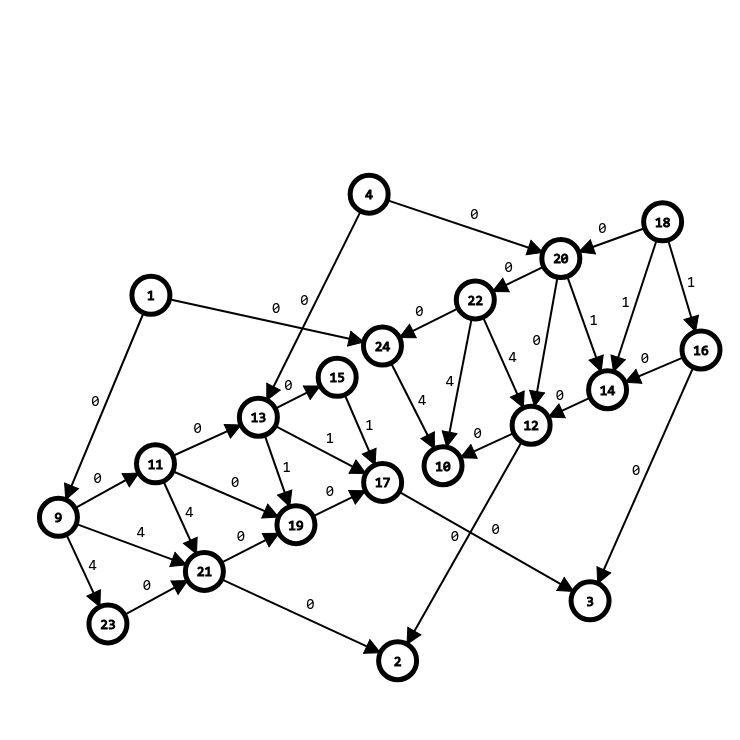
点数和边数都是 \(\mathcal O(m)\) 的,最后跑一次 \(Dijkstra\) 是 \(O(m \log m)\) 的。
总结
最短路的题一般都是考虑重构图,降低边数/点数。
如果是取 \(\min_{i = l}^{r} a_i\) 用双层图跑最短路,如果是 \(\sum_{i = l}^{r} a_i\) 就差分跑最短路。
代码
#include <bits/stdc++.h>

#define For(i, l, r) for (register int i = (l), i##end = (int)(r); i <= i##end; ++i)

#define Fordown(i, r, l) for (register int i = (r), i##end = (int)(l); i >= i##end; --i)

#define Rep(i, r) for (register int i = (0), i##end = (int)(r); i < i##end; ++i)

#define Set(a, v) memset(a, v, sizeof(a))

#define Cpy(a, b) memcpy(a, b, sizeof(a))

#define debug(x) cout << #x << ": " << (x) << endl

#define pb push_back

using namespace std;

template<typename T> inline bool chkmin(T &a, T b) { return b < a ? a = b, 1 : 0; }

template<typename T> inline bool chkmax(T &a, T b) { return b > a ? a = b, 1 : 0; }

inline int read() {

	int x(0), sgn(1); char ch(getchar());

	for (; !isdigit(ch); ch = getchar()) if (ch == '-') sgn = -1;

	for (; isdigit(ch); ch = getchar()) x = (x * 10) + (ch ^ 48);

	return x * sgn;

}

void File() {

#ifdef zjp_shadow

	freopen ("2270.in", "r", stdin);

	freopen ("2270.out", "w", stdout);

#endif

}

const int N = 1e6 + 1e3, M = N << 2;

int n, m, k, val[N], id[N], tot;

vector<int> In[N], Out[N], ch[N];

int Head[N], Next[M], to[M], weight[M], e;

inline void add_edge(int u, int v, int w, bool rev = false) {

	if (rev) swap(u, v);

	to[++ e] = v; Next[e] = Head[u]; Head[u] = e; weight[e] = w;

}

int clk, dfn[N], anc[N][20], Log2[N], dep[N];

void Dfs_Init(int u) {

	dfn[u] = ++ clk;

	for (int v : ch[u])

		dep[v] = dep[u] + 1, Dfs_Init(v), anc[v][0] = u;

}

inline int Lca(int x, int y) {

	if (dep[x] < dep[y]) swap(x, y);

	int gap = dep[x] - dep[y];

	Fordown (i, Log2[gap], 0)

		if (gap >> i & 1) x = anc[x][i];

	if (x == y) return x;

	Fordown (i, Log2[dep[x]], 0)

		if (anc[x][i] != anc[y][i]) x = anc[x][i], y = anc[y][i];

	return anc[x][0];

}

void Rebuild() {

	static int pre[N][2], suf[N][2];

	For (i, 1, n) {

		struct Node { int type, num, pos; };

		vector<Node> V;

		for (int x : In[i]) V.push_back({0, x, id[x]});

		for (int x : Out[i]) V.push_back({1, x, id[x]});

		sort(V.begin(), V.end(), [&](Node a, Node b) { return dfn[a.pos] < dfn[b.pos]; });

		Rep (i, V.size()) Rep (id, 2) {

			pre[i][id] = ++ tot;

			if (V[i].type == id)

				add_edge(V[i].num, pre[i][id], 0, V[i].type);

			if (i) add_edge(pre[i - 1][id], pre[i][id], 0, id);

		}

		Fordown (i, V.size() - 1, 0) Rep (id, 2) {

			suf[i][id] = ++ tot;

			if (V[i].type == (id ^ 1))

				add_edge(V[i].num, suf[i][id], 0, V[i].type);

			if (i < int(V.size()) - 1)

				add_edge(suf[i][id], suf[i + 1][id], 0, id);

		}

		Rep (i, V.size()) Rep (id, 2)

			add_edge(pre[i][id], suf[i][id], dep[V[i].pos], id);

		Rep (i, V.size() - 1) {

			int dis = dep[Lca(V[i].pos, V[i + 1].pos)];

			Rep (id, 2)

				add_edge(pre[i][id], suf[i + 1][id], dis, id);

		}

	}

}

int dis[N]; bool vis[N];

void Dijkstra() {

	priority_queue<pair<int, int>> P;

	Set(dis, 0x7f); Set(vis, false);

	for (int v : Out[1])

		P.emplace(- (dis[v] = val[v]), v);

	while (!P.empty()) {

		int u = P.top().second; P.pop();

		if (vis[u]) continue; vis[u] = true;

		for (int i = Head[u], v = to[i]; i; v = to[i = Next[i]])

			if (chkmin(dis[v], dis[u] + weight[i] + val[v]))

				P.emplace(- dis[v], v);

	}

}

int main () {

	File();

	int cases = read();

	while (cases --) {

		n = read(); tot = m = read(); k = read();

		Set(val, 0); Set(Head, 0); e = clk = 0;

		For (i, 1, n)

			In[i].clear(), Out[i].clear();

		For (i, 1, k)

			ch[i].clear();

		For (i, 1, m) {

			Out[read()].pb(i);

			In[read()].pb(i);

			val[i] = read(), id[i] = read();

		}

		For (i, 1, k - 1) {

			int u = read(), v = read(); read(); ch[u].pb(v);

		}

		Dfs_Init(1);

		For (i, 2, k)

			Log2[i] = Log2[i >> 1] + 1;

		For (j, 1, Log2[k]) For (i, 1, k)

			anc[i][j] = anc[anc[i][j - 1]][j - 1];

		Rebuild();

		Dijkstra();

		For (i, 2, n) {

			int ans = 0x7f7f7f7f;

			for (int v : In[i])

				chkmin(ans, dis[v]);

			printf ("%d\n", ans);

		}

	}

	return 0;

}
「SDOI2017」遗忘的集合
题意
给你一个长度为 \(n\) 的数组 \(f(i)\) ,你需要构造一个集合,满足对于所有 \(i\) 能被集合中元素凑出来的方案(只考虑出现次数,不考虑顺序)对于 \(p\) 取模为 \(f(i)\) ( \(p\) 为质数)。
然后解要字典序尽量小。
数据范围
对于 \(100\%\) 的数据,有 \(1 \leq n < 2^{18}\),\(10^6 \leq p < 2^{30}\),\(\forall i, 0 \leq f(i)< p\) 。
题解
对于计数类背包我们通常考虑生成函数,令 \(a_i \in \{0, 1\}\) 表示 \(i\) 是否出现在集合中,那么 \(f\) 对应的生成函数就是:
\]
现在就变成了构造一组 \(a_i\) 满足 \(F(x)\) 。
两边取对数那么有:
\]
如果做过各种背包套路题的就知道:
\]
这个证明可以看 zsy 大佬的博客 。
考虑代入前面的式子,就有
\]
令 \(T = ij\) 交换和式,那么就有
\]
那么我们就只要求出 \(\ln F(x)\) ,然后就可以得到 \(\sum_{d | T}a_d \times \frac dT\) 。
也就是 \(ia_i = \sum_{k | i} k c_k\) ,其中 \(c_k\) 为给定的系数。
可以莫比乌斯反演,但是没有必要。我们从前往后枚举每个 \(d\) 我们把每个 \(d\) 的倍数 \(T\) 减掉当前的值就行了。
多项式求 \(\ln\) 复杂度在于多项式除法,用主定理证的 \(\mathcal O(n \log n)\) 实际上常数大到飞起(还有个 \(MTT\) 。。)
总结
牢记普通生成函数的形式。
\]
以及一个经典多项式对数的形式。
\]
代码
傻吊出题人出个求 \(\ln\) 的题还要任意模数 \(FFT\) 。。
注意用 \(MTT\) 的话要预处理单位根来卡精度。
#include <bits/stdc++.h>

#define For(i, l, r) for (register int i = (l), i##end = (int)(r); i <= i##end; ++i)

#define Fordown(i, r, l) for (register int i = (r), i##end = (int)(l); i >= i##end; --i)

#define Rep(i, r) for (register int i = (0), i##end = (int)(r); i < i##end; ++i)

#define Set(a, v) memset(a, v, sizeof(a))

#define Cpy(a, b) memcpy(a, b, sizeof(a))

#define debug(x) cout << #x << ": " << (x) << endl

using namespace std;

template<typename T> inline bool chkmin(T &a, T b) { return b < a ? a = b, 1 : 0; }

template<typename T> inline bool chkmax(T &a, T b) { return b > a ? a = b, 1 : 0; }

inline int read() {

	int x(0), sgn(1); char ch(getchar());

	for (; !isdigit(ch); ch = getchar()) if (ch == '-') sgn = -1;

	for (; isdigit(ch); ch = getchar()) x = (x * 10) + (ch ^ 48);

	return x * sgn;

}

void File() {

#ifdef zjp_shadow

	freopen ("2271.in", "r", stdin);

	freopen ("2271.out", "w", stdout);

#endif

}

const double Pi = acos(-1.0);

struct Complex {

	double re, im;

};

inline Complex operator + (const Complex &lhs, const Complex &rhs) {

	return (Complex) {lhs.re + rhs.re, lhs.im + rhs.im};

}

inline Complex operator - (const Complex &lhs, const Complex &rhs) {

	return (Complex) {lhs.re - rhs.re, lhs.im - rhs.im};

}

inline Complex operator * (const Complex &lhs, const Complex &rhs) {

	return (Complex){lhs.re * rhs.re - lhs.im * rhs.im, lhs.re * rhs.im + lhs.im * rhs.re};

}

const int Maxn = (1 << 22) + 5;

int len, rev[Maxn];

Complex W[Maxn];

void FFT(Complex *P, int opt) {

	For (i, 0, len - 1) if (i < rev[i]) swap(P[i], P[rev[i]]);

	for (int i = 2, p = 1; i <= len; p = i, i <<= 1) {

		Rep (k, p)

			W[k] = (Complex){cos(2 * Pi * k / i), opt * sin(2 * Pi * k / i)};

		for (int j = 0; j < len; j += i) {

			For (k, 0, p - 1) {

				Complex u = P[j + k], v = P[j + k + p] * W[k];

				P[j + k] = u + v; P[j + k + p] = u - v;

			}

		}

	}

	if (!~opt) For (i, 0, len - 1) P[i].re /= len;

}

void FFT_Init(int n) {

	int cnt = 0; for (len = 1; len <= n; len <<= 1) ++ cnt;

	For (i, 0, len - 1) rev[i] = (rev[i >> 1] >> 1) | ((i & 1) << (cnt - 1));

}

void Trans(int *a, Complex *P) {

	Rep (i, len)

		P[i] = (Complex){(double)a[i], 0};

	FFT(P, 1);

}

const int Pow = (1 << 15) - 1;

int F[Maxn], G[Maxn], CoefF[Maxn], CoefG[Maxn], res[Maxn], Mod;

Complex A[Maxn], B[Maxn], C[Maxn], D[Maxn], sum[Maxn];

inline int Get_Mod(double x) {

	return (int)((x - floor(x / Mod) * Mod) + .5);

}

void Mult(Complex *a, Complex *b, int base, int opt = 1) {

	Rep (i, len) sum[i] = sum[i] + a[i] * b[i];

	if (opt) {

		FFT(sum, -1);

		Rep (i, len) {

			res[i] = (res[i] + 1ll * base * Get_Mod(sum[i].re)) % Mod;

			sum[i] = (Complex){0, 0};

		}

	}

}

void Mult(int *f, int *g, int *ans, int len) {

	FFT_Init(len);

	Rep (i, len << 1) res[i] = 0;

	Rep (i, len)

		CoefF[i] = f[i] & Pow, F[i] = f[i] >> 15;

	Rep (i, len)

		CoefG[i] = g[i] & Pow, G[i] = g[i] >> 15;

	Trans(CoefF, A); Trans(F, B);

	Trans(CoefG, C); Trans(G, D);

	Mult(A, C, 1);

	Mult(B, D, 1 << 30);

	Mult(A, D, 1 << 15, 0);

	Mult(B, C, 1 << 15);

	Rep (i, len << 1) ans[i] = res[i];

}

inline int fpm(int x, int power) {

	int res = 1;

	for (; power; power >>= 1, x = 1ll * x * x % Mod)

		if (power & 1) res = 1ll * res * x % Mod;

	return res;

}

const int N = 1e6 + 1e3;

int tmp[N];

void Get_Inv(int *a, int *b, int len) {

	if (len == 1) {

		b[0] = fpm(a[0], Mod - 2); return;

	}

	Get_Inv(a, b, len >> 1);

	Mult(a, b, tmp, len);

	Rep (i, len) tmp[i] = Mod - tmp[i]; tmp[0] += 2;

	Mult(tmp, b, b, len);

}

int der[N], inv[N];

void Get_Ln(int *a, int *b, int len) {

	For (i, 1, len - 1)

		der[i - 1] = 1ll * i * a[i] % Mod;

	Get_Inv(a, inv, len);

	Mult(der, inv, b, len);

	Fordown (i, len - 1, 0)

		b[i] = 1ll * b[i - 1] * fpm(i, Mod - 2) % Mod;

}

int x[N], f[N], ans[N];

int main () {

	File();

	int n = read(); Mod = read();

	f[0] = 1; For (i, 1, n) f[i] = read();

	int len = 1; while (len <= n) len <<= 1;

	Get_Ln(f, f, len);

	For (i, 1, n) f[i] = 1ll * f[i] * i % Mod;

	For (i, 1, n)

		for (int j = i << 1; j <= n; j += i)

			(f[j] += Mod - f[i]) %= Mod;

	vector<int> ans;

	For (i, 1, n)

		if (f[i]) ans.push_back(i);

	printf ("%d\n", int(ans.size()));

	Rep (i, ans.size())

		printf ("%d%c", ans[i], i == iend - 1 ? '\n' : ' ');

	return 0;

}
「SDOI2017」文本校正
题意
给你字符串 \(S\) 和 \(T\) ,问你是否能把 \(T\) 分成三段重组后变成 \(S\) ,如果可行则给出方案。
数据范围
\(T \le 30, 3 \leq n \leq 1000000\),\(1 \leq S_i. T_i \leq m \leq 1000000\)
题解
可以考虑把 \(T\) 划分成 \(3\) 段为 \(ABC\) 考虑重组后的形式,共有 \(3! = 6\) 种方式。
- \(ABC:\) 直接暴力判断即可。
- \(CBA:\) 不会做。
- \(ACB:\) 枚举 \(AC\) 分界点,然后???
- \(BAC:\) 和上面是一样的。
- \(CAB:\) 不知道
- \(BCA:\) 和上面一种一样的。
省选没退役就来填坑。
SDOI2017 Round2 详细题解的更多相关文章
- SDOI2017 Round1 简要题解
我们 TM 怎么又要上文化课..我 哔哔哔哔哔哔 「SDOI2017」数字表格 题意 有 \(T\) 组数据,求 \[ \prod_{i = 1}^{n} \prod_{j = 1}^{m} fib[ ...
- noip2013Day2T3-华容道【一个蒟蒻的详细题解】
描述 小 B 最近迷上了华容道,可是他总是要花很长的时间才能完成一次.于是,他想到用编程来完成华容道:给定一种局面,华容道是否根本就无法完成,如果能完成,最少需要多少时间. 小 B 玩的华容道与经典的 ...
- DZY Loves Math 系列详细题解
BZOJ 3309: DZY Loves Math I 题意 \(f(n)\) 为 \(n\) 幂指数的最大值. \[ \sum_{i = 1}^{a} \sum_{j = 1}^{b} f(\gcd ...
- BZOJ 4540 [Hnoi2016]序列 | 莫队 详细题解
传送门 BZOJ 4540 题解 --怎么说呢--本来想写线段树+矩阵乘法的-- --但是嘛--yali的机房太热了--困--写不出来-- 于是弃疗,写起了莫队.(但是我连莫队都想不出来!) 首先用单 ...
- Leetcode:Repeated DNA Sequences详细题解
题目 All DNA is composed of a series of nucleotides abbreviated as A, C, G, and T, for example: " ...
- POJ 3468 A Simple Problem with Integers(详细题解) 线段树
这是个线段树题目,做之前必须要有些线段树基础才行不然你是很难理解的. 此题的难点就是在于你加的数要怎么加,加入你一直加到叶子节点的话,复杂度势必会很高的 具体思路 在增加时,如果要加的区间正好覆盖一个 ...
- HDU 2553 N皇后问题(详细题解)
这是一道深搜题目!问题的关键是在剪枝. 下面我们对问题进行分析: 1.一行只能放一个皇后,所以我们一旦确定此处可以放皇后,那么该行就只能放一个皇后,下面的就不要再搜了. 2.每一列只能放一个皇后,所以 ...
- Leetcode:Largest Number详细题解
题目 Given a list of non negative integers, arrange them such that they form the largest number. For e ...
- PAT1074 Reversing Linked List (25)详细题解
02-1. Reversing Linked List (25) 时间限制 400 ms 内存限制 65536 kB 代码长度限制 8000 B 判题程序 Standard 作者 CHEN, Yue ...
随机推荐
- 免费开源ERP Odoo实施指南 连载二:POSTGRESQL概述
PostgreSQL是Odoo支持的数据库.PostgreSQL是起源于大学的一个历史很长的开源数据库系统.包括美国航天局NASA.德国证券交易中心.中国的平安.腾讯的微信支付.阿里巴巴的阿里云都在用 ...
- ios手机录屏软件哪个好
苹果手机中的airplay镜像,是苹果手机系统的一大特色,可以轻松把手机屏幕投射电脑,这个功能使苹果手机相较安卓手机投屏会更加轻松,那么如何实现苹果手机投射电脑屏幕?下面小编便来分享ios手机录屏软件 ...
- 对国内IoT的展望
这个世界上让任何人最安心的,莫过于自己能够完全控制,反之什么都无法控制的,万念俱灰之下,最后只有自我了结.芸芸众生都是在这个之间徘徊,尽可能的去掌控,尽可能的去拥有,觉得能够安心,其实只是自由的内心被 ...
- Python第四天 流程控制 if else条件判断 for循环 while循环
Python第四天 流程控制 if else条件判断 for循环 while循环 目录 Pycharm使用技巧(转载) Python第一天 安装 shell 文件 Python第二天 ...
- 网络编程中TCP基础巩固以及Linux打开的文件过多文件句柄的总结
1.TCP连接(短链接和长连接) 什么是TCP连接?TCP(Transmission Control Protocol 传输控制协议)是一种面向连接的.可靠的.基于字节流的传输层通信协议. 当网络通信 ...
- windows10禁用更新方法
本方法由本人在无意中发现,实测有效 1.第一步 打开文件管理器路径进入到win10的下载更新文件的目录 C:\Windows\SoftwareDistribution 选中Download文件夹 ...
- mysql导出表的字段及相关属性
需要导出数据库中表的字段及属性,制成表格保存到word中 首先找到要导的库, 在查询页面输入sql SELECT COLUMN_NAME 列名, COLUMN_TYPE 数据类型, DATA_TYPE ...
- 模块简介:(logging)(re)(subprocess)
''' logging模块: logging的日志可以分为 debug():Detailed information, typically of interest only when diagnosi ...
- 【Python 02】计算机与程序设计
计算机 根据一系列指令对数据进行处理的工具或机器. 特征: 可以进行计算 根据指令执行任务 组成: 运算器+控制器(CPU) 存储器(内存及硬盘):内存存储临时数据.硬盘存储相对永久的数据 输入设备和 ...
- c++11の死锁
一.死锁的产生 两个mutex的时候,mutex1,mutex2 如果两把锁两个线程的顺序不一致,会造成相互等待释放资源,造成死锁 二.死锁的避免 1.是否需要两把以上的锁,如果不用两把锁,自然不会存 ...