
caffe中softmax loss源码阅读
(1) softmax loss
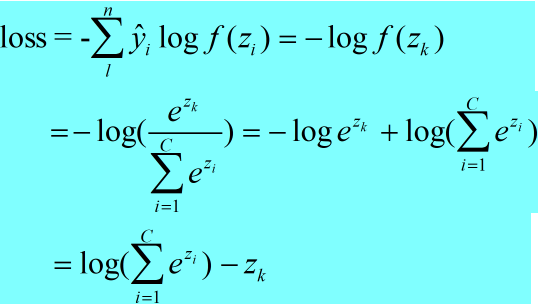
<1> softmax loss的函数形式为:
 (1)
(1)
zi为softmax的输入,f(zi)为softmax的输出。
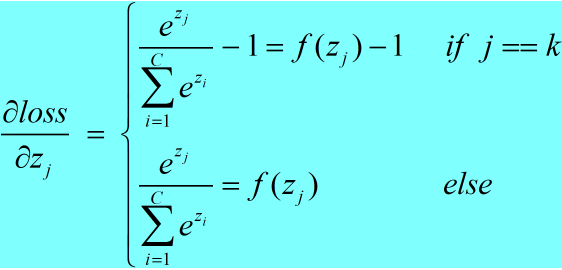
<2> softmax loss对其输入zj求导:
 (2)
(2)
如果j==k,则zk是变量,否则zj是变量。
和的导数等于导数的和,对和中某个元素求导的话有:
(2) softmax_loss_layer.cpp中的Forward_cpu()函数:
 template <typename Dtype>

 void SoftmaxWithLossLayer<Dtype>::Forward_cpu(

     const vector<Blob<Dtype>*>& bottom, const vector<Blob<Dtype>*>& top) {

   // The forward pass computes the softmax prob values.
     //调用softmax层的forward函数,得到对应的输出,存到prob_中

   softmax_layer_->Forward(softmax_bottom_vec_, softmax_top_vec_);

   const Dtype* prob_data = prob_.cpu_data();
     //一般loss层有两个输入blob,网络的predict blob(bottom[0])和label blob(bottom[1])

   const Dtype* label = bottom[]->cpu_data();
     //dim = N*C*H*W / N = C*H*W

   int dim = prob_.count() / outer_num_;
     //count变量是计算loss时的有效样本数

   int count = ;

   Dtype loss = ;

   for (int i = ; i < outer_num_; ++i) {

     for (int j = ; j < inner_num_; j++) {
         //读取label

       const int label_value = static_cast<int>(label[i * inner_num_ + j]);
         //如果该样本的label等于deploy中softmaxWithLoss中设定的参数ignore_label_,则该样本不参与前向和后向计算

       if (has_ignore_label_ && label_value == ignore_label_) {

         continue;

       }
         //判断label_value是否大于等于0

       DCHECK_GE(label_value, );
         //判断label_value是否小于prob_.shape(softmax_axis_)=C

       DCHECK_LT(label_value, prob_.shape(softmax_axis_));
         //对于softmax的输出channel,计算label_value索引对应的channel中prob的log.对应公式(1)

       loss -= log(std::max(prob_data[i * dim + label_value * inner_num_ + j],

                            Dtype(FLT_MIN)));
         //有效样本数加一

       ++count;

     }

   }
     //最终在训练日志中显示的loss为计算的总loss除以有效样本数

   top[]->mutable_cpu_data()[] = loss / get_normalizer(normalization_, count);

   if (top.size() == ) {

     top[]->ShareData(prob_);

   }

 }
(3) softmax_loss_layer.cpp中的Backward_cpu函数:
 template <typename Dtype>

 void SoftmaxWithLossLayer<Dtype>::Backward_cpu(const vector<Blob<Dtype>*>& top,

     const vector<bool>& propagate_down, const vector<Blob<Dtype>*>& bottom) {

   if (propagate_down[]) {

     LOG(FATAL) << this->type()

                << " Layer cannot backpropagate to label inputs.";

   }

   if (propagate_down[]) {

     Dtype* bottom_diff = bottom[]->mutable_cpu_diff();

     const Dtype* prob_data = prob_.cpu_data();
       //将softmax的输出prob_复制给bottom[0]的diff(梯度) blob

     caffe_copy(prob_.count(), prob_data, bottom_diff);

     const Dtype* label = bottom[]->cpu_data();

     int dim = prob_.count() / outer_num_;

     int count = ;

     for (int i = ; i < outer_num_; ++i) {

       for (int j = ; j < inner_num_; ++j) {

         const int label_value = static_cast<int>(label[i * inner_num_ + j]);

         if (has_ignore_label_ && label_value == ignore_label_) {

           for (int c = ; c < bottom[]->shape(softmax_axis_); ++c) {

             bottom_diff[i * dim + c * inner_num_ + j] = ;

           }

         } else {
             //对应公式(2),在反传梯度时,label索引对应的diff减1,其他不变。

           bottom_diff[i * dim + label_value * inner_num_ + j] -= ;

           ++count;

         }

       }

     }

     // Scale gradient
       //top[0]->cpu_diff()[0] = N
       //N / count

     Dtype loss_weight = top[]->cpu_diff()[] /

                         get_normalizer(normalization_, count);

     caffe_scal(prob_.count(), loss_weight, bottom_diff);

   }

 }
caffe中softmax loss源码阅读的更多相关文章
- caffe中batch norm源码阅读
1. batch norm 输入batch norm层的数据为[N, C, H, W], 该层计算得到均值为C个,方差为C个,输出数据为[N, C, H, W]. <1> 形象点说,均值的 ...
- 【源码阅读】Java集合之三 - ArrayDeque源码深度解读
Java 源码阅读的第一步是Collection框架源码,这也是面试基础中的基础: 针对Collection的源码阅读写一个系列的文章,本文是第三篇ArrayDeque. ---@pdai JDK版本 ...
- 【源码阅读】Java集合之二 - LinkedList源码深度解读
Java 源码阅读的第一步是Collection框架源码,这也是面试基础中的基础: 针对Collection的源码阅读写一个系列的文章; 本文是第二篇LinkedList. ---@pdai JDK版 ...
- 【源码阅读】Java集合之一 - ArrayList源码深度解读
Java 源码阅读的第一步是Collection框架源码,这也是面试基础中的基础: 针对Collection的源码阅读写一个系列的文章,从ArrayList开始第一篇. ---@pdai JDK版本 ...
- Caffe源码阅读(1) 全连接层
Caffe源码阅读(1) 全连接层 发表于 2014-09-15 | 今天看全连接层的实现.主要看的是https://github.com/BVLC/caffe/blob/master/src ...
- caffe-windows中classification.cpp的源码阅读
caffe-windows中classification.cpp的源码阅读 命令格式: usage: classification string(模型描述文件net.prototxt) string( ...
- 源码阅读笔记 - 1 MSVC2015中的std::sort
大约寒假开始的时候我就已经把std::sort的源码阅读完毕并理解其中的做法了,到了寒假结尾,姑且把它写出来 这是我的第一篇源码阅读笔记,以后会发更多的,包括算法和库实现,源码会按照我自己的代码风格格 ...
- 源码阅读经验谈-slim,darknet,labelimg,caffe(1)
本文首先谈自己的源码阅读体验,然后给几个案例解读,选的例子都是比较简单.重在说明我琢磨的点线面源码阅读方法.我不是专业架构师,是从一个深度学习算法工程师的角度来谈的,不专业的地方请大家轻拍. 经常看别 ...
- SpringMVC源码阅读:Controller中参数解析
1.前言 SpringMVC是目前J2EE平台的主流Web框架,不熟悉的园友可以看SpringMVC源码阅读入门,它交代了SpringMVC的基础知识和源码阅读的技巧 本文将通过源码(基于Spring ...
随机推荐
- F#周报2019年第38期
新闻 宣告.NET Core 3.0第一个候选版本 .NET Core 3.0第一个候选版本中ASP.NET Core与Blazor的更新 F#的就业市场情形如何 Finalization实现细节 G ...
- charles 访问控制设置
本文参考:charles 访问控制设置 charles 访问控制设置 access control settings 访问账户设置: 这里可以配置连接到charles时的一些配置: 这个访问控制确定谁 ...
- GS-PON数据库分区列范围查询优化案例
查询慢的SQL: with p as( select np.nodecode , np.nodename, d.deviceid, d.devicename, d.loopaddress, p.res ...
- 25 个 Linux 下最炫酷又强大的命令行神器,你用过其中哪几个呢?
本文首发于:微信公众号「运维之美」,公众号 ID:Hi-Linux. 「运维之美」是一个有情怀.有态度,专注于 Linux 运维相关技术文章分享的公众号.公众号致力于为广大运维工作者分享各类技术文章和 ...
- Winform组合ComboBox和TreeView实现ComboTree
最近做Winform项目需要用到类似ComboBox的TreeView控件. 虽然各种第三方控件很多,但是存在各种版本不兼容问题.所以自己写了个简单的ComboTreeView控件. 下图是实现效果: ...
- 关闭vue的eslint代码检测和WebStorm的代码检测
1. 在vue项目中 bulid > webpack.base.conf.js 中: 如图,在rules规则中有一条规则是校验代码的,也就是红框2那行,要取消可以直接注释掉这行,或者把红框1的函 ...
- 三段式有限状态机Verilog代码
状态机由状态寄存器和组合逻辑电路构成,能够根据控制信号按照预先设定的状态进行状态转移,是协调相关信号动作.完成特定操作的控制中心.有限状态机简写为FSM(Finite State Machine),主 ...
- StackOverflow 第四周周报及19年就业情况分析
这是 Stack Overflow 第四周周报,两篇 Java.两篇 Python.公众号「渡码」为日更,欢迎关注.另外,我搜集了今年的就业数据,对招聘情况和岗位情况做了简单总结,想了解的朋友点这里. ...
- WordPress 文章插入的超链接访问不了
这两天学习WordPress的时候,想着插入超链接直接访问地址,但是没成功.比如添加一个百度的超链接点击之后,就会变成 https://网站域名/go/?url=http://www.baidu.co ...
- Hive窗口函数最全案例详解
语法: 分析函数 over(partition by 列名 order by 列名 rows between 开始位置 and 结束位置) 常用分析函数: 聚合类 avg().sum().max(). ...