
一次性讲清楚spring中bean的生命周期之一:getSingleton方法
要想讲清楚spring中bean的生命周期,真的是不容易,以AnnotationConfigApplicationContext上下文为基础来讲解bean的生命周期,AnnotationConfigApplicationContext是基于注解的上下文,使用XML的方式现在很少见,所以以此上下文为基础,使用XML的上下文ClassPathXmlApplicationContext的步骤和AnnotationConfigApplicationContext类似。
了解过spring源码的都知道,在AnnotationConfigApplicationContext中调用了父类AbstractApplicationContext的refresh()方法,
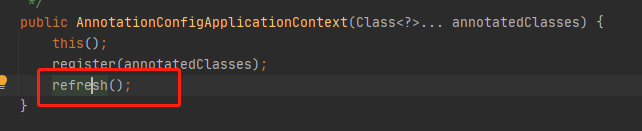
refresh方法中调用了10个左右的方法,具体方法不一一细看,看今天分析的重点方法finishBeanFactoryInitialization方法,
@Override

	public void refresh() throws BeansException, IllegalStateException {

		synchronized (this.startupShutdownMonitor) {

			// Prepare this context for refreshing.

			prepareRefresh();

			// Tell the subclass to refresh the internal bean factory.

			ConfigurableListableBeanFactory beanFactory = obtainFreshBeanFactory();

			// Prepare the bean factory for use in this context.

			prepareBeanFactory(beanFactory);

			try {

				// Allows post-processing of the bean factory in context subclasses.

				postProcessBeanFactory(beanFactory);

				// Invoke factory processors registered as beans in the context.

				invokeBeanFactoryPostProcessors(beanFactory);

				// Register bean processors that intercept bean creation.

				registerBeanPostProcessors(beanFactory);

				// Initialize message source for this context.

				initMessageSource();

				// Initialize event multicaster for this context.

				initApplicationEventMulticaster();

				// Initialize other special beans in specific context subclasses.

				onRefresh();

				// Check for listener beans and register them.

				registerListeners();

				// Instantiate all remaining (non-lazy-init) singletons.

				finishBeanFactoryInitialization(beanFactory);

				// Last step: publish corresponding event.

				finishRefresh();

			}

			catch (BeansException ex) {

				if (logger.isWarnEnabled()) {

					logger.warn("Exception encountered during context initialization - " +

							"cancelling refresh attempt: " + ex);

				}

				// Destroy already created singletons to avoid dangling resources.

				destroyBeans();

				// Reset 'active' flag.

				cancelRefresh(ex);

				// Propagate exception to caller.

				throw ex;

			}

			finally {

				// Reset common introspection caches in Spring's core, since we

				// might not ever need metadata for singleton beans anymore...

				resetCommonCaches();

			}

		}

	}
在该方法中又调用了preInstantiateSingletons()方法,这个方法才是今天的主角,在该方法中会生成所有非懒加载的单例bean。方法定义如下,
@Override

	public void preInstantiateSingletons() throws BeansException {

		if (logger.isTraceEnabled()) {

			logger.trace("Pre-instantiating singletons in " + this);

		}

		// Iterate over a copy to allow for init methods which in turn register new bean definitions.

		// While this may not be part of the regular factory bootstrap, it does otherwise work fine.

		List<String> beanNames = new ArrayList<>(this.beanDefinitionNames);

		// Trigger initialization of all non-lazy singleton beans...

		for (String beanName : beanNames) {

			RootBeanDefinition bd = getMergedLocalBeanDefinition(beanName);

			if (!bd.isAbstract() && bd.isSingleton() && !bd.isLazyInit()) {

				if (isFactoryBean(beanName)) {

					Object bean = getBean(FACTORY_BEAN_PREFIX + beanName);

					if (bean instanceof FactoryBean) {

						final FactoryBean<?> factory = (FactoryBean<?>) bean;

						boolean isEagerInit;

						if (System.getSecurityManager() != null && factory instanceof SmartFactoryBean) {

							isEagerInit = AccessController.doPrivileged((PrivilegedAction<Boolean>)

											((SmartFactoryBean<?>) factory)::isEagerInit,

									getAccessControlContext());

						}

						else {

							isEagerInit = (factory instanceof SmartFactoryBean &&

									((SmartFactoryBean<?>) factory).isEagerInit());

						}

						if (isEagerInit) {

							getBean(beanName);

						}

					}

				}

				else {

					getBean(beanName);

				}

			}

		}

		// Trigger post-initialization callback for all applicable beans...

		for (String beanName : beanNames) {

			Object singletonInstance = getSingleton(beanName);

			if (singletonInstance instanceof SmartInitializingSingleton) {

				final SmartInitializingSingleton smartSingleton = (SmartInitializingSingleton) singletonInstance;

				if (System.getSecurityManager() != null) {

					AccessController.doPrivileged((PrivilegedAction<Object>) () -> {

						smartSingleton.afterSingletonsInstantiated();

						return null;

					}, getAccessControlContext());

				}

				else {

					smartSingleton.afterSingletonsInstantiated();

				}

			}

		}

	}
该方法完成的主要逻辑是遍历所有的beanName,调用getBean(beanName)方法生成单例bean,在遍历过程中对FactoryBean做了特殊的判断,大家都知道FactoryBean是一种特殊的bean,在《spring中FactoryBean是什么bean》重点分析该bean。重点看getBean(beanName)方法,getBean(beanName)方法调用了doGetBean(beanName)方法,
@Override

	public Object getBean(String name) throws BeansException {

		return doGetBean(name, null, null, false);

	}
doGetBean方法定义如下,
protected <T> T doGetBean(final String name, @Nullable final Class<T> requiredType,

			@Nullable final Object[] args, boolean typeCheckOnly) throws BeansException {

		final String beanName = transformedBeanName(name);

		Object bean;

		// Eagerly check singleton cache for manually registered singletons.

		Object sharedInstance = getSingleton(beanName);

		if (sharedInstance != null && args == null) {

			if (logger.isTraceEnabled()) {

				if (isSingletonCurrentlyInCreation(beanName)) {

					logger.trace("Returning eagerly cached instance of singleton bean '" + beanName +

							"' that is not fully initialized yet - a consequence of a circular reference");

				}

				else {

					logger.trace("Returning cached instance of singleton bean '" + beanName + "'");

				}

			}

			bean = getObjectForBeanInstance(sharedInstance, name, beanName, null);

		}

		else {

			// Fail if we're already creating this bean instance:

			// We're assumably within a circular reference.

			if (isPrototypeCurrentlyInCreation(beanName)) {

				throw new BeanCurrentlyInCreationException(beanName);

			}

			// Check if bean definition exists in this factory.

			BeanFactory parentBeanFactory = getParentBeanFactory();

			if (parentBeanFactory != null && !containsBeanDefinition(beanName)) {

				// Not found -> check parent.

				String nameToLookup = originalBeanName(name);

				if (parentBeanFactory instanceof AbstractBeanFactory) {

					return ((AbstractBeanFactory) parentBeanFactory).doGetBean(

							nameToLookup, requiredType, args, typeCheckOnly);

				}

				else if (args != null) {

					// Delegation to parent with explicit args.

					return (T) parentBeanFactory.getBean(nameToLookup, args);

				}

				else if (requiredType != null) {

					// No args -> delegate to standard getBean method.

					return parentBeanFactory.getBean(nameToLookup, requiredType);

				}

				else {

					return (T) parentBeanFactory.getBean(nameToLookup);

				}

			}

			if (!typeCheckOnly) {

				markBeanAsCreated(beanName);

			}

			try {

				final RootBeanDefinition mbd = getMergedLocalBeanDefinition(beanName);

				checkMergedBeanDefinition(mbd, beanName, args);

				// Guarantee initialization of beans that the current bean depends on.

				String[] dependsOn = mbd.getDependsOn();

				if (dependsOn != null) {

					for (String dep : dependsOn) {

						if (isDependent(beanName, dep)) {

							throw new BeanCreationException(mbd.getResourceDescription(), beanName,

									"Circular depends-on relationship between '" + beanName + "' and '" + dep + "'");

						}

						registerDependentBean(dep, beanName);

						try {

							getBean(dep);

						}

						catch (NoSuchBeanDefinitionException ex) {

							throw new BeanCreationException(mbd.getResourceDescription(), beanName,

									"'" + beanName + "' depends on missing bean '" + dep + "'", ex);

						}

					}

				}

				// Create bean instance.

				if (mbd.isSingleton()) {

					sharedInstance = getSingleton(beanName, () -> {

						try {

							return createBean(beanName, mbd, args);

						}

						catch (BeansException ex) {

							// Explicitly remove instance from singleton cache: It might have been put there

							// eagerly by the creation process, to allow for circular reference resolution.

							// Also remove any beans that received a temporary reference to the bean.

							destroySingleton(beanName);

							throw ex;

						}

					});

					bean = getObjectForBeanInstance(sharedInstance, name, beanName, mbd);

				}

				else if (mbd.isPrototype()) {

					// It's a prototype -> create a new instance.

					Object prototypeInstance = null;

					try {

						beforePrototypeCreation(beanName);

						prototypeInstance = createBean(beanName, mbd, args);

					}

					finally {

						afterPrototypeCreation(beanName);

					}

					bean = getObjectForBeanInstance(prototypeInstance, name, beanName, mbd);

				}

				else {

					String scopeName = mbd.getScope();

					final Scope scope = this.scopes.get(scopeName);

					if (scope == null) {

						throw new IllegalStateException("No Scope registered for scope name '" + scopeName + "'");

					}

					try {

						Object scopedInstance = scope.get(beanName, () -> {

							beforePrototypeCreation(beanName);

							try {

								return createBean(beanName, mbd, args);

							}

							finally {

								afterPrototypeCreation(beanName);

							}

						});

						bean = getObjectForBeanInstance(scopedInstance, name, beanName, mbd);

					}

					catch (IllegalStateException ex) {

						throw new BeanCreationException(beanName,

								"Scope '" + scopeName + "' is not active for the current thread; consider " +

								"defining a scoped proxy for this bean if you intend to refer to it from a singleton",

								ex);

					}

				}

			}

			catch (BeansException ex) {

				cleanupAfterBeanCreationFailure(beanName);

				throw ex;

			}

		}

		// Check if required type matches the type of the actual bean instance.

		if (requiredType != null && !requiredType.isInstance(bean)) {

			try {

				T convertedBean = getTypeConverter().convertIfNecessary(bean, requiredType);

				if (convertedBean == null) {

					throw new BeanNotOfRequiredTypeException(name, requiredType, bean.getClass());

				}

				return convertedBean;

			}

			catch (TypeMismatchException ex) {

				if (logger.isTraceEnabled()) {

					logger.trace("Failed to convert bean '" + name + "' to required type '" +

							ClassUtils.getQualifiedName(requiredType) + "'", ex);

				}

				throw new BeanNotOfRequiredTypeException(name, requiredType, bean.getClass());

			}

		}

		return (T) bean;

	}
doGetBean方法中有getSingleton、getObjectForBeanInstance、createBean等方法是很重要的。在doGetBean方法中首先调用getSingleton方法检查单例缓存中是否有该bean,如果没有则判断当前bean的作用域是单例(singleton)还是原型(prototype),如果是单例的,再次调用getSingleton方法,不过这次的该方法是重载的一个;如果是原型的则调用createBean方法生成bean,上面几个步骤生成的beanInstance均要调用getObjectForBeanInstance方法获得bean对象。先看getSingleton方法
@Nullable

    protected Object getSingleton(String beanName, boolean allowEarlyReference) {

        Object singletonObject = this.singletonObjects.get(beanName);

        if (singletonObject == null && isSingletonCurrentlyInCreation(beanName)) {

            synchronized (this.singletonObjects) {

                singletonObject = this.earlySingletonObjects.get(beanName);

                if (singletonObject == null && allowEarlyReference) {

                    ObjectFactory<?> singletonFactory = this.singletonFactories.get(beanName);

                    if (singletonFactory != null) {

                        singletonObject = singletonFactory.getObject();

                        this.earlySingletonObjects.put(beanName, singletonObject);

                        this.singletonFactories.remove(beanName);

                    }

                }

            }

        }

        return singletonObject;

    }
在该方法中涉及到三个对象singletonObjects、earlySingletonObjects、singletonFactories,使用这三个对象可以很好的解决循环依赖的问题,这里暂时不讲这个,先看其中的逻辑,
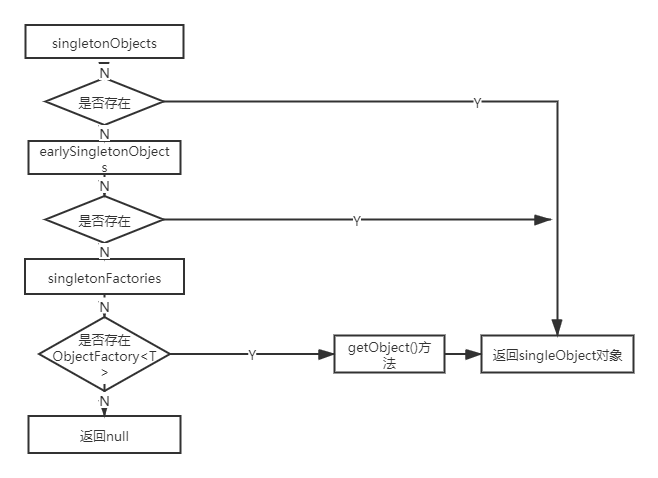
执行的逻辑大概是上面的过程。对singletonObject、earlySingletonObjects、singletonFactories逐级判断,其中singletonFactories中存储的是提前暴露的实例工厂,用来生成一个实例或者实例的代理类。
本文重点对spring生成bean的入门进行了分析,重点分析了代码的调用过程及getSingleton方法,该方法还有一个重载的方法,放到后面分析。

一次性讲清楚spring中bean的生命周期之一:getSingleton方法的更多相关文章
- 一次性讲清楚spring中bean的生命周期之二:FactoryBean的前世今生
前言 在<spring中FactoryBean是什么bean>一文中,带着小伙伴学习了spring中的FactoryBean,了解了到了FactoryBean其实是一种生产Bean的bea ...
- 一次性讲清楚spring中bean的生命周期之三:bean是如何实例化的
在前面的两篇博文<一次性讲清楚spring中bean的生命周期之一:getSingleton方法>和<一次性讲清楚spring中bean的生命周期之二:FactoryBean的前世今 ...
- JAVA面试题:Spring中bean的生命周期
Spring 中bean 的生命周期短暂吗? 在spring中,从BeanFactory或ApplicationContext取得的实例为Singleton,也就是预设为每一个Bean的别名只能维持一 ...
- 深入理解Spring中bean的生命周期
[Spring中bean的生命周期] bean的生命周期 1.以ApplocationContext上下文单例模式装配bean为例,深入探讨bean的生命周期: (1).生命周期图: (2).具体事例 ...
- Spring中Bean的生命周期及其扩展点
原创作品,可以转载,但是请标注出处地址http://www.cnblogs.com/V1haoge/p/6106456.html Spring中Bean的管理是其最基本的功能,根据下面的图来了解Spr ...
- 简:Spring中Bean的生命周期及代码示例
(重要:spring bean的生命周期. spring的bean周期,装配.看过spring 源码吗?(把容器启动过程说了一遍,xml解析,bean装载,bean缓存等)) 完整的生命周期概述(牢记 ...
- 通过BeanPostProcessor理解Spring中Bean的生命周期
通过BeanPostProcessor理解Spring中Bean的生命周期及AOP原理 Spring源码解析(十一)Spring扩展接口InstantiationAwareBeanPostProces ...
- 一分钟掌握Spring中bean的生命周期!
Spring 中bean 的生命周期短暂吗? 在spring中,从BeanFactory或ApplicationContext取得的实例为Singleton,也就是预设为每一个Bean 的别名只能维持 ...
- Spring中bean的生命周期!
Spring 中bean 的生命周期短暂吗? 在spring中,从BeanFactory或ApplicationContext取得的实例为Singleton,也就是预设为每一个Bean的别名只能维持一 ...
随机推荐
- 有哪些适用于律师事务所的CRM系统?
中国的经济发展和政治稳定给律师行业带来了巨大的空间.而互联网的发展也让律师事务所遍地开花.如何在大大小小的律所中脱颖而出,是每个律所都迫切需要解决的问题.为了让您的律师事务所在激烈的竞争中脱颖而出,今 ...
- Linux下的ARP攻击-断网
1.软件工具安装 1. nmap --网络嗅探工具 2. dsniff ( arpspoof ) --ARP嗅探工具 3. net-tools ( ifconfig ) --网络工具 sudo ...
- vue2.0与3.0响应式原理机制
vue2.0响应式原理 - defineProperty 这个原理老生常谈了,就是拦截对象,给对象的属性增加set 和 get方法,因为核心是defineProperty所以还需要对数组的方法进行拦截 ...
- [bug] Maven [WARNING] 'parent.relativePath' of POM
参考 https://blog.csdn.net/simajinxiu/article/details/86667894
- https://www.jqhtml.com/30047.html strace + 命令: 这条命令十分强大,可以定位你程序到底是哪个地方出了问题
https://www.jqhtml.com/30047.html 我的Linux手册 服务器 浏览数:72 2019-1-30 原文链接 基础安装 # CentOS sudo yum install ...
- Ansible playbook编写Apache角色
编写Apache角色:使用源码安装 在files中下载扩展包和安装包 [root@localhost project]# ls roles/httpd/files/ apr-1.6.5.tar.gz ...
- python基础之面向对象(二)(封装、继承、多态)
一.封装 (1)封装是面向对象的一大特点 (2)面向对象编程的第一步--将属性和方法封装到一个抽象的类当中 (3)外界使用类创建对象,然后让对象调用方法 (4)对象方法的细节都被封装在类的内部 1.案 ...
- shell应用之监测电脑内存、负载和磁盘的使用情况
1 #!/bin/bash 2 for i in $(cat ip.txt);do 3 #内存 4 total_memo=$(ssh $i "free -m" |grep Mem ...
- 03丨认识文档数据库MongoDB
- 10.12 telnet:远程登录主机
telnet命令 以前是用于登录远程主机,对远程主机进行管理的.但是因为telnet是采用明文传送报文的,其安全性不好,因此现在很多Linux服务器都不开放telnet服务,而是改用更安全的SSH服务 ...