
数据结构(Splay平衡树):HDU 1890 Robotic Sort
Robotic Sort
Time Limit: 6000/2000 MS (Java/Others) Memory Limit: 32768/32768 K (Java/Others)
Total Submission(s): 3456 Accepted Submission(s): 1493
deep in the Czech Technical University buildings, there are
laboratories for examining mechanical and electrical properties of
various materials. In one of yesterday’s presentations, you have seen
how was one of the laboratories changed into a new multimedia lab. But
there are still others, serving to their original purposes.
In
this task, you are to write software for a robot that handles samples in
such a laboratory. Imagine there are material samples lined up on a
running belt. The samples have different heights, which may cause
troubles to the next processing unit. To eliminate such troubles, we
need to sort the samples by their height into the ascending order.
Reordering
is done by a mechanical robot arm, which is able to pick up any number
of consecutive samples and turn them round, such that their mutual order
is reversed. In other words, one robot operation can reverse the order
of samples on positions between A and B.
A possible way to sort
the samples is to find the position of the smallest one (P1) and reverse
the order between positions 1 and P1, which causes the smallest sample
to become first. Then we find the second one on position P and reverse
the order between 2 and P2. Then the third sample is located etc.
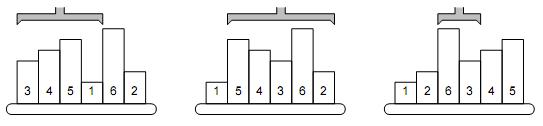
The
picture shows a simple example of 6 samples. The smallest one is on the
4th position, therefore, the robot arm reverses the first 4 samples.
The second smallest sample is the last one, so the next robot operation
will reverse the order of five samples on positions 2–6. The third step
will be to reverse the samples 3–4, etc.
Your task is to find
the correct sequence of reversal operations that will sort the samples
using the above algorithm. If there are more samples with the same
height, their mutual order must be preserved: the one that was given
first in the initial order must be placed before the others in the final
order too.
input consists of several scenarios. Each scenario is described by two
lines. The first line contains one integer number N , the number of
samples, 1 ≤ N ≤ 100 000. The second line lists exactly N
space-separated positive integers, they specify the heights of
individual samples and their initial order.
The last scenario is followed by a line containing zero.
Each Pi must be an integer (1 ≤ Pi ≤ N ) giving the position of the i-th sample just before the i-th reversal operation.
Note
that if a sample is already on its correct position Pi , you should
output the number Pi anyway, indicating that the “interval between Pi
and Pi ” (a single sample) should be reversed.
3 4 5 1 6 2
4
3 3 2 1
0
4 2 4 4
 #include <algorithm>

 #include <iostream>

 #include <cstring>

 #include <cstdio>

 using namespace std;

 const int maxn=;

 int n,fa[maxn],ch[maxn][],sz[maxn];

 int flip[maxn],pos[maxn],rt;

 struct Node{

     int x,id;

 }a[maxn];

 void Flip(int x){

     swap(ch[x][],ch[x][]);

     flip[x]^=;

 }

 void Push_down(int x){

     if(flip[x]){

         Flip(ch[x][]);

         Flip(ch[x][]);

         flip[x]=;

     }

 }

 int pd[maxn];

 void P(int x){

     int cnt=;

     while(x){

         pd[++cnt]=x;

         x=fa[x];

     }

     while(cnt){

         Push_down(pd[cnt--]);

     }

 }

 void Push_up(int x){

     sz[x]=sz[ch[x][]]+sz[ch[x][]]+;

 }

 void Rotate(int x){

     int y=fa[x],g=fa[y],c=ch[y][]==x;

     ch[y][c]=ch[x][c^];fa[ch[x][c^]]=y;

     ch[x][c^]=y;fa[y]=x;fa[x]=g;

     if(g)ch[g][ch[g][]==y]=x;

     Push_up(y);

 }

 void Splay(int x,int g=){

     P(x);

     for(int y;(y=fa[x])!=g;Rotate(x))

         if(fa[y]!=g)

             Rotate((ch[fa[y]][]==y)==(ch[y][]==x)?y:x);

     Push_up(x);

     if(!g)rt=x;

 }

 int Build(int f,int l,int r){

     if(l>r)return ;

     int mid=(l+r)>>;fa[mid]=f;

     ch[mid][]=Build(mid,l,mid-);

     ch[mid][]=Build(mid,mid+,r);

     sz[mid]=;

     Push_up(mid);

     return mid;

 }

 bool cmp(Node a,Node b){

     if(a.x!=b.x)

     return a.x<b.x;

     return a.id<b.id;

 }

 int main(){

     while(~scanf("%d",&n)&&n){

         memset(flip,,sizeof(flip));

         rt=Build(,,n+);

         for(int i=;i<=n;i++)

             scanf("%d",&a[i].x);

         for(int i=;i<=n;i++)

             a[i].id=i;

         sort(a+,a+n+,cmp);

         for(int i=;i<=n;i++)

             pos[i+]=a[i].id+;

         pos[]=;pos[n+]=n+;

         for(int i=,p;i<n+;i++){

             Splay(pos[]);

             Splay(pos[i],pos[]);

             printf("%d ",sz[ch[ch[rt][]][]]+);

             Splay(pos[i]);

             p=ch[pos[i]][];

             while(ch[p][]){

                 Push_down(p);

                 p=ch[p][];

             }

             Push_down(p);

             Splay(pos[i-]);

             Splay(p,pos[i-]);

             Flip(ch[ch[rt][]][]);

         }

         printf("%d\n",n);

     }

     return ;

 }
数据结构(Splay平衡树):HDU 1890 Robotic Sort的更多相关文章
- hdu 1890 Robotic Sort(splay 区间反转+删点)
题目链接:hdu 1890 Robotic Sort 题意: 给你n个数,每次找到第i小的数的位置,然后输出这个位置,然后将这个位置前面的数翻转一下,然后删除这个数,这样执行n次. 题解: 典型的sp ...
- HDU 1890 Robotic Sort | Splay
Robotic Sort Time Limit: 6000/2000 MS (Java/Others) Memory Limit: 32768/32768 K (Java/Others) [Pr ...
- HDU 1890 Robotic Sort (splay tree)
Robotic Sort Time Limit: 6000/2000 MS (Java/Others) Memory Limit: 32768/32768 K (Java/Others)Tota ...
- HDU 1890 Robotic Sort(splay)
[题目链接] http://acm.hdu.edu.cn/showproblem.php?pid=1890 [题意] 给定一个序列,每次将i..P[i]反转,然后输出P[i],P[i]定义为当前数字i ...
- HDU 1890 - Robotic Sort - [splay][区间反转+删除根节点]
题目链接:http://acm.hdu.edu.cn/showproblem.php?pid=1890 Time Limit: 6000/2000 MS (Java/Others) Memory Li ...
- hdu 1890 Robotic Sort
原题链接:http://acm.hdu.edu.cn/showproblem.php?pid=1890 如下: #include<cstdio> #include<cstdlib&g ...
- hdu 1890 Robotic SortI(splay区间旋转操作)
题目链接:http://acm.hdu.edu.cn/showproblem.php?pid=1890 题解:splay又一高级的功能,区间旋转这个是用线段树这些实现不了的,这题可以学习splay的旋 ...
- 【HDOJ】1890 Robotic Sort
伸展树伤不起啊,很容易wa,很容易T,很容易M. /* 1890 */ #include <iostream> #include <string> #include <m ...
- 数据结构(Splay平衡树):COGS 339. [NOI2005] 维护数列
339. [NOI2005] 维护数列 时间限制:3 s 内存限制:256 MB [问题描述] 请写一个程序,要求维护一个数列,支持以下 6 种操作:(请注意,格式栏 中的下划线‘ _ ’表示实际 ...
随机推荐
- Stream类
为什么需要 Stream Stream 作为 Java 8 的一大亮点,它与 java.io 包里的 InputStream 和 OutputStream 是完全不同的概念.它也不同于 StAX 对 ...
- 开源的Android开发框架-------PowerFramework使用心得(五)网络请求HTTPRequest
GET请求示例 //所有参数都使用Bundle,用putString Bundle bundle = new Bundle(); bundle.putString("username&quo ...
- Android之提交数据到服务端方法简单封装
在Android应用中,除了单机版的应用,其余的应用免不了需要频繁地与服务端进行数据交互,如果每一种方法都独立写一段代码,那会造成代码大量重复,冗余,这不是我们所希望的,所以我们可以对其进行一些封装, ...
- Android开发--推送
需要的知识点:Notification.Service 第三方开源框架 : android-async-http-master 推送的来源:android项目中,有时会有这样一种需求:客户每隔一段时间 ...
- java simple check whether a file or directory.
Ref: check whether a file or directory First, make sure the path exists by using: new File(path).ex ...
- ValidationContext
.NET 4 和Silverlight 中可以使用以下方法: ? public static void Validate(this Entity entity) { // prepare th ...
- Unity Manual 用户手册
unity3d 文档的中文网址: http://game.ceeger.com/Manual/
- 【转】 iOS开发之手势gesture详解
原文:http://www.cnblogs.com/salam/archive/2013/04/30/iOS_gesture.html 前言 在iOS中,你可以使用系统内置的手势识别 (Gesture ...
- 纯命令行教你Cocoapods的安装和使用
关于cocoapods的介绍和作用,网上有很多大神介绍的比我清楚,建议去看一下唐巧的http://blog.devtang.com/blog/2014/05/25/use-cocoapod-to-ma ...
- java中的继承要点
java的一大特性既是:继承. 1.因为有了一个子类继承了一个父类,才有了后面的多态. 2.类的继承,不要为了节省代码,为了继承而继承,把那个没有任何相关的类链接在一起,继承必须用在 is a,就是例 ...