
Keras实现autoencoder
Keras使我们搭建神经网络变得异常简单,之前我们使用了Sequential来搭建LSTM:keras实现LSTM。
我们要使用Keras的functional API搭建更加灵活的网络结构,比如说本文的autoencoder,关于autoencoder的介绍可以在这里找到:deep autoencoder。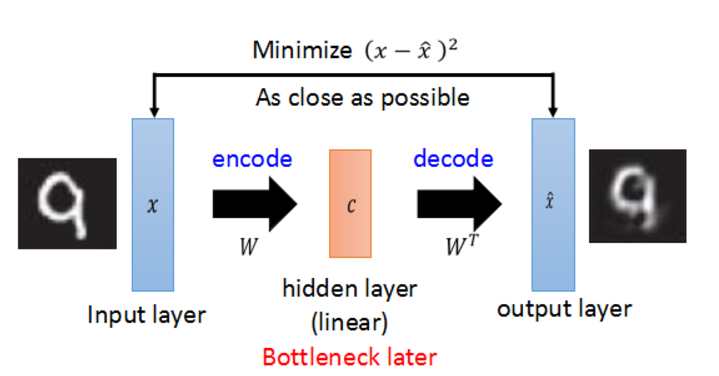
现在我们就开始。
step 0 导入需要的包
 import keras

 from keras.layers import Dense, Input

 from keras.datasets import mnist

 from keras.models import Model

 import numpy as np
step 1 数据预处理
这里需要说明一下,导入的原始数据shape为(60000,28,28),autoencoder使用(60000,28*28),而且autoencoder属于无监督学习,所以只需要导入x_train和x_test.
 (x_train, _), (x_test, _) = mnist.load_data()

 x_train = x_train.astype('float32')/255.0

 x_test = x_test.astype('float32')/255.0

 #print(x_train.shape)

 x_train = x_train.reshape(x_train.shape[0], -1)

 x_test = x_test.reshape(x_test.shape[0], -1)

 #print(x_train.shape)
step 2 向图片添加噪声
添加噪声是为了让autoencoder更robust,不容易出现过拟合。
 #add random noise

 x_train_nosiy = x_train + 0.3 * np.random.normal(loc=0., scale=1., size=x_train.shape)

 x_test_nosiy = x_test + 0.3 * np.random.normal(loc=0, scale=1, size=x_test.shape)

 x_train_nosiy = np.clip(x_train_nosiy, 0., 1.)

 x_test_nosiy = np.clip(x_test_nosiy, 0, 1.)

 print(x_train_nosiy.shape, x_test_nosiy.shape)
step 3 搭建网络结构
分别构建encoded和decoded,然后将它们链接起来构成整个autoencoder。使用Model建模。
 #build autoencoder model

 input_img = Input(shape=(28*28,))

 encoded = Dense(500, activation='relu')(input_img)

 decoded = Dense(784, activation='sigmoid')(encoded)

 autoencoder = Model(input=input_img, output=decoded)
step 4 compile
因为这里是让解压后的图片和原图片做比较, loss使用的是binary_crossentropy。
 autoencoder.compile(optimizer='adam', loss='binary_crossentropy')

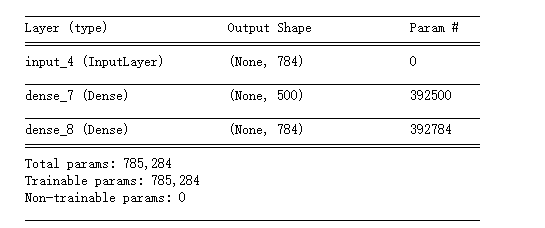
 autoencoder.summary()
step 5 train
指定epochs,batch_size,可以使用validation_data,keras训练的时候不会使用它,而是用来做模型评价。
autoencoder.fit(x_train_nosiy, x_train, epochs=20, batch_size=128, verbose=1, validation_data=(x_test, x_test))
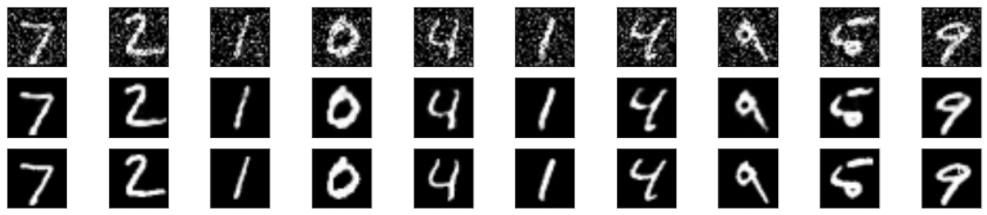
step 6 对比一下解压缩后的图片和原图片
 %matplotlib inline

 import matplotlib.pyplot as plt

 #decoded test images

 decoded_img = autoencoder.predict(x_test_nosiy)

 n = 10

 plt.figure(figsize=(20, 4))

 for i in range(n):

     #noisy data

     ax = plt.subplot(3, n, i+1)

     plt.imshow(x_test_nosiy[i].reshape(28, 28))

     plt.gray()

     ax.get_xaxis().set_visible(False)

     ax.get_yaxis().set_visible(False)

     #predict

     ax = plt.subplot(3, n, i+1+n)

     plt.imshow(decoded_img[i].reshape(28, 28))

     plt.gray()

     ax.get_yaxis().set_visible(False)

     ax.get_xaxis().set_visible(False)

     #original

     ax = plt.subplot(3, n, i+1+2*n)

     plt.imshow(x_test[i].reshape(28, 28))

     plt.gray()

     ax.get_yaxis().set_visible(False)

     ax.get_xaxis().set_visible(False)

 plt.show()
这样的结果,你能分出哪个是压缩解压缩后的图片哪个是原图片吗?
reference:
https://keras.io/getting-started/functional-api-guide/
Keras实现autoencoder的更多相关文章
- keras使用AutoEncoder对mnist数据降维
import keras import matplotlib.pyplot as plt from keras.datasets import mnist (x_train, _), (x_test, ...
- tlflearn 编码解码器 ——数据降维用
# -*- coding: utf-8 -*- """ Auto Encoder Example. Using an auto encoder on MNIST hand ...
- Keras(六)Autoencoder 自编码 原理及实例 Save&reload 模型的保存和提取
Autoencoder 自编码 压缩与解压 原来有时神经网络要接受大量的输入信息, 比如输入信息是高清图片时, 输入信息量可能达到上千万, 让神经网络直接从上千万个信息源中学习是一件很吃力的工作. 所 ...
- 深度学习Keras框架笔记之AutoEncoder类
深度学习Keras框架笔记之AutoEncoder类使用笔记 keras.layers.core.AutoEncoder(encoder, decoder,output_reconstruction= ...
- 用Keras搭建神经网络 简单模版(六)——Autoencoder 自编码
import numpy as np np.random.seed(1337) from keras.datasets import mnist from keras.models import Mo ...
- CNN autoencoder 进行异常检测——TODO,使用keras进行测试
https://sefiks.com/2018/03/23/convolutional-autoencoder-clustering-images-with-neural-networks/ http ...
- 深度学习中的Data Augmentation方法(转)基于keras
在深度学习中,当数据量不够大时候,常常采用下面4中方法: 1. 人工增加训练集的大小. 通过平移, 翻转, 加噪声等方法从已有数据中创造出一批"新"的数据.也就是Data Augm ...
- 深度学习之自编码器AutoEncoder
原文地址:https://blog.csdn.net/marsjhao/article/details/73480859 一.什么是自编码器(Autoencoder) 自动编码器是一种数据的压缩算法, ...
- (zhuan) Variational Autoencoder: Intuition and Implementation
Agustinus Kristiadi's Blog TECH BLOG TRAVEL BLOG PORTFOLIO CONTACT ABOUT Variational Autoencoder: In ...
随机推荐
- Laravel5.1 搭建博客 --展示简单的首页
今天起开始搭建博客,把之前学的东西运用下. 1 创建 配置项目 1.1 创建项目 composer create-project laravel/laravel blog 5.1.1 1.2 配置数据 ...
- Ubuntu系统-网络配置
网络配置 静态IP root@ubuntu:~# cat /etc/network/interfaces # This file describes the network interfaces av ...
- zoj3497(经典矩阵乘法)
原以为是用搜索做的题,想了好久都无法想到一个高效正确的解法. 后面发现竟然这就是矩阵的应用! 碉堡! 给定一个有向图,问从A点恰好走k步(允许重复经过边)到达B点的方案数mod p的值 ——选自ma ...
- ng-template
一,锚点链接 定义锚点: <a href="#login" class="btn btn-primary">Login</a> < ...
- Dropdownlist中用viewmodel传值处理方法
背景:MVC框架,页面使用razor语法,下拉框的话使用了@Html.DropDownList(),以前传值使用viewdata,但是我们老大说这个方式比较low,希望我可以使用viewmodel的方 ...
- VMware虚拟机Host-Only(仅主机模式)
转载于:https://www.linuxidc.com/Linux/2016-09/135521p3.htm 三.Host-Only(仅主机模式) Host-Only模式其实就是NAT模式去除了虚拟 ...
- HttpURLConnection 当作请求调用接口不带返回参数的工具类
package cn.smartercampus.core.util; import java.io.BufferedReader; import java.io.InputStream; impor ...
- 【Python之路】第二十一篇--Memcached、Redis
Memcached Memcached 是一个高性能的分布式内存对象缓存系统,用于动态Web应用以减轻数据库负载.它通过在内存中缓存数据和对象来减少读取数据库的次数,从而提高动态.数据库驱动网站的速度 ...
- mysql 使用命令执行外部sql文件
语句 source e:\\phpPro\\fileName.sql 注意,不需要再后面加 分号 !!!!!
- 【sed / awk脚本编写】
awk awk分为BEGIN部分,正则匹配部分,END部分三部分. 我一般在BEGIN部分定义一些变量,正则部分用于匹配和执行一些解析和统计,END部分用于输出结果. 总体结构: awk 'BEGIN ...