
集合之TreeSet(含JDK1.8源码分析)
一、前言
前面分析了Set接口下的hashSet和linkedHashSet,下面接着来看treeSet,treeSet的底层实现是基于treeMap的。
四个关注点在treeSet上的答案
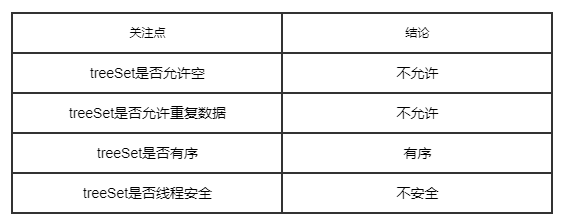
二、treeSet的数据结构
因为treeSet的底层是基于treeMap的,所以treeSet的数据结构就是treeMap的数据结构:红黑树,因为前面已经分析过了treeMap的数据结构,这里不再赘述。集合之TreeMap(含JDK1.8源码分析)。
三、treeSet源码分析-属性及构造函数
3.1 类的继承关系
public class TreeSet<E> extends AbstractSet<E>

    implements NavigableSet<E>, Cloneable, java.io.Serializable
说明:实现了NavigableSet接口,定义了一些共有的操作。
3.2 类的属性
/**

     * The backing map.

     */

    private transient NavigableMap<E,Object> m;

    // Dummy value to associate with an Object in the backing Map

    private static final Object PRESENT = new Object();

    //版本号

    private static final long serialVersionUID = -2479143000061671589L;
说明:属性m为NavigableMap接口,treeSet的一些操作都是基于此map的,而前面分析treeMap的时候,发现treeMap实现了NavigableMap接口,所以hashSet中基于NavigableMap接口的操作实际上都是基于其实现类treeMap的操作,此处也是多态的概念。
treeMap的继承实现关系:
public class TreeMap<K,V>

    extends AbstractMap<K,V>

    implements NavigableMap<K,V>, Cloneable, java.io.Serializable
而对于Object类型的属性PRESENT,在分析hashSet的时候已经做了说明,因为map(treeSet中是NavigableMap)是存储key-value键值对的,所以PRESENT只是配一下key-value中value的位置,起个占位的作用,没有什么实际的意义,所有通过treeSet添加进来的key都对应同一个value值,PRESENT。
3.3 类的构造函数

1、TreeSet(NavigableMap<E,Object> m)型
/**

     * Constructs a set backed by the specified navigable map.

     */

    TreeSet(NavigableMap<E,Object> m) {

        this.m = m;

    }
说明:构建一个treeSet,基于navigable map(其实现类treeMap)实现的。
2、TreeSet()型
/**

     * Constructs a new, empty tree set, sorted according to the

     * natural ordering of its elements.  All elements inserted into

     * the set must implement the {@link Comparable} interface.

     * Furthermore, all such elements must be <i>mutually

     * comparable</i>: {@code e1.compareTo(e2)} must not throw a

     * {@code ClassCastException} for any elements {@code e1} and

     * {@code e2} in the set.  If the user attempts to add an element

     * to the set that violates this constraint (for example, the user

     * attempts to add a string element to a set whose elements are

     * integers), the {@code add} call will throw a

     * {@code ClassCastException}.

     */

    public TreeSet() {

        this(new TreeMap<E,Object>());

    }
说明:构建一个treeSet,排序是基于插入元素的自然顺序。
3、TreeSet(Comparator<? super E> comparator)型
/**

     * Constructs a new, empty tree set, sorted according to the specified

     * comparator.  All elements inserted into the set must be <i>mutually

     * comparable</i> by the specified comparator: {@code comparator.compare(e1,

     * e2)} must not throw a {@code ClassCastException} for any elements

     * {@code e1} and {@code e2} in the set.  If the user attempts to add

     * an element to the set that violates this constraint, the

     * {@code add} call will throw a {@code ClassCastException}.

     *

     * @param comparator the comparator that will be used to order this set.

     *        If {@code null}, the {@linkplain Comparable natural

     *        ordering} of the elements will be used.

     */

    public TreeSet(Comparator<? super E> comparator) {

        this(new TreeMap<>(comparator));

    }
说明:构建一个treeSet,排序是基于自定义的比较器的排序规则。
4、TreeSet(Collection<? extends E> c)型
/**

     * Constructs a new tree set containing the elements in the specified

     * collection, sorted according to the <i>natural ordering</i> of its

     * elements.  All elements inserted into the set must implement the

     * {@link Comparable} interface.  Furthermore, all such elements must be

     * <i>mutually comparable</i>: {@code e1.compareTo(e2)} must not throw a

     * {@code ClassCastException} for any elements {@code e1} and

     * {@code e2} in the set.

     *

     * @param c collection whose elements will comprise the new set

     * @throws ClassCastException if the elements in {@code c} are

     *         not {@link Comparable}, or are not mutually comparable

     * @throws NullPointerException if the specified collection is null

     */

    public TreeSet(Collection<? extends E> c) {

        this();

        addAll(c);

    }
说明:构建一个treeSet,包含参数c中的元素,排序是基于元素的自然顺序。
5、TreeSet(SortedSet<E> s)型
/**

     * Constructs a new tree set containing the same elements and

     * using the same ordering as the specified sorted set.

     *

     * @param s sorted set whose elements will comprise the new set

     * @throws NullPointerException if the specified sorted set is null

     */

    public TreeSet(SortedSet<E> s) {

        this(s.comparator());

        addAll(s);

    }
说明:构建一个treeSet,排序是基于SortedSet指定的排序规则。
四、treeSet源码分析-核心函数
4.1 增:add函数----存储元素
/**
* Adds the specified element to this set if it is not already present.
* More formally, adds the specified element {@code e} to this set if
* the set contains no element {@code e2} such that
* <tt>(e==null ? e2==null : e.equals(e2))</tt>.
* If this set already contains the element, the call leaves the set
* unchanged and returns {@code false}.
*
* @param e element to be added to this set
* @return {@code true} if this set did not already contain the specified
* element
* @throws ClassCastException if the specified object cannot be compared
* with the elements currently in this set
* @throws NullPointerException if the specified element is null
* and this set uses natural ordering, or its comparator
* does not permit null elements
*/
public boolean add(E e) {
return m.put(e, PRESENT)==null;
}
说明:添加一个原先set中未存在的元素,返回true,若是该元素已经存在,set不做改变,返回false。
可以看到其方法内部调用navigableMap的put方法,因为treeMap是其实现类,所以实际执行的时候,调用的是treeMap的put方法。可参见:集合之TreeMap(含JDK1.8源码分析)。
4.2 增:remove函数----删除元素
/**
* Removes the specified element from this set if it is present.
* More formally, removes an element {@code e} such that
* <tt>(o==null ? e==null : o.equals(e))</tt>,
* if this set contains such an element. Returns {@code true} if
* this set contained the element (or equivalently, if this set
* changed as a result of the call). (This set will not contain the
* element once the call returns.)
*
* @param o object to be removed from this set, if present
* @return {@code true} if this set contained the specified element
* @throws ClassCastException if the specified object cannot be compared
* with the elements currently in this set
* @throws NullPointerException if the specified element is null
* and this set uses natural ordering, or its comparator
* does not permit null elements
*/
public boolean remove(Object o) {
return m.remove(o)==PRESENT;
}
说明:若set中存在要删除的元素,删除,返回true,不存在,返回false。
可以看到其方法内部调用navigableMap的remove方法,因为treeMap是其实现类,所以实际执行的时候,调用的是treeMap的remove方法。可参见:集合之TreeMap(含JDK1.8源码分析)。
4.3 contains函数----是否存在该元素
/**
* Returns {@code true} if this set contains the specified element.
* More formally, returns {@code true} if and only if this set
* contains an element {@code e} such that
* <tt>(o==null ? e==null : o.equals(e))</tt>.
*
* @param o object to be checked for containment in this set
* @return {@code true} if this set contains the specified element
* @throws ClassCastException if the specified object cannot be compared
* with the elements currently in the set
* @throws NullPointerException if the specified element is null
* and this set uses natural ordering, or its comparator
* does not permit null elements
*/
public boolean contains(Object o) {
return m.containsKey(o);
}
说明:若set中存在该元素,返回true,不存在,返回false。
可以看到其方法内部调用navigableMap的containsKey方法,因为treeMap是其实现类,所以实际执行的时候,调用的是treeMap的containsKey方法。
五、总结
总之,treeSet底层是基于treeMap实现的,可以自定义比较器对元素进行排序,或是使用元素的自然顺序。
集合之TreeSet(含JDK1.8源码分析)的更多相关文章
- 集合之LinkedHashSet(含JDK1.8源码分析)
一.前言 上篇已经分析了Set接口下HashSet,我们发现其操作都是基于hashMap的,接下来看LinkedHashSet,其底层实现都是基于linkedHashMap的. 二.linkedHas ...
- 集合之HashSet(含JDK1.8源码分析)
一.前言 我们已经分析了List接口下的ArrayList和LinkedList,以及Map接口下的HashMap.LinkedHashMap.TreeMap,接下来看的是Set接口下HashSet和 ...
- 集合之HashMap(含JDK1.8源码分析)
一.前言 之前的List,讲了ArrayList.LinkedList,反映的是两种思想: (1)ArrayList以数组形式实现,顺序插入.查找快,插入.删除较慢 (2)LinkedList以链表形 ...
- 集合之LinkedList(含JDK1.8源码分析)
一.前言 LinkedList是基于链表实现的,所以先讲解一下什么是链表.链表原先是C/C++的概念,是一种线性的存储结构,意思是将要存储的数据存在一个存储单元里面,这个存储单元里面除了存放有待存储的 ...
- 集合之ArrayList(含JDK1.8源码分析)
一.ArrayList的数据结构 ArrayList底层的数据结构就是数组,数组元素类型为Object类型,即可以存放所有类型数据.我们对ArrayList类的实例的所有的操作(增删改查等),其底层都 ...
- 集合之TreeMap(含JDK1.8源码分析)
一.前言 前面所说的hashMap和linkedHashMap都不具备统计的功能,或者说它们的统计性能的时间复杂度都不是很好,要想对两者进行统计,需要遍历所有的entry,时间复杂度比较高,此时,我们 ...
- 集合之LinkedHashMap(含JDK1.8源码分析)
一.前言 大多数的情况下,只要不涉及线程安全问题,map都可以使用hashMap,不过hashMap有一个问题,hashMap的迭代顺序不是hashMap的存储顺序,即hashMap中的元素是无序的. ...
- 【集合框架】JDK1.8源码分析之HashMap(一) 转载
[集合框架]JDK1.8源码分析之HashMap(一) 一.前言 在分析jdk1.8后的HashMap源码时,发现网上好多分析都是基于之前的jdk,而Java8的HashMap对之前做了较大的优化 ...
- 【集合框架】JDK1.8源码分析之ArrayList详解(一)
[集合框架]JDK1.8源码分析之ArrayList详解(一) 一. 从ArrayList字表面推测 ArrayList类的命名是由Array和List单词组合而成,Array的中文意思是数组,Lis ...
随机推荐
- Spring Boot+Spring Security+JWT 实现 RESTful Api 权限控制
摘要:用spring-boot开发RESTful API非常的方便,在生产环境中,对发布的API增加授权保护是非常必要的.现在我们来看如何利用JWT技术为API增加授权保护,保证只有获得授权的用户才能 ...
- 小a与黄金街道 (欧拉函数)
题意:a, b两个人在长度为n的一维数轴上(从1开始).a在1,b在n.每个人以1m/s的速度相向而行,则每一时刻存在坐标x,y,当cgd(n, x)==1,gcd(n, y)==1时,t1=k^x, ...
- pytorch例子学习——TRANSFER LEARNING TUTORIAL
参考:https://pytorch.org/tutorials/beginner/transfer_learning_tutorial.html 以下是两种主要的迁移学习场景 微调convnet : ...
- docker 14 dockerfile自定义mycentos
Base镜像(scratch) Docker Hub中99%的镜像是通过在base镜像中安装和配置需要的软件构建出来的.也就是说base镜像是所有其他镜像的鼻祖. hub默认centos镜像是什么情况 ...
- ORA-00600: internal error code, arguments: [2662]
转自 http://www.eygle.com/archives/2005/12/oracle_diagnostics_howto_deal_2662_error.html 在ORA-00600 22 ...
- MSYS2 简单配置
Windows 下用 SWIG 打包 C/C++ 为 Python 接口的时候,需要用到 32-bit/64-bit 编译器,MSYS2 给出了个一揽子方案,安装见其官方网站. 本文主要记录 MSYS ...
- node.js api文档生成
ApiDoc官网地址为:http://apidocjs.com/在Java中有Swagger及其升级版的Swagger2+Springfox自动生成接口管理文档.而在Node.js中则可以利用ApiD ...
- AI 概率图模型
概率图模型(Probabilistic Graphical Model) 有向图模型 信念网络 贝叶斯网络 无向模型 马尔科夫随机场 马尔科夫网络
- mongo固定集合
固定集合:事先创建,大小固定 类型于环形队列,空间不足队列头文件被替换 不能手动删除文档,只能自动替换 db.ceateCollection("COLLECTION_NAME",{ ...
- 使用Git进行代码管理的心得--github for windows
首先简述一下Git进行代码管理的情况 我使用的是github for windows,官网下载的速度太慢,所以用了离线安装包.安装之后会有GitHub和GitShell两个软件,其中Github采用图 ...