
fast planner总结
一、前端 kinodynamic A*算法动力学路径搜索
1.1 路径搜索的主要函数为kinodynamicAstar类的search函数
int KinodynamicAstar::search(Eigen::Vector3d start_pt, Eigen::Vector3d start_v, Eigen::Vector3d start_a,

                             Eigen::Vector3d end_pt, Eigen::Vector3d end_v, bool init, bool dynamic, double time_start)

{

//初始化参数

  start_vel_ = start_v;

  start_acc_ = start_a;

  PathNodePtr cur_node = path_node_pool_[0];

  cur_node->parent = NULL;

  cur_node->state.head(3) = start_pt;

  cur_node->state.tail(3) = start_v;

  cur_node->index = posToIndex(start_pt);

  cur_node->g_score = 0.0;

  Eigen::VectorXd end_state(6);

  Eigen::Vector3i end_index;

  double time_to_goal;

  end_state.head(3) = end_pt;

  end_state.tail(3) = end_v;

  end_index = posToIndex(end_pt);

  cur_node->f_score = lambda_heu_ * estimateHeuristic(cur_node->state, end_state, time_to_goal);

  cur_node->node_state = IN_OPEN_SET;

  open_set_.push(cur_node);

  use_node_num_ += 1;

  if (dynamic)

  {

    time_origin_ = time_start;

    cur_node->time = time_start;

    cur_node->time_idx = timeToIndex(time_start);

    expanded_nodes_.insert(cur_node->index, cur_node->time_idx, cur_node);

    // cout << "time start: " << time_start << endl;

  }

  else

    expanded_nodes_.insert(cur_node->index, cur_node);

  PathNodePtr neighbor = NULL;

  PathNodePtr terminate_node = NULL;

  bool init_search = init;

  const int tolerance = ceil(1 / resolution_);

  while (!open_set_.empty())

  {

    cur_node = open_set_.top();

    // Terminate?

    bool reach_horizon = (cur_node->state.head(3) - start_pt).norm() >= horizon_;

    bool near_end = abs(cur_node->index(0) - end_index(0)) <= tolerance &&

                    abs(cur_node->index(1) - end_index(1)) <= tolerance &&

                    abs(cur_node->index(2) - end_index(2)) <= tolerance;

//当前节点超出horizon或接近目标点,计算一条直达的曲线,并检查曲线是否存在。

//主要为了解决稀疏采样,最终不能精准的到达目标点的问题

    if (reach_horizon || near_end)

    {

      terminate_node = cur_node;

      retrievePath(terminate_node);

      if (near_end)

      {

        // Check whether shot traj exist

        estimateHeuristic(cur_node->state, end_state, time_to_goal);

        computeShotTraj(cur_node->state, end_state, time_to_goal);

        if (init_search)

          ROS_ERROR("Shot in first search loop!");

      }

    }

    if (reach_horizon)

    {

      if (is_shot_succ_)

      {

        std::cout << "reach end" << std::endl;

        return REACH_END;

      }

      else

      {

        std::cout << "reach horizon" << std::endl;

        return REACH_HORIZON;

      }

    }

    if (near_end)

    {

      if (is_shot_succ_)

      {

        std::cout << "reach end" << std::endl;

        return REACH_END;

      }

      else if (cur_node->parent != NULL)

      {

        std::cout << "near end" << std::endl;

        return NEAR_END;

      }

      else

      {

        std::cout << "no path" << std::endl;

        return NO_PATH;

      }

    }

    //开始节点扩展

    open_set_.pop();

    cur_node->node_state = IN_CLOSE_SET;

    iter_num_ += 1;

    double res = 1 / 2.0, time_res = 1 / 1.0, time_res_init = 1 / 20.0;

    Eigen::Matrix<double, 6, 1> cur_state = cur_node->state;

    Eigen::Matrix<double, 6, 1> pro_state;

    vector<PathNodePtr> tmp_expand_nodes;

    Eigen::Vector3d um;

    double pro_t;

    vector<Eigen::Vector3d> inputs;

    vector<double> durations;

    //获取采样输入

    if (init_search)

    {

      inputs.push_back(start_acc_);

      for (double tau = time_res_init * init_max_tau_; tau <= init_max_tau_ + 1e-3;

           tau += time_res_init * init_max_tau_)

        durations.push_back(tau);

      init_search = false;

    }

    else

    {

      for (double ax = -max_acc_; ax <= max_acc_ + 1e-3; ax += max_acc_ * res)

        for (double ay = -max_acc_; ay <= max_acc_ + 1e-3; ay += max_acc_ * res)

          for (double az = -max_acc_; az <= max_acc_ + 1e-3; az += max_acc_ * res)

          {

            um << ax, ay, az;

            inputs.push_back(um);  //输入也储存下,方便后面采样用

          }

      for (double tau = time_res * max_tau_; tau <= max_tau_; tau += time_res * max_tau_)

        durations.push_back(tau);  //输入持续时间

    }

    // cout << "cur state:" << cur_state.head(3).transpose() << endl;

    for (int i = 0; i < inputs.size(); ++i)

      for (int j = 0; j < durations.size(); ++j)

      {

        um = inputs[i];

        double tau = durations[j];

        stateTransit(cur_state, pro_state, um, tau);   //前向积分成路径

        pro_t = cur_node->time + tau;

        Eigen::Vector3d pro_pos = pro_state.head(3);

        // Check if in close set

        Eigen::Vector3i pro_id = posToIndex(pro_pos);

        int pro_t_id = timeToIndex(pro_t);

        PathNodePtr pro_node = dynamic ? expanded_nodes_.find(pro_id, pro_t_id) : expanded_nodes_.find(pro_id);

        if (pro_node != NULL && pro_node->node_state == IN_CLOSE_SET)

        {

          if (init_search)

            std::cout << "close" << std::endl;

          continue;

        }

        // Check maximal velocity

        Eigen::Vector3d pro_v = pro_state.tail(3);

        if (fabs(pro_v(0)) > max_vel_ || fabs(pro_v(1)) > max_vel_ || fabs(pro_v(2)) > max_vel_)

        {

          if (init_search)

            std::cout << "vel" << std::endl;

          continue;

        }

        // Check not in the same voxel

        Eigen::Vector3i diff = pro_id - cur_node->index;

        int diff_time = pro_t_id - cur_node->time_idx;

        if (diff.norm() == 0 && ((!dynamic) || diff_time == 0))

        {

          if (init_search)

            std::cout << "same" << std::endl;

          continue;

        }

        // Check safety

        Eigen::Vector3d pos;

        Eigen::Matrix<double, 6, 1> xt;

        bool is_occ = false;

        for (int k = 1; k <= check_num_; ++k)

        {

          double dt = tau * double(k) / double(check_num_);

          stateTransit(cur_state, xt, um, dt);

          pos = xt.head(3);

          if (edt_environment_->sdf_map_->getInflateOccupancy(pos) == 1 )

          {

            is_occ = true;

            break;

          }

        }

        if (is_occ)

        {

          if (init_search)

            std::cout << "safe" << std::endl;

          continue;

        }

    //计算代价

        double time_to_goal, tmp_g_score, tmp_f_score;

        tmp_g_score = (um.squaredNorm() + w_time_) * tau + cur_node->g_score;

        tmp_f_score = tmp_g_score + lambda_heu_ * estimateHeuristic(pro_state, end_state, time_to_goal);

    //节点裁剪

/*********

首先判断当前临时扩展节点与current node的其他临时扩展节点是否在同一个voxel中,如果是的话,

就要进行剪枝。要判断当前临时扩展节点的fscore是否比同一个voxel的对比fscore小,如果是的话,

则更新这一Voxel节点为当前临时扩展节点。

如果不剪枝的话,则首先判断当前临时扩展节点pro_node是否出现在open集中,如果是不是的话,

则可以直接将pro_node加入open集中。如果存在于open集但还未扩展的话,

则比较当前临时扩展节点与对应VOXEL节点的fscore,若更小,则更新voxel中的节点。

需要进行说明的是,在Fast planner的实现中,open集是通过两个数据结构实现的,

一个队列用来存储,弹出open集中的节点。

另一个哈希表NodeHashtable 用来查询节点是否已经存在于open集中。

而判断一个节点是否存在于close set中,则是通过Nodehashtable 与nodestate来决定的,如果nodeState 是 InCloseSet, 且存在于NodeHashtable,

则说明该节点已经被扩展过了,存在于close set中。

*****************/

        // Compare nodes expanded from the same parent

        bool prune = false;

        for (int j = 0; j < tmp_expand_nodes.size(); ++j)

        {

          PathNodePtr expand_node = tmp_expand_nodes[j];

          if ((pro_id - expand_node->index).norm() == 0 && ((!dynamic) || pro_t_id == expand_node->time_idx))

          {

            prune = true;

            if (tmp_f_score < expand_node->f_score)

            {

              expand_node->f_score = tmp_f_score;

              expand_node->g_score = tmp_g_score;

              expand_node->state = pro_state;

              expand_node->input = um;

              expand_node->duration = tau;

              if (dynamic)

                expand_node->time = cur_node->time + tau;

            }

            break;

          }

        }

        // This node end up in a voxel different from others

        if (!prune)

        {

          if (pro_node == NULL)

          {

            pro_node = path_node_pool_[use_node_num_];

            pro_node->index = pro_id;

            pro_node->state = pro_state;

            pro_node->f_score = tmp_f_score;

            pro_node->g_score = tmp_g_score;

            pro_node->input = um;

            pro_node->duration = tau;

            pro_node->parent = cur_node;

            pro_node->node_state = IN_OPEN_SET;

            if (dynamic)

            {

              pro_node->time = cur_node->time + tau;

              pro_node->time_idx = timeToIndex(pro_node->time);

            }

            open_set_.push(pro_node);

            if (dynamic)

              expanded_nodes_.insert(pro_id, pro_node->time, pro_node);

            else

              expanded_nodes_.insert(pro_id, pro_node);

            tmp_expand_nodes.push_back(pro_node);

            use_node_num_ += 1;

            if (use_node_num_ == allocate_num_)

            {

              cout << "run out of memory." << endl;

              return NO_PATH;

            }

          }

          else if (pro_node->node_state == IN_OPEN_SET)

          {

            if (tmp_g_score < pro_node->g_score)

            {

              // pro_node->index = pro_id;

              pro_node->state = pro_state;

              pro_node->f_score = tmp_f_score;

              pro_node->g_score = tmp_g_score;

              pro_node->input = um;

              pro_node->duration = tau;

              pro_node->parent = cur_node;

              if (dynamic)

                pro_node->time = cur_node->time + tau;

            }

          }

          else

          {

            cout << "error type in searching: " << pro_node->node_state << endl;

          }

        }

      }

    // init_search = false;

  }

  cout << "open set empty, no path!" << endl;

  cout << "use node num: " << use_node_num_ << endl;

  cout << "iter num: " << iter_num_ << endl;

  return NO_PATH;

}
1.2 启发式函数设置
主要是利用庞特里亚金原理解决两点边界问题,得到最优解后,同时得到代价。
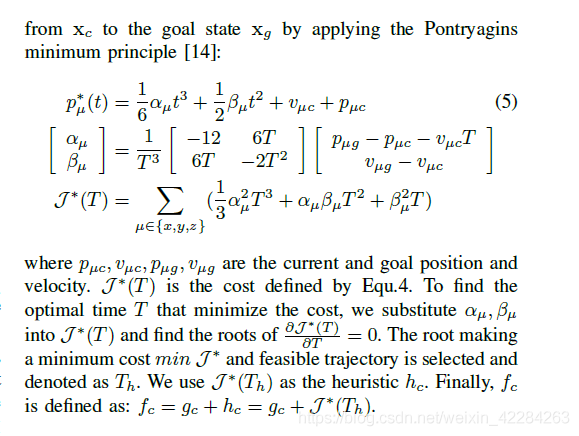
首先通过设置启发函数对时间求导等于0,得到启发函数关于时间T的四次方程,再通过求解该四次方程,得到一系列实根,通过比较这些实根所对应的cost大小,得到最优时间。这里需要注意,关于时间的一元四次方程是通过费拉里方法求解的,需要嵌套一个元三次方程进行求解,也就是代码中应的cubic()函数。
double KinodynamicAstar::estimateHeuristic(Eigen::VectorXd x1, Eigen::VectorXd x2, double& optimal_time)

{

  const Vector3d dp = x2.head(3) - x1.head(3);

  const Vector3d v0 = x1.segment(3, 3);

  const Vector3d v1 = x2.segment(3, 3);

  double c1 = -36 * dp.dot(dp);

  double c2 = 24 * (v0 + v1).dot(dp);

  double c3 = -4 * (v0.dot(v0) + v0.dot(v1) + v1.dot(v1));

  double c4 = 0;

  double c5 = w_time_;

  std::vector<double> ts = quartic(c5, c4, c3, c2, c1);

  double v_max = max_vel_ * 0.5;

  double t_bar = (x1.head(3) - x2.head(3)).lpNorm<Infinity>() / v_max;

  ts.push_back(t_bar);

  double cost = 100000000;

  double t_d = t_bar;

  for (auto t : ts)

  {

    if (t < t_bar)

      continue;

    double c = -c1 / (3 * t * t * t) - c2 / (2 * t * t) - c3 / t + w_time_ * t;

    if (c < cost)

    {

      cost = c;

      t_d = t;

    }

  }

  optimal_time = t_d;

  return 1.0 * (1 + tie_breaker_) * cost;

}
公式推导参考:https://blog.csdn.net/qq_16775293/article/details/124845417
1.3 这里我们遇到了第二个重要的函数ComputeShotTraj. 即利用庞特里亚金原理解一个两点边值问题。因为最优控制时间已经在estimateHeuristic中计算过了,所以这里只要引入该时间进行多项式计算即可。这部分的目的是为了验证该轨迹是安全的,即不发生碰撞,速度、加速度不超限。
bool KinodynamicAstar::computeShotTraj(Eigen::VectorXd state1, Eigen::VectorXd state2, double time_to_goal)

{

  /* ---------- get coefficient ---------- */

  const Vector3d p0 = state1.head(3);

  const Vector3d dp = state2.head(3) - p0;

  const Vector3d v0 = state1.segment(3, 3);

  const Vector3d v1 = state2.segment(3, 3);

  const Vector3d dv = v1 - v0;

  double t_d = time_to_goal;

  MatrixXd coef(3, 4);

  end_vel_ = v1;

  Vector3d a = 1.0 / 6.0 * (-12.0 / (t_d * t_d * t_d) * (dp - v0 * t_d) + 6 / (t_d * t_d) * dv);

  Vector3d b = 0.5 * (6.0 / (t_d * t_d) * (dp - v0 * t_d) - 2 / t_d * dv);

  Vector3d c = v0;

  Vector3d d = p0;

  // 1/6 * alpha * t^3 + 1/2 * beta * t^2 + v0

  // a*t^3 + b*t^2 + v0*t + p0

  coef.col(3) = a, coef.col(2) = b, coef.col(1) = c, coef.col(0) = d;

  Vector3d coord, vel, acc;

  VectorXd poly1d, t, polyv, polya;

  Vector3i index;

  Eigen::MatrixXd Tm(4, 4);

  Tm << 0, 1, 0, 0, 0, 0, 2, 0, 0, 0, 0, 3, 0, 0, 0, 0;

  /* ---------- forward checking of trajectory ---------- */

  double t_delta = t_d / 10;

  for (double time = t_delta; time <= t_d; time += t_delta)

  {

    t = VectorXd::Zero(4);

    for (int j = 0; j < 4; j++)

      t(j) = pow(time, j);

    for (int dim = 0; dim < 3; dim++)

    {

      poly1d = coef.row(dim);

      coord(dim) = poly1d.dot(t);

      vel(dim) = (Tm * poly1d).dot(t);

      acc(dim) = (Tm * Tm * poly1d).dot(t);

      if (fabs(vel(dim)) > max_vel_ || fabs(acc(dim)) > max_acc_)

      {

        // cout << "vel:" << vel(dim) << ", acc:" << acc(dim) << endl;

        // return false;

      }

    }

    if (coord(0) < origin_(0) || coord(0) >= map_size_3d_(0) || coord(1) < origin_(1) || coord(1) >= map_size_3d_(1) ||

        coord(2) < origin_(2) || coord(2) >= map_size_3d_(2))

    {

      return false;

    }

    // if (edt_environment_->evaluateCoarseEDT(coord, -1.0) <= margin_) {

    //   return false;

    // }

    if (edt_environment_->sdf_map_->getInflateOccupancy(coord) == 1)

    {

      return false;

    }

  }

  coef_shot_ = coef;

  t_shot_ = t_d;

  is_shot_succ_ = true;

  return true;

}
二、后端优化
2.1 离散采样,获取一些轨迹点和速度、加速度。
void KinodynamicAstar::getSamples(double& ts, vector<Eigen::Vector3d>& point_set,

                                  vector<Eigen::Vector3d>& start_end_derivatives)

{

  /* ---------- path duration ---------- */

  double T_sum = 0.0;

  if (is_shot_succ_)

    T_sum += t_shot_;

  PathNodePtr node = path_nodes_.back();

  while (node->parent != NULL)

  {

    T_sum += node->duration;

    node = node->parent;

  }

  // cout << "duration:" << T_sum << endl;

  // Calculate boundary vel and acc

  Eigen::Vector3d end_vel, end_acc;

  double t;

  if (is_shot_succ_)

  {

    t = t_shot_;

    end_vel = end_vel_;

    for (int dim = 0; dim < 3; ++dim)

    {

      Vector4d coe = coef_shot_.row(dim);

      end_acc(dim) = 2 * coe(2) + 6 * coe(3) * t_shot_;

    }

  }

  else

  {

    t = path_nodes_.back()->duration;

    end_vel = node->state.tail(3);

    end_acc = path_nodes_.back()->input;

  }

  // Get point samples

  int seg_num = floor(T_sum / ts);

  seg_num = max(8, seg_num);

  ts = T_sum / double(seg_num);

  bool sample_shot_traj = is_shot_succ_;

  node = path_nodes_.back();

  for (double ti = T_sum; ti > -1e-5; ti -= ts)

  {

    if (sample_shot_traj)

    {

      // samples on shot traj

      Vector3d coord;

      Vector4d poly1d, time;

      for (int j = 0; j < 4; j++)

        time(j) = pow(t, j);

      for (int dim = 0; dim < 3; dim++)

      {

        poly1d = coef_shot_.row(dim);

        coord(dim) = poly1d.dot(time);

      }

      point_set.push_back(coord);

      t -= ts;

      /* end of segment */

      if (t < -1e-5)

      {

        sample_shot_traj = false;

        if (node->parent != NULL)

          t += node->duration;

      }

    }

    else

    {

      // samples on searched traj

      Eigen::Matrix<double, 6, 1> x0 = node->parent->state;

      Eigen::Matrix<double, 6, 1> xt;

      Vector3d ut = node->input;

      stateTransit(x0, xt, ut, t);

      point_set.push_back(xt.head(3));

      t -= ts;

      // cout << "t: " << t << ", t acc: " << T_accumulate << endl;

      if (t < -1e-5 && node->parent->parent != NULL)

      {

        node = node->parent;

        t += node->duration;

      }

    }

  }

  reverse(point_set.begin(), point_set.end());

  // calculate start acc

  Eigen::Vector3d start_acc;

  if (path_nodes_.back()->parent == NULL)

  {

    // no searched traj, calculate by shot traj

    start_acc = 2 * coef_shot_.col(2);

  }

  else

  {

    // input of searched traj

    start_acc = node->input;

  }

  start_end_derivatives.push_back(start_vel_);

  start_end_derivatives.push_back(end_vel);

  start_end_derivatives.push_back(start_acc);

  start_end_derivatives.push_back(end_acc);

}
2.2 前端离散点拟合成B样条曲线
每获得一个轨迹点就认为是一段?就有多少个控制点?这样控制点有点多啊
void NonUniformBspline::parameterizeToBspline(const double& ts, const vector<Eigen::Vector3d>& point_set,

                                              const vector<Eigen::Vector3d>& start_end_derivative,

                                              Eigen::MatrixXd&               ctrl_pts) {

  if (ts <= 0) {

    cout << "[B-spline]:time step error." << endl;

    return;

  }

  if (point_set.size() < 2) {

    cout << "[B-spline]:point set have only " << point_set.size() << " points." << endl;

    return;

  }

  if (start_end_derivative.size() != 4) {

    cout << "[B-spline]:derivatives error." << endl;

  }

  int K = point_set.size();

  // write A

  Eigen::Vector3d prow(3), vrow(3), arow(3);

  prow << 1, 4, 1;

  vrow << -1, 0, 1;

  arow << 1, -2, 1;

  Eigen::MatrixXd A = Eigen::MatrixXd::Zero(K + 4, K + 2);

  for (int i = 0; i < K; ++i) A.block(i, i, 1, 3) = (1 / 6.0) * prow.transpose();

  A.block(K, 0, 1, 3)         = (1 / 2.0 / ts) * vrow.transpose();

  A.block(K + 1, K - 1, 1, 3) = (1 / 2.0 / ts) * vrow.transpose();

  A.block(K + 2, 0, 1, 3)     = (1 / ts / ts) * arow.transpose();

  A.block(K + 3, K - 1, 1, 3) = (1 / ts / ts) * arow.transpose();

  // cout << "A:\n" << A << endl;

  // A.block(0, 0, K, K + 2) = (1 / 6.0) * A.block(0, 0, K, K + 2);

  // A.block(K, 0, 2, K + 2) = (1 / 2.0 / ts) * A.block(K, 0, 2, K + 2);

  // A.row(K + 4) = (1 / ts / ts) * A.row(K + 4);

  // A.row(K + 5) = (1 / ts / ts) * A.row(K + 5);

  // write b

  Eigen::VectorXd bx(K + 4), by(K + 4), bz(K + 4);

  for (int i = 0; i < K; ++i) {

    bx(i) = point_set[i](0);

    by(i) = point_set[i](1);

    bz(i) = point_set[i](2);

  }

  for (int i = 0; i < 4; ++i) {

    bx(K + i) = start_end_derivative[i](0);

    by(K + i) = start_end_derivative[i](1);

    bz(K + i) = start_end_derivative[i](2);

  }

  // solve Ax = b

  Eigen::VectorXd px = A.colPivHouseholderQr().solve(bx);

  Eigen::VectorXd py = A.colPivHouseholderQr().solve(by);

  Eigen::VectorXd pz = A.colPivHouseholderQr().solve(bz);

  // convert to control pts

  ctrl_pts.resize(K + 2, 3);

  ctrl_pts.col(0) = px;

  ctrl_pts.col(1) = py;

  ctrl_pts.col(2) = pz;

  // cout << "[B-spline]: parameterization ok." << endl;

}
虽然在计算B样条曲线上某一点的值时论文用的是DeBoor公式,但是在使用均匀B样条对前端路径进行拟合时用的是B样条的矩阵表达方法,具体参见论文:K. Qin, “General matrix representations for b-splines,” The Visual Computer, vol. 16, no. 3, pp. 177–186, 2000.
2.3 B样条优化
Eigen::MatrixXd BsplineOptimizer::BsplineOptimizeTraj(const Eigen::MatrixXd& points, const double& ts,

                                                      const int& cost_function, int max_num_id,

                                                      int max_time_id) {

  setControlPoints(points);

  setBsplineInterval(ts);

  setCostFunction(cost_function);

  setTerminateCond(max_num_id, max_time_id);

  optimize();

  return this->control_points_;

}

void BsplineOptimizer::optimize() {

  /* initialize solver */

  iter_num_        = 0;

  min_cost_        = std::numeric_limits<double>::max();

  const int pt_num = control_points_.rows();

  g_q_.resize(pt_num);

  g_smoothness_.resize(pt_num);

  g_distance_.resize(pt_num);

  g_feasibility_.resize(pt_num);

  g_endpoint_.resize(pt_num);

  g_waypoints_.resize(pt_num);

  g_guide_.resize(pt_num);

  if (cost_function_ & ENDPOINT) {

    variable_num_ = dim_ * (pt_num - order_);

    // end position used for hard constraint

    end_pt_ = (1 / 6.0) *

        (control_points_.row(pt_num - 3) + 4 * control_points_.row(pt_num - 2) +

         control_points_.row(pt_num - 1));

  } else {

    variable_num_ = max(0, dim_ * (pt_num - 2 * order_)) ;

  }

  /* do optimization using NLopt slover */

  nlopt::opt opt(nlopt::algorithm(isQuadratic() ? algorithm1_ : algorithm2_), variable_num_);

  opt.set_min_objective(BsplineOptimizer::costFunction, this);//设置优化函数

  opt.set_maxeval(max_iteration_num_[max_num_id_]);//优化最大次数

  opt.set_maxtime(max_iteration_time_[max_time_id_]);//优化最大时间

  opt.set_xtol_rel(1e-5);//最后停止阈值

  vector<double> q(variable_num_);

  for (int i = order_; i < pt_num; ++i) {

    if (!(cost_function_ & ENDPOINT) && i >= pt_num - order_) continue;

    for (int j = 0; j < dim_; j++) {

      q[dim_ * (i - order_) + j] = control_points_(i, j);

    }

  }

  if (dim_ != 1) {

    vector<double> lb(variable_num_), ub(variable_num_);

    const double   bound = 10.0;

    for (int i = 0; i < variable_num_; ++i) {

      lb[i] = q[i] - bound;

      ub[i] = q[i] + bound;

    }

    opt.set_lower_bounds(lb);//设置下限

    opt.set_upper_bounds(ub);//设置上限

  }

  try {

    // cout << fixed << setprecision(7);

    // vec_time_.clear();

    // vec_cost_.clear();

    // time_start_ = ros::Time::now();

    double        final_cost;

    nlopt::result result = opt.optimize(q, final_cost);

    /* retrieve the optimization result */

    // cout << "Min cost:" << min_cost_ << endl;

  } catch (std::exception& e) {

    ROS_WARN("[Optimization]: nlopt exception");

    cout << e.what() << endl;

  }

  for (int i = order_; i < control_points_.rows(); ++i) {

    if (!(cost_function_ & ENDPOINT) && i >= pt_num - order_) continue;

    for (int j = 0; j < dim_; j++) {

      control_points_(i, j) = best_variable_[dim_ * (i - order_) + j];

    }

  }

  if (!(cost_function_ & GUIDE)) ROS_INFO_STREAM("iter num: " << iter_num_);

}
2.4 cost设计
2.4.1 平滑度cost:
三次B样条公式为:
$p(t) = p_{0} * F_{0,3}(t) + p_{1} * F_{1,3}(t) + p_{2} * F_{2,3}(t) + p_{3} * F_{3,3}(t) $
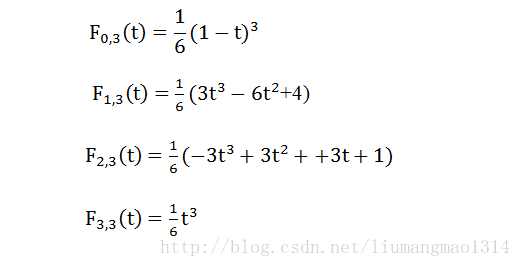
jerk就是对p(t)求三次导,这时会发现是一个常数,将每一段的jerk平方加起来,就得到cost。
梯度的求法:cost对控制点的求导。运用链式求导法则。
转变为cost对jerk的求导 * jerk对控制点的求导。
void BsplineOptimizer::calcSmoothnessCost(const vector<Eigen::Vector3d>& q, double& cost,

                                          vector<Eigen::Vector3d>& gradient) {

  cost = 0.0;

  Eigen::Vector3d zero(0, 0, 0);

  std::fill(gradient.begin(), gradient.end(), zero);

  Eigen::Vector3d jerk, temp_j;

  for (int i = 0; i < q.size() - order_; i++) {

    /* evaluate jerk */

    jerk = q[i + 3] - 3 * q[i + 2] + 3 * q[i + 1] - q[i];

    cost += jerk.squaredNorm();

    temp_j = 2.0 * jerk;

    /* jerk gradient */

    gradient[i + 0] += -temp_j;

    gradient[i + 1] += 3.0 * temp_j;

    gradient[i + 2] += -3.0 * temp_j;

    gradient[i + 3] += temp_j;

  }

}
fast planner总结的更多相关文章
- opencv中的SIFT,SURF,ORB,FAST 特征描叙算子比较
opencv中的SIFT,SURF,ORB,FAST 特征描叙算子比较 参考: http://wenku.baidu.com/link?url=1aDYAJBCrrK-uk2w3sSNai7h52x_ ...
- 基于Fast Bilateral Filtering 算法的 High-Dynamic Range(HDR) 图像显示技术。
一.引言 本人初次接触HDR方面的知识,有描述不正确的地方烦请见谅. 为方便文章描述,引用部分百度中的文章对HDR图像进行简单的描述. 高动态范围图像(High-Dynamic Range,简称HDR ...
- Fast RCNN 训练自己的数据集(3训练和检测)
转载请注明出处,楼燚(yì)航的blog,http://www.cnblogs.com/louyihang-loves-baiyan/ https://github.com/YihangLou/fas ...
- Fast RCNN 训练自己数据集 (2修改数据读取接口)
Fast RCNN训练自己的数据集 (2修改读写接口) 转载请注明出处,楼燚(yì)航的blog,http://www.cnblogs.com/louyihang-loves-baiyan/ http ...
- 网格弹簧质点系统模拟(Spring-Mass System by Fast Method)附源码
弹簧质点模型的求解方法包括显式欧拉积分和隐式欧拉积分等方法,其中显式欧拉积分求解快速,但积分步长小,两个可视帧之间需要多次积分,而隐式欧拉积分则需要求解线性方程组,但其稳定性好,能够取较大的积分步长. ...
- XiangBai——【AAAI2017】TextBoxes_A Fast Text Detector with a Single Deep Neural Network
XiangBai--[AAAI2017]TextBoxes:A Fast Text Detector with a Single Deep Neural Network 目录 作者和相关链接 方法概括 ...
- 论文笔记--Fast RCNN
很久之前试着写一篇深度学习的基础知识,无奈下笔之后发现这个话题确实太大,今天发一篇最近看的论文Fast RCNN.这篇文章是微软研究院的Ross Girshick大神的一篇作品,主要是对RCNN的一些 ...
- [转]Amazon DynamoDB – a Fast and Scalable NoSQL Database Service Designed for Internet Scale Applications
This article is from blog of Amazon CTO Werner Vogels. -------------------- Today is a very exciting ...
- FAST特征点检测features2D
#include <opencv2/core/core.hpp> #include <opencv2/features2d/features2d.hpp> #include & ...
- TCP Fast Open
We know that Web services use the TCP protocol at the transport layer. Standard TCP protocol to thre ...
随机推荐
- Huawei OJ 题解 - 31. 整数拆分 - Go 参考解答
## 简介- 详情:http://oj.rnd.huawei.com/problems/31/details- 难度:简单## 思路TODO## 用例TODO## 解答```gopackage mai ...
- day03-实现02
实现02 3.实现任务阶段3-处理Servlet02 3.3Servlet规范设计 3.3.1MyServlet 该类模仿Servlet接口,为了简化,只声明了三个方法:init(),service( ...
- Crony 一个基于Go语言实现的分布式定时任务管理平台
crony - 分布式定时任务管理平台 1. 基本介绍 1.1 项目背景 项目中存在许多定时任务,很多代码写法都是采取见缝插针式的写法或者直接丢到task服务里面写,存在以下问题 服务多实例时执行定时 ...
- layui文件上传
//前端代码 <div class="layui-form-item"> <label class="layui-form-label"> ...
- 二分查找-LeetCode704 简单题
LeetCode代码链接:https://leetcode.cn/problems/binary-search/ 题目:给定一个 n 个元素有序的(升序)整型数组 nums 和一个目标值 target ...
- Python函数/动态参数/关键字参数
1.函数 #函数语法: #函数名规范:小谢字母开头,不同字母下划线隔开(字母数字下划线) #def 函数名(): #函数体:希望函数做的事情 1.1.无参函数 #无参函数 def music(): p ...
- js 中常用函数汇总(含示例)
〇.前言 js 在日常开发中还是比较常用的,本文将常用的 js 方法简单汇总一下,希望对你我有一点帮助. 一.重复 / 延迟操作 1.设置固定时间间隔,重复执行(setInterval(funcRef ...
- texlive安装与vscode环境配置
环境 系统:windows10 texlive下载 下载地址: 官网:http://tug.org/texlive/ 清华镜像源: https://mirrors.tuna.tsinghua.edu. ...
- MyBatis四大参数两种写法
MyBatis四大参数两种写法 1.在主配置文件中,直接写到value值里面 2.四大参数写入单独配置文件 开始是 为了避免以后其他框架冲突 都加个前缀 jdbc. 主要是红色框里的三个部分 自己定义 ...
- ArcGIS工具 - 批量删除空图层
为了减少数据的冗余,我们经常需将数据库中的空图层(没有任何记录的要素类或表)删除,删除数据本来是一个很简单的操作,但如果数据量大,则需通过程序来处理.例如,删除成百上千个标准分幅DLG数据库中等高线数 ...