
[LeetCode] Max Points on a Line 共线点个数
Given n points on a 2D plane, find the maximum number of points that lie on the same straight line.
Example 1:
Input: [[1,1],[2,2],[3,3]]

Output: 3

Explanation:

^

|

|        o

|     o

|  o

+------------->

0  1  2  3  4
Example 2:
Input: [[1,1],[3,2],[5,3],[4,1],[2,3],[1,4]]

Output: 4

Explanation:

^

|

|  o

|     o        o

|        o

|  o        o

+------------------->

0  1  2  3  4  5  6
这道题给了我们一堆二维点,然后让求最大的共线点的个数,根据初中数学可以知道,两点确定一条直线,而且可以写成 y = ax + b 的形式,所有共线的点都满足这个公式。所以这些给定点两两之间都可以算一个斜率,每个斜率代表一条直线,对每一条直线,带入所有的点看是否共线并计算个数,这是整体的思路。但是还有两点特殊情况需要考虑,一是当两个点重合时,无法确定一条直线,但这也是共线的情况,需要特殊处理。二是斜率不存在的情况,由于两个点 (x1, y1) 和 (x2, y2) 的斜率k表示为 (y2 - y1) / (x2 - x1),那么当 x1 = x2 时斜率不存在,这种共线情况需要特殊处理。这里需要用到 TreeMap 来记录斜率和共线点个数之间的映射,其中第一种重合点的情况假定其斜率为 INT_MIN,第二种情况假定其斜率为 INT_MAX,这样都可以用 TreeMap 映射了。还需要顶一个变量 duplicate 来记录重合点的个数,最后只需和 TreeMap 中的数字相加即为共线点的总数,但这种方法现在已经无法通过 OJ 了,代码可以参见评论区八楼。
由于通过斜率来判断共线需要用到除法,而用 double 表示的双精度小数在有的系统里不一定准确,为了更加精确无误的计算共线,应当避免除法,从而避免无线不循环小数的出现,那么怎么办呢,这里把除数和被除数都保存下来,不做除法,但是要让这两数分别除以它们的最大公约数,这样例如8和4,4和2,2和1,这三组商相同的数就都会存到一个映射里面,同样也能实现目标,而求 GCD 的函数如果用递归来写那么一行就搞定了,叼不叼,这个方法能很好的避免除法的出现,算是牺牲了空间来保证精度吧,参见代码如下:
C++ 解法一:
class Solution {

public:

    int maxPoints(vector<vector<int>>& points) {

        int res = ;

        for (int i = ; i < points.size(); ++i) {

            map<pair<int, int>, int> m;

            int duplicate = ;

            for (int j = i + ; j < points.size(); ++j) {

                if (points[i][] == points[j][] && points[i][] == points[j][]) {

                    ++duplicate; continue;

                }

                int dx = points[j][] - points[i][];

                int dy = points[j][] - points[i][];

                int d = gcd(dx, dy);

                ++m[{dx / d, dy / d}];

            }

            res = max(res, duplicate);

            for (auto it = m.begin(); it != m.end(); ++it) {

                res = max(res, it->second + duplicate);

            }

        }

        return res;

    }

    int gcd(int a, int b) {

        return (b == ) ? a : gcd(b, a % b);

    }

};
Java 解法一:
class Solution {

    public int maxPoints(int[][] points) {

        int res = 0;

        for (int i = 0; i < points.length; ++i) {

            Map<Map<Integer, Integer>, Integer> m = new HashMap<>();

            int duplicate = 1;

            for (int j = i + 1; j < points.length; ++j) {

                if (points[i][0] == points[j][0] && points[i][1] == points[j][1]) {

                    ++duplicate; continue;

                }

                int dx = points[j][0] - points[i][0];

                int dy = points[j][1] - points[i][1];

                int d = gcd(dx, dy);

                Map<Integer, Integer> t = new HashMap<>();

                t.put(dx / d, dy / d);

                m.put(t, m.getOrDefault(t, 0) + 1);

            }

            res = Math.max(res, duplicate);

            for (Map.Entry<Map<Integer, Integer>, Integer> e : m.entrySet()) {

                res = Math.max(res, e.getValue() + duplicate);

            }

        }

        return res;

    }

    public int gcd(int a, int b) {

        return (b == 0) ? a : gcd(b, a % b);

    }

}
令博主惊奇的是,这道题的 OJ 居然容忍 brute force 的方法通过,博主认为下面这种 O(n3) 的解法之所以能通过 OJ,可能还有一个原因就是用了比较高效的判断三点共线的方法。一般来说判断三点共线有三种方法,斜率法,周长法,面积法 (请参见这个帖子)。而其中通过判断叉积为零的面积法是坠好的。比如说有三个点 A(x1, y1)、B(x2, y2)、C(x3, y3),那么判断三点共线就是判断下面这个等式是否成立:
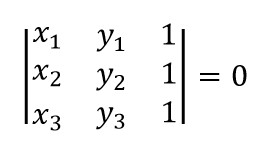
行列式的求法不用多说吧,不会的话回去翻线性代数,当初少打点刀塔不就好啦~
C++ 解法二:
class Solution {

public:

    int maxPoints(vector<vector<int>>& points) {

        int res = ;

        for (int i = ; i < points.size(); ++i) {

            int duplicate = ;

            for (int j = i + ; j < points.size(); ++j) {

                int cnt = ;

                long long x1 = points[i][], y1 = points[i][];

                long long x2 = points[j][], y2 = points[j][];

                if (x1 == x2 && y1 == y2) {++duplicate; continue;}

                for (int k = ; k < points.size(); ++k) {

                    int x3 = points[k][], y3 = points[k][];

                    if (x1 * y2 + x2 * y3 + x3 * y1 - x3 * y2 - x2 * y1 - x1 * y3 == ) {

                        ++cnt;

                    }

                }

                res = max(res, cnt);

            }

            res = max(res, duplicate);

        }

        return res;

    }

};
Java 解法二:
class Solution {

    public int maxPoints(int[][] points) {

        int res = 0, n = points.length;

        for (int i = 0; i < n; ++i) {

            int duplicate = 1;

            for (int j = i + 1; j < n; ++j) {

                int cnt = 0;

                long x1 = points[i][0], y1 = points[i][1];

                long x2 = points[j][0], y2 = points[j][1];

                if (x1 == x2 && y1 == y2) {++duplicate;continue;}

                for (int k = 0; k < n; ++k) {

                    int x3 = points[k][0], y3 = points[k][1];

                    if (x1*y2 + x2*y3 + x3*y1 - x3*y2 - x2*y1 - x1 * y3 == 0) {

                        ++cnt;

                    }

                }

                res = Math.max(res, cnt);

            }

            res = Math.max(res, duplicate);

        }

        return res;

    }

}
Github 同步地址:
https://github.com/grandyang/leetcode/issues/149
类似题目:
参考资料:
https://leetcode.com/problems/max-points-on-a-line/
https://leetcode.com/problems/max-points-on-a-line/discuss/221044/
https://leetcode.com/problems/max-points-on-a-line/discuss/47113/A-java-solution-with-notes
LeetCode All in One 题目讲解汇总(持续更新中...)
[LeetCode] Max Points on a Line 共线点个数的更多相关文章
- [LintCode] Max Points on a Line 共线点个数
Given n points on a 2D plane, find the maximum number of points that lie on the same straight line. ...
- [LeetCode] 149. Max Points on a Line 共线点个数
Given n points on a 2D plane, find the maximum number of points that lie on the same straight line. ...
- LeetCode: Max Points on a Line 解题报告
Max Points on a Line Given n points on a 2D plane, find the maximum number of points that lie on the ...
- [leetcode]Max Points on a Line @ Python
原题地址:https://oj.leetcode.com/problems/max-points-on-a-line/ 题意:Given n points on a 2D plane, find th ...
- [LeetCode] Max Points on a Line 题解
题意 Given n points on a 2D plane, find the maximum number of points that lie on the same straight lin ...
- LeetCode:Max Points on a Line
题目链接 Given n points on a 2D plane, find the maximum number of points that lie on the same straight l ...
- 【leetcode】Max Points on a Line
Max Points on a Line 题目描述: Given n points on a 2D plane, find the maximum number of points that lie ...
- [LeetCode OJ] Max Points on a Line
Max Points on a Line Submission Details 27 / 27 test cases passed. Status: Accepted Runtime: 472 ms ...
- 【LeetCode】149. Max Points on a Line
Max Points on a Line Given n points on a 2D plane, find the maximum number of points that lie on the ...
随机推荐
- Dozer扫盲级教程
前言 这篇文章是本人在阅读Dozer官方文档(5.5.1版本,官网已经一年多没更新了)的过程中,整理下来我认为比较基础的应用场景. 本文中提到的例子应该能覆盖JavaBean映射的大部分场景,希望对你 ...
- winform程序一启动抛出异常--调用目标发生异常
在本机测试没有问题,可一到别的电脑上就抛出异常,这是最麻烦的事,一时间还找不出什么原因,本机上还无法重现. 现在好了,终于找到一个完美解决的办法,在Program.cs类中加入如下代码 static ...
- 02 button的练习
private void button1_Click(object sender, EventArgs e) { MessageBox.Show("我也喜欢你!"); //if ( ...
- C++ map的基本操作和使用
原文地址:http://blog.sina.com.cn/s/blog_61533c9b0100fa7w.html Map是c++的一个标准容器,她提供了很好一对一的关系,在一些程序中建立一个map可 ...
- apache中怎么配置网站的默认首页
配置方法如下:1.首先需要打开Apache的配置文件httpd.conf文件,使用一般的编辑器或者记事本打开均可.2.找到或者搜索到如下字段:<IfModule dir_module> D ...
- 分布式搜索elasticsearch配置文件详解
elasticsearch的config文件夹里面有两个配置文件:elasticsearch.yml和logging.yml,第一个是es的基本配置文件,第二个是日志配置文件,es也是使用log4j来 ...
- xinetd cpu 100%
今天,有个给客户试用的环境出现xinetd cpu 100%,而且连续运行很长时间了.之前也有环境发生过,今天排查解决了三四个问题,实在是查的身体都不舒服了,还没时间查这个问题... 知道的求解...
- 安装Oracle时出现环境变量Path的值大于1023的解决办法
出现的情况我就不说了,直接重点: 计算机->属性->高级系统设置->高级->环境变量 1)在"系统变量"编辑Path,全选将其中的路径全部复制出来放到文本文 ...
- JavaScript 数据属性和访问器属性
在JavaScript中对象被定义为"无序属性的集合,其属性可以包含基本值.对象或函数."通俗点讲,我们可以把对象理解为一组一组的名值对,其中值可以是数据或函数. 创建自定义对象通 ...
- Atitit 软件国际化原理与概论
Atitit 软件国际化原理与概论 语言和文化习俗因地域不同而差别很大.对某一特定的地域的 语言环境称为"locale".它不仅包括语言和货币单位,而且还包括 数字标示格式, 日期 ...