
why’s kafka so fast
As we all know that Kafka is very fast, much faster than most of its competitors. So what’s the reason here?
Avoid Random Disk Access
Kafka writes everything onto the disk in order and consumers fetch data in order too. So disk access always works sequentially instead of randomly. For traditional hard disks(HDD), sequential access is much faster than random access. Here is a comparison:
| hardware | sequential writes | random writes |
|---|---|---|
| 6 * 7200rpm SATA RAID-5 | 300MB/s | 50KB/s |
Kafka Writes Everything Onto The Disk Instead of Memory
Yes, you read that right. Kafka writes everything onto the disk instead of memory. But wait a moment, isn’t memory supposed to be faster than disks? Typically it’s the case, for Random Disk Access. But for sequential access, the difference is much smaller. Here is a comparison taken from https://queue.acm.org/detail.cfm?id=1563874.

As you can see, it’s not that different. But still, sequential memory access is faster than Sequential Disk Access, why not choose memory? Because Kafka runs on top of JVM, which gives us two disadvantages.
1.The memory overhead of objects is very high, often doubling the size of the data stored(or even higher).
2.Garbage Collection happens every now and then, so creating objects in memory is very expensive as in-heap data increases because we will need more time to collect unused data(which is garbage).
So writing to file systems may be better than writing to memory. Even better, we can utilize MMAP(memory mapped files) to make it faster.
Memory Mapped Files(MMAP)
Basically, MMAP(Memory Mapped Files) can map the file contents from the disk into memory. And when we write something into the mapped memory, the OS will flush the change onto the disk sometime later. So everything is faster because we are using memory actually, but in an indirect way. So here comes the question. Why would we use MMAP to write data onto disks, which later will be mapped into memory? It seems to be a roundabout route. Why not just write data into memory directly? As we have learned previously, Kafka runs on top of JVM, if we wrote data into memory directly, the memory overhead would be high and GC would happen frequently. So we use MMAP here to avoid the issue.
Zero Copy
Suppose that we are fetching data from the memory and sending them to the Internet. What is happening in the process is usually twofold.
1.To fetch data from the memory, we need to copy those data from the Kernel Context into the Application Context.
2.To send those data to the Internet, we need to copy the data from the Application Context into the Kernel Context.
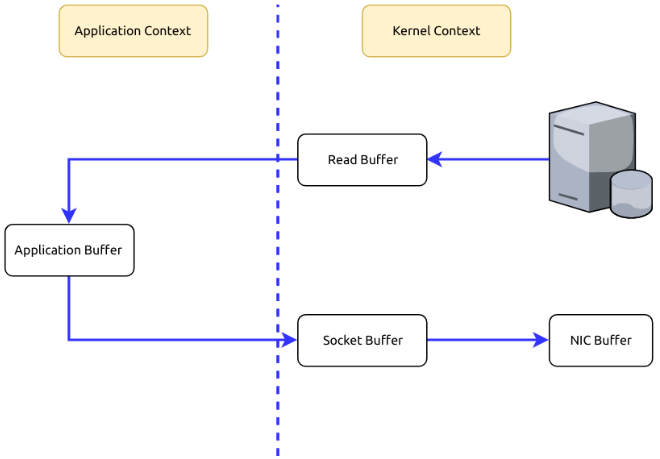
As you can see, it’s redundant to copy data between the Kernel Context and the Application Context. Can we avoid it? Yes, using Zero Copy we can copy data directly from the Kernel Context to the Kernel Context.

Batch Data
Kafka only sends data when batch.size is reached instead of one by one. Assuming the bandwidth is 10MB/s, sending 10MB data in one go is much faster than sending 10000 messages one by one(assuming each message takes 100 bytes).
"I would be fine and made no troubles."
why’s kafka so fast的更多相关文章
- Apache Kafka for Item Setup
At Walmart.com in the U.S. and at Walmart's 11 other websites around the world, we provide seamless ...
- Apache Kafka - Schema Registry
关于我们为什么需要Schema Registry? 参考, https://www.confluent.io/blog/how-i-learned-to-stop-worrying-and-love- ...
- Understanding, Operating and Monitoring Apache Kafka
Apache Kafka is an attractive service because it's conceptually simple and powerful. It's easy to un ...
- Build an ETL Pipeline With Kafka Connect via JDBC Connectors
This article is an in-depth tutorial for using Kafka to move data from PostgreSQL to Hadoop HDFS via ...
- How to choose the number of topics/partitions in a Kafka cluster?
This is a common question asked by many Kafka users. The goal of this post is to explain a few impor ...
- kafka producer源码
producer接口: /** * Licensed to the Apache Software Foundation (ASF) under one or more * contributor l ...
- Flume-ng+Kafka+storm的学习笔记
Flume-ng Flume是一个分布式.可靠.和高可用的海量日志采集.聚合和传输的系统. Flume的文档可以看http://flume.apache.org/FlumeUserGuide.html ...
- Apache Kafka: Next Generation Distributed Messaging System---reference
Introduction Apache Kafka is a distributed publish-subscribe messaging system. It was originally dev ...
- Exploring Message Brokers: RabbitMQ, Kafka, ActiveMQ, and Kestrel--reference
[This article was originally written by Yves Trudeau.] http://java.dzone.com/articles/exploring-mess ...
随机推荐
- JDK1.8 Stream
Java 8 API添加了一个新的抽象称为流Stream,可以让你以一种声明的方式处理数据. Stream 使用一种类似用 SQL 语句从数据库查询数据的直观方式来提供一种对 Java 集合运算和表达 ...
- JZOJ.2117. 【2016-12-30普及组模拟】台风
题目大意: 天气预报频道每天从卫星上接受卫星云图.图片被看作是一个矩阵,每个位置上要么是”#”,要么”.”,”#”表示该位置没有云,”.”表示有云,地图上每个位置有多达8个相邻位置,分别是,左上.上. ...
- java9模块不可见问题
问题描述 jdk.internal.reflect包不可见 问题原因 java9模块化之后,java.base只把jdk.internal.reflect暴露给了少数几个内部包而没有向当前模块暴露. ...
- block注意事项
1.block的声明和注意事项 #import "ZYViewController.h" @interface ZYViewController () @end /*用typede ...
- ES6的export与Nodejs的module.exports比较
首先我们要明白一个前提,CommonJS模块规范和ES6模块规范完全是两种不同的概念. CommonJS模块规范 Node应用由模块组成,采用CommonJS模块规范. 根据这个规范,每个文件就是一个 ...
- 如何使用 Set 来提高JS代码的性能
摘要: 高效使用Set! 作者:前端小智 原文:如何使用 Set 来提高代码的性能 Fundebug经授权转载,版权归原作者所有. 为了保证的可读性,本文采用意译而非直译. 我确信有很多开发人员坚持使 ...
- 解决Vue调用springboot接口403跨域问题
最近在做一个前后端分离的项目, 前端用的是Vue后端使用的是springboot, 在项目整合的时候发现前端调用后端接口报错403跨域请求问题 前端跨域请求已解决, 那么问题就出在后端了, 找了一些资 ...
- lf 前后端分离 (1) auth,token认证
一.关于登录验证 用户在登录的时候会通过验证以及滑动解锁,注意的是需要后端if verify(request.data): 来判断是否发送了那三个验证数据 通过 random_str=str(uuid ...
- 201871010108-高文利《面向对象程序设计(java)》第八周学习总结
项目 内容 这个作业属于哪个课程 <任课教师博客主页链接> https://www.cnblogs.com/nwnu-daizh/ 这个作业的要求在哪里 <作业链接地址> ht ...
- JDOJ 2254 Who am I?
JDOJ 2254: Who am I? Description 输出程序自己本身的源代码. Input 无 Output 输出程序自己本身的源代码. 我真是搞不懂了出这道题还把它归到程序语法基础题里 ...