
Introducing Deep Reinforcement
The manuscript of Deep Reinforcement Learning is available now! It makes significant improvements to Deep Reinforcement Learning: An Overview, which has received 100+ citations, by extending its latest version more than one year ago from 70 pages to 150 pages.
It draws a big picture of deep reinforcement learning (RL) with many details. It covers contemporary work in historical contexts. It endeavours to answer the following questions: 1) Why deep? 2) What is the state of the art? and, 3) What are the issues, and potential solutions? It attempts to help those who want to get more familiar with deep RL, and to serve as a reference for people interested in this fascinating area, like professors, researchers, students, engineers, managers, investors, etc. Shortcomings and mistakes are inevitable; comments and criticisms are welcome.
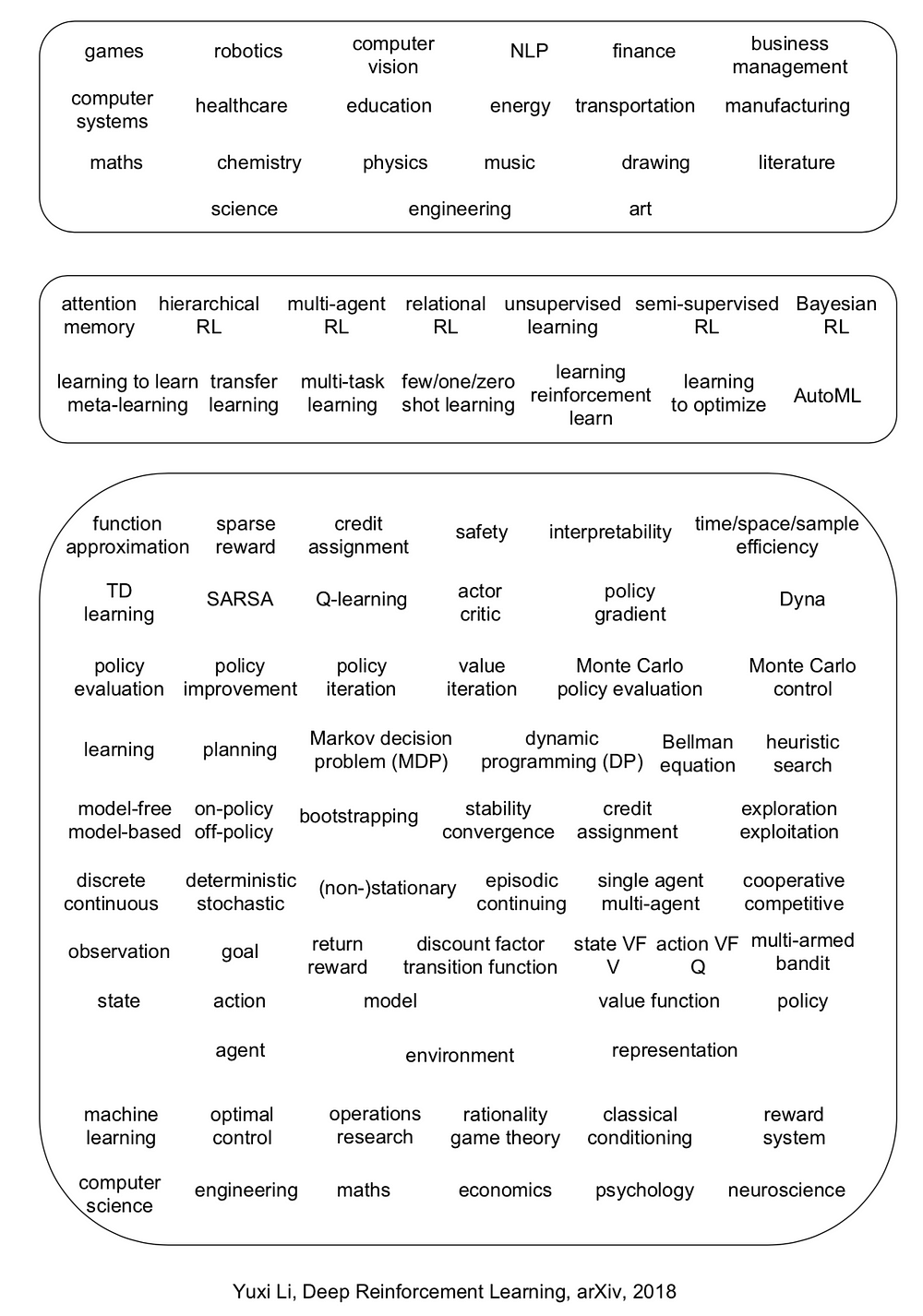
The manuscript introduces AI, machine learning, and deep learning briefly, and provides a mini tutorial for reinforcement learning. The following figure illustrates relationships among these concepts, with major contents for machine learning and AI .Deep reinforcement learning is reinforcement learning integrated with deep learning, or deep artificial neural networks. A blog is dedicated to Resources for Deep Reinforcement Learning.

The manuscript covers six core elements: value function, policy, reward, model, exploration vs. exploitation, and representation; six important mechanisms: attention and memory, unsupervised learning, hierarchical RL, multi-agent RL, relational RL, and learning to learn; and twelve applications: games, robotics, natural language processing (NLP), computer vision, finance, business management, healthcare, education, energy, transportation, computer systems, and, science, engineering, and art.

Deep reinforcement learning has made exceptional achievements, e.g., DQN applying to Atari games ignited this wave of deep RL, and AlphaGo (Zero) and DeepStack set landmarks for AI. Deep RL has many newly invented algorithms/architectures, e.g., DQN, A3C, TRPO, PPO, DDPG, Trust-PCL, GPS, UNREAL, DNC, etc. Moreover, deep RL has been enjoying very abound and diverse applications, e.g., Capture the Flag, Dota 2, StarCraft II, robotics, character animation, conversational AI, neural architecture design (AutoML), data center cooling, recommender systems, data augmentation, model compression, combinatorial optimization, program synthesis, theorem proving, medical imaging, music, and chemical retrosynthesis, so on and so forth. A blog is dedicated to Reinforcement Learning applications.
In general, RL is probably helpful, if a problem can be regarded as or transformed to a sequential decision making problem, and states, actions, maybe rewards, can be constructed; sometimes the problem may not appear as an RL problem on the surface. Roughly speaking, if a task involves some manual designed “strategy”, then there is a chance for reinforcement learning to help. Creativity would push the frontiers of deep RL further with respect to core elements, important mechanisms, and applications.
Albeit being so successful, deep RL encounters many issues, like credit assignment, sparse reward, sample efficiency, instability, divergence, interpretability, safety, etc.; even reproducibility is an issue.
Six research directions are proposed as both challenges and opporrtunities. There are already some progress in these directions, e.g., Dopamine, TStarBots, MOREL, GQN, visual reasoning, neural-symbolic learning, UPN, causal InfoGAN, meta-gradient RL, along with many applications as above.
- systematic, comparative study of deep RL algorithms
- “solve” multi-agent problems
- learn from entities, but not just raw inputs
- design an optimal representation for RL
- AutoRL
- develop killer applications for (deep) RL
It is desirable to integrate RL more deeply with AI, with more intelligence in the end-to-end mapping from raw inputs to decisions, to incorporate knowledge, to have common sense, to be more efficient, to be more interpretable, and to avoid obvious mistakes, etc., rather than working as a blackbox.

Deep learning and reinforcement learning, being selected as one of the MIT Technology Review 10 Breakthrough Technologies in 2013 and 2017 respectively, will play their crucial roles in achieving artificial general intelligence. David Silver proposed a conjecture: artificial intelligence = reinforcement learning + deep learning (AI = RL + DL). We will see both deep learning and reinforcement learning prospering in the coming years and beyond. Deep learning is exploding. It is the right time to nurture, educate and lead the market for reinforcement learning.
Deep learning, in this third wave of AI, will have deeper influences, as we have already seen from its many achievements. Reinforcement learning, as a more general learning and decision making paradigm, will deeply influence deep learning, machine learning, and artificial intelligence in general.
Introducing Deep Reinforcement的更多相关文章
- 论文笔记之:Asynchronous Methods for Deep Reinforcement Learning
Asynchronous Methods for Deep Reinforcement Learning ICML 2016 深度强化学习最近被人发现貌似不太稳定,有人提出很多改善的方法,这些方法有很 ...
- (转) Playing FPS games with deep reinforcement learning
Playing FPS games with deep reinforcement learning 博文转自:https://blog.acolyer.org/2016/11/23/playing- ...
- (zhuan) Deep Reinforcement Learning Papers
Deep Reinforcement Learning Papers A list of recent papers regarding deep reinforcement learning. Th ...
- Learning Roadmap of Deep Reinforcement Learning
1. 知乎上关于DQN入门的系列文章 1.1 DQN 从入门到放弃 DQN 从入门到放弃1 DQN与增强学习 DQN 从入门到放弃2 增强学习与MDP DQN 从入门到放弃3 价值函数与Bellman ...
- (转) Deep Reinforcement Learning: Playing a Racing Game
Byte Tank Posts Archive Deep Reinforcement Learning: Playing a Racing Game OCT 6TH, 2016 Agent playi ...
- 论文笔记之:Dueling Network Architectures for Deep Reinforcement Learning
Dueling Network Architectures for Deep Reinforcement Learning ICML 2016 Best Paper 摘要:本文的贡献点主要是在 DQN ...
- getting started with building a ROS simulation platform for Deep Reinforcement Learning
Apparently, this ongoing work is to make a preparation for futural research on Deep Reinforcement Le ...
- (转) Deep Reinforcement Learning: Pong from Pixels
Andrej Karpathy blog About Hacker's guide to Neural Networks Deep Reinforcement Learning: Pong from ...
- 论文笔记之:Deep Reinforcement Learning with Double Q-learning
Deep Reinforcement Learning with Double Q-learning Google DeepMind Abstract 主流的 Q-learning 算法过高的估计在特 ...
随机推荐
- LDA模型应用实践-希拉里邮件主题分类
#coding=utf8 import numpy as np import pandas as pd import re from gensim import corpora, models, si ...
- 获取APP图片资源
iOS开发项目-斗鱼直播APP - 网易云课堂 一. 二.导出Assets.car中的图片资源 cartool
- 温度传感器的AD值,电压和电阻的计算方法
V是输入的电压,VCC是标准电压,R为固定电阻,NTC为热敏电阻.计算公式是V=(NTC/(NTC+R))*VCC电压或电阻转化AD的计算方式为AD=(V/VCC)*2^n=(NTC/(NTC+R)) ...
- 51Nod:1085 背包问题
1085 背包问题 基准时间限制:1 秒 空间限制:131072 KB 分值: 0 难度:基础题 收藏 关注 在N件物品取出若干件放在容量为W的背包里,每件物品的体积为W1,W2--Wn(Wi为 ...
- Linux系统部署应用ECShop
- 新建Android一个项目-菜鸟篇
①打开Eclipse,单击菜单栏的“File”->把鼠标光标移动到“New”->在弹出的列表框中,如果直接能看到“Android Applicaion Project”选项项,则直接单击此 ...
- idea_快捷键default&eclipse
关键字: SpringMybatisplusRedisApplicationTests github关键字(springboot拦截器完整项目): implements WebMvcConfigure ...
- 在VSCode中配置Eslint格式化
在VSCode中配置Eslint 格式化时使代码保持Eslint语法规范 安装Eslint以及prettier美化插件 在VSCode配置设置项中添加如下代码 { "workbench.co ...
- 【网络通讯】Nat知识了解
一.Nat的含义 NAT(Network Address Translation,网络地址转换)是1994年提出的.当在专用网内部的一些主机本来已经分配到了本地IP地址(即仅在本专用网内使用的专用地址 ...
- 【java编程】java对象copy
实现java对象Copy的三种方式 一.克隆 implements Cloneable 二.序列化 implements Serializable 三.利用反射机制copy apache的BeanUt ...