
Memory-mapped I/O vs port-mapped I/O
关于MMIO和PIO,我看到的解释最清楚的文章,原文在这里:Memory-mapped I/O vs port-mapped I/O - 2015
Microprocessors normally use two methods to connect external devices: memory mapped or port mapped I/O. However, as far as the peripheral is concerned, both methods are really identical.
Memory mapped I/O is mapped into the same address space as program memory and/or user memory, and is accessed in the same way.
Port mapped I/O uses a separate, dedicated address space and is accessed via a dedicated set of microprocessor instructions.
The difference between the two schemes occurs within the microprocessor. Intel has, for the most part, used the port mapped scheme for their microprocessors and Motorola has used the memory mapped scheme.
As 16-bit processors have become obsolete and replaced with 32-bit and 64-bit in general use, reserving ranges of memory address space for I/O is less of a problem, as the memory address space of the processor is usually much larger than the required space for all memory and I/O devices in a system.
Therefore, it has become more frequently practical to take advantage of the benefits of memory-mapped I/O. However, even with address space being no longer a major concern, neither I/O mapping method is universally superior to the other, and there will be cases where using port-mapped I/O is still preferable.
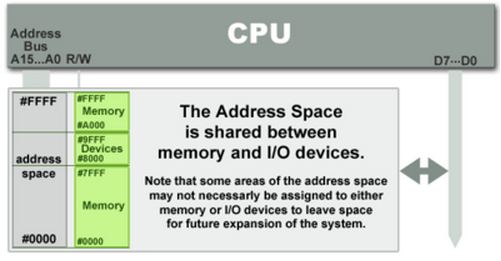
I/O
devices are mapped into the system memory map along with RAM and ROM.
To access a hardware device, simply read or write to those 'special'
addresses using the normal memory access instructions.
The advantage to this method is that every instruction which can access memory can be used to manipulate an I/O device.
The
disadvantage to this method is that the entire address bus must be
fully decoded for every device. For example, a machine with a 32-bit
address bus would require logic gates to resolve the state of all 32
address lines to properly decode the specific address of any device.
This increases the cost of adding hardware to the machine.
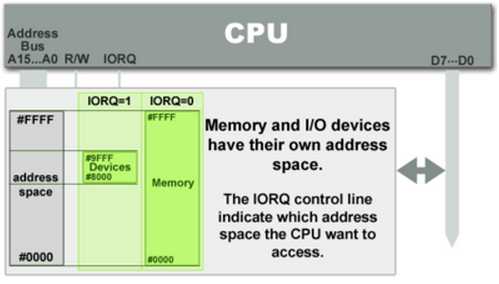
Picture source : IO Devices
I/O
devices are mapped into a separate address space. This is usually
accomplished by having a different set of signal lines to indicate a
memory access versus a port access. The address lines are usually shared
between the two address spaces, but less of them are used for accessing
ports. An example of this is the standard PC which uses 16 bits of port
address space, but 32 bits of memory address space.
The
advantage to this system is that less logic is needed to decode a
discrete address and therefore less cost to add hardware devices to a
machine. On the older PC compatible machines, only 10 bits of address
space were decoded for I/O ports and so there were only 1024 unique port
locations; modern PC's decode all 16 address lines. To read or write
from a hardware device, special port I/O instructions are used.
From a software perspective, this is a slight disadvantage because more
instructions are required to accomplish the same task. For instance, if
we wanted to test one bit on a memory mapped port, there is a single
instruction to test a bit in memory, but for ports we must read the data
into a register, then test the bit.
Comparison - Memory-mapped vs port-mapped
| Memory-mapped IO | Port-mapped IO |
|---|---|
| Same address bus to address memory and I/O devices | Different address spaces for memory and I/O devices |
| Access to the I/O devices using regular instructions | Uses a special class of CPU instructions to access I/O devices |
| Most widely used I/O method | x86 Intel microprocessors - IN and OUT instructions |
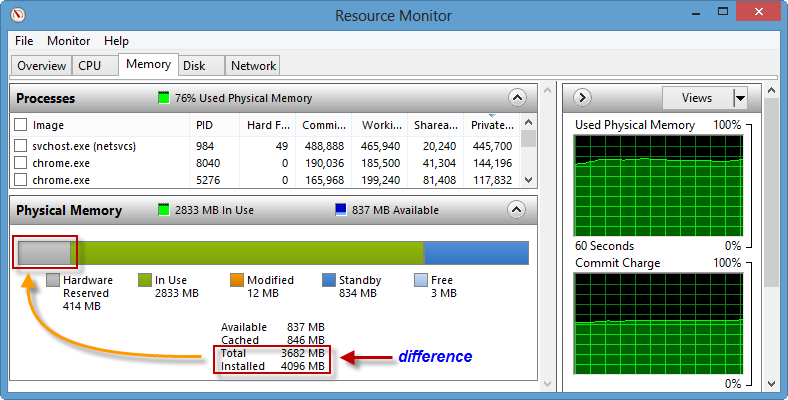
We can check the reserved memory address space from the Resource Monitor via our desktop's Task Manager.
Memory-mapped I/O vs port-mapped I/O的更多相关文章
- System and method for parallel execution of memory transactions using multiple memory models, including SSO, TSO, PSO and RMO
A data processor supports the use of multiple memory models by computer programs. At a device extern ...
- 【DM642学习笔记六】TI参考文档--DM642 Video Port Mini Driver
这个文档介绍了在DM642EVM板上视频采集和显示微驱动的使用和设计.用EDMA进行存储器和视频端口的数据传输.为了增强代码的复用性和简化设计过程,驱动分为通用视频端口层和特定编解码芯片微驱动层两个 ...
- Anatomy of a Program in Memory
Memory management is the heart of operating systems; it is crucial for both programming and system a ...
- [转]Anatomy of a Program in Memory
Memory management is the heart of operating systems; it is crucial for both programming and system a ...
- Method and apparatus for providing total and partial store ordering for a memory in multi-processor system
An improved memory model and implementation is disclosed. The memory model includes a Total Store Or ...
- Unity3D Optimizing Graphics Performance for iOS
原地址:http://blog.sina.com.cn/s/blog_72b936d801013ptr.html icense Comparisons http://unity3d.com/unity ...
- linux 查看系统状态方法
Linux下如何查看系统启动时间和运行时间 1.uptime命令输出:16:11:40 up 59 days, 4:21, 2 users, load average: 0.00, 0.01, 0.0 ...
- linux包之dmidecode
http://www.dmtf.org/standards/smbios Dmidecode 这款软件允许你在 Linux 系统下获取有关硬件方面的信息.Dmidecode 遵循 SMBIOS/DMI ...
- System Address Map Initialization in x86/x64 Architecture Part 2: PCI Express-Based Systems
原文 http://resources.infosecinstitute.com/system-address-map-initialization-x86x64-architecture-pa ...
- psutil官方文档
psutil documentation¶ Quick links Home page Install Blog Forum Download Development guide What’s new ...
随机推荐
- 用CSS给表格加边框
很久之前,给表格加边框用的方法是给表格加上背景色,然后把cellspacing="1",再给td设置成另一种颜色,这样间接的加边框颜色. 一直没去细研究,今天发现了一种很简单的加边 ...
- NOJ——1508火烧赤壁2(并查集+启发式合并+逆序加边)
[1508] 火烧赤壁2 时间限制: 1000 ms 内存限制: 65535 K 问题描述 上次出了一道火烧赤壁的题目给当时的新生,也就是你们的上一届学长们做,那么这次,我又想到了另一个想法. 上次的 ...
- inux读取ISO文件或是光驱的方法--挂载
inux读取ISO文件或是光驱的方法--挂载 首先在虚拟机选项的设置里设置CD/DVD选项,勾选:Connect at power on 再在连接中选择:Use ISO image file即选择镜像 ...
- 用户认证系统 django.contrib.auth模块
一 导入auth模块 from django.contrib.auth.models import User from django.contrib import auth auth模块的操作针对的就 ...
- 马士兵hadoop第四课:Yarn和Map/Reduce配置启动和原理讲解(转)
马士兵hadoop第一课:虚拟机搭建和安装hadoop及启动 马士兵hadoop第二课:hdfs集群集中管理和hadoop文件操作 马士兵hadoop第三课:java开发hdfs 马士兵hadoop第 ...
- DispatcherServlet与ContextLoaderListener的对比
1. 从DispatcherServlet和ContextLoaderListener的初始化过程可以看出,二者分别会生成一个WebApplicationContext,且以不同的attrName注册 ...
- Pushlets的初始化陷阱
Pushlets是在类名为Pushlet的servlet的init方法中进行初始化的.一般我们会在web.xml配置pushlet的时候,指定其servlet在Web应用启动时就进行初始化,即便这样, ...
- 【NOIP2016练习】T3 tree (树形DP)
题意:一棵有N个结点的树,每个节点上有权值c[i] 需要选出若干结点,对于任意结点他的所有祖先都被选取且选取总个数不能超过lim 在此前提下使权值和最大 n,lim<=3000 思路:WA了1次 ...
- Java 经典笔试题
这些题目对我的笔试帮助很大,有需要的朋友都可以来看看,在笔试中能遇到的题目基本上下面都会出现,虽然形式不同,当考察的基本的知识点还是相同的. 在分析中肯定有不足和谬误的地方还请大虾们能够给予及时的纠正 ...
- Codeforces Gym 100650C The Game of Efil 模拟+阅读题
原题链接:http://codeforces.com/gym/100650/attachments/download/3269/20052006-acmicpc-east-central-north- ...