
MAX II Device Compatibility with 5.0-V CMOS Devices
http://www.altera.com/literature/hb/max2/max2_mii51009.pdf
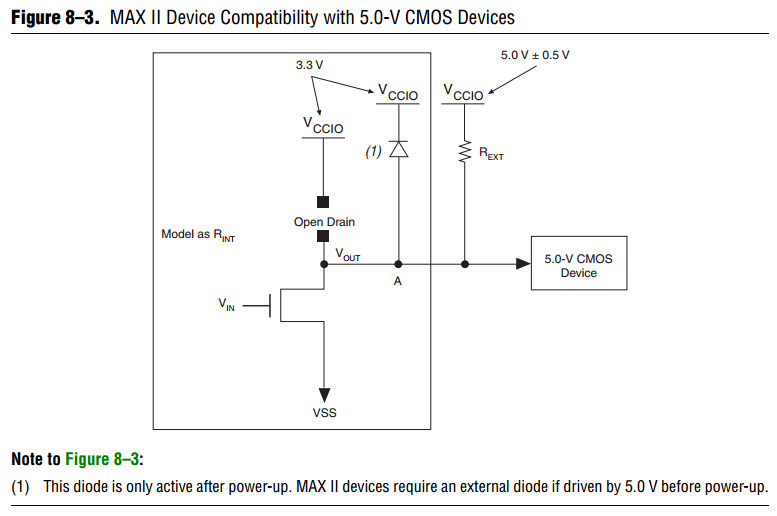
The open-drain pin never drives high, only low or tri-state. When the open-drain pin is active, it drives low.
When the open-drain pin is inactive, the pin is tri-stated and the trace pulls up to 5.0 V by the external resistor.
The purpose of enabling the I/O clamp diode is to protect the MAX II device’s I/O pins.
The 3.3-V VCCIO supplied to the I/O clamp diodes causes the voltage at point A to clamp at 4.0 V,
which meets the MAX II device’s reliability limits when the trace voltage exceeds 4.0 V.
The device operates successfully because a 5.0-V input is within its input specification.
The I/O clamp diode is only supported in the EPM1270 and EPM2210 devices’ I/O Bank 3.
An external protection diode is needed for other I/O banks in EPM1270 and EPM2210 devices
and all I/O pins in EPM240 and EPM570 devices.
The pull-up resistor value should be small enough for sufficient signal rise time,
but large enough so that it does not violate the IOL (output low) specification of MAX II devices.
The maximum MAX II device IOL depends on the programmable drive strength of the I/O output.
Table 8–1 shows the programmable drive strength settings
that are available for the 3.3-V LVTTL/LVCMOS I/O standard for MAX II devices.
The Quartus II software uses the maximum current strength as the default setting.
The PCI I/O standard is always set at 20 mA with no alternate setting.

To compute the required value of REXT, first calculate the model of the open-drain
transistors on the MAX II device. This output resistor (REXT) can be modeled by
dividing VOL by IOL (REXT = VOL/IOL). Table 8–2 shows the maximum VOL for the 3.3-V
LVTTL/LVCMOS I/O standard for MAX II devices.
f For more information about I/O standard specifications, refer to the DC and Switching
Characteristics chapter in the MAX II Device Handbook.

Select REXT so that the MAX II device’s IOL specification is not violated. You can
compute the required pull-up resistor value of REXT by using the equation: REXT =
(VCC/IOL) – RINT. For example, if an I/O pin is configured as a 3.3-V LVTTL with a 16
mA drive strength, given that the maximum power supply (VCC) is 5.5 V, the value of
REXT can be calculated as follows:

This resistor value computation assumes worst-case conditions. You can adjust the
REXT value according to the device configuration drive strength. Additionally, if your
system does not see a wide variation in voltage-supply levels, you can adjust these
calculations accordingly.
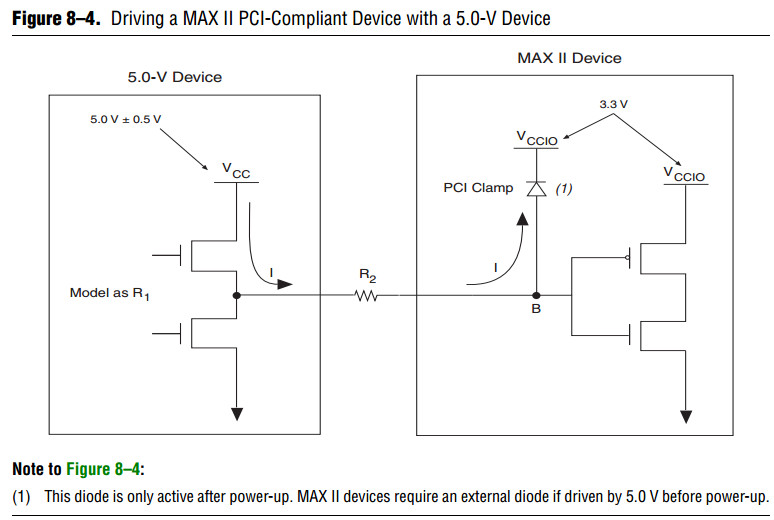
Because MAX II devices are 3.3-V, 32-bit, 66-MHz PCI compliant, the input circuitry
accepts a maximum high-level input voltage (VIH) of 4.0 V.
To drive a MAX II device with a 5.0-V device, you must connect a resistor (R2)
between the MAX II device and the 5.0-V device. See Figure 8–4.
If VCCIO for MAX II devices is 3.3 V and the I/O clamp diode is enabled, the voltage at point B in Figure 8–4 is 4.0 V,
which meets the MAX II devices reliability limits when the trace voltage exceeds 4.0 V.
To limit large current draw from the 5.0-V device, R2 should be small enough for a fast signal rise time
and large enough so that it does not violate the high-level output current (IOH) specifications of the devices driving the trace.
To compute the required value of R2, first calculate the model of the pull-up transistors on the 5.0-V device.
This output resistor (R1) can be modeled by dividing the 5.0-V device supply voltage (VCC) by the IOH: R1 = VCC/IOH
Figure 8–5 shows an example of typical output drive characteristics of a 5.0-V device.
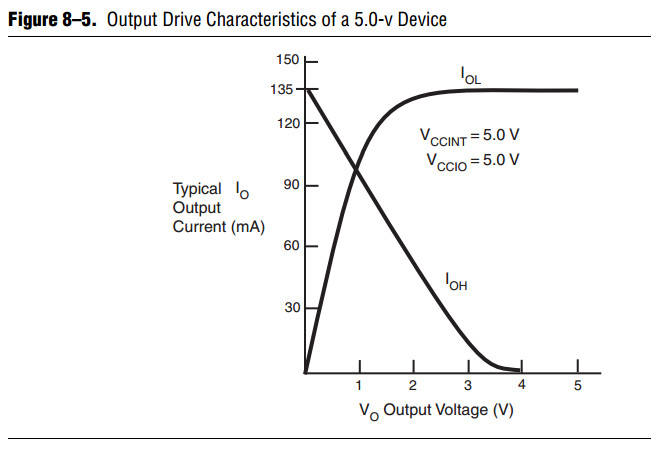
As shown above, R1 = 5.0 V/135 mA.
The values usually shown in data sheets reflect typical operating conditions.
Subtract 20% from the data sheet value for guard band.
This subtraction applied to the above example gives R1 a value of 30.
Select R2 so that the MAX II device’s IOH specification is not violated. For example,
if the above device has a maximum IOH of 8 mA, given the I/O clamp diode,
VIN = VCCIO + 0.7 V = 3.7 V.
Given that the maximum supply load of a 5.0-V device (VCC) is 5.5 V, the value of R2
can be calculated as follows:

This analysis assumes worst-case conditions. If your system does not see a wide
variation in voltage-supply levels, you can adjust these calculations accordingly.
Because 5.0-V device tolerance in MAX II devices requires use of the I/O clamp, and
this clamp is activated only after power-up, 5.0-V signals may not be driven into the
device until it is configured.
The I/O clamp diode is only supported in the EPM1270 and EPM2210 devices’ I/O Bank 3.
An external protection diode is needed for other I/O banks for EPM1270 and EPM2210 devices
and all I/O pins in EPM240 and EPM570 devices.
MAX II Device Compatibility with 5.0-V CMOS Devices的更多相关文章
- Multiplexing SDIO Devices Using MAX II or CoolRunner-II CPLD
XAPP906 Supporting Multiple SD Devices with CoolRunner-II CPLDs There has been an increasing demand ...
- Delphi XE5 Device compatibility
Delphi XE5 Device compatibility https://docs.google.com/spreadsheet/ccc?key=0AoEN2CEsVvJ0dGhVaWJE ...
- 3、一、Introduction(入门):2、Device Compatibility(设备兼容性)
2.Device Compatibility(设备兼容性) Android is designed to run on many different types of devices, from ...
- java.lang.UnsatisfiedLinkError: org.apache.hadoop.util.NativeCrc32.nativeComputeChunkedSumsByteArray(II[BI[BIILjava/lang/String;JZ)V
环境: Spark2.1.0 .Hadoop-2.7.5 代码运行系统:Win 7在运行Spark程序写出文件(savaAsTextFile)的时候,我遇到了这个错误: // :: ERROR U ...
- Android Google官方文档解析之——Device Compatibility
Android is designed to run on many different types of devices, from phones to tablets and television ...
- win7上代码连接hadoop出现错误 :org.apache.hadoop.util.NativeCrc32.nativeComputeChunkedSumsByteArray(II[BI[BIILjava/lang/String;JZ)V
在idea和eclipse中调试hadoop中hdfs文件,之前好好的,结果突然就出现java.lang.UnsatisfiedLinkError: org.apache.hadoop.util.Na ...
- 关于freemarker标签+Spring3.0 V层学习
import标签 就是把其他的ftl页面引用进来 <#import "/common/ui.ftl" as ui> 使用时 <@ui.message/>,m ...
- linux内核挂载根文件系统时报错”VFS: Cannot open root device "ram0" or unknown-block(0,0): error -6“如何处理?
1. 通过error -6得到: #define ENXIO 6 /* No such device or address */ 2. 解决办法 使能CONFIG_BL ...
- VFS: Cannot open root device "nfs" or unknown-block(0,255)错误的解决
1. 解决办法:在内核配置时候文件系统中选中Root file system on NFS
随机推荐
- WCF - Autofac IOC
/// <summary> /// IOC实例提供者,基于AutoFac /// /// </summary> public class IocInstanceProvider ...
- HDU 4283 You Are the One(区间DP(最优出栈顺序))
题目链接:http://acm.hdu.edu.cn/showproblem.php?pid=4283 题目大意:有一群屌丝,每个屌丝有个屌丝值,如果他第K个上场,屌丝值就为a[i]*(k-1),通过 ...
- MySQL 连接本地数据库、远程数据库命令
一.MySQL 连接本地数据库,用户名为“root”,密码“123”(注意:“-p”和“123” 之间不能有空格) C:/>mysql -h localhost -u root -p123 二. ...
- Python输入/输出
1.在python2.x中raw_input( )和input( ),两个函数都存在,其中区别为 raw_input( )---将所有输入作为字符串看待,返回字符串类型 input( )-----只能 ...
- 最邻近规则分类KNN算法
例子: 求未知电影属于什么类型: 算法介绍: 步骤: 为了判断未知实例的类别,以所有已知类别的实例作为参照 选择参数K 计算未知实例与所有已知实例的距离 选择最近K个已 ...
- Spark(二)CentOS7.5搭建Spark2.3.1分布式集群
一 下载安装包 1 官方下载 官方下载地址:http://spark.apache.org/downloads.html 2 安装前提 Java8 安装成功 zookeeper 安 ...
- C11多线程
参考: http://www.oschina.net/translate/cplusplus-11-threading-make-your-multitasking-life http://blog. ...
- Observer 观察者
意图 定义对象间的一种一对多的依赖关系 ,当一个对象的状态发生改变时, 所有依赖于它的对象都得到通知并被自动更新. 动机 一致性,松耦合 需要维护相关对象间的一致性.我们不希望为了维持一致性而使各类紧 ...
- JS 如何准确获取当前页面URL网址信息
在WEB开发中,时常会用到javascript来获取当前页面的url网址信息,在这里是一些获取url信息的小总结. 下面我们举例一个URL,然后获得它的各个组成部分:http://i.cnblogs. ...
- Bootstrap--响应式显示图片信息列表
HTML布局 <link href="~/Content/StyleSheet1.css" rel="stylesheet" /> <div ...