
python基础学习笔记(九)
python异常
python用异常对象(exception object)来表示异常情况。遇到错误后,会引发异常。如果异常对象并未被处理或捕捉,程序就会用所谓的 回溯(Traceback, 一种错误信息)终止执行:

>>> 1/0

Traceback (most recent call last):

  File "<pyshell#0>", line 1, in <module>

    1/0

ZeroDivisionError: integer division or modulo by zero
raise 语句
为了引发异常,可以使用一个类(Exception的子类)或者实例参数数调用raise 语句。下面的例子使用内建的Exception异常类:
>>> raise Exception    #引发一个没有任何错误信息的普通异常

Traceback (most recent call last):

  File "<pyshell#1>", line 1, in <module>

    raise Exception

Exception

>>> raise Exception('hyperdrive overload')   # 添加了一些异常错误信息

Traceback (most recent call last):

  File "<pyshell#2>", line 1, in <module>

    raise Exception('hyperdrive overload')

Exception: hyperdrive overload
系统自带的内建异常类:
>>> import exceptions

>>> dir(exceptions)

['ArithmeticError', 'AssertionError', 'AttributeError', 'BaseException', 'BufferError', 'BytesWarning', 'DeprecationWarning', 'EOFError', 'EnvironmentError', 'Exception', 'FloatingPointError', 'FutureWarning', 'GeneratorExit', 'IOError', 'ImportError', 'ImportWarning', 'IndentationError', 'IndexError', 'KeyError', 'KeyboardInterrupt', 'LookupError', 'MemoryError', 'NameError', 'NotImplementedError', 'OSError', 'OverflowError', 'PendingDeprecationWarning', 'ReferenceError', 'RuntimeError', 'RuntimeWarning', 'StandardError', 'StopIteration', 'SyntaxError', 'SyntaxWarning', 'SystemError', 'SystemExit', 'TabError', 'TypeError', 'UnboundLocalError', 'UnicodeDecodeError', 'UnicodeEncodeError', 'UnicodeError', 'UnicodeTranslateError', 'UnicodeWarning', 'UserWarning', 'ValueError', 'Warning', 'WindowsError', 'ZeroDivisionError', '__doc__', '__name__', '__package__']
哇!好多,常用的内建异常类:
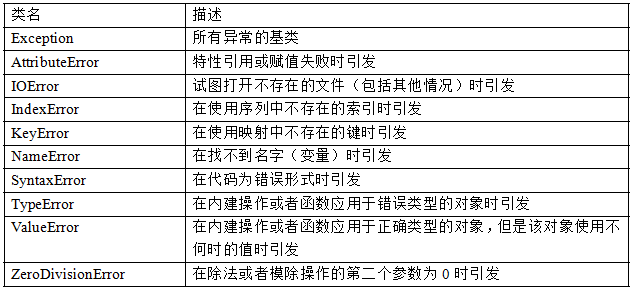
自定义异常
尽管内建的异常类已经包括了大部分的情况,而且对于很多要求都已经足够了,但有些时候还是需要创建自己的异常类。
和常见其它类一样----只是要确保从Exception类继承,不管直接继承还是间接继承。像下面这样:
>>> class someCustomExcetion(Exception):pass
当然,也可以为这个类添加一些方法。
捕捉异常
我们可以使用 try/except 来实现异常的捕捉处理。
假设创建了一个让用户输入两个数,然后进行相除的程序:
x = input('Enter the first number: ')

y = input('Enter the second number: ')

print x/y

#运行并且输入

Enter the first number: 10

Enter the second number: 0

Traceback (most recent call last):

  File "I:/Python27/yichang", line 3, in <module>

    print x/y

ZeroDivisionError: integer division or modulo by zero
为了捕捉异常并做出一些错误处理,可以这样写:
try:

    x = input('Enter the first number: ')

    y = input('Enter the second number: ')

    print x/y

except ZeroDivisionError:

  print "输入的数字不能为0!"


#再来云行

>>>

Enter the first number: 10

Enter the second number: 0

输入的数字不能为0!           #怎么样?这次已经友好的多了
假如,我们在调试的时候引发异常会好些,如果在与用户的进行交互的过程中又是不希望用户看到异常信息的。那如何开启/关闭 “屏蔽”机制?
class MuffledCalulator:

    muffled = False   #这里默认关闭屏蔽

    def calc(self,expr):

        try:

            return eval(expr)

        except ZeroDivisionError:

            if self.muffled:

                print 'Divsion by zero is illagal'

            else:

                raise

#运行程序:

>>> calculator = MuffledCalulator()

>>> calculator.calc('10/2')

5

>>> calculator.clac('10/0')

Traceback (most recent call last):

  File "<pyshell#30>", line 1, in <module>

    calculator.clac('10/0')

AttributeError: MuffledCalulator instance has no attribute 'clac'   #异常信息被输出了

>>> calculator.muffled = True   #现在打开屏蔽

>>> calculator.calc('10/0')

Divsion by zero is illagal
多个except 子句
如果运行上面的(输入两个数,求除法)程序,输入面的内容,就会产生另外一个异常:
try:

    x = input('Enter the first number: ')

    y = input('Enter the second number: ')

    print x/y

except ZeroDivisionError:

  print "输入的数字不能为0!"


#运行输入:

>>>

Enter the first number: 10

Enter the second number: 'hello.word'  #输入非数字

Traceback (most recent call last):

  File "I:\Python27\yichang", line 4, in <module>

    print x/y

TypeError: unsupported operand type(s) for /: 'int' and 'str'  #又报出了别的异常信息
好吧!我们可以再加个异常的处理来处理这种情况:
try:

    x = input('Enter the first number: ')

    y = input('Enter the second number: ')

    print x/y

except ZeroDivisionError:

    print "输入的数字不能为0!"

except TypeError:           # 对字符的异常处理

  print "请输入数字!"


#再来运行:

>>>

Enter the first number: 10

Enter the second number: 'hello,word'

请输入数字!
一个块捕捉多个异常
我们当然也可以用一个块来捕捉多个异常:
try:

    x = input('Enter the first number: ')

    y = input('Enter the second number: ')

    print x/y

except (ZeroDivisionError,TypeError,NameError):

    print "你的数字不对!"
捕捉全部异常
就算程序处理了好几种异常,比如上面的程序,运行之后,假如我输入了下面的内容呢
>>>

Enter the first number: 10

Enter the second number:   #不输入任何内容,回车

Traceback (most recent call last):

  File "I:\Python27\yichang", line 3, in <module>

    y = input('Enter the second number: ')

  File "<string>", line 0

   ^

SyntaxError: unexpected EOF while parsing
晕死~! 怎么办呢?总有被我们不小心忽略处理的情况,如果真想用一段代码捕捉所有异常,那么可在except子句中忽略所有的异常类:
try:

    x = input('Enter the first number: ')

    y = input('Enter the second number: ')

    print x/y

except:

    print '有错误发生了!'

#再来输入一些内容看看

>>>

Enter the first number: 'hello' * )0

有错误发生了!
结束
别急!再来说说最后一个情况,好吧,用户不小心输入了错误的信息,能不能再给次机会输入?我们可以加个循环,保你输对时才结束:
while True:

    try:

        x = input('Enter the first number: ')

        y = input('Enter the second number: ')

        value = x/y

        print 'x/y is',value
        break

    except:

        print '列效输入,再来一次!'

#运行

>>>

Enter the first number: 10

Enter the second number:

列效输入,再来一次!

Enter the first number: 10

Enter the second number: 'hello'

列效输入,再来一次!

Enter the first number: 10

Enter the second number: 2

x/y is 5
python基础学习笔记(九)的更多相关文章
- 0003.5-20180422-自动化第四章-python基础学习笔记--脚本
0003.5-20180422-自动化第四章-python基础学习笔记--脚本 1-shopping """ v = [ {"name": " ...
- Python基础学习笔记(九)常用数据类型转换函数
参考资料: 1. <Python基础教程> 2. http://www.runoob.com/python/python-variable-types.html 3. http://www ...
- python 基础学习笔记(1)
声明: 本人是在校学生,自学python,也是刚刚开始学习,写博客纯属为了让自己整理知识点和关键内容,当然也希望可以通过我都博客来提醒一些零基础学习python的人们.若有什么不对,请大家及时指出, ...
- Python 基础学习笔记(超详细版)
1.变量 python中变量很简单,不需要指定数据类型,直接使用等号定义就好.python变量里面存的是内存地址,也就是这个值存在内存里面的哪个地方,如果再把这个变量赋值给另一个变量,新的变量通过之前 ...
- Python基础学习笔记(十三)异常
参考资料: 1. <Python基础教程> 2. http://www.runoob.com/python/python-exceptions.html Python用异常对象(excep ...
- Python基础学习笔记(十二)文件I/O
参考资料: 1. <Python基础教程> 2. http://www.runoob.com/python/python-files-io.html ▶ 键盘输入 注意raw_input函 ...
- Python基础学习笔记(十一)函数、模块与包
参考资料: 1. <Python基础教程> 2. http://www.runoob.com/python/python-functions.html 3. http://www.liao ...
- Python基础学习笔记(十)日期Calendar和时间Timer
参考资料: 1. <Python基础教程> 2. http://www.runoob.com/python/python-date-time.html 3. http://www.liao ...
- Python基础学习笔记(八)常用字典内置函数和方法
参考资料: 1. <Python基础教程> 2. http://www.runoob.com/python/python-dictionary.html 3. http://www.lia ...
- Python基础学习笔记(七)常用元组内置函数
参考资料: 1. <Python基础教程> 2. http://www.runoob.com/python/python-tuples.html 3. http://www.liaoxue ...
随机推荐
- <转>通过反射获取Form/MenuStrip/ContextMenuStrip等列表
private void button1_Click(object sender, EventArgs e) { treeView1.Nodes.Clear(); Assembly a = Assem ...
- Linux下的进程类别(内核线程、轻量级进程和用户进程)--Linux进程的管理与调度(四)
本文中出现的,内核线程,轻量级进程,用户进程,用户线程等概念,如果不太熟悉, 可以参见 内核线程.轻量级进程.用户线程三种线程概念解惑(线程≠轻量级进程) Linux进程类别 虽然我们在区分Linux ...
- 15LaTeX学习系列之---LaTeX里插入数学公式
目录 目录 前言 (一)常用的数学公式命令 ==1.上下标== ==2.矢量== ==3.括号== ==4.符号关系== ==5.三角形符号== ==6.求和与累积== ==7.积分与微分== ==8 ...
- MySQL基本简单操作03
MySQL基本简单操作 现在我创建了一个数据表,表的内容如下: mysql> select * from gubeiqing_table; +----------+-----+ | name | ...
- Java设计模式之七 ----- 享元模式和代理模式
前言 在上一篇中我们学习了结构型模式的组合模式和过滤器模式.本篇则来学习下结构型模式最后的两个模式, 享元模式和代理模式. 享元模式 简介 享元模式主要用于减少创建对象的数量,以减少内存占用和提高性能 ...
- 浅析JAVA中堆内存与栈内存的区别
Java把内存划分成两种:一种是栈内存,一种是堆内存. 一.栈内存 存放基本类型的变量,对象的引用和方法调用,遵循先入后出的原则. 栈内存在函数中定义的“一些基本类型的变量和对象的引用变量”都 ...
- Android Activity.startActivity流程简介
http://blog.csdn.net/myarrow/article/details/14224273 1. 基本概念 1.1 Instrumentation是什么? 顾名思义,仪器仪表,用于在应 ...
- Jedis使用管道优化批量输出插入的效率
Jedis连接池: package com.daxin.jedis_datastructure; /** * * @author daxin * * @email leodaxin@163com * ...
- (java项目)坦克大战 2.0
这个版本,只能算是一个雏形,把最基本的东西给完成了,不过,后面可添加的也不多.有一点,还是想去实现,那就是敌方坦克自己寻找对手!也就是游戏AI. emmm, 什么时候可以了解一下这个AI.顺便学学py ...
- e 的由来
https://www.zhihu.com/question/20296247 对数的发现 很多科学家发现对数螺线在自然界中广泛存在.从大如星系.台风,到小如花朵.海螺……宇宙中到处都是对数螺线的身影