
scikit-learn画ROC图
1.使用sklearn库和matplotlib.pyplot库
import sklearn

import matplotlib.pyplot as plt
2.准备绘图函数的传入参数1.预测的概率值数组2.预测的labels值数组
for i in range(len(y_labeles)):

    a = np.argmax(y_labeles[i])

    y_pred.append(y_conv.eval(feed_dict={x: np.reshape(mnist.test.images[i], [1, 784]),  keep_prob: 0.5}, session=sess)[0][a])

    y_labeles_d1.append(correct_prediction.eval(feed_dict={x: np.reshape(mnist.test.images[i], [1, 784]), y_: np.reshape(y_labeles[i], [1, 10]), keep_prob: 0.5}, session=sess))
3.调用sklearn.metrics.roc_curve();
fpr, tpr, thresholds = sklearn.metrics.roc_curve(y_labeles_d1, y_pred)

plt.plot(fpr, tpr, 'b')#生成ROC曲线

plt.legend(loc='lower right')

plt.plot([0, 1], [0, 1], 'r--')

plt.xlim([0, 1])

plt.ylim([0, 1])

plt.ylabel('TP')

plt.xlabel('FP')

plt.show()
4.例子
import tensorflow as tf

from tensorflow.examples.tutorials.mnist import input_data

import numpy as np

import sklearn

import matplotlib.pyplot as plt

mnist = input_data.read_data_sets('data/', one_hot=True)

def weight_variable(shape, name):

    initial = tf.truncated_normal(shape, stddev=0.1, name=name)

    return tf.Variable(initial)

def bias_variable(shape, name):

    initial = tf.constant(0.1, shape=shape, name=name)

    return tf.Variable(initial)

def conv2d(x, W):

    return tf.nn.conv2d(x, W, strides=[1, 1, 1, 1], padding='SAME')

def max_pool_2x2(x):

    return tf.nn.max_pool(x, ksize=[1, 2, 2, 1], strides=[1, 2, 2, 1], padding='SAME')

x = tf.placeholder(tf.float32, [None, 784])

y_ = tf.placeholder(tf.float32, [None, 10])

x_image = tf.reshape(x, [-1, 28, 28, 1])

W_conv1 = weight_variable([5, 5, 1, 32], name='W_conv1')

b_conv1 = bias_variable([32], name='b_conv1')

h_conv1 = tf.nn.relu(conv2d(x_image, W_conv1) + b_conv1)

h_pool1 = max_pool_2x2(h_conv1)

W_conv2 = weight_variable([5, 5, 32, 64], name='W_conv2')

b_conv2 = bias_variable([64], name='b_conv2')

h_conv2 = tf.nn.relu(conv2d(h_pool1, W_conv2) + b_conv2)

h_pool2 = max_pool_2x2(h_conv2)

W_fc1 = weight_variable([7*7*64, 1024], name='W_fc1')

b_fc1 = bias_variable([1024], name='b_fc1')

h_pool2_flat = tf.reshape(h_pool2, [-1, 7*7*64])

h_fc1 = tf.nn.relu(tf.matmul(h_pool2_flat, W_fc1) + b_fc1)

keep_prob = tf.placeholder(tf.float32)

h_fc1_drop = tf.nn.dropout(h_fc1, keep_prob)

W_fc2 = weight_variable([1024, 10], name='W_fc2')

b_fc2 = bias_variable([10], name='b_fc2')

y_conv = tf.nn.softmax(tf.matmul(h_fc1_drop, W_fc2) + b_fc2)

cross_entropy = tf.reduce_sum(tf.nn.softmax_cross_entropy_with_logits(logits=y_conv, labels=y_))

# cross_entropy = tf.reduce_mean(-tf.reduce_sum(y_ * tf.log(y_conv), reduction_indices=[1]))

train_step = tf.train.AdamOptimizer(1e-4).minimize(cross_entropy)

correct_prediction = tf.equal(tf.argmax(y_conv, 1), tf.argmax(y_, 1))

accuracy = tf.reduce_mean(tf.cast(correct_prediction, tf.float32))

sess = tf.Session()

sess.run(tf.global_variables_initializer())

for i in range(500):

    batch = mnist.train.next_batch(100)

    train_step.run(session=sess, feed_dict={x: batch[0], y_: batch[1], keep_prob: 0.5})

    if i % 500 == 0 and i != 0:

        train_accuracy = accuracy.eval(session=sess, feed_dict={x: batch[0], y_: batch[1], keep_prob: 1.0})

        print('step %d, training accuracy %g' % (i, train_accuracy))

print("!!!!!")

print('test accuracy %g' % accuracy.eval(session=sess, feed_dict={

    x: mnist.test.images, y_: mnist.test.labels, keep_prob: 1.0

}))

saver = tf.train.Saver()

saver.save(sess, './trained_variables.ckpt', global_step=1000)

y_labeles = mnist.test.labels

y_pred = []

y_labeles_d1 = []

for i in range(len(y_labeles)):

    a = np.argmax(y_labeles[i])

    y_pred.append(y_conv.eval(feed_dict={x: np.reshape(mnist.test.images[i], [1, 784]),  keep_prob: 0.5}, session=sess)[0][a])

    y_labeles_d1.append(correct_prediction.eval(feed_dict={x: np.reshape(mnist.test.images[i], [1, 784]), y_: np.reshape(y_labeles[i], [1, 10]), keep_prob: 0.5}, session=sess))

fpr, tpr, thresholds = sklearn.metrics.roc_curve(y_labeles_d1, y_pred)

plt.plot(fpr, tpr, 'b')#生成ROC曲线

plt.legend(loc='lower right')

plt.plot([0, 1], [0, 1], 'r--')

plt.xlim([0, 1])

plt.ylim([0, 1])

plt.ylabel('TP')

plt.xlabel('FP')

plt.show()

# with tf.Session() as sess:

#   new_saver = tf.train.import_meta_graph('my_test_model-1000.meta')

#   new_saver.restore(sess, tf.train.latest_checkpoint('./'))

# print(sess.run(W_conv1))
5.效果:
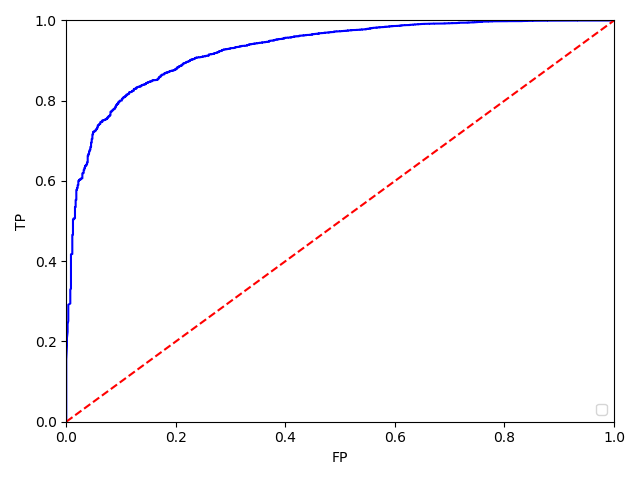
scikit-learn画ROC图的更多相关文章
- (原创)(三)机器学习笔记之Scikit Learn的线性回归模型初探
一.Scikit Learn中使用estimator三部曲 1. 构造estimator 2. 训练模型:fit 3. 利用模型进行预测:predict 二.模型评价 模型训练好后,度量模型拟合效果的 ...
- MATLAB画ROC曲线,及计算AUC值
根据决策值和真实标签画ROC曲线,同时计算AUC的值 步骤: 根据决策值和真实标签画ROC曲线,同时计算AUC的值: 计算算法的决策函数值deci 根据决策函数值deci对真实标签y进行降序排序,得到 ...
- 使用Mysql Workbench 画E-R图
MySQL Workbench 是一款专为MySQL设计的ER/数据库建模工具.你可以用MySQL Workbench设计和创建新的数据库图示,建立数据库文档,以及进行复杂的MySQL 迁移.这里介绍 ...
- 用rose画UML图(用例图,活动图)
用rose画UML图(用例图,活动图) 首先,安装rose2003,电脑从win8升到win10以后,发现win10并不支持rose2003的安装,换了rose2007以后,发现也不可以. 解决途径: ...
- python中matplotlib画折线图实例(坐标轴数字、字符串混搭及标题中文显示)
最近在用python中的matplotlib画折线图,遇到了坐标轴 "数字+刻度" 混合显示.标题中文显示.批量处理等诸多问题.通过学习解决了,来记录下.如有错误或不足之处,望请指 ...
- 相机拍的图,电脑上画的图,word里的文字,电脑屏幕,手机屏幕,相机屏幕显示大小一切的一切都搞明白了!
相机拍的图,电脑上画的图,word里的文字,电脑屏幕,手机屏幕,相机屏幕显示大小一切的一切都搞明白了! 先说图片X×dpi=点数dotX是图片实际尺寸,简单点,我们只算图片的高吧,比如说拍了张图片14 ...
- SAS 画折线图PROC GPLOT
虽然最后做成PPT里的图表会被要求用EXCEL画,但当我们只是在分析的过程中,想看看数据的走势,直接在SAS里画会比EXCEL画便捷的多. 修改起来也会更加的简单,,不用不断的修改程序然后刷新EXCE ...
- Windows8.1画热度图 - 坑
想要的效果 如上是silverlight版本.原理是设定一个调色板,为256的渐变色(存在一个png文件中,宽度为256,高度为1),然后针对要处理的距离矩阵图形,取图片中每个像素的Alpha值作为索 ...
- 使用网站websequencediagrams在线画时序图
在线画时序图的网站:https://www.websequencediagrams.com/ 该网站提供拖拉图形和编写脚本代码2个方式来制作时序图,同时提供多种显示风格. 实例: 1.脚本代码: ti ...
随机推荐
- Django-cookie的保存以及删除操作
Django里的保存cookie和flask是有区别的 今天我就说以下Django里的cookie操作 #先导包 #导入Django模块 from django.http import HttpRes ...
- 在没有任何投票节点情况下将从节点转换为Primary节点脚本
cfg={ "_id": "rs01", "version": 2, "protocolVersion": Number ...
- nginx发布静态网页
http://www.jb51.net/article/71384.htm 切记不要把项目放在/root下 会出现 nginx open() "" failed (13: Perm ...
- 再谈高性能Web服务器,MemoryPool的作用
在以往使用c#实现scoket服务器中,通常遇到一个问题就是内存占用高,GC次数频繁,导致处理能力直线下降 其主要原因是在处理socket请求时,大量的申请,复制内存,为了解决这个问题,NET Cor ...
- 10分钟打造强大的gvim
感谢Ruchee的共享精神,让我等vim新手省去了配置vim的麻烦(教程地址:配置文件使用指南). 只需要简单的6个步骤,就可以配置完成一个强大的gvim神器,下图是我的最终配置效果图. (另外,我的 ...
- Java reflect 反射学习笔记
1. class 类的使用 万事万物皆对象 (基本数据类型, 静态成员不是面向对象), 所以我们创建的每一个类都是对象, 即类本身是java.lang.Class类的实例对象, 但是这些对象不需要 n ...
- php -- 数据库信息
----- 023-dbinfo.php ----- <!DOCTYPE html> <html> <head> <meta http-equiv=" ...
- mpvue使用scroll-view实现图片横向滑动
html代码 <div class="swiper-home"> <scroll-view scroll-x="true" style=&qu ...
- Disruptor入门
一.什么是 Disruptor Disruptor是一个高性能的异步处理框架,或者可以认为是最快的消息框架(轻量的JMS),也可以认为是一个观察者模式实现,或者事件-监听模式的实现,直接称disrup ...
- postgresql 创建用户并创建数据库
首先通过 sudo -i -u postgres 以管理员身份 postgres 登陆,然后通过 createuser --interactive (-- interactive 是交互式,创建过程可 ...