
吴裕雄 python 机器学习-DMT(1)
import numpy as np

import operator as op

from math import log

def createDataSet():

    dataSet = [[1, 1, 'yes'],

               [1, 1, 'yes'],

               [1, 0, 'no'],

               [0, 1, 'no'],

               [0, 1, 'no']]

    labels = ['no surfacing','flippers']

    return dataSet, labels

dataSet,labels = createDataSet()

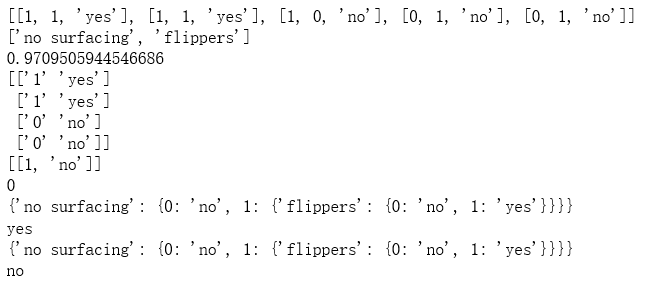
print(dataSet)

print(labels)

def calcShannonEnt(dataSet):

    labelCounts = {}

    for featVec in dataSet:

        currentLabel = featVec[-1]

        if(currentLabel not in labelCounts.keys()):

            labelCounts[currentLabel] = 0

        labelCounts[currentLabel] += 1

    shannonEnt = 0.0

    rowNum = len(dataSet)

    for key in labelCounts:

        prob = float(labelCounts[key])/rowNum

        shannonEnt -= prob * log(prob,2)

    return shannonEnt

shannonEnt = calcShannonEnt(dataSet)

print(shannonEnt)

def splitDataSet(dataSet, axis, value):

    retDataSet = []

    for featVec in dataSet:

        if(featVec[axis] == value):

            reducedFeatVec = featVec[:axis]

            reducedFeatVec.extend(featVec[axis+1:])

            retDataSet.append(reducedFeatVec)

    return retDataSet

retDataSet = splitDataSet(dataSet,1,1)

print(np.array(retDataSet))

retDataSet = splitDataSet(dataSet,1,0)

print(retDataSet)

def chooseBestFeatureToSplit(dataSet):

    numFeatures = np.shape(dataSet)[1]-1

    baseEntropy = calcShannonEnt(dataSet)

    bestInfoGain = 0.0

    bestFeature = -1

    for i in range(numFeatures):

        featList = [example[i] for example in dataSet]

        uniqueVals = set(featList)

        newEntropy = 0.0

        for value in uniqueVals:

            subDataSet = splitDataSet(dataSet, i, value)

            prob = len(subDataSet)/float(len(dataSet))

            newEntropy += prob * calcShannonEnt(subDataSet)

        infoGain = baseEntropy - newEntropy

        if (infoGain > bestInfoGain):

            bestInfoGain = infoGain

            bestFeature = i

    return bestFeature

bestFeature = chooseBestFeatureToSplit(dataSet)

print(bestFeature)

def majorityCnt(classList):

    classCount={}

    for vote in classList:

        if(vote not in classCount.keys()):

            classCount[vote] = 0

        classCount[vote] += 1

    sortedClassCount = sorted(classCount.items(), key=op.itemgetter(1), reverse=True)

    return sortedClassCount[0][0]

def createTree(dataSet,labels):

    classList = [example[-1] for example in dataSet]

    if(classList.count(classList[0]) == len(classList)):

        return classList[0]

    if len(dataSet[0]) == 1:

        return majorityCnt(classList)

    bestFeat = chooseBestFeatureToSplit(dataSet)

    bestFeatLabel = labels[bestFeat]

    myTree = {bestFeatLabel:{}}

    del(labels[bestFeat])

    featValues = [example[bestFeat] for example in dataSet]

    uniqueVals = set(featValues)

    for value in uniqueVals:

        subLabels = labels[:]

        myTree[bestFeatLabel][value] = createTree(splitDataSet(dataSet, bestFeat, value),subLabels)

    return myTree

myTree = createTree(dataSet,labels)

print(myTree)

def classify(inputTree,featLabels,testVec):

    for i in inputTree.keys():

        firstStr = i

        break

    secondDict = inputTree[firstStr]

    featIndex = featLabels.index(firstStr)

    key = testVec[featIndex]

    valueOfFeat = secondDict[key]

    if isinstance(valueOfFeat, dict):

        classLabel = classify(valueOfFeat, featLabels, testVec)

    else:

        classLabel = valueOfFeat

    return classLabel

featLabels = ['no surfacing', 'flippers']

classLabel = classify(myTree,featLabels,[1,1])

print(classLabel)

import pickle

def storeTree(inputTree,filename):

    fw = open(filename,'wb')

    pickle.dump(inputTree,fw)

    fw.close()

def grabTree(filename):

    fr = open(filename,'rb')

    return pickle.load(fr)

filename = "D:\\mytree.txt"

storeTree(myTree,filename)

mySecTree = grabTree(filename)

print(mySecTree)

featLabels = ['no surfacing', 'flippers']

classLabel = classify(mySecTree,featLabels,[0,0])

print(classLabel)
吴裕雄 python 机器学习-DMT(1)的更多相关文章
- 吴裕雄 python 机器学习-DMT(2)
import matplotlib.pyplot as plt decisionNode = dict(boxstyle="sawtooth", fc="0.8" ...
- 吴裕雄 python 机器学习——分类决策树模型
import numpy as np import matplotlib.pyplot as plt from sklearn import datasets from sklearn.model_s ...
- 吴裕雄 python 机器学习——回归决策树模型
import numpy as np import matplotlib.pyplot as plt from sklearn import datasets from sklearn.model_s ...
- 吴裕雄 python 机器学习——线性判断分析LinearDiscriminantAnalysis
import numpy as np import matplotlib.pyplot as plt from matplotlib import cm from mpl_toolkits.mplot ...
- 吴裕雄 python 机器学习——逻辑回归
import numpy as np import matplotlib.pyplot as plt from matplotlib import cm from mpl_toolkits.mplot ...
- 吴裕雄 python 机器学习——ElasticNet回归
import numpy as np import matplotlib.pyplot as plt from matplotlib import cm from mpl_toolkits.mplot ...
- 吴裕雄 python 机器学习——Lasso回归
import numpy as np import matplotlib.pyplot as plt from sklearn import datasets, linear_model from s ...
- 吴裕雄 python 机器学习——岭回归
import numpy as np import matplotlib.pyplot as plt from sklearn import datasets, linear_model from s ...
- 吴裕雄 python 机器学习——线性回归模型
import numpy as np from sklearn import datasets,linear_model from sklearn.model_selection import tra ...
随机推荐
- Sebastian Ruder : NLP 领域知名博主博士论文面向自然语言处理的神经网络迁移学习
Sebastian Ruder 博士的答辩 PPT<Neural Transfer Learning for Natural Language Processing>介绍了面向自然语言的迁 ...
- solr 使用edismax来控制评分
如何控制评分 如果设置了sort字段,那么将会按照sort字段的顺序返回结果. 如果没有设置sort字段,那么将会根据相关度打分来排序.也就是说,相关度更高的排在前面. 如何来定制适合自身业务的排序打 ...
- git error: failed to push some refs to...
在git环境下push代码时,报错如下: 用gitk查看提交的信息,发现没有生产changeID,主要原因是clone项目时没有把hook克隆下来,解决办法:将项目clone地址的&& ...
- fabric Node SDK进行连接
yum install gcc-c++ npm install --unsafe-perm --registry=https://registry.npm.taobao.org chmod -R
- 最近玩了下linux下的lampp注意一些使用
最近玩了下linux下的lampp注意一些使用 1 配置文件 /opt/lampp/etc 2 一些命令 mysql命令 /opt/lampp/bin/mysql php命令 /opt/lampp/b ...
- jupyter notebook 小笔记
安装直接按这个步骤了: https://hub.mybinder.org/user/ipython-ipython-in-depth-xj8fraz8/notebooks/binder/Index.i ...
- 高程三 BOM 读书笔记
<!DOCTYPE html> <html> <head> <meta charset="utf-8"> <meta http ...
- 4. powerdesigner 生成sql脚本步骤
1. 选择数据库类型:DataBase(数据库)-- Change Current DBMS 2. 生成数据库脚本:DataBase(数据库)--generate Database
- PHP Yii2.0PHPexecl导入。
use app\models\execl; use \PHPExcel; /*execl导入数据*/ public function Execlupload(){ if(Yii::$app->r ...
- 【JAVA】使用Aphache poi操作EXCEL 笔记
1 下载poi,地址 http://poi.apache.org/ 选择3.9版本. 2 刚开始尝试 把poi.jar放在D:\Program Files\java\jdk1.6.0_20\lib(不 ...