
吴裕雄--天生自然 R语言开发学习:基本统计分析(续三)







#---------------------------------------------------------------------#

# R in Action (2nd ed): Chapter 7                                     #

# Basic statistics                                                    #

# requires packages npmc, ggm, gmodels, vcd, Hmisc,                   #

#                   pastecs, psych, doBy to be installed              #

# install.packages(c("ggm", "gmodels", "vcd", "Hmisc",                #

#                    "pastecs", "psych", "doBy"))                     #

#---------------------------------------------------------------------#

mt <- mtcars[c("mpg", "hp", "wt", "am")]

head(mt)

# Listing 7.1 - Descriptive stats via summary

mt <- mtcars[c("mpg", "hp", "wt", "am")]

summary(mt)

# Listing 7.2 - descriptive stats via sapply

mystats <- function(x, na.omit=FALSE){

  if (na.omit)

    x <- x[!is.na(x)]

  m <- mean(x)

  n <- length(x)

  s <- sd(x)

  skew <- sum((x-m)^3/s^3)/n

  kurt <- sum((x-m)^4/s^4)/n - 3

  return(c(n=n, mean=m, stdev=s, skew=skew, kurtosis=kurt))

}

myvars <- c("mpg", "hp", "wt")

sapply(mtcars[myvars], mystats)

# Listing 7.3 - Descriptive stats via describe (Hmisc)

library(Hmisc)

myvars <- c("mpg", "hp", "wt")

describe(mtcars[myvars])

# Listing 7.,4 - Descriptive stats via stat.desc (pastecs)

library(pastecs)

myvars <- c("mpg", "hp", "wt")

stat.desc(mtcars[myvars])

# Listing 7.5 - Descriptive stats via describe (psych)

library(psych)

myvars <- c("mpg", "hp", "wt")

describe(mtcars[myvars])

# Listing 7.6 - Descriptive stats by group with aggregate

myvars <- c("mpg", "hp", "wt")

aggregate(mtcars[myvars], by=list(am=mtcars$am), mean)

aggregate(mtcars[myvars], by=list(am=mtcars$am), sd)

# Listing 7.7 - Descriptive stats by group via by

dstats <- function(x)sapply(x, mystats)

myvars <- c("mpg", "hp", "wt")

by(mtcars[myvars], mtcars$am, dstats)

# Listing 7.8 - Descriptive stats by group via summaryBy

library(doBy)

summaryBy(mpg+hp+wt~am, data=mtcars, FUN=mystats)

# Listing 7.9 - Descriptive stats by group via describe.by (psych)

library(psych)

myvars <- c("mpg", "hp", "wt")

describeBy(mtcars[myvars], list(am=mtcars$am))

# summary statistics by group via the reshape package

library(reshape)

dstats <- function(x)(c(n=length(x), mean=mean(x), sd=sd(x)))

dfm <- melt(mtcars, measure.vars=c("mpg", "hp", "wt"),

            id.vars=c("am", "cyl"))

cast(dfm, am + cyl + variable ~ ., dstats)

# frequency tables

library(vcd)

head(Arthritis)

# one way table

mytable <- with(Arthritis, table(Improved))

mytable  # frequencies

prop.table(mytable) # proportions

prop.table(mytable)*100 # percentages

# two way table

mytable <- xtabs(~ Treatment+Improved, data=Arthritis)

mytable # frequencies

margin.table(mytable,1) #row sums

margin.table(mytable, 2) # column sums

prop.table(mytable) # cell proportions

prop.table(mytable, 1) # row proportions

prop.table(mytable, 2) # column proportions

addmargins(mytable) # add row and column sums to table

# more complex tables

addmargins(prop.table(mytable))

addmargins(prop.table(mytable, 1), 2)

addmargins(prop.table(mytable, 2), 1)

# Listing 7.10 - Two way table using CrossTable

library(gmodels)

CrossTable(Arthritis$Treatment, Arthritis$Improved)

# Listing 7.11 - Three way table

mytable <- xtabs(~ Treatment+Sex+Improved, data=Arthritis)

mytable

ftable(mytable)

margin.table(mytable, 1)

margin.table(mytable, 2)

margin.table(mytable, 2)

margin.table(mytable, c(1,3))

ftable(prop.table(mytable, c(1,2)))

ftable(addmargins(prop.table(mytable, c(1, 2)), 3))

# Listing 7.12 - Chi-square test of independence

library(vcd)

mytable <- xtabs(~Treatment+Improved, data=Arthritis)

chisq.test(mytable)

mytable <- xtabs(~Improved+Sex, data=Arthritis)

chisq.test(mytable)

# Fisher's exact test

mytable <- xtabs(~Treatment+Improved, data=Arthritis)

fisher.test(mytable)

# Chochran-Mantel-Haenszel test

mytable <- xtabs(~Treatment+Improved+Sex, data=Arthritis)

mantelhaen.test(mytable)

# Listing 7.13 - Measures of association for a two-way table

library(vcd)

mytable <- xtabs(~Treatment+Improved, data=Arthritis)

assocstats(mytable)

# Listing 7.14 Covariances and correlations

states<- state.x77[,1:6]

cov(states)

cor(states)

cor(states, method="spearman")

x <- states[,c("Population", "Income", "Illiteracy", "HS Grad")]

y <- states[,c("Life Exp", "Murder")]

cor(x,y)

# partial correlations

library(ggm)

# partial correlation of population and murder rate, controlling

# for income, illiteracy rate, and HS graduation rate

pcor(c(1,5,2,3,6), cov(states))

# Listing 7.15 - Testing a correlation coefficient for significance

cor.test(states[,3], states[,5])

# Listing 7.16 - Correlation matrix and tests of significance via corr.test

library(psych)

corr.test(states, use="complete")

# t test

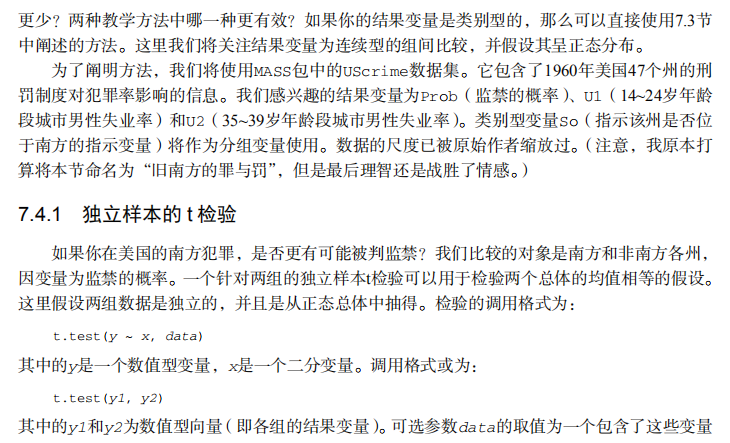
library(MASS)

t.test(Prob ~ So, data=UScrime)

# dependent t test

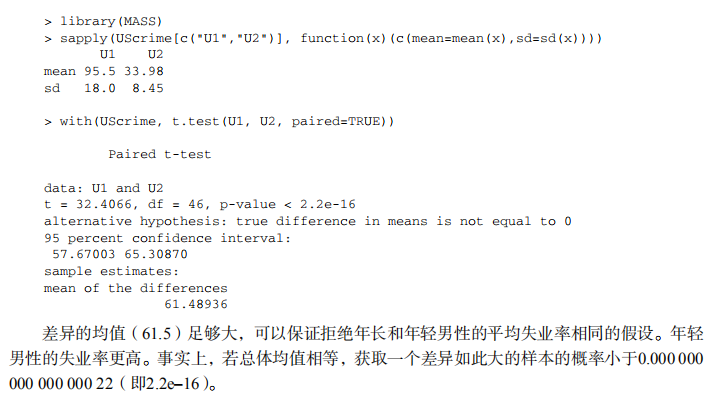
sapply(UScrime[c("U1","U2")], function(x)(c(mean=mean(x),sd=sd(x))))

with(UScrime, t.test(U1, U2, paired=TRUE))

# Wilcoxon two group comparison

with(UScrime, by(Prob, So, median))

wilcox.test(Prob ~ So, data=UScrime)

sapply(UScrime[c("U1", "U2")], median)

with(UScrime, wilcox.test(U1, U2, paired=TRUE))

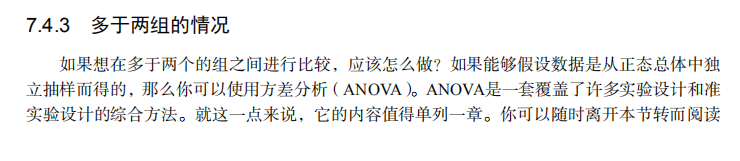
# Kruskal Wallis test

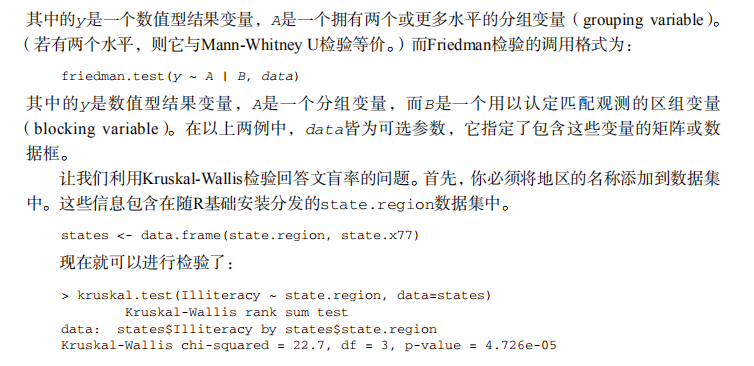
states <- data.frame(state.region, state.x77)

kruskal.test(Illiteracy ~ state.region, data=states)

# Listing 7.17 - Nonparametric multiple comparisons

source("http://www.statmethods.net/RiA/wmc.txt")

states <- data.frame(state.region, state.x77)

wmc(Illiteracy ~ state.region, data=states, method="holm")
吴裕雄--天生自然 R语言开发学习:基本统计分析(续三)的更多相关文章
- 吴裕雄--天生自然 R语言开发学习:R语言的安装与配置
下载R语言和开发工具RStudio安装包 先安装R
- 吴裕雄--天生自然 R语言开发学习:数据集和数据结构
数据集的概念 数据集通常是由数据构成的一个矩形数组,行表示观测,列表示变量.表2-1提供了一个假想的病例数据集. 不同的行业对于数据集的行和列叫法不同.统计学家称它们为观测(observation)和 ...
- 吴裕雄--天生自然 R语言开发学习:导入数据
2.3.6 导入 SPSS 数据 IBM SPSS数据集可以通过foreign包中的函数read.spss()导入到R中,也可以使用Hmisc 包中的spss.get()函数.函数spss.get() ...
- 吴裕雄--天生自然 R语言开发学习:使用键盘、带分隔符的文本文件输入数据
R可从键盘.文本文件.Microsoft Excel和Access.流行的统计软件.特殊格 式的文件.多种关系型数据库管理系统.专业数据库.网站和在线服务中导入数据. 使用键盘了.有两种常见的方式:用 ...
- 吴裕雄--天生自然 R语言开发学习:R语言的简单介绍和使用
假设我们正在研究生理发育问 题,并收集了10名婴儿在出生后一年内的月龄和体重数据(见表1-).我们感兴趣的是体重的分 布及体重和月龄的关系. 可以使用函数c()以向量的形式输入月龄和体重数据,此函 数 ...
- 吴裕雄--天生自然 R语言开发学习:基础知识
1.基础数据结构 1.1 向量 # 创建向量a a <- c(1,2,3) print(a) 1.2 矩阵 #创建矩阵 mymat <- matrix(c(1:10), nrow=2, n ...
- 吴裕雄--天生自然 R语言开发学习:图形初阶(续二)
# ----------------------------------------------------# # R in Action (2nd ed): Chapter 3 # # Gettin ...
- 吴裕雄--天生自然 R语言开发学习:图形初阶(续一)
# ----------------------------------------------------# # R in Action (2nd ed): Chapter 3 # # Gettin ...
- 吴裕雄--天生自然 R语言开发学习:图形初阶
# ----------------------------------------------------# # R in Action (2nd ed): Chapter 3 # # Gettin ...
- 吴裕雄--天生自然 R语言开发学习:基本图形(续二)
#---------------------------------------------------------------# # R in Action (2nd ed): Chapter 6 ...
随机推荐
- Mybatis学习——初始MyBatis
什么是MyBatis框架? MyBatis框架是一种ORM(既对象关系映射)框架. 什么是ORM框架? 是一种为了解决面向对象与关系数据库之间数据不匹配的技术,它通过描述Java对象和关系数据库表之间 ...
- 2.redis-help使用,基本命令
redis 帮助 > help redis-cli Type: "help @<group>" to get a list of commands in < ...
- python使用rsa非对称加密
1.安装rsa 支持python 2.7 或者 python 3.5 以上版本 使用豆瓣pypi源来安装rsa pip install -i https://pypi.douban.com/simpl ...
- Maven--归类依赖
<project xmlns="http://maven.apache.org/POM/4.0.0" xmlns:xsi="http://www.w3.org/20 ...
- python机器学习(1:K_means聚类算法)
一.算法介绍 K-means算法是最简单的也是最著名的划分聚类算法,由于简洁和效率使得他成为所有聚类算法中最广泛使用的.算法的目的是使各个样本与所在均值的误差平方和达到最小(这也是评价K-means算 ...
- Python list 字符串 注册 登录
#list #列表 python中 数组.array等都用列表 list表示#创建一个liststu = ['xiaoming','xiaoli','xiaohuang','alex','lily', ...
- 翻译——1_Project Overview, Data Wrangling and Exploratory Analysis-checkpoint
为提高提高大学能源效率进行建筑能源需求预测 本文翻译哈佛大学的能源分析和预测报告,这是原文 暂无数据源,个人认为学习分析方法就足够 内容: 项目概述 了解数据 探索性分析 使用不同的机器学习方法进行预 ...
- cmake target_link_libraries() 中<PUBLIC|PRIVATE|INTERFACE> 的区别
如果目标的头文件中包含了依赖的头文件(源文件间接包含),那么这里就是PUBLIC 如果目标仅源文件中包含了依赖的头文件,那么这里就是PRIVATE 如果目标的头文件包含依赖,但源文件未包含,那么这里就 ...
- No module named 'dateutil'
pip3 install python-dateutil
- mysql计算时间差-本例为计算分钟差然后/60计算小时保留一位小数,由于直接得小时只会取整
-- ORDER_TIME datetime NOT NULL(字段类型)SELECTso.`ID`,so.`ORDER_TIME`,NOW(),CONCAT(ROUND(TIMESTAMPDIFF( ...