
8 Regular Expressions You Should Know
Regular expressions are a language of their own. When you learn a new programming language, they're this little sub-language that makes no sense at first glance. Many times you have to read another tutorial, article, or book just to understand the "simple" pattern described. Today, we'll review eight regular expressions that you should know for your next coding project.
Background Info on Regular Expressions
This is what Wikipedia has to say about them:
In computing, regular expressions provide a concise and flexible means for identifying strings of text of interest, such as particular characters, words, or patterns of characters. Regular expressions (abbreviated as regex or regexp, with plural forms regexes, regexps, or regexen) are written in a formal language that can be interpreted by a regular expression processor, a program that either serves as a parser generator or examines text and identifies parts that match the provided specification.
Now, that doesn't really tell me much about the actual patterns. The regexes I'll be going over today contains characters such as \w, \s, \1, and many others that represent something totally different from what they look like.
If you'd like to learn a little about regular expressions before you continue reading this article, I'd suggest watching the Regular Expressions for Dummies screencast series.
The eight regular expressions we'll be going over today will allow you to match a(n): username, password, email, hex value (like #fff or #000), slug, URL, IP address, and an HTML tag. As the list goes down, the regular expressions get more and more confusing. The pictures for each regex in the beginning are easy to follow, but the last four are more easily understood by reading the explanation.
The key thing to remember about regular expressions is that they are almost read forwards and backwards at the same time. This sentence will make more sense when we talk about matching HTML tags.
Note: The delimiters used in the regular expressions are forward slashes, "/". Each pattern begins and ends with a delimiter. If a forward slash appears in a regex, we must escape it with a backslash: "\/".
1. Matching a Username

Pattern:
|
1
|
/^[a-z0-9_-]{3,16}$/ |
Description:
We begin by telling the parser to find the beginning of the string (^), followed by any lowercase letter (a-z), number (0-9), an underscore, or a hyphen. Next, {3,16} makes sure that are at least 3 of those characters, but no more than 16. Finally, we want the end of the string ($).
String that matches:
my-us3r_n4m3
String that doesn't match:
th1s1s-wayt00_l0ngt0beausername (too long)
2. Matching a Password

Pattern:
|
1
|
/^[a-z0-9_-]{6,18}$/ |
Description:
Matching a password is very similar to matching a username. The only difference is that instead of 3 to 16 letters, numbers, underscores, or hyphens, we want 6 to 18 of them ({6,18}).
String that matches:
myp4ssw0rd
String that doesn't match:
mypa$$w0rd (contains a dollar sign)
3. Matching a Hex Value

Pattern:
|
1
|
/^#?([a-f0-9]{6}|[a-f0-9]{3})$/ |
Description:
We begin by telling the parser to find the beginning of the string (^). Next, a number sign is optional because it is followed a question mark. The question mark tells the parser that the preceding character — in this case a number sign — is optional, but to be "greedy" and capture it if it's there. Next, inside the first group (first group of parentheses), we can have two different situations. The first is any lowercase letter between a and f or a number six times. The vertical bar tells us that we can also have three lowercase letters between a and f or numbers instead. Finally, we want the end of the string ($).
The reason that I put the six character before is that parser will capture a hex value like #ffffff. If I had reversed it so that the three characters came first, the parser would only pick up #fff and not the other three f's.
String that matches:
#a3c113
String that doesn't match:
#4d82h4 (contains the letter h)
4. Matching a Slug

Pattern:
|
1
|
/^[a-z0-9-]+$/ |
Description:
You will be using this regex if you ever have to work with mod_rewrite and pretty URL's. We begin by telling the parser to find the beginning of the string (^), followed by one or more (the plus sign) letters, numbers, or hyphens. Finally, we want the end of the string ($).
String that matches:
my-title-here
String that doesn't match:
my_title_here (contains underscores)
5. Matching an Email
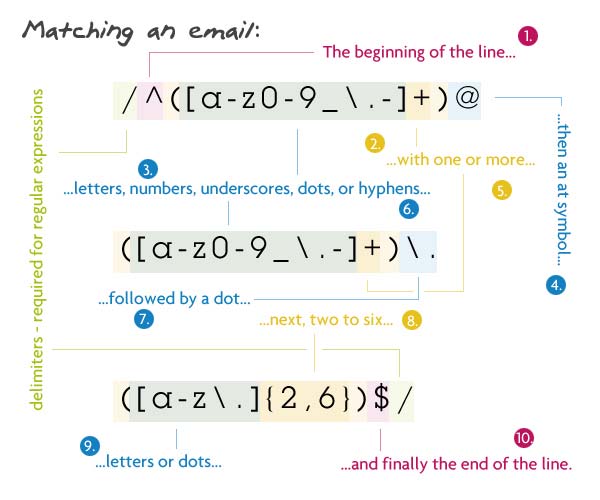
Pattern:
|
1
|
/^([a-z0-9_\.-]+)@([\da-z\.-]+)\.([a-z\.]{2,6})$/ |
Description:
We begin by telling the parser to find the beginning of the string (^). Inside the first group, we match one or more lowercase letters, numbers, underscores, dots, or hyphens. I have escaped the dot because a non-escaped dot means any character. Directly after that, there must be an at sign. Next is the domain name which must be: one or more lowercase letters, numbers, underscores, dots, or hyphens. Then another (escaped) dot, with the extension being two to six letters or dots. I have 2 to 6 because of the country specific TLD's (.ny.us or .co.uk). Finally, we want the end of the string ($).
String that matches:
john@doe.com
String that doesn't match:
john@doe.something (TLD is too long)
6. Matching a URL

Pattern:
|
1
|
/^(https?:\/\/)?([\da-z\.-]+)\.([a-z\.]{2,6})([\/\w \.-]*)*\/?$/ |
Description:
This regex is almost like taking the ending part of the above regex, slapping it between "http://" and some file structure at the end. It sounds a lot simpler than it really is. To start off, we search for the beginning of the line with the caret.
The first capturing group is all option. It allows the URL to begin with "http://", "https://", or neither of them. I have a question mark after the s to allow URL's that have http or https. In order to make this entire group optional, I just added a question mark to the end of it.
Next is the domain name: one or more numbers, letters, dots, or hypens followed by another dot then two to six letters or dots. The following section is the optional files and directories. Inside the group, we want to match any number of forward slashes, letters, numbers, underscores, spaces, dots, or hyphens. Then we say that this group can be matched as many times as we want. Pretty much this allows multiple directories to be matched along with a file at the end. I have used the star instead of the question mark because the star says zero or more, not zero or one. If a question mark was to be used there, only one file/directory would be able to be matched.
Then a trailing slash is matched, but it can be optional. Finally we end with the end of the line.
String that matches:
http://net.tutsplus.com/about
String that doesn't match:
http://google.com/some/file!.html (contains an exclamation point)
7. Matching an IP Address

Pattern:
|
1
|
/^(?:(?:25[0-5]|2[0-4][0-9]|[01]?[0-9][0-9]?)\.){3}(?:25[0-5]|2[0-4][0-9]|[01]?[0-9][0-9]?)$/ |
Description:
Now, I'm not going to lie, I didn't write this regex; I got it from here. Now, that doesn't mean that I can't rip it apart character for character.
The first capture group really isn't a captured group because
|
1
|
|
was placed inside which tells the parser to not capture this group (more on this in the last regex). We also want this non-captured group to be repeated three times — the {3} at the end of the group. This group contains another group, a subgroup, and a literal dot. The parser looks for a match in the subgroup then a dot to move on.
The subgroup is also another non-capture group. It's just a bunch of character sets (things inside brackets): the string "25" followed by a number between 0 and 5; or the string "2" and a number between 0 and 4 and any number; or an optional zero or one followed by two numbers, with the second being optional.
After we match three of those, it's onto the next non-capturing group. This one wants: the string "25" followed by a number between 0 and 5; or the string "2" with a number between 0 and 4 and another number at the end; or an optional zero or one followed by two numbers, with the second being optional.
We end this confusing regex with the end of the string.
String that matches:
73.60.124.136 (no, that is not my IP address :P)
String that doesn't match:
256.60.124.136 (the first group must be "25" and a number between zero and five)
8. Matching an HTML Tag

Pattern:
|
1
|
/^<([a-z]+)([^<]+)*(?:>(.*)<\/\1>|\s+\/>)$/ |
Description:
One of the more useful regexes on the list. It matches any HTML tag with the content inside. As usually, we begin with the start of the line.
First comes the tag's name. It must be one or more letters long. This is the first capture group, it comes in handy when we have to grab the closing tag. The next thing are the tag's attributes. This is any character but a greater than sign (>). Since this is optional, but I want to match more than one character, the star is used. The plus sign makes up the attribute and value, and the star says as many attributes as you want.
Next comes the third non-capture group. Inside, it will contain either a greater than sign, some content, and a closing tag; or some spaces, a forward slash, and a greater than sign. The first option looks for a greater than sign followed by any number of characters, and the closing tag. \1 is used which represents the content that was captured in the first capturing group. In this case it was the tag's name. Now, if that couldn't be matched we want to look for a self closing tag (like an img, br, or hr tag). This needs to have one or more spaces followed by "/>".
The regex is ended with the end of the line.
String that matches:
<a href="http://net.tutsplus.com/">Nettuts+</a>
String that doesn't match:
<img src="img.jpg" alt="My image>" /> (attributes can't contain greater than signs)
Conclusion
I hope that you have grasped the ideas behind regular expressions a little bit better. Hopefully you'll be using these regexes in future projects! Many times you won't need to decipher a regex character by character, but sometimes if you do this it helps you learn. Just remember, don't be afraid of regular expressions, they might not seem it, but they make your life a lot easier. Just try and pull out a tag's name from a string without regular expressions! ;)
- Follow us on Twitter, or subscribe to the NETTUTS RSS Feed for more daily web development tuts and articles.

Tuts+ tutorials are translated into other languages by our community members—you can be involved too!
 N/A
N/A


 Front-End Engineerat Truth Labs in Chicago, IL, USA
8 Regular Expressions You Should Know的更多相关文章
- PCRE Perl Compatible Regular Expressions Learning
catalog . PCRE Introduction . pcre2api . pcre2jit . PCRE Programing 1. PCRE Introduction The PCRE li ...
- 转载:邮箱正则表达式Comparing E-mail Address Validating Regular Expressions
Comparing E-mail Address Validating Regular Expressions Updated: 2/3/2012 Summary This page compares ...
- Regular Expressions --正则表达式官方教程
http://docs.oracle.com/javase/tutorial/essential/regex/index.html This lesson explains how to use th ...
- Regular Expressions in Grep Command with 10 Examples --reference
Regular expressions are used to search and manipulate the text, based on the patterns. Most of the L ...
- [Regular Expressions] Find Plain Text Patterns
The simplest use of Regular Expressions is to find a plain text pattern. In this lesson we'll look a ...
- [Regular Expressions] Introduction
var str = "Is this This?"; //var regex = new RegExp("is", "gi"); var r ...
- Introducing Regular Expressions 学习笔记
Introducing Regular Expressions 读书笔记 工具: regexbuddy:http://download.csdn.net/tag/regexbuddy%E7%A0%B4 ...
- [转]8 Regular Expressions You Should Know
Regular expressions are a language of their own. When you learn a new programming language, they're ...
- 正则表达式(Regular expressions)使用笔记
Regular expressions are a powerful language for matching text patterns. This page gives a basic intr ...
随机推荐
- 前端们,gulp该用起来了,简单的demo入门——gulp系列(一)
gulp.grunt前端自动化工具,只有用过才知道多么重要. 它们问世这么久了?你真的用过吗? 写个简单的less.watch任务的demo分享———— 1.准备: 安装全局node.npm,这个教程 ...
- 15套帮助你展示 App 设计的透视屏幕原型素材
Dribbble 和 Behance 是最好两个展示你的设计作品的地方.现在流行使用透视屏幕来展示应用程序设计效果,尤其是在 Dribbble 上面,有众多高品质的免费资源和设计素材. 这篇文章汇集了 ...
- dock基本使用
通过Docker源安装最新版本通过Docker源安装最新版本 要安装最新的 Docker 版本,首先需要安装 apt-transport-https 支持,之后通过添加源来安装.要安装最新的 Dock ...
- [Architect] Abp 框架原理解析(5) UnitOfWork
本节目录 介绍 分析Abp源码 实现UOW 介绍 UOW(全称UnitOfWork)是指工作单元. 在Abp中,工作单元对于仓储和应用服务方法默认开启.并在一次请求中,共享同一个工作单元. 同时在Ab ...
- [Bootstrap]7天深入Bootstrap(2)整体架构
大多数Bootstrap的使用者都认为Bootstrap只提供了CSS组件 和JavaScript插件,其实CSS组件和JavaScript插件只是Bootstrap框架的表现形式而已,它们都是构建在 ...
- 概率论 --- Uva 11181 Probability|Given
Uva 11181 Probability|Given Problem's Link: http://acm.hust.edu.cn/vjudge/problem/viewProblem.acti ...
- php Calender(日历)代码
代码如下: <?php /** * * 我的日历 * date_default_timezone_set date mktime * @param int $year * @param int ...
- 与众不同 windows phone 8.0 & 8.1 系列文章索引
[源码下载] [与众不同 windows phone 7.5 (sdk 7.1) 系列文章索引] 与众不同 windows phone 8.0 & 8.1 系列文章索引 作者:webabcd ...
- csharp: MVC Controls
http://mvccontrolstoolkit.codeplex.com/ MVC Controls Toolkit http://mvcjquerycontrols.codeplex.com/ ...
- asp.net 前台绑定后台变量方法总结:<%= %> 和<%# %>的区别
经常会碰到在前台代码中要使用(或绑定)后台代码中变量值的问题.一般有<%= str%>和<%# str %>两种方式,这里简单总结一下.如有错误或异议之处,敬请各位指教. 一 ...