
深度学习中batch normalization
目录
Batch Normalization笔记
我们将会用MNIST数据集来演示这个batch normalization的使用, 以及他所带来的效果:
引包
import tensorflow as tf

import os

from tensorflow.examples.tutorials.mnist import input_data

from tensorflow.contrib.layers import flatten

import numpy as np

import tensorflow.contrib.slim as slim
构建模型:
def model1(input, is_training, keep_prob):

    input = tf.reshape(input, shape=[-1, 28, 28, 1])

    batch_norm_params = {

        'decay': 0.95,

        'updates_collections': None

    }

    with slim.arg_scope([slim.batch_norm, slim.dropout], is_training=is_training):

        with slim.arg_scope([slim.conv2d, slim.fully_connected],

                            weights_initializer=tf.truncated_normal_initializer(stddev=0.1),

                                normalizer_fn=slim.batch_norm, normalizer_params=batch_norm_params,

                            activation_fn=tf.nn.crelu):

            conv1 = slim.conv2d(input, 16, 5, scope='conv1')

            pool1 = slim.max_pool2d(conv1, 2, scope='pool1')

            conv2 = slim.conv2d(pool1, 32, 5, scope='conv2')

            pool2 = slim.max_pool2d(conv2, 2, scope='pool2')

            flatten = slim.flatten(pool2)

            fc = slim.fully_connected(flatten, 1024, scope='fc1')

            print(fc.get_shape())

            drop = slim.dropout(fc, keep_prob=keep_prob)

            logits = slim.fully_connected(drop, 10, activation_fn=None, scope='logits')

            return logits
def model2(input, is_training, keep_prob):

    input = tf.reshape(input, shape=[-1, 28, 28, 1])

    with slim.arg_scope([slim.conv2d, slim.fully_connected],

                        weights_initializer=tf.truncated_normal_initializer(stddev=0.1),

                            normalizer_fn=None, activation_fn=tf.nn.crelu):

        with slim.arg_scope([slim.dropout], is_training=is_training):

            conv1 = slim.conv2d(input, 16, 5, scope='conv1')

            pool1 = slim.max_pool2d(conv1, 2, scope='pool1')

            conv2 = slim.conv2d(pool1, 32, 5, scope='conv2')

            pool2 = slim.max_pool2d(conv2, 2, scope='pool2')

            flatten = slim.flatten(pool2)

            fc = slim.fully_connected(flatten, 1024, scope='fc1')

            print(fc.get_shape())

            drop = slim.dropout(fc, keep_prob=keep_prob)

            logits = slim.fully_connected(drop, 10, activation_fn=None, scope='logits')

            return logits
构建训练函数
def train(model, model_path, train_log_path, test_log_path):

    # 计算图

    graph = tf.Graph()

    with graph.as_default():

        X = tf.placeholder(dtype=tf.float32, shape=[None, 28 * 28])

        Y = tf.placeholder(dtype=tf.float32, shape=[None, 10])

        is_training = tf.placeholder(dtype=tf.bool)

        logit = model(X, is_training, 0.7)

        loss =tf.reduce_mean(tf.nn.softmax_cross_entropy_with_logits(logits=logit, labels=Y))

        accuray = tf.reduce_mean(tf.cast(tf.equal(tf.argmax(logit, 1), tf.argmax(Y, 1)), tf.float32))

        global_step = tf.Variable(0, trainable=False)

        learning_rate = tf.train.exponential_decay(0.1, global_step, 1000, 0.95, staircase=True)

        optimizer = tf.train.AdagradOptimizer(learning_rate=learning_rate)

        update = slim.learning.create_train_op(loss, optimizer, global_step)

        mnist = input_data.read_data_sets("tmp", one_hot=True)

        saver = tf.train.Saver()

        tf.summary.scalar("loss", loss)

        tf.summary.scalar("accuracy", accuray)

        merged_summary_op = tf.summary.merge_all()

        train_summary_writter = tf.summary.FileWriter(train_log_path, graph=tf.get_default_graph())

        test_summary_writter = tf.summary.FileWriter(test_log_path, graph=tf.get_default_graph())

        init = tf.global_variables_initializer()

        iter_num = 10000

        batch_size = 1024

        os.environ["CUDA_VISIBLE_DEVICES"] = '2'  # 选择cuda的设备

        gpu_options = tf.GPUOptions(per_process_gpu_memory_fraction=0.2)  # gpu显存使用

        with tf.Session(config=tf.ConfigProto(gpu_options=gpu_options)) as sess:

            sess.run(init)

            if not os.path.exists(os.path.dirname(model_path)):

                os.makedirs(os.path.dirname(model_path))

            else:

                try:

                    saver.restore(sess, model_path)

                except:

                    pass

            for i in range(iter_num):

                x, y = mnist.train.next_batch(batch_size)

                sess.run(update, feed_dict={X:x, Y:y, is_training:True})

                if i  % 100 == 0:

                    x_test, y_test = mnist.test.next_batch(batch_size)

                    print("train:", sess.run(accuray, feed_dict={X: x, Y: y, is_training:False}))

                    print("test:", sess.run(accuray, feed_dict={X: x_test, Y: y_test, is_training:False}))

                    saver.save(sess, model_path)

                    g, summary = sess.run([global_step, merged_summary_op], feed_dict={X: x, Y: y, is_training:False})

                    train_summary_writter.add_summary(summary, g)

                    train_summary_writter.flush()

                    g, summary = sess.run([global_step, merged_summary_op], feed_dict={X: x_test, Y: y_test, is_training:False})

                    test_summary_writter.add_summary(summary, g)

                    test_summary_writter.flush()

        train_summary_writter.close()

        test_summary_writter.close()
下面我们来进行计算:
train(model1, "model1/model", "model1_train_log", "model1_test_log")
train(model2, "model2/model", "model2_train_log", "model2_test_log")
结论
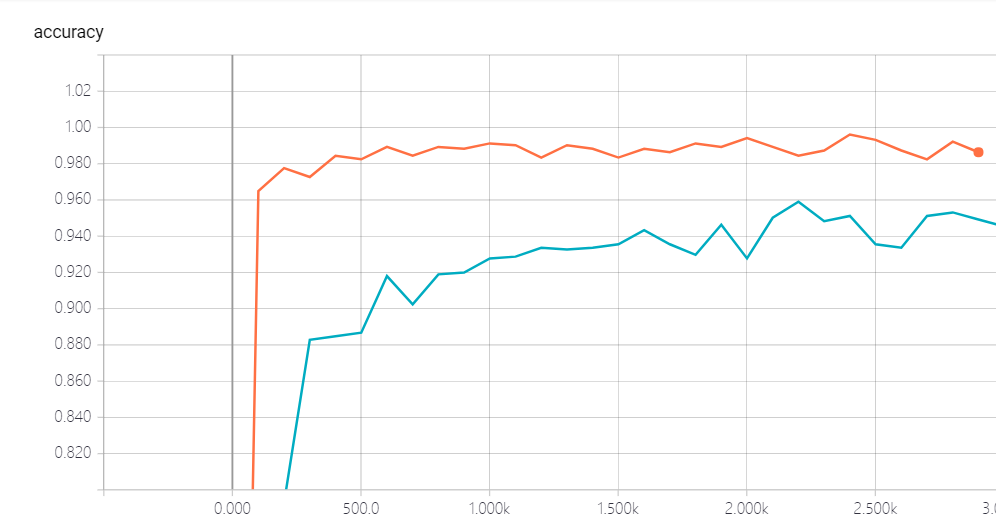
我们发现, 加了batch norm的似乎收敛的更快一些, 这个我们可以从对比上可以很清楚的看到, 所以这个bn是我们一个很好的技术, 前提是你选的参数比较适合.
以下是两个注意点:
The keys to use batch normalization in slim are:
Set proper decay rate for BN layer. Because a BN layer uses EMA (exponential moving average) to approximate the population mean/variance, it takes sometime to warm up, i.e. to get the EMA close to real population mean/variance. The default decay rate is 0.999, which is kind of high for our little cute MNIST dataset and needs ~1000 steps to get a good estimation. In my code, decay is set to 0.95, then it learns the population statistics very quickly. However, a large value of decay does have it own advantage: it gathers information from more mini-batches thus is more stable.
Use slim.learning.create_train_op to create train op instead of tf.train.GradientDescentOptimizer(0.1).minimize(loss) or something else!.
深度学习中batch normalization的更多相关文章
- 深度学习中 Batch Normalization
深度学习中 Batch Normalization为什么效果好?(知乎) https://www.zhihu.com/question/38102762
- 深度学习中 Batch Normalization为什么效果好
看mnist数据集上其他人的CNN模型时了解到了Batch Normalization 这种操作.效果还不错,至少对于训练速度提升了很多. batch normalization的做法是把数据转换为0 ...
- zz详解深度学习中的Normalization,BN/LN/WN
详解深度学习中的Normalization,BN/LN/WN 讲得是相当之透彻清晰了 深度神经网络模型训练之难众所周知,其中一个重要的现象就是 Internal Covariate Shift. Ba ...
- 深度学习中的Normalization模型
Batch Normalization(简称 BN)自从提出之后,因为效果特别好,很快被作为深度学习的标准工具应用在了各种场合.BN 大法虽然好,但是也存在一些局限和问题,诸如当 BatchSize ...
- [优化]深度学习中的 Normalization 模型
来源:https://www.chainnews.com/articles/504060702149.htm 机器之心专栏 作者:张俊林 Batch Normalization (简称 BN)自从提出 ...
- 深度学习之Batch Normalization
在机器学习领域中,有一个重要的假设:独立同分布假设,也就是假设训练数据和测试数据是满足相同分布的,否则在训练集上学习到的模型在测试集上的表现会比较差.而在深层神经网络的训练中,当中间神经层的前一层参数 ...
- 深度学习中优化【Normalization】
深度学习中优化操作: dropout l1, l2正则化 momentum normalization 1.为什么Normalization? 深度神经网络模型的训练为什么会很困难?其中一个重 ...
- 深度学习中的batch、epoch、iteration的含义
深度学习的优化算法,说白了就是梯度下降.每次的参数更新有两种方式. 第一种,遍历全部数据集算一次损失函数,然后算函数对各个参数的梯度,更新梯度.这种方法每更新一次参数都要把数据集里的所有样本都看一遍, ...
- 深度学习中 --- 解决过拟合问题(dropout, batchnormalization)
过拟合,在Tom M.Mitchell的<Machine Learning>中是如何定义的:给定一个假设空间H,一个假设h属于H,如果存在其他的假设h’属于H,使得在训练样例上h的错误率比 ...
随机推荐
- linux_ssh
什么是ssh? 配置文件位置:/etc/ssh/sshd_config 远程登录和为其他网络提供安全的加密数据传输协议,默认端口22,默认协议是SSH2 # 远程终端通过ssh连接服务器管理服务器 # ...
- linkinFrame--测试项目添加git管理
OK,前面一篇博客,已经搭建好了项目的基础的结构.现在我们添加一个简单的servlet来测试下项目能不能跑,然后在讲项目添加到coding上用git管理. 1,我们编写一个servlet,编写一个js ...
- vi使用手册
VI是unix上最常用的文本编辑工具,我自己电脑上面也装了VIM编辑器,这个据称是程序员码字神器我实在没觉得那里舒服了,所以又用回了自己的Sublime.这里整理下vi常用操作,如果以后直接在Linu ...
- [Python]Conda 介绍及常用命令
一.介绍 Anaconda 是一个用于科学计算的 Python 发行版,支持 Linux, Mac, Windows, 包含了众多流行的科学计算.数据分析的 Python 包.其使用conda系统进行 ...
- Mac 提示安装包已损坏
mac 系统更新到 Sierra 10.12.X 版本后,从非 itunes 渠道下载的软件安装时都会报 “安装包已损坏” 的错误,这是新的系统设置的安全机制,为了解决这个问题,可以在命令行中输入命令 ...
- 网卡bond技术
概览: 目前网卡绑定mode共有七种(0~6)bond0.bond1.bond2.bond3.bond4.bond5.bond6 常用的有三种: mode=0:平衡负载模式,有自动备援,但需要&quo ...
- 关于fprint()和fwrite()
int num = 12345; 将12345作为二进制数存储到num中 1. fprintf(fp,"%d",num); //把字符'1','2','3','4','5'的二进制 ...
- 浅析调用JSR303的validate方法, 验证失败时抛出ConstraintViolationException
废话不多说,直接进入正题:如何使用JSR303的validate,进行数据校验,失败后直接抛出异常加入流转信息中,并在form页面提示出来. 首先我们为了启用验证,需要向 项目中添加Bean验证的实现 ...
- [DeeplearningAI笔记]改善深层神经网络_深度学习的实用层面1.10_1.12/梯度消失/梯度爆炸/权重初始化
觉得有用的话,欢迎一起讨论相互学习~Follow Me 1.10 梯度消失和梯度爆炸 当训练神经网络,尤其是深度神经网络时,经常会出现的问题是梯度消失或者梯度爆炸,也就是说当你训练深度网络时,导数或坡 ...
- 删除一个目录及其子目录下的所有.svn文件
今天建立svn,加入代码,发现这些个文件夹中竟然已经有.svn文件夹,也就是它以前使用过svn, 这下就有点麻烦,在全新的svn里,这些.svn需要删除,又不可能一个一个手工去删除 网上翻了一下,发现 ...