
PP: Robust Anomaly Detection for Multivariate Time Series through Stochastic Recurrent Neural Network
PROBLEM: OmniAnomaly
multivariate time series anomaly detection + unsupervised
主体思想: input: multivariate time series to RNN ------> capture the normal patterns -----> reconstruct input data by the representations ------> use the reconstruction probabilities to determine anomalies.
INTRODUCTION:
1. The first challenge is how to learn robust latent representations, considering both the temporal dependence and stochasticity of multivariate time series.
-------stochastic RNN + explicit temporal dependence among stochastic variables.
Stochastic variables are latent representations of input data and their quality is the key to model performance.
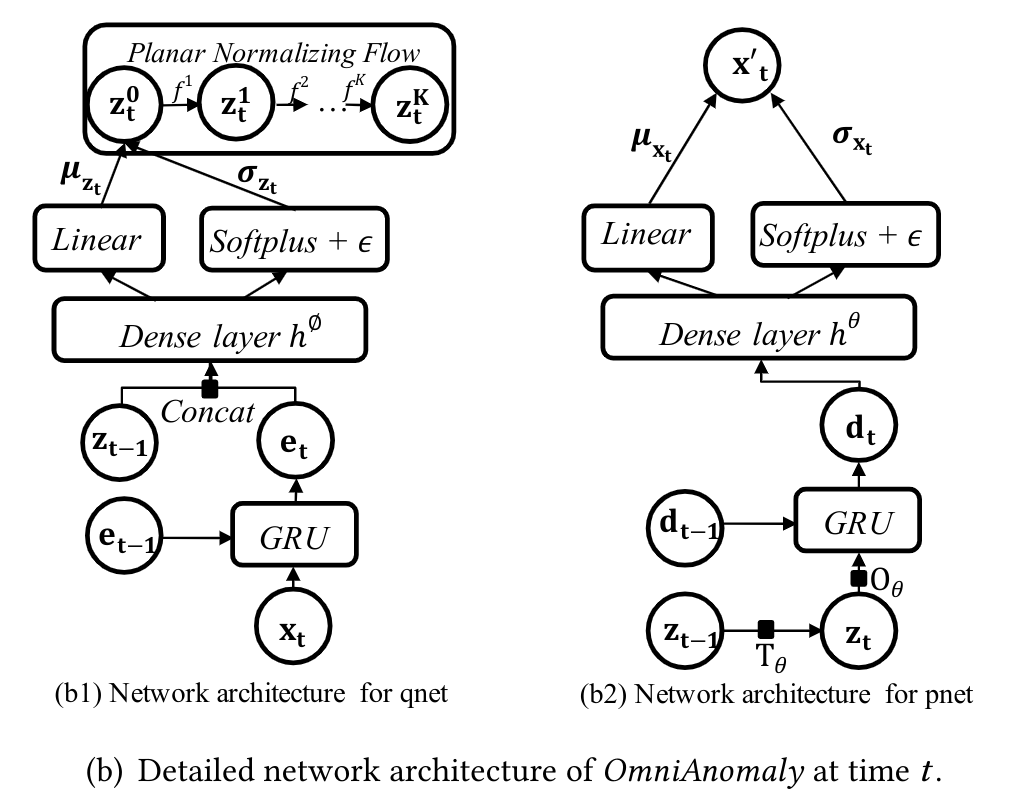
Their approach glues GRU and VAE with two key techniques:
- stochastic variable connection technique: explicitly model temporal dependence among stochastic variables in the latent space.
- Planar Normalizing Flows, which uses a series of invertible mappings可逆映射 to learn non-Gaussian posterior distributions in latent stochastic space.
2. The second challenge is how to provide interpretation to the detected entity-level anomalies, given the stochastic deep learning approaches.
Challenge: 1. capture long-term dependence. 2. capture probability distributions of multivariate time series. 3. how to interpret your results (unsupervised learning)
EVIDENCE: literature 5 shown that explicitly modeling the temporal dependence are better.
RELATED WORK:
PRELIMINARIES:
Problem statement: 以时序数据的个数作为维度,M个TS, x 属于R[M*N], x_t为一个M维的列向量,
gru, vae, and stochastic gradient variational bayes
DESIGN
OmniAnomaly structure: returns an anomaly score for x_t.
- online detection
- offline detection
- data preprocessing: data standardization, sequence segmentation through sliding windows T+1;
- input: multivariate time series inside a window, ----------Model training ------------output: an anomaly score for each observation ------- automatic threshold selection;
Detection: detect anomalies based on the reconstruction probability of x_t.
Loss function: ELBO;
Variational inference algorithms: SGVB;
Output: a univariate time series of anomaly scores
Automatic thresholds selection: extreme value theory + peaks-over-threshold;
1. use GRU to capture complex temporal dependence in x-space.
2. apply VAE to map observations to stochastic variables.
3. explicitly model temporal dependence among latent space, they propose the stochastic variable connection technique.
4. adopt planar NF.
Evaluation:
We use Precision, Recall, F1-Score (denoted as F1) to evaluate the performance of OmniAnomaly.
Baseline:
- LSTM with nonparametric dynamic thresholding
- EncDec-AD
- DAGMM
- LSTM-VAE
- Donut; 采取别的方式使donut适用于multivariate TS.
Supplementary knowledge:
1. VAE:
inference net qnet + generative net pnet.
2. GRU: gate recurrent unit
Reference
PP: Robust Anomaly Detection for Multivariate Time Series through Stochastic Recurrent Neural Network的更多相关文章
- PP: Unsupervised anomaly detection via variational auto-encoder for seasonal KPIs in web applications
Problem: unsupervised anomaly detection for seasonal KPIs in web applications. Donut: an unsupervise ...
- PP: A dual-stage attention-based recurrent neural network for time series prediction
Problem: time series prediction The nonlinear autoregressive exogenous model: The Nonlinear autoregr ...
- "Regressing Robust and Discriminative 3D Morphable Models with a very Deep Neural Network" 解读
简介:这是一篇17年的CVPR,作者提出使用现有的人脸识别深度神经网络Resnet101来得到一个具有鲁棒性的人脸模型. 原文链接:https://www.researchgate.net/publi ...
- Anomaly Detection for Time Series Data with Deep Learning——本质分类正常和异常的行为,对于检测异常行为,采用预测正常行为方式来做
A sample network anomaly detection project Suppose we wanted to detect network anomalies with the un ...
- Machine Learning No.10: Anomaly detection
1. Algorithm 2. evaluating an anomaly detection system 3. anomaly detection vs supervised learning 4 ...
- PP: Time series anomaly detection with variational autoencoders
Problem: unsupervised anomaly detection Model: VAE-reEncoder VAE with two encoders and one decoder. ...
- Time Series Anomaly Detection
这里有个2015年的综述文章,概括的比较好,各种技术的适用场景. https://iwringer.wordpress.com/2015/11/17/anomaly-detection-concep ...
- PP: Deep r -th Root of Rank Supervised Joint Binary Embedding for Multivariate Time Series Retrieval
from: Dacheng Tao 悉尼大学 PROBLEM: time series retrieval: given the current multivariate time series se ...
- PP: Toeplitz Inverse Covariance-Based Clustering of Multivariate Time Series Data
From: Stanford University; Jure Leskovec, citation 6w+; Problem: subsequence clustering. Challenging ...
随机推荐
- mysql数据库批量执行sql文件对数据库进行操作【windows版本】
起因: 因工作需要,在本机测试环境升级mysql数据库,需逐条执行mysql数据库的sql文件对数据库进行升级,因此找了些关于mysql的文章,对批量升级数据库所需的sql文件进行升级. 整理思路: ...
- HTML块级、行级元素,特殊字符,嵌套规则
如果介绍HTML网页基本标签的嵌套规则,首先要说的就是元素的分类.元素可以划分为块级元素和行级元素,块级元素是什么?它可以独占一行,可以设置宽高度,默认是100%:行级元素与之相反,它的内容决定它的宽 ...
- Android中通过Fragment进行简单的页面切换
首先是activity中的布局 <?xml version="1.0" encoding="utf-8"?> <androidx.constr ...
- LAN、WAN和WLAN的区别
1.LAN 局域网(Local Area Network)接口,通俗讲就是路由和用户之间网线口: 2.WAN 广域网(Wide Area Network),通俗讲就是和猫外部网连接的网线口: 3.WL ...
- 二次剩余的判定及Cipolla算法
二次剩余 ppp是奇素数.所有的运算都是在群Zp∗Z_{p}^{*}Zp∗中的运算.方程x2=a≠0x^2=a \neq 0x2=a̸=0问是否有解,以及解是什么?若有解,aaa就是模ppp的二次 ...
- css3元素如何扭曲、移位或旋转
css3 transform 兼容性:IE10+ transform:rotate(deg) 正数为顺时针,负数为逆时针 <!DOCTYPE html> <html lang=&qu ...
- UVA-1588
只用C来写 题目:https://vjudge.net/problem/UVA-1588 #include<stdio.h> #include<string.h> #defin ...
- Flex布局如何实现最后一个元素右对齐,或者第一个元素左对齐
先来看看一个例子 在一个div我们把四个按钮全部放到右边去了,看下效果↓ 这个时候我们想把第一个按钮左对齐,其他保持不变 这时候我们来个第一个按钮样式上加上 :margin-right: auto; ...
- C# DES加密、解密
/// <summary> /// DES加密字符串 /// </summary> /// <param name="pToEncrypt">待 ...
- 轻量级RPC设计与实现第五版(最终版)
在最近一段时间里,通过搜集有关资料加上自己的理解,设计了一款轻量级RPC,起了一个名字lightWeightRPC.它拥有一个RPC常见的基本功能.主要功能和特点如下: 利用Spring实现依赖注入与 ...