
poj 1330 Nearest Common Ancestors(LCA 基于二分搜索+st&rmq的LCA)
| Time Limit: 1000MS | Memory Limit: 10000K | |
| Total Submissions: 30147 | Accepted: 15413 |
Description
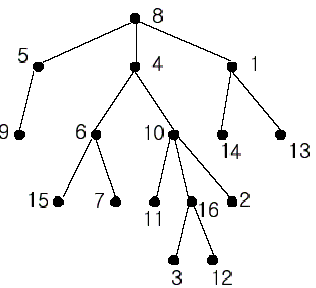
In the figure, each node is labeled with an integer from {1, 2,...,16}. Node 8 is the root of the tree. Node x is an ancestor of node y if node x is in the path between the root and node y. For example, node 4 is an ancestor of node 16. Node 10 is also an ancestor of node 16. As a matter of fact, nodes 8, 4, 10, and 16 are the ancestors of node 16. Remember that a node is an ancestor of itself. Nodes 8, 4, 6, and 7 are the ancestors of node 7. A node x is called a common ancestor of two different nodes y and z if node x is an ancestor of node y and an ancestor of node z. Thus, nodes 8 and 4 are the common ancestors of nodes 16 and 7. A node x is called the nearest common ancestor of nodes y and z if x is a common ancestor of y and z and nearest to y and z among their common ancestors. Hence, the nearest common ancestor of nodes 16 and 7 is node 4. Node 4 is nearer to nodes 16 and 7 than node 8 is.
For other examples, the nearest common ancestor of nodes 2 and 3 is node 10, the nearest common ancestor of nodes 6 and 13 is node 8, and the nearest common ancestor of nodes 4 and 12 is node 4. In the last example, if y is an ancestor of z, then the nearest common ancestor of y and z is y.
Write a program that finds the nearest common ancestor of two distinct nodes in a tree.
Input
Output
Sample Input
2

16

1 14

8 5

10 16

5 9

4 6

8 4

4 10

1 13

6 15

10 11

6 7

10 2

16 3

8 1

16 12

16 7

5

2 3

3 4

3 1

1 5

3 5
Sample Output
4

3
Source
#include<iostream>

#include<vector>

#include<cstdio>

#include<cmath>

#include<algorithm>

using namespace std;

const int N=;

const int logN=;

vector<int> G[N];

int root;

int parent[][N];

int fa[N],n,x,y,s,t;

int depth[N];

void dfs(int v,int p,int d)

{

    parent[][v]=p;

    depth[v]=d;

    for(int i=;i<G[v].size();i++)

        if (G[v][i]!=p)

        {

            fa[G[v][i]]=v;

            dfs(G[v][i],v,d+);

        }

}

void init(int V)

{

    int root;

    for(int i=;i<=n;i++)

        if (fa[i]==) {root=i; break;}

    dfs(root,-,);

    for(int k=;k+<logN;k++)

    {

        for(int v=;v<=V;v++)

        {

            if(parent[k][v]<) parent[k+][v]=-;

             else parent[k+][v]=parent[k][parent[k][v]];

        }

    }

}

int lca(int u,int v)

{

    if (depth[u]>depth[v]) swap(u,v);

    for(int k=;k<logN;k++)

    {

        if ((depth[v]-depth[u])>>k & )

            v=parent[k][v];

    }

    if (u==v) return u;

    for(int k=logN-;k>=;k--)

    {

        if (parent[k][u]!=parent[k][v])

        {

            u=parent[k][u];

            v=parent[k][v];

        }

    }

    return parent[][u];

}

int main()

{

    int T;

    scanf("%d",&T);

    while(T--)

    {

        scanf("%d",&n);

        for(int i=;i<=n;i++) {G[i].clear(); fa[i]=;}

        for(int i=;i<=n-;i++)

        {

            scanf("%d%d",&x,&y);

            G[x].push_back(y);

            fa[y]=x;

        }

        init(n);

        scanf("%d%d",&s,&t);

        int croot=lca(s,t);

        printf("%d\n",croot);

    }

    return ;

}
ST&RMQ 的LCA
#include<iostream>

#include<vector>

#include<cstdio>

#include<cmath>

#include<algorithm>

#include<cstring>

using namespace std;

const int N=;

const int M=;

int tot,cnt,n,T,s,t;

int head[N];   //记录i节点在e数组中的其实位置

int ver[*N];  //ver:保存遍历的节点序列,长度为2n-1,从下标1开始保存

int R[*N];    // R:和遍历序列对应的节点深度数组,长度为2n-1,从下标1开始保存

int first[N];  //first:每个节点在遍历序列中第一次出现的位置

bool vis[N];   //遍历时的标记数组

int dp[*N][M],fa[N];

struct edge

{

    int u,v,next;

}e[*N];

void dfs(int u ,int dep)

{

    vis[u] = true;

    ver[++tot] = u;

    first[u] = tot;

    R[tot] = dep;

    for(int k=head[u]; k!=-; k=e[k].next)

        if( !vis[e[k].v] )  //这里可以省个vis数组,如果在dfs改成dfs(当前节点,当前节点的父亲,当前节点的深度)  具体可以参照connections with cities        {

            int v=e[k].v;

            dfs(v,dep+);

            ver[++tot]=u;

            R[tot]=dep;

        }

}

void ST(int n)

{

    for(int i=;i<=n;i++)

        dp[i][] = i;

    for(int j=;(<<j)<=n;j++)

    {

        for(int i=;i+(<<j)-<=n;i++)

        {

            int a = dp[i][j-] , b = dp[i+(<<(j-))][j-];

            dp[i][j] = R[a]<R[b]?a:b;

        }

    }

}

int RMQ(int l,int r)

{

   int k=(int)(log((double)(r-l+))/log(2.0));

    int a = dp[l][k], b = dp[r-(<<k)+][k]; //保存的是编号

    return R[a]<R[b]?a:b;

}

int LCA(int u ,int v)

{

    int x = first[u] , y = first[v];

    if(x > y) swap(x,y);

    int res = RMQ(x,y);

    return ver[res];

}

void addedge(int u,int v)

{

    e[++cnt].u=u;

    e[cnt].v=v;

    e[cnt].next=head[u];

    head[u]=cnt;

}

int main()

{

    int T;

    scanf("%d",&T);

    while(T--)

    {

        scanf("%d",&n);

        memset(head,-,sizeof(head));

        memset(vis,,sizeof(vis));

        memset(fa,,sizeof(fa));

        cnt=; tot=;

        for(int i=;i<n;i++)

        {

            int x,y;

            scanf("%d%d",&x,&y);

            addedge(x,y);

            fa[y]=x;

        }

        for(int i=;i<=n;i++)

            if (fa[i]==) { dfs(i,); break;}

        ST(*n-);

        scanf("%d%d",&s,&t);

        printf("%d\n",LCA(s,t));

    }

    return ;

}
poj 1330 Nearest Common Ancestors(LCA 基于二分搜索+st&rmq的LCA)的更多相关文章
- POJ 1330 Nearest Common Ancestors / UVALive 2525 Nearest Common Ancestors (最近公共祖先LCA)
POJ 1330 Nearest Common Ancestors / UVALive 2525 Nearest Common Ancestors (最近公共祖先LCA) Description A ...
- POJ - 1330 Nearest Common Ancestors(基础LCA)
POJ - 1330 Nearest Common Ancestors Time Limit: 1000MS Memory Limit: 10000KB 64bit IO Format: %l ...
- POJ.1330 Nearest Common Ancestors (LCA 倍增)
POJ.1330 Nearest Common Ancestors (LCA 倍增) 题意分析 给出一棵树,树上有n个点(n-1)条边,n-1个父子的边的关系a-b.接下来给出xy,求出xy的lca节 ...
- POJ 1330 Nearest Common Ancestors(lca)
POJ 1330 Nearest Common Ancestors A rooted tree is a well-known data structure in computer science a ...
- POJ 1330 Nearest Common Ancestors 倍增算法的LCA
POJ 1330 Nearest Common Ancestors 题意:最近公共祖先的裸题 思路:LCA和ST我们已经很熟悉了,但是这里的f[i][j]却有相似却又不同的含义.f[i][j]表示i节 ...
- LCA POJ 1330 Nearest Common Ancestors
POJ 1330 Nearest Common Ancestors Time Limit: 1000MS Memory Limit: 10000K Total Submissions: 24209 ...
- POJ 1330 Nearest Common Ancestors 【LCA模板题】
任意门:http://poj.org/problem?id=1330 Nearest Common Ancestors Time Limit: 1000MS Memory Limit: 10000 ...
- POJ 1330 Nearest Common Ancestors (LCA,dfs+ST在线算法)
Nearest Common Ancestors Time Limit: 1000MS Memory Limit: 10000K Total Submissions: 14902 Accept ...
- POJ 1330 Nearest Common Ancestors(Targin求LCA)
传送门 Nearest Common Ancestors Time Limit: 1000MS Memory Limit: 10000K Total Submissions: 26612 Ac ...
随机推荐
- SQL 收集
1.union CREATE TABLE dbo.#testTab ( Id int NOT NULL ) insert into #testTab values(); insert into #te ...
- .Net Core EF Core之Sqlite使用及部署
1.添加引用Nuget包 Microsoft.EntityFrameworkCore.Sqlite Microsoft.EntityFrameworkCore.Design Microsoft.Ent ...
- 51nod 1102 面积最大的矩形(单调栈)
http://www.51nod.com/onlineJudge/questionCode.html#!problemId=1102 题意: 思路: 做法就是求出每个长方形向左向右所能延伸的最大距离. ...
- JS进阶系列之this
在javascript中,this的指向是在执行上下文的创建阶段确定的,其实只要知道不同执行方式下,this的指向分别是是什么,就能很好的掌握this这个让人摸不透的东西. 一.全局执行 全局执行又分 ...
- Linux基础※※※※Linux中的图形相关工具
kolourPaint类似于Win中个mspaint: Ubuntu安装:sudo apt-get install kolourpaint4 图1 kolourPaint界面 其他类似的画图工具见链接 ...
- python 判断字符串是否以数字结尾
import re def end_num(string): #以一个数字结尾字符串 text = re.compile(r".*[0-9]$") if text.match(st ...
- vs2010_相关目录
1. C:\Program Files\Microsoft SDKs\Windows\v7.0A 2.创建了 C:\Program Files\Microsoft Visual Studio 9.0 ...
- C#一套简单的单例系统
单例基类 public class CSingletonBase<TYPE> { public static TYPE Singleton { get { return m_singlet ...
- Anagram 由颠倒字母顺序而构成的字
2018-07-15 19:23:08 Valid Anagram 问题描述: 问题描述: 可以使用map来记录各个字符出现的个数,在O(n)的时间复杂度内完成,当然也可以使用排序算法在O(nlogn ...
- Python 运算符重载
https://www.cnblogs.com/hotbaby/p/4913363.html