
leveldb 学习记录(一) skiplist
leveldb
LevelDb是一个持久化存储的KV系统,并非完全将数据放置于内存中,部分数据也会存储到磁盘上。
想了解这个由谷歌大神编写的经典项目.
可以从数据结构以及数据结构的处理下手,也可以从示例的某一点深入跟进系统,查看处理流程.
windows下编译leveldb 地址 leveldb 源码编译 vs版本
目前手头资料中,源码中的文档以及网络的代码分析心得如下,本文也做了参考,感谢作者.
流程类
结构入手类
1 arena内存池略过。 nginx内存池 stl内存池均可参考实现原理(《stl源码分析》)
2 bloomfilter相当于多重哈希,比对哈希值判断是否有相同元素插入 略过。
3 数据结构skiplist 多数操作log(n)
参考 https://segmentfault.com/a/1190000003051117
跳表的关键点在于定义和查找方法
定义如下:
SkipList的定义:
1. 一个跳表应该有几个层(level)组成;
2. 跳表的第一层包含所有的元素;
3. 每一层都是一个有序的链表;
4. 如果元素x出现在第i层,则所有比i小的层都包含x;
5. 第i层的元素通过一个down指针指向下一层拥有相同值的元素;
6. 在每一层中,-1和1两个元素都出现(分别表示INT_MIN和INT_MAX);
7. Top指针指向最高层的第一个元素。
图示:
find
查找方法为
1 起点为最高层第一个元素 若元素小于查找值 则查找该元素的后继值
2 若元素大于查找值 则降低层级再次查找
3 若该元素的后继值 为NULL或者大于该值 ,则降低层数再次查找
4 直到查找成功或者达到表的最底层且无元素可查找
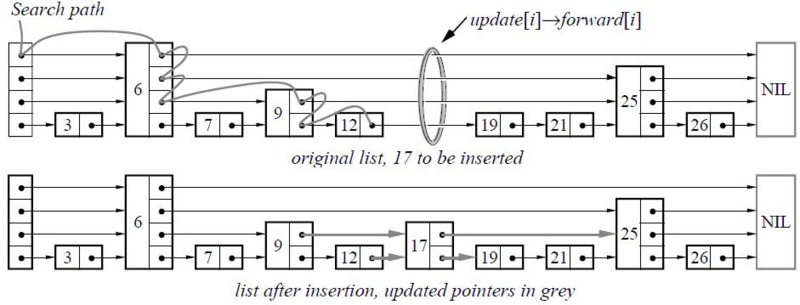
图示中查找 17
起点为最高层第一个元素 6 6<17 6的下一个元素为null 则在元素6中降低层级
再次查找6的下一个元素 是25 降低层级
再次查找6的下一个元素 是9
再次查找9的下一个元素 是25 降低层级
再次查找9的下一个元素 是12
再次查找12的下一个元素 是19 此处为最低层级 则未查找到(进行插入)
insert
查找也可用于insert 注意insert 元素时候层级是随机的
leveldb 中skiplist 结构如下(内存池与原子指针等结构暂时不予理会)
 template<typename Key, class Comparator>

 struct SkipList<Key,Comparator>::Node {

   explicit Node(const Key& k) : key(k) { }

   Key const key;

   // Accessors/mutators for links.  Wrapped in methods so we can

   // add the appropriate barriers as necessary.

   Node* Next(int n) {

     assert(n >= );

     // Use an 'acquire load' so that we observe a fully initialized

     // version of the returned Node.

     return reinterpret_cast<Node*>(next_[n].Acquire_Load());

   }

   void SetNext(int n, Node* x) {

     assert(n >= );

     // Use a 'release store' so that anybody who reads through this

     // pointer observes a fully initialized version of the inserted node.

     next_[n].Release_Store(x);

   }

   // No-barrier variants that can be safely used in a few locations.

   Node* NoBarrier_Next(int n) {

     assert(n >= );

     return reinterpret_cast<Node*>(next_[n].NoBarrier_Load());

   }

   void NoBarrier_SetNext(int n, Node* x) {

     assert(n >= );

     next_[n].NoBarrier_Store(x);

   }

  private:

   // Array of length equal to the node height.  next_[0] is lowest level link.

   port::AtomicPointer next_[];

 };

 template<typename Key, class Comparator>

 typename SkipList<Key,Comparator>::Node*

 SkipList<Key,Comparator>::NewNode(const Key& key, int height) {

   char* mem = arena_->AllocateAligned(

       sizeof(Node) + sizeof(port::AtomicPointer) * (height - ));

   return new (mem) Node(key);

 }
抛开内存池和多线程情况下的原子操作 定义很简单
分配 获取下一个元素 设置下一个元素
template<typename Key, class Comparator>中的 key是元素类型 Comparator是元素比较大小的策略
元素插入操作如下
 template<typename Key, class Comparator>

 void SkipList<Key,Comparator>::Insert(const Key& key) {

   // TODO(opt): We can use a barrier-free variant of FindGreaterOrEqual()

   // here since Insert() is externally synchronized.

   Node* prev[kMaxHeight];

   Node* x = FindGreaterOrEqual(key, prev);

   assert(x == NULL || !Equal(key, x->key));

   int height = RandomHeight();

   if (height > GetMaxHeight()) {

     for (int i = GetMaxHeight(); i < height; i++) {

       prev[i] = head_;

     }

     //fprintf(stderr, "Change height from %d to %d\n", max_height_, height);

     // It is ok to mutate max_height_ without any synchronization

     // with concurrent readers.  A concurrent reader that observes

     // the new value of max_height_ will see either the old value of

     // new level pointers from head_ (NULL), or a new value set in

     // the loop below.  In the former case the reader will

     // immediately drop to the next level since NULL sorts after all

     // keys.  In the latter case the reader will use the new node.

     max_height_.NoBarrier_Store(reinterpret_cast<void*>(height));

   }

   x = NewNode(key, height);

   for (int i = ; i < height; i++) {

     // NoBarrier_SetNext() suffices since we will add a barrier when

     // we publish a pointer to "x" in prev[i].

     x->NoBarrier_SetNext(i, prev[i]->NoBarrier_Next(i));

     prev[i]->SetNext(i, x);

   }

 }
插入元素的层级是随机的 并且获取当前最大层级数并未使用原子操作 因为根据逻辑并无影响 不使用原子操作也是性能上的一种考虑
元素读取操作如下
 template<typename Key, class Comparator>

 typename SkipList<Key,Comparator>::Node* SkipList<Key,Comparator>::FindGreaterOrEqual(const Key& key, Node** prev)

     const {

   Node* x = head_;

   int level = GetMaxHeight() - ;

   while (true) {

     Node* next = x->Next(level);

     if (KeyIsAfterNode(key, next)) {

       // Keep searching in this list

       x = next;

     } else {

       if (prev != NULL) prev[level] = x;

       if (level == ) {

         return next;

       } else {

         // Switch to next list

         level--;

       }

     }

   }

 }
find
查找方法为
1 起点为最高层第一个元素 若元素小于查找值 则查找该元素的后继值
2 若元素大于查找值 则降低层级再次查找
3 若该元素的后继值 为NULL或者大于该值 ,则降低层数再次查找
4 直到查找成功或者达到表的最底层且无元素可查找
图示中查找 17
起点为最高层第一个元素 6 6<17 6的下一个元素为null 则在元素6中降低层级
再次查找6的下一个元素 是25 降低层级
再次查找6的下一个元素 是9
再次查找9的下一个元素 是25 降低层级
再次查找9的下一个元素 是12
再次查找12的下一个元素 是19 此处为最低层级 则未查找到(进行插入)
leveldb 学习记录(一) skiplist的更多相关文章
- leveldb 学习记录(四) skiplist补与变长数字
在leveldb 学习记录(一) skiplist 已经将skiplist的插入 查找等操作流程用图示说明 这里在介绍 下skiplist的代码 里面有几个模块 template<typenam ...
- leveldb 学习记录(三) MemTable 与 Immutable Memtable
前文: leveldb 学习记录(一) skiplist leveldb 学习记录(二) Slice 存储格式: leveldb数据在内存中以 Memtable存储(核心结构是skiplist 已介绍 ...
- leveldb 学习记录(四)Log文件
前文记录 leveldb 学习记录(一) skiplistleveldb 学习记录(二) Sliceleveldb 学习记录(三) MemTable 与 Immutable Memtablelevel ...
- leveldb 学习记录(五)SSTable格式介绍
本节主要记录SSTable的结构 为下一步代码阅读打好基础,考虑到已经有大量优秀博客解析透彻 就不再编写了 这里推荐 https://blog.csdn.net/tankles/article/det ...
- leveldb 学习记录(七) SSTable构造
使用TableBuilder构造一个Table struct TableBuilder::Rep { // TableBuilder内部使用的结构,记录当前的一些状态等 Options options ...
- leveldb 学习记录(八) compact
随着运行时间的增加,memtable会慢慢 转化成 sstable. sstable会越来越多 我们就需要进行整合 compact 代码会在写入查询key值 db写入时等多出位置调用MaybeSche ...
- leveldb 学习记录(二) Slice
基本每个KV库都有一个简洁的字符串管理类 比如redis的sds 比如leveldb的slice 管理一个字符串指针和数据长度 通过对字符串指针 长度的管理实现一般的创建 判断是否为空 获取第N个位 ...
- leveldb 学习记录(六)SSTable:Block操作
block结构示意图 sstable中Block 头文件如下: class Block { public: // Initialize the block with the specified con ...
- LevelDB学习笔记 (3): 长文解析memtable、跳表和内存池Arena
LevelDB学习笔记 (3): 长文解析memtable.跳表和内存池Arena 1. MemTable的基本信息 我们前面说过leveldb的所有数据都会先写入memtable中,在leveldb ...
随机推荐
- QThread的一些使用心得
qthread这个类主要用于解决pyqt中多线程的问题,常见用法是将后台代码封装在该类的run()方法中,再对qthread对象执行start()函数来启动线程. 但往往一个业务会有粒度划分,多个粒度 ...
- 彻底理解js中this的指向,不必硬背
来自 https://blog.csdn.net/u011088260/article/details/79230661 首先必须要说的是,this的指向在函数定义的时候是确定不了的,只有函数执行 ...
- 导出Excel实现 (ASP.NET C# 代码部分)
背景: 实现导出Excel功能. 技术: ASP.NET , 采用`Aspose.Cells`第三方组件, C# 实现通用部分. 根据前台Ext Grid完成导入Excel中文列与实际存储列的对应关 ...
- Xilinx------BUFG,IBUFG,BUFGP,IBUFGDS等含义以及使用
转载-----BUFG,IBUFG,BUFGP,IBUFGDS等含义以及使用 目前,大型设计一般推荐使用同步时序电路.同步时序电路基于时钟触发沿设计,对时钟的周期.占空比.延时和抖动提出了更高的要 ...
- ASCS HA
Please let us know what do you mean by "the PAS can not be accessed", what error did you f ...
- How to solve “Dynamic Web Module 3.1 requires Java 1.7 or newer” in Eclipse
How to solve “Dynamic Web Module 3.1 requires Java 1.7 or newer” in Eclipse Last updated on June 20t ...
- leetcode771
int numJewelsInStones(string J, string S) { set<char> st; ; for (auto c : J) { st.insert(c); } ...
- Rocket MQ 1 - 用
参考 http://www.iocoder.cn/categories/RocketMQ/ ; https://www.jianshu.com/nb/16219849 首先上启动方法,分别启动name ...
- sourcetree合并分支
参考: https://blog.csdn.net/qq_34975710/article/details/74469068
- Linux shell : 管道 |
概念 意义 理解 用法 返回值 PIPESTATUS An array variable (see Arrays) containing a list of exit status values fr ...