
RNN和LSTM
一、RNN
全称为Recurrent Neural Network,意为循环神经网络,用于处理序列数据。
序列数据是指在不同时间点上收集到的数据,反映了某一事物、现象等随时间的变化状态或程度。即数据之间有联系。
RNN的特点:1,,层间神经元也有连接(主要为隐层);2,共享参数
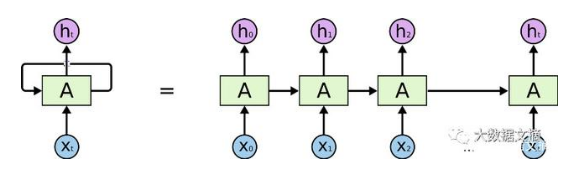
其结构如上图所示,数据为顺序处理,在处理长序列数据时,极易导致梯度消失问题。
二、LSTM
LSTM为长短期记忆,是一种变种的RNN,在RNN的基础上引入了细胞状态,根据细胞状态可决定哪些状态应该保留下来,哪些状态应该被遗忘。
LSTM可一定程度上解决梯度消失问题。
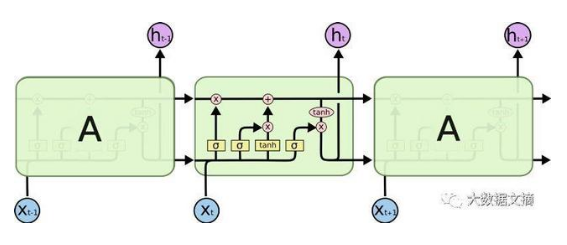
由上图可知,在RNN的基础上,增加了一路输入和输出,增加的这一路就是细胞状态。
由上一时刻的输出和当前时刻的输入,经过sigmod函数之后,趋近于0被遗忘的多,趋近于1被遗忘的少。
由上一时刻的输出和当前时刻的输入,经过sigmod函数之后,决定哪些内容应该被记住,被记住的内容并不是上一时刻的输出和当前时刻的输入,而是需要经过tanh函数。
程序:应用LSTM训练mnist数据集
import os

import torch

import torch.nn as nn

import torch.utils.data as Data

from torch.autograd import Variable

import torchvision.datasets as dsets

import matplotlib.pyplot as plt

import torchvision.transforms as transforms

# torch.manual_seed(1)    # reproducible

# Hyper Parameters

EPOCH = 1               # train the training data n times, to save time, we just train 1 epoch

BATCH_SIZE = 64

LR = 0.01              # learning rate

DOWNLOAD_MNIST = False    #已下载好数据集,就设置为False,否则为TRUE

TIME_STEP=28     #可理解为输入图像维度

INPUT_SIZE=28

# Mnist digits dataset

if not(os.path.exists('./mnist/')) or not os.listdir('./mnist/'):

    # not mnist dir or mnist is empyt dir

    DOWNLOAD_MNIST = True

train_data = dsets.MNIST(

    root='./mnist/',

    train=True,                                     # this is training data

    transform=transforms.ToTensor(),    # Converts a PIL.Image or numpy.ndarray to

                                                    # torch.FloatTensor of shape (C x H x W) and normalize in the range [0.0, 1.0]

    download=DOWNLOAD_MNIST,

)

# plot one example

# print(train_data.train_data.size())                 # (60000, 28, 28)

# print(train_data.train_labels.size())               # (60000)

# plt.imshow(train_data.train_data[0].numpy(), cmap='gray')

# plt.title('%i' % train_data.train_labels[0])

# plt.show()

# Data Loader for easy mini-batch return in training, the image batch shape will be (50, 1, 28, 28)

train_loader = Data.DataLoader(dataset=train_data, batch_size=BATCH_SIZE, shuffle=True)

# pick 2000 samples to speed up testing

test_data = dsets.MNIST(root='./mnist/', train=False,transform=transforms.ToTensor())

test_x = test_data.test_data.type(torch.FloatTensor)[:2000]/255.   # shape from (2000, 28, 28) to (2000, 1, 28, 28), value in range(0,1)

test_y = test_data.test_labels.numpy()[:2000]

class RNN(nn.Module):

    def __init__(self):

        super(RNN, self).__init__()

        self.rnn = nn.LSTM(

            input_size=INPUT_SIZE,

            hidden_size=64,

            num_layers=1,

            batch_first=True

        )

        self.out=nn.Linear(64,10)

    def forward(self,x):

        r_out,(h_n,h_c)=self.rnn(x,None)

        out=self.out(r_out[:,-1,:])    #数据格式为[batch,time_step,input],因此输出参考的是最后时刻的数据

        return out

rnn=RNN()

print(rnn)  # net architecture

optimizer = torch.optim.Adam(rnn.parameters(), lr=LR)   # optimize all cnn parameters

loss_func = nn.CrossEntropyLoss()                       # the target label is not one-hotted

for epoch in range(EPOCH):

    for step, (x, y) in enumerate(train_loader):   # gives batch data, normalize x when iterate train_loader

        b_x=Variable(x.view(-1,28,28))

        b_y=Variable(y)

        output = rnn(b_x)             # cnn output

        loss = loss_func(output, b_y)   # cross entropy loss

        optimizer.zero_grad()           # clear gradients for this training step

        loss.backward()                 # backpropagation, compute gradients

        optimizer.step()                # apply gradients

        if step % 50 == 0:

            test_output = rnn(test_x)

            pred_y = torch.max(test_output, 1)[1].data.numpy().squeeze()

            accuracy =float((pred_y==test_y).astype(int).sum())/float(test_y.size)

            print('Epoch: ', epoch, '| train loss: %.4f' % loss.data.numpy(), '| test accuracy: %.2f' % accuracy)

# print 10 predictions from test data

test_output = rnn(test_x[:10].view(-1,28,28))

pred_y = torch.max(test_output, 1)[1].data.numpy().squeeze()

print(pred_y, 'prediction number')

print(test_y[:10], 'real number')
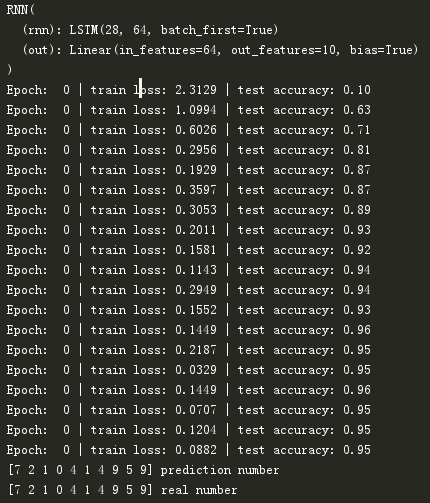
运行结果为:
RNN和LSTM的更多相关文章
- RNN and LSTM saliency Predection Scene Label
http://handong1587.github.io/deep_learning/2015/10/09/rnn-and-lstm.html //RNN and LSTM http://hando ...
- RNN 与 LSTM 的应用
之前已经介绍过关于 Recurrent Neural Nnetwork 与 Long Short-Trem Memory 的网络结构与参数求解算法( 递归神经网络(Recurrent Neural N ...
- Naive RNN vs LSTM vs GRU
0 Recurrent Neural Network 1 Naive RNN 2 LSTM peephole Naive RNN vs LSTM 记忆更新部分的操作,Naive RNN为乘法,LSTM ...
- TensorFlow之RNN:堆叠RNN、LSTM、GRU及双向LSTM
RNN(Recurrent Neural Networks,循环神经网络)是一种具有短期记忆能力的神经网络模型,可以处理任意长度的序列,在自然语言处理中的应用非常广泛,比如机器翻译.文本生成.问答系统 ...
- 浅谈RNN、LSTM + Kreas实现及应用
本文主要针对RNN与LSTM的结构及其原理进行详细的介绍,了解什么是RNN,RNN的1对N.N对1的结构,什么是LSTM,以及LSTM中的三门(input.ouput.forget),后续将利用深度学 ...
- 3. RNN神经网络-LSTM模型结构
1. RNN神经网络模型原理 2. RNN神经网络模型的不同结构 3. RNN神经网络-LSTM模型结构 1. 前言 之前我们对RNN模型做了总结.由于RNN也有梯度消失的问题,因此很难处理长序列的数 ...
- RNN以及LSTM的介绍和公式梳理
前言 好久没用正儿八经地写博客了,csdn居然也有了markdown的编辑器了,最近花了不少时间看RNN以及LSTM的论文,在组内『夜校』分享过了,再在这里总结一下发出来吧,按照我讲解的思路,理解RN ...
- 深度学习:浅谈RNN、LSTM+Kreas实现与应用
主要针对RNN与LSTM的结构及其原理进行详细的介绍,了解什么是RNN,RNN的1对N.N对1的结构,什么是LSTM,以及LSTM中的三门(input.ouput.forget),后续将利用深度学习框 ...
- 利用RNN(lstm)生成文本【转】
本文转载自:https://www.jianshu.com/p/1a4f7f5b05ae 致谢以及参考 最近在做序列化标注项目,试着理解rnn的设计结构以及tensorflow中的具体实现方法.在知乎 ...
随机推荐
- docker安装与测试 及 安装docker compose
Docker 是一个开源的应用容器引擎,让开发者可以打包他们的应用以及依赖包到一个可移植的容器中,然后发布到任何流行的Linux机器上,也可以实现虚拟化,容器是完全使用沙箱机制,相互之间不会有任何接口 ...
- 全面系统讲解CSS 工作应用+面试一步搞定
- Zookeeper+Kafka集群部署(转)
Zookeeper+Kafka集群部署 主机规划: 10.200.3.85 Kafka+ZooKeeper 10.200.3.86 Kafka+ZooKeeper 10.200.3.87 Kaf ...
- C语言博客作业05--指针
1.本章学习总结 1.1 思维导图 1.2 本章学习体会及代码量学习体会 1.2.1 学习体会 1.2.2 代码累计 2.PTA总分 2.1截图PTA中函数题目集的排名得分 2.2 我的总分: 3.P ...
- 快速排序-python
- 消息队列与Kafka
2019-04-09 关键词: 消息队列.为什么使用消息队列.消息队列的好处.消息队列的意义.Kafka是什么 本篇文章系本人就当前所掌握的知识关于 消息队列 与 kafka 知识点的一些简要介绍,不 ...
- 改善python程序的建议[转]
<编写高质量代码 改善Python程序的91个建议> <编写高质量代码 改善Python程序的91个建议>读后程序学习小结 - BigDeng_2014的专栏 - CSDN博客 ...
- MySQL逻辑备份mysqldump
MySQL 备份之 mysqldump mysqldump mysqldump工具备份: 本质:导出的是SQL语句文件 优点:不论是什么存储引擎,都可以用mysqldump备成SQL语句 缺点:速度较 ...
- (二叉树 BFS) leetcode 107. Binary Tree Level Order Traversal II
Given a binary tree, return the bottom-up level order traversal of its nodes' values. (ie, from left ...
- 三、TensorFlow模型的保存和加载
1.模型的保存: import tensorflow as tf v1 = tf.Variable(1.0,dtype=tf.float32) v2 = tf.Variable(2.0,dtype=t ...