
TensorFlow(十):卷积神经网络实现手写数字识别以及可视化
上代码:
import tensorflow as tf

from tensorflow.examples.tutorials.mnist import input_data

mnist = input_data.read_data_sets('MNIST_data',one_hot=True)

#每个批次的大小

batch_size = 100

#计算一共有多少个批次

n_batch = mnist.train.num_examples // batch_size

#参数概要

def variable_summaries(var):

    with tf.name_scope('summaries'):

        mean = tf.reduce_mean(var)

        tf.summary.scalar('mean', mean)#平均值

        with tf.name_scope('stddev'):

            stddev = tf.sqrt(tf.reduce_mean(tf.square(var - mean)))

        tf.summary.scalar('stddev', stddev)#标准差

        tf.summary.scalar('max', tf.reduce_max(var))#最大值

        tf.summary.scalar('min', tf.reduce_min(var))#最小值

        tf.summary.histogram('histogram', var)#直方图

#初始化权值

def weight_variable(shape,name):

    initial = tf.truncated_normal(shape,stddev=0.1)#生成一个截断的正态分布

    return tf.Variable(initial,name=name)

#初始化偏置

def bias_variable(shape,name):

    initial = tf.constant(0.1,shape=shape)

    return tf.Variable(initial,name=name)

#卷积层

def conv2d(x,W):

    #x input tensor of shape `[batch, in_height, in_width, in_channels]`

    #W filter / kernel tensor of shape [filter_height, filter_width, in_channels, out_channels]

    #`strides[0] = strides[3] = 1`. strides[1]代表x方向的步长,strides[2]代表y方向的步长

    #padding: A `string` from: `"SAME", "VALID"`

    return tf.nn.conv2d(x,W,strides=[1,1,1,1],padding='SAME')

#池化层

def max_pool_2x2(x):

    #ksize [1,x,y,1]

    return tf.nn.max_pool(x,ksize=[1,2,2,1],strides=[1,2,2,1],padding='SAME')

#命名空间

with tf.name_scope('input'):

    #定义两个placeholder

    x = tf.placeholder(tf.float32,[None,784],name='x-input')

    y = tf.placeholder(tf.float32,[None,10],name='y-input')

    with tf.name_scope('x_image'):

        #改变x的格式转为4D的向量[batch, in_height, in_width, in_channels]`

        x_image = tf.reshape(x,[-1,28,28,1],name='x_image')

with tf.name_scope('Conv1'):

    #初始化第一个卷积层的权值和偏置

    with tf.name_scope('W_conv1'):

        W_conv1 = weight_variable([5,5,1,32],name='W_conv1')#5*5的采样窗口,32个卷积核从1个平面抽取特征

    with tf.name_scope('b_conv1'):

        b_conv1 = bias_variable([32],name='b_conv1')#每一个卷积核一个偏置值

    #把x_image和权值向量进行卷积,再加上偏置值,然后应用于relu激活函数

    with tf.name_scope('conv2d_1'):

        conv2d_1 = conv2d(x_image,W_conv1) + b_conv1

    with tf.name_scope('relu'):

        h_conv1 = tf.nn.relu(conv2d_1)

    with tf.name_scope('h_pool1'):

        h_pool1 = max_pool_2x2(h_conv1)#进行max-pooling

with tf.name_scope('Conv2'):

    #初始化第二个卷积层的权值和偏置

    with tf.name_scope('W_conv2'):

        W_conv2 = weight_variable([5,5,32,64],name='W_conv2')#5*5的采样窗口,64个卷积核从32个平面抽取特征

    with tf.name_scope('b_conv2'):

        b_conv2 = bias_variable([64],name='b_conv2')#每一个卷积核一个偏置值

    #把h_pool1和权值向量进行卷积,再加上偏置值,然后应用于relu激活函数

    with tf.name_scope('conv2d_2'):

        conv2d_2 = conv2d(h_pool1,W_conv2) + b_conv2

    with tf.name_scope('relu'):

        h_conv2 = tf.nn.relu(conv2d_2)

    with tf.name_scope('h_pool2'):

        h_pool2 = max_pool_2x2(h_conv2)#进行max-pooling

#28*28的图片第一次卷积后还是28*28,第一次池化后变为14*14

#第二次卷积后为14*14,第二次池化后变为了7*7

#进过上面操作后得到64张7*7的平面

with tf.name_scope('fc1'):

    #初始化第一个全连接层的权值

    with tf.name_scope('W_fc1'):

        W_fc1 = weight_variable([7*7*64,1024],name='W_fc1')#上一场有7*7*64个神经元,全连接层有1024个神经元

    with tf.name_scope('b_fc1'):

        b_fc1 = bias_variable([1024],name='b_fc1')#1024个节点

    #把池化层2的输出扁平化为1维

    with tf.name_scope('h_pool2_flat'):

        h_pool2_flat = tf.reshape(h_pool2,[-1,7*7*64],name='h_pool2_flat')

    #求第一个全连接层的输出

    with tf.name_scope('wx_plus_b1'):

        wx_plus_b1 = tf.matmul(h_pool2_flat,W_fc1) + b_fc1

    with tf.name_scope('relu'):

        h_fc1 = tf.nn.relu(wx_plus_b1)

    #keep_prob用来表示神经元的输出概率

    with tf.name_scope('keep_prob'):

        keep_prob = tf.placeholder(tf.float32,name='keep_prob')

    with tf.name_scope('h_fc1_drop'):

        h_fc1_drop = tf.nn.dropout(h_fc1,keep_prob,name='h_fc1_drop')

with tf.name_scope('fc2'):

    #初始化第二个全连接层

    with tf.name_scope('W_fc2'):

        W_fc2 = weight_variable([1024,10],name='W_fc2')

    with tf.name_scope('b_fc2'):

        b_fc2 = bias_variable([10],name='b_fc2')

    with tf.name_scope('wx_plus_b2'):

        wx_plus_b2 = tf.matmul(h_fc1_drop,W_fc2) + b_fc2

    with tf.name_scope('softmax'):

        #计算输出

        prediction = tf.nn.softmax(wx_plus_b2)

#交叉熵代价函数

with tf.name_scope('cross_entropy'):

    cross_entropy = tf.reduce_mean(tf.nn.softmax_cross_entropy_with_logits_v2(labels=y,logits=prediction),name='cross_entropy')

    tf.summary.scalar('cross_entropy',cross_entropy)

#使用AdamOptimizer进行优化

with tf.name_scope('train'):

    train_step = tf.train.AdamOptimizer(1e-4).minimize(cross_entropy)

#求准确率

with tf.name_scope('accuracy'):

    with tf.name_scope('correct_prediction'):

        #结果存放在一个布尔列表中

        correct_prediction = tf.equal(tf.argmax(prediction,1),tf.argmax(y,1))#argmax返回一维张量中最大的值所在的位置

    with tf.name_scope('accuracy'):

        #求准确率

        accuracy = tf.reduce_mean(tf.cast(correct_prediction,tf.float32))

        tf.summary.scalar('accuracy',accuracy)

#合并所有的summary

merged = tf.summary.merge_all()

with tf.Session() as sess:

    sess.run(tf.global_variables_initializer())

    train_writer = tf.summary.FileWriter('logs/train',sess.graph)

    test_writer = tf.summary.FileWriter('logs/test',sess.graph)

    for i in range(1001):

        #训练模型

        batch_xs,batch_ys =  mnist.train.next_batch(batch_size)

        sess.run(train_step,feed_dict={x:batch_xs,y:batch_ys,keep_prob:0.5})

        #记录训练集计算的参数

        summary = sess.run(merged,feed_dict={x:batch_xs,y:batch_ys,keep_prob:1.0})

        train_writer.add_summary(summary,i)

        #记录测试集计算的参数

        batch_xs,batch_ys =  mnist.test.next_batch(batch_size)

        summary = sess.run(merged,feed_dict={x:batch_xs,y:batch_ys,keep_prob:1.0})

        test_writer.add_summary(summary,i)

        if i%100==0:

            test_acc = sess.run(accuracy,feed_dict={x:mnist.test.images,y:mnist.test.labels,keep_prob:1.0})

            train_acc = sess.run(accuracy,feed_dict={x:mnist.train.images[:10000],y:mnist.train.labels[:10000],keep_prob:1.0})

            print ("Iter " + str(i) + ", Testing Accuracy= " + str(test_acc) + ", Training Accuracy= " + str(train_acc))
打开cmd,进入当前文件夹,执行tensorboard --logdir='C:\Users\FELIX\Desktop\tensor学习\logs'
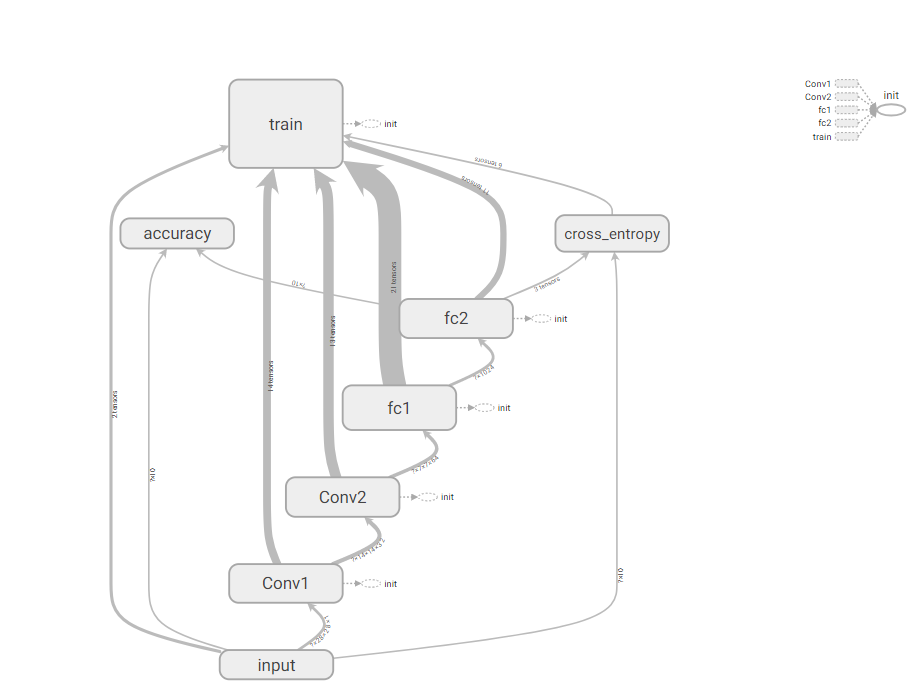
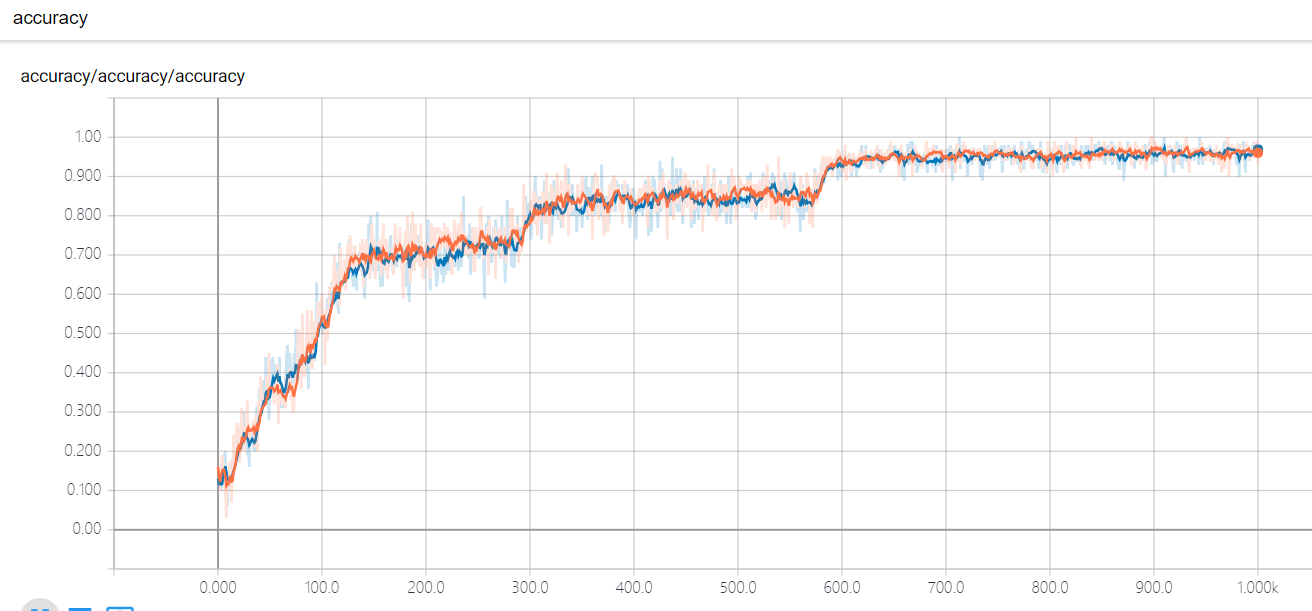
就可以进入tensorboard可视化界面了。
TensorFlow(十):卷积神经网络实现手写数字识别以及可视化的更多相关文章
- TensorFlow卷积神经网络实现手写数字识别以及可视化
边学习边笔记 https://www.cnblogs.com/felixwang2/p/9190602.html # https://www.cnblogs.com/felixwang2/p/9190 ...
- 第二节,TensorFlow 使用前馈神经网络实现手写数字识别
一 感知器 感知器学习笔记:https://blog.csdn.net/liyuanbhu/article/details/51622695 感知器(Perceptron)是二分类的线性分类模型,其输 ...
- 卷积神经网络CNN 手写数字识别
1. 知识点准备 在了解 CNN 网络神经之前有两个概念要理解,第一是二维图像上卷积的概念,第二是 pooling 的概念. a. 卷积 关于卷积的概念和细节可以参考这里,卷积运算有两个非常重要特性, ...
- 基于卷积神经网络的手写数字识别分类(Tensorflow)
import numpy as np import tensorflow as tf from tensorflow.examples.tutorials.mnist import input_dat ...
- 莫烦pytorch学习笔记(八)——卷积神经网络(手写数字识别实现)
莫烦视频网址 这个代码实现了预测和可视化 import os # third-party library import torch import torch.nn as nn import torch ...
- BP神经网络的手写数字识别
BP神经网络的手写数字识别 ANN 人工神经网络算法在实践中往往给人难以琢磨的印象,有句老话叫“出来混总是要还的”,大概是由于具有很强的非线性模拟和处理能力,因此作为代价上帝让它“黑盒”化了.作为一种 ...
- 利用c++编写bp神经网络实现手写数字识别详解
利用c++编写bp神经网络实现手写数字识别 写在前面 从大一入学开始,本菜菜就一直想学习一下神经网络算法,但由于时间和资源所限,一直未展开比较透彻的学习.大二下人工智能课的修习,给了我一个学习的契机. ...
- TensorFlow.NET机器学习入门【5】采用神经网络实现手写数字识别(MNIST)
从这篇文章开始,终于要干点正儿八经的工作了,前面都是准备工作.这次我们要解决机器学习的经典问题,MNIST手写数字识别. 首先介绍一下数据集.请首先解压:TF_Net\Asset\mnist_png. ...
- 用Keras搭建神经网络 简单模版(三)—— CNN 卷积神经网络(手写数字图片识别)
# -*- coding: utf-8 -*- import numpy as np np.random.seed(1337) #for reproducibility再现性 from keras.d ...
随机推荐
- Scratch编程:多彩的舞台(六)
“ 上节课的内容全部掌握了吗?反复练习了没有,编程最好的学习方法就是练习.练习.再练习.一定要记得多动手.多动脑筋哦~~” 01 — 游戏介绍 这是一款简单的小游戏,实现了一个小女孩在多彩的舞台上进行 ...
- 20190705-记IIS发布.NET CORE框架系统之所遇
新手在IIS上发布.NET CORE框架的系统之注意事项 序:本篇随笔是我的处子笔,只想记录自己觉得在系统发布过程中比较重要的步骤,一来,忝作自己的学习笔记,以备不时之需,二来,也希望可以帮助有需要的 ...
- bootstrap环境搭建
Bootstrap 是stwitter公司的两名前端设计师设计的基于html css javascript的超强的前端框架. Bootstrap 是一移动设备为优先,pc机,平板,手机皆适用的框架. ...
- 前端之:传统的DOM是如何渲染的?
a.纯后端渲染:页面发送请求,后端服务器中将数据拼成完整DOM树,并转换成一个字节流作为HTTP Response的body返回给浏览器.优点在于 返回的HTTP Response是包含着全部页面内容 ...
- 编写一个stm32 svc关中断函数
做到了让stm32触发svc中断并传递进去参数然后切换到handler模式并修改特殊寄存器的值,从而达到关中断,但是其实这个程序直接就是特权级,故不进入handler模式也可以修改特殊寄存器..... ...
- 七年总结常用 Git 命令清单
我每天使用 Git ,但是很多命令记不住. 一般来说,日常使用只要记住下图6个命令,就可以了.但是熟练使用,恐怕要记住60-100个命令. 下面是我整理的常用 Git 命令清单.几个专用名词的译名如下 ...
- ubuntu18.04 为应用程序添加桌面图标
一.桌面图标位置 Lniux下桌面图标储存路径为:/usr/share/applications 二.桌面图标格式 所有桌面图标格式均为desktop,即名为XXX.desktop 三.编辑内容(常用 ...
- shell脚本编写mind
首先我们要缩小这个问题的范围 如果在面试中被问到这样的问题,说说shell脚本编写思路 如:你是在公司主要负责zabbix监控的 对答如下:shell脚本这个说法挺广的,您看我这么跟您说吧,我在平时工 ...
- SpringBoot Kafka 整合集成 示例教程
1.使用IDEA新建工程,创建工程 springboot-kafka-producer 工程pom.xml文件添加如下依赖: <!-- 添加 kafka 依赖 --> <depend ...
- 【转】java注解处理器——在编译期修改语法树
https://blog.csdn.net/a_zhenzhen/article/details/86065063 前言从需求说起由于相关政策,最近公司安全部要求各系统在rpc接口调用的交互过程中把相 ...