
吴裕雄--天生自然 R语言开发学习:分类(续二)

#-----------------------------------------------------------------------------#

# R in Action (2nd ed): Chapter 17                                            #

# Classification                                                              #

# requires packaged rpart, party, randomForest, kernlab, rattle               #

# install.packages(c("rpart", "party", "randomForest", "e1071", "rpart.plot") #

# install.packages(rattle, dependencies = c("Depends", "Suggests"))           #

#-----------------------------------------------------------------------------#

par(ask=TRUE)

# Listing 17.1 - Prepare the breast cancer data

loc <- "http://archive.ics.uci.edu/ml/machine-learning-databases/"

ds  <- "breast-cancer-wisconsin/breast-cancer-wisconsin.data"

url <- paste(loc, ds, sep="")

breast <- read.table(url, sep=",", header=FALSE, na.strings="?")

names(breast) <- c("ID", "clumpThickness", "sizeUniformity",

                   "shapeUniformity", "maginalAdhesion",

                   "singleEpithelialCellSize", "bareNuclei",

                   "blandChromatin", "normalNucleoli", "mitosis", "class")

df <- breast[-1]

df$class <- factor(df$class, levels=c(2,4),

                   labels=c("benign", "malignant"))

set.seed(1234)

train <- sample(nrow(df), 0.7*nrow(df))

df.train <- df[train,]

df.validate <- df[-train,]

table(df.train$class)

table(df.validate$class)

# Listing 17.2 - Logistic regression with glm()

fit.logit <- glm(class~., data=df.train, family=binomial())

summary(fit.logit)

prob <- predict(fit.logit, df.validate, type="response")

logit.pred <- factor(prob > .5, levels=c(FALSE, TRUE),

                     labels=c("benign", "malignant"))

logit.perf <- table(df.validate$class, logit.pred,

                    dnn=c("Actual", "Predicted"))

logit.perf

# Listing 17.3 - Creating a classical decision tree with rpart()

library(rpart)

set.seed(1234)

dtree <- rpart(class ~ ., data=df.train, method="class",

               parms=list(split="information"))

dtree$cptable

plotcp(dtree)

dtree.pruned <- prune(dtree, cp=.0125)

library(rpart.plot)

prp(dtree.pruned, type = 2, extra = 104,

    fallen.leaves = TRUE, main="Decision Tree")

dtree.pred <- predict(dtree.pruned, df.validate, type="class")

dtree.perf <- table(df.validate$class, dtree.pred,

                    dnn=c("Actual", "Predicted"))

dtree.perf

# Listing 17.4 - Creating a conditional inference tree with ctree()

library(party)

fit.ctree <- ctree(class~., data=df.train)

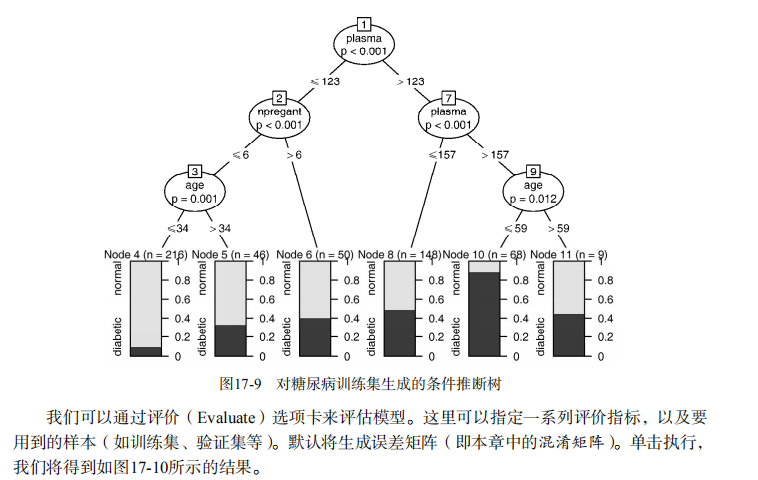
plot(fit.ctree, main="Conditional Inference Tree")

ctree.pred <- predict(fit.ctree, df.validate, type="response")

ctree.perf <- table(df.validate$class, ctree.pred,

                    dnn=c("Actual", "Predicted"))

ctree.perf

# Listing 17.5 - Random forest

library(randomForest)

set.seed(1234)

fit.forest <- randomForest(class~., data=df.train,

                           na.action=na.roughfix,

                           importance=TRUE)

fit.forest

importance(fit.forest, type=2)

forest.pred <- predict(fit.forest, df.validate)

forest.perf <- table(df.validate$class, forest.pred,

                     dnn=c("Actual", "Predicted"))

forest.perf

# Listing 17.6 - A support vector machine

library(e1071)

set.seed(1234)

fit.svm <- svm(class~., data=df.train)

fit.svm

svm.pred <- predict(fit.svm, na.omit(df.validate))

svm.perf <- table(na.omit(df.validate)$class,

                  svm.pred, dnn=c("Actual", "Predicted"))

svm.perf

# Listing 17.7 Tuning an RBF support vector machine (this can take a while)

set.seed(1234)

tuned <- tune.svm(class~., data=df.train,

                  gamma=10^(-6:1),

                  cost=10^(-10:10))

tuned

fit.svm <- svm(class~., data=df.train, gamma=.01, cost=1)

svm.pred <- predict(fit.svm, na.omit(df.validate))

svm.perf <- table(na.omit(df.validate)$class,

                  svm.pred, dnn=c("Actual", "Predicted"))

svm.perf

# Listing 17.8 Function for assessing binary classification accuracy

performance <- function(table, n=2){

  if(!all(dim(table) == c(2,2)))

    stop("Must be a 2 x 2 table")

  tn = table[1,1]

  fp = table[1,2]

  fn = table[2,1]

  tp = table[2,2]

  sensitivity = tp/(tp+fn)

  specificity = tn/(tn+fp)

  ppp = tp/(tp+fp)

  npp = tn/(tn+fn)

  hitrate = (tp+tn)/(tp+tn+fp+fn)

  result <- paste("Sensitivity = ", round(sensitivity, n) ,

                  "\nSpecificity = ", round(specificity, n),

                  "\nPositive Predictive Value = ", round(ppp, n),

                  "\nNegative Predictive Value = ", round(npp, n),

                  "\nAccuracy = ", round(hitrate, n), "\n", sep="")

  cat(result)

}

# Listing 17.9 - Performance of breast cancer data classifiers

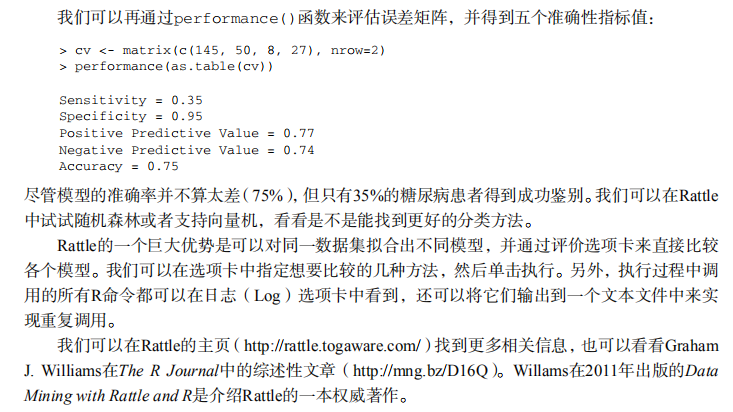
performance(dtree.perf)

performance(ctree.perf)

performance(forest.perf)

performance(svm.perf)

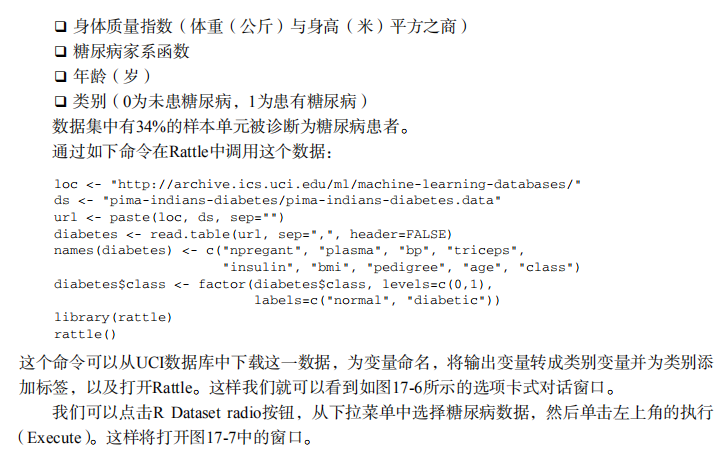
# Using Rattle Package for data mining

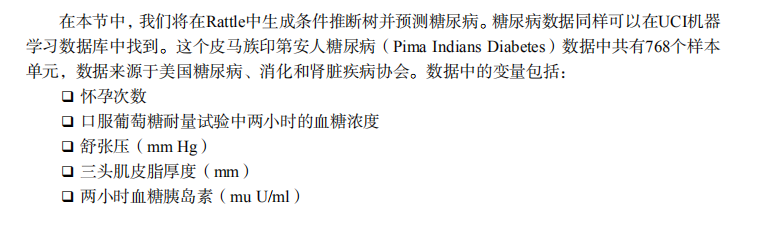
loc <- "http://archive.ics.uci.edu/ml/machine-learning-databases/"

ds <- "pima-indians-diabetes/pima-indians-diabetes.data"

url <- paste(loc, ds, sep="")

diabetes <- read.table(url, sep=",", header=FALSE)

names(diabetes) <- c("npregant", "plasma", "bp", "triceps",

                     "insulin", "bmi", "pedigree", "age", "class")

diabetes$class <- factor(diabetes$class, levels=c(0,1),

                         labels=c("normal", "diabetic"))

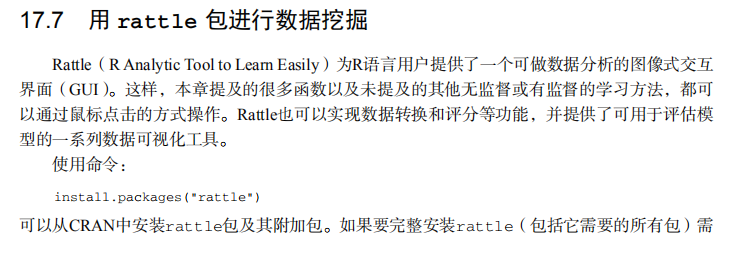
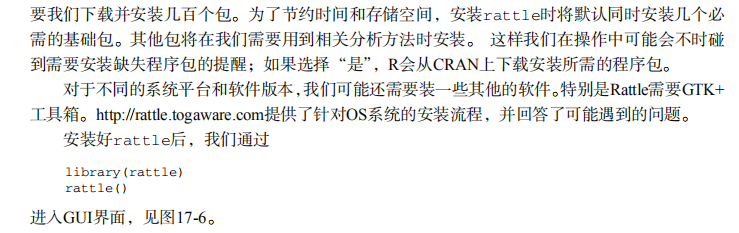
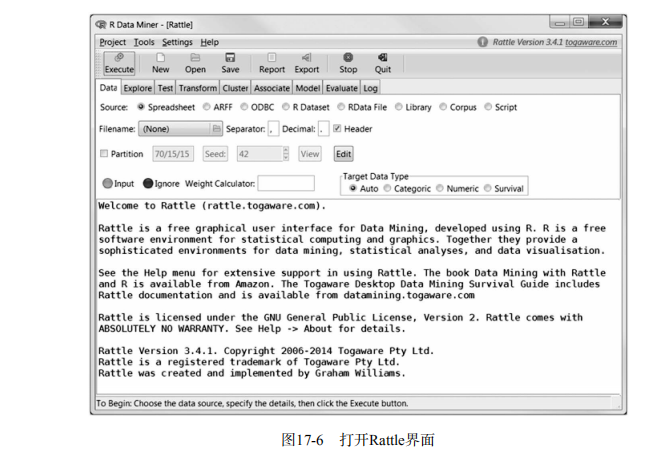
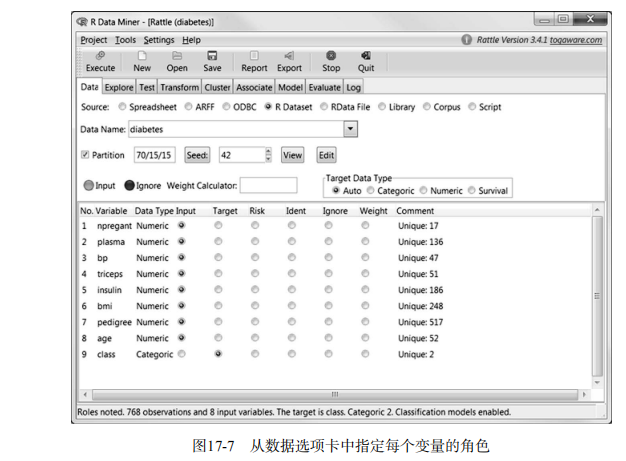
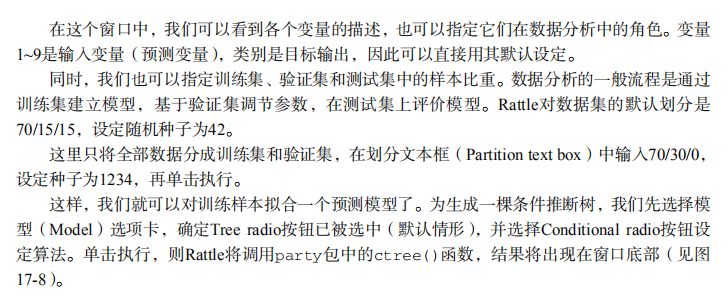
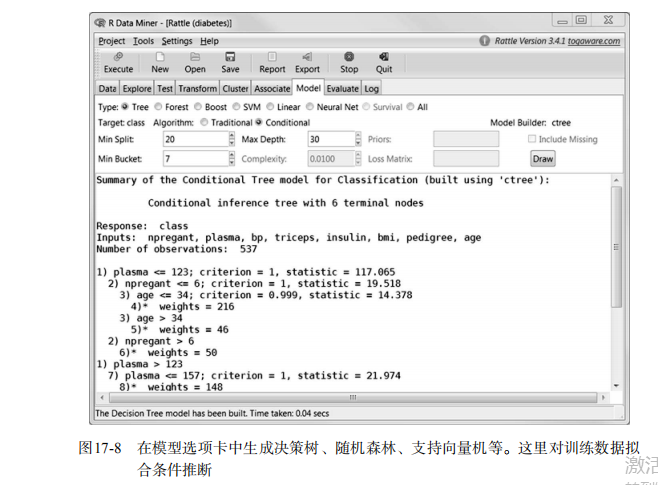
library(rattle)

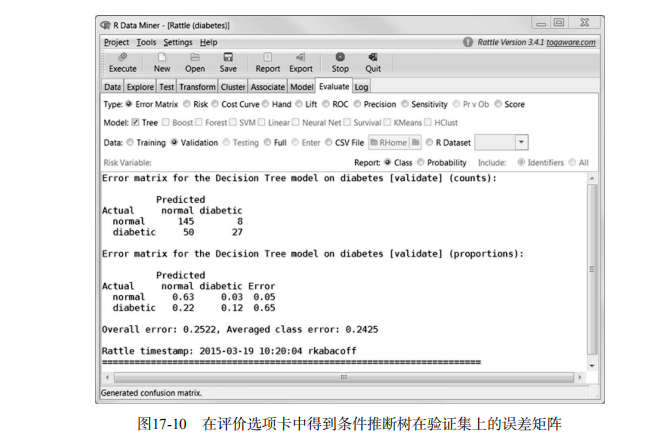
rattle()
吴裕雄--天生自然 R语言开发学习:分类(续二)的更多相关文章
- 吴裕雄--天生自然 R语言开发学习:R语言的安装与配置
下载R语言和开发工具RStudio安装包 先安装R
- 吴裕雄--天生自然 R语言开发学习:数据集和数据结构
数据集的概念 数据集通常是由数据构成的一个矩形数组,行表示观测,列表示变量.表2-1提供了一个假想的病例数据集. 不同的行业对于数据集的行和列叫法不同.统计学家称它们为观测(observation)和 ...
- 吴裕雄--天生自然 R语言开发学习:导入数据
2.3.6 导入 SPSS 数据 IBM SPSS数据集可以通过foreign包中的函数read.spss()导入到R中,也可以使用Hmisc 包中的spss.get()函数.函数spss.get() ...
- 吴裕雄--天生自然 R语言开发学习:使用键盘、带分隔符的文本文件输入数据
R可从键盘.文本文件.Microsoft Excel和Access.流行的统计软件.特殊格 式的文件.多种关系型数据库管理系统.专业数据库.网站和在线服务中导入数据. 使用键盘了.有两种常见的方式:用 ...
- 吴裕雄--天生自然 R语言开发学习:R语言的简单介绍和使用
假设我们正在研究生理发育问 题,并收集了10名婴儿在出生后一年内的月龄和体重数据(见表1-).我们感兴趣的是体重的分 布及体重和月龄的关系. 可以使用函数c()以向量的形式输入月龄和体重数据,此函 数 ...
- 吴裕雄--天生自然 R语言开发学习:基础知识
1.基础数据结构 1.1 向量 # 创建向量a a <- c(1,2,3) print(a) 1.2 矩阵 #创建矩阵 mymat <- matrix(c(1:10), nrow=2, n ...
- 吴裕雄--天生自然 R语言开发学习:图形初阶(续二)
# ----------------------------------------------------# # R in Action (2nd ed): Chapter 3 # # Gettin ...
- 吴裕雄--天生自然 R语言开发学习:图形初阶(续一)
# ----------------------------------------------------# # R in Action (2nd ed): Chapter 3 # # Gettin ...
- 吴裕雄--天生自然 R语言开发学习:图形初阶
# ----------------------------------------------------# # R in Action (2nd ed): Chapter 3 # # Gettin ...
- 吴裕雄--天生自然 R语言开发学习:基本图形(续二)
#---------------------------------------------------------------# # R in Action (2nd ed): Chapter 6 ...
随机推荐
- Necklace HDU - 3874 (线段树/树状数组 + 离线处理)
Necklace HDU - 3874 Mery has a beautiful necklace. The necklace is made up of N magic balls. Each b ...
- Servlet&JSP复习笔记 03
1.Servlet的声明周期 容器如何创建Servlet对象,如何为Servlet对象分配资源,如何调用Servlet对象的方法来处理请求,以及如何销毁Servlet对象的过程. a.实例化 容器调用 ...
- JVM内存结构图表展示
1.理解的JVM内存结构 2.对于垃圾回收问题 垃圾的回收只在堆和永久区(方法区)中,因为对于线程而言,私有存储空间如栈.本地方法区.程序计数器等,会随着方法的加载完成而直接释放空间,因此不需要进行 ...
- drf序列化和反序列化
目录 drf序列化和反序列化 一.自定义序列化 1.1 设置国际化 二.通过视图类的序列化和反序列化 三.ModelSerializer类实现序列化和反序列化 drf序列化和反序列化 一.自定义序列化 ...
- 关于sql更新最后一个逗号的去除或则最后的and的去除
去除最后的逗号substr_replace($update_sql ,"",-1);去除最后的and substr_replace($update_sql ,"" ...
- idea高效插件
RestfulToolkit:url定位controller,快捷键:ctrl+\Maven Helper:依赖分析JRebel:热部署Rainbow Brackets:个性化花括号aiXcode:a ...
- 吴裕雄--天生自然 pythonTensorFlow图形数据处理:解决module 'tensorflow' has no attribute 'Session'
原因:因为是tensorflow 2.0版本
- 吴裕雄--天生自然 PYTHON3开发学习:CGI编程
<Directory "/var/www/cgi-bin"> AllowOverride None Options +ExecCGI Order allow,deny ...
- E、阔力梯的树
题:https://ac.nowcoder.com/acm/contest/4010/E?&headNav=acm 分析:dsu.贪心方法:考虑插入一个值x,对总体贡献,若查找在序列中左边有值 ...
- [原]UEFI+GPT启动VHD
1. 缘起 2. 创建VHD文件并写入系统镜像到VHD文件 2.1 制作VHD文件 2.1.1 纯界面创建 2.1.2 命令行创建 2.2 把系统镜像写入VHD文件 3. 添加VHD文件到系统引导 3 ...